
You stare at your trading terminal in stunned silence. The “New Order” button is grayed out. Your open positions have vanished from the trade window. A red banner flashes across your client dashboard: “Maximum Drawdown Breached. Account Status: Inactive.”
Every funded trader experiences this moment at least once. But what actually happens on the broker’s server when that threshold is crossed? Where did your open trades go? Are accumulated profits forfeited? Can customer support overturn the breach, and what are your options moving forward?
Below is a transparent, behind-the-scenes breakdown of the exact automated liquidation sequence, the difference between hard and soft breaches, and the disciplined roadmap required to bounce back without burning more capital.
The 5-Stage Automated Liquidation Sequence
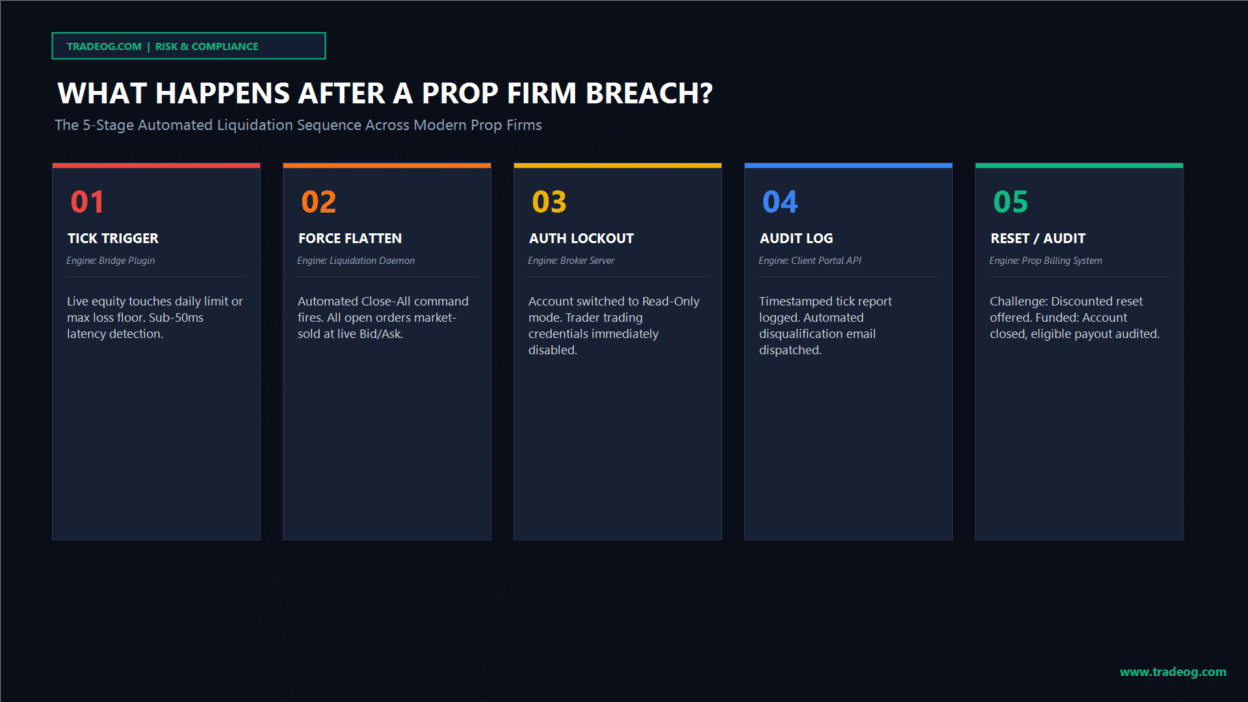
When a breach occurs, it is not reviewed manually by a human risk manager in real time. Modern prop firms operate automated risk daemons integrated directly into the broker bridge (MetaTrader Manager, cTrader Server API, or DXtrade Gateway). The liquidation sequence fires in milliseconds:
- Stage 1: The Tick-Level Trigger (<50ms Latency): Your live equity touches the daily loss limit or maximum overall drawdown floor. The risk plugin registers an instant boolean flag:
Equity < Min_Allowed_Equity = TRUE. - Stage 2: Automated Flatten (Close-All Execution): The daemon immediately broadcasts an emergency market-order liquidation command across all open tickets. Every active trade is closed at the live market Bid (for buys) or Ask (for sells). Any slippage that occurs during this market-close order is absorbed directly into your final settled balance.
- Stage 3: Credential Lockout (Read-Only Mode): The broker server changes your trading password or modifies your user group to Read-Only (Investor). You can still log in to view charts and history, but order routing is permanently disabled.
- Stage 4: Automated Breach Audit & Dispatch: The firm’s database logs the exact server timestamp, tick quote, and equity deficit. An automated webhook triggers an email notification to your registered address confirming the rule violation.
- Stage 5: Account Settlement & Reset Generation: If the account was in an evaluation phase, the system generates a discounted reset link or archives the credentials. If the account was funded, the contract is formally terminated, and the compliance team audits whether any prior eligible profits are payable.
Hard Breach vs. Soft Breach in Prop Firm Trading
Related: soft vs hard breach and prop firm drawdown.
Not all prop firm rule violations result in the death of your account. Reputable prop firms distinguish between Hard Breaches (terminal) and Soft Breaches (operational warnings):
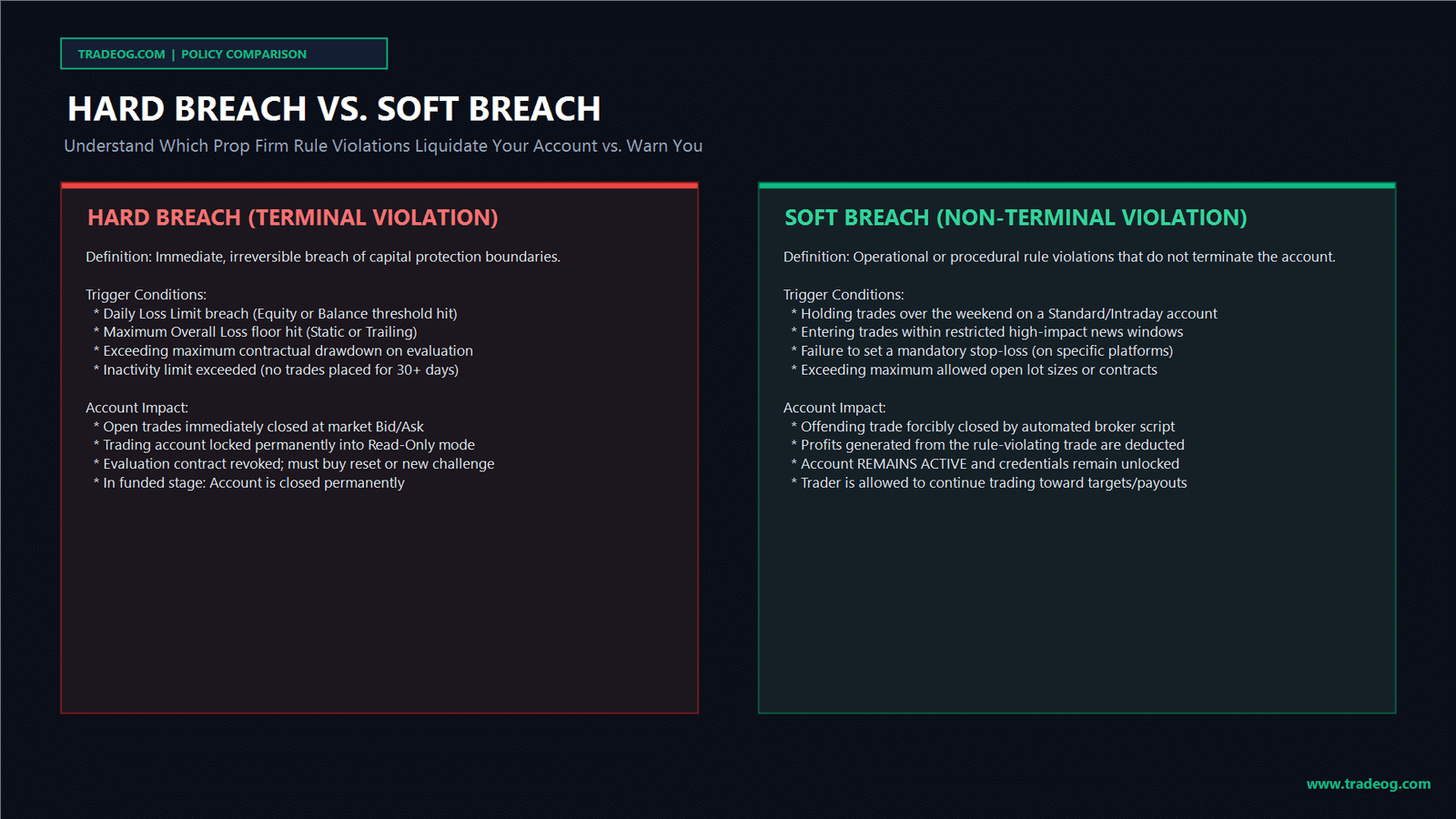
| Violation Type | Example Triggers | Immediate Server Action | Can You Keep Trading? |
|---|---|---|---|
| HARD BREACH (Terminal Capital Violation) |
* Daily Loss Limit breached * Maximum Overall Drawdown hit * 30-Day inactivity rule exceeded |
All positions closed; trading permissions permanently revoked. | ❌ NO. Account is terminated permanently. |
| SOFT BREACH (Operational / Rule Violation) |
* Holding trades over weekend (standard accounts) * Trading during restricted news windows * Forgetting mandatory stop-loss placement * Exceeding maximum allowed open lot sizes |
Offending position closed automatically by server script; profit from trade deducted. | ✅ YES. Account remains active and unlocked. |
If you experience a Soft Breach (such as leaving a trade open past 4:00 PM EST on Friday on an FTMO regular account), the system simply flattens the trade. You swallow the loss or forfeit the profit, but your evaluation or funded account remains intact.
What Happens to Your Accumulated Profits After a Breach?
This is one of the most contentious issues in prop trading: “If I had $4,000 in accumulated profit and breached my daily loss limit, do I still get paid?”
The answer depends entirely on your payout cycle timing:
- Scenario A: Profits Accumulated During an Active Evaluation: You receive nothing. Challenge accounts are simulated test environments; profit targets only exist to qualify for funded capital. A breach voids all progress.
- Scenario B: Payout Request Already Submitted & Approved: If you requested a payout on the 1st of the month, the firm approved it, and you continued trading on leftover buffer and breached on the 3rd, top-tier firms (like FTMO or The 5%ers) will still process your approved payout. Your account is closed, but your earned money is transferred.
- Scenario C: Breaching Before Payout Approval: If you made $5,000, never submitted a withdrawal request, and hit your daily loss limit on a subsequent trade, almost every prop firm’s terms of service state that all accumulated profits are forfeited upon contract termination.
Professional Rule: When you hit a payout milestone, request the maximum allowable withdrawal immediately. Never leave large profit buffers sitting in a prop firm account unless you are intentionally compounding an account scale-up plan.
Can You Dispute or Overturn a Prop Firm Breach?
Traders frequently flood prop firm support channels with dispute requests after a liquidation. To save time and emotional energy, understand when support will—and will not—overturn an automated liquidation:
When Support Will REJECT Your Appeal (98% of Cases):
- “The market spiked unexpectedly on high-impact news.” (News risk is entirely the trader’s responsibility).
- “My stop-loss experienced 5 pips of slippage.” (Stop-loss orders are market orders subject to liquidity; firms do not guarantee fill pricing).
- “The trade bounced back into profit 20 seconds later.” (Equity drawdown is monitored tick-by-tick; mid-candle recovery does not negate a breach).
- “My home internet or power disconnected.” (Platform connection issues are classified as retail technical failure).
When Support WILL Reintegrate Your Account (Valid Disputes):
- Broker Server Outage / Data Freeze: If the prop firm’s broker server froze globally, preventing all traders from closing positions or modifying orders, the firm will audit server logs and restore affected accounts.
- Off-Market Pricing Error (Bad Tick): If an erroneous liquidity provider feed prints a single erroneous spike (a “ghost tick”) that did not exist on the interbank market, the firm’s compliance team will void the tick and reinstate the account.
The 4-Step Post-Breach Recovery Roadmap
The 48 hours immediately following an account breach are the most dangerous period for a trader’s financial health. Emotional frustration triggers “revenge buying”—purchasing another evaluation immediately while mentally tilted.
Follow this professional recovery blueprint instead:

- Phase 1: Complete Data Log Audit (Within 24 Hours): Export your CSV statements and platform trade logs. Confirm the mathematical trigger: Did you blow up from a single oversized position, multiple correlated stops, or overnight spread expansion?
- Phase 2: Enforce a Mandatory 48-Hour Trading Blackout: Step completely away from charts. Do not purchase a reset, do not buy a new evaluation, and do not trade live capital. Break the emotional spiral before committing new funds.
- Phase 3: Identify the Sizing Failure: 90% of breaches trace back to improper risk per trade. If your risk per trade exceeded 0.50% of your account balance, your mathematical survival runway was too narrow.
- Phase 4: Systematic Re-Entry: When you purchase your next challenge, institute a personal circuit breaker: set your personal daily stop loss at 50% of the firm’s daily limit (e.g., stopping at -2.5% on a 5% limit account). Trade the buffer, not the balance.
Frequently Asked Questions (FAQ)
Do prop firms charge a fee when you breach an account?
No. You are never liable for financial losses incurred on a simulated prop firm account. The worst consequence is the loss of your evaluation fee and the termination of your trading credentials.
What is a prop firm “Reset,” and should I buy one?
A reset allows you to restart your current evaluation from scratch at a discounted price (usually 10% to 20% cheaper than purchasing a new account). However, only buy a reset if your trading strategy is performing well and the breach was an isolated technical error—not if you are currently trading on emotional tilt.
Can you get funded again with the same prop firm after a breach?
Yes. Reputable prop firms place no restrictions on how many evaluations you can attempt. You can purchase a new evaluation immediately, and passing it will grant you a brand-new funded account.
Summary
A prop firm breach is not a career death sentence; it is a structural risk enforcement. Understanding the automated liquidation sequence, knowing the difference between hard and soft breaches, and implementing a strict post-breach recovery protocol is what separates amateurs who cycle through fees from professionals who protect capital and build sustainable trading careers.