

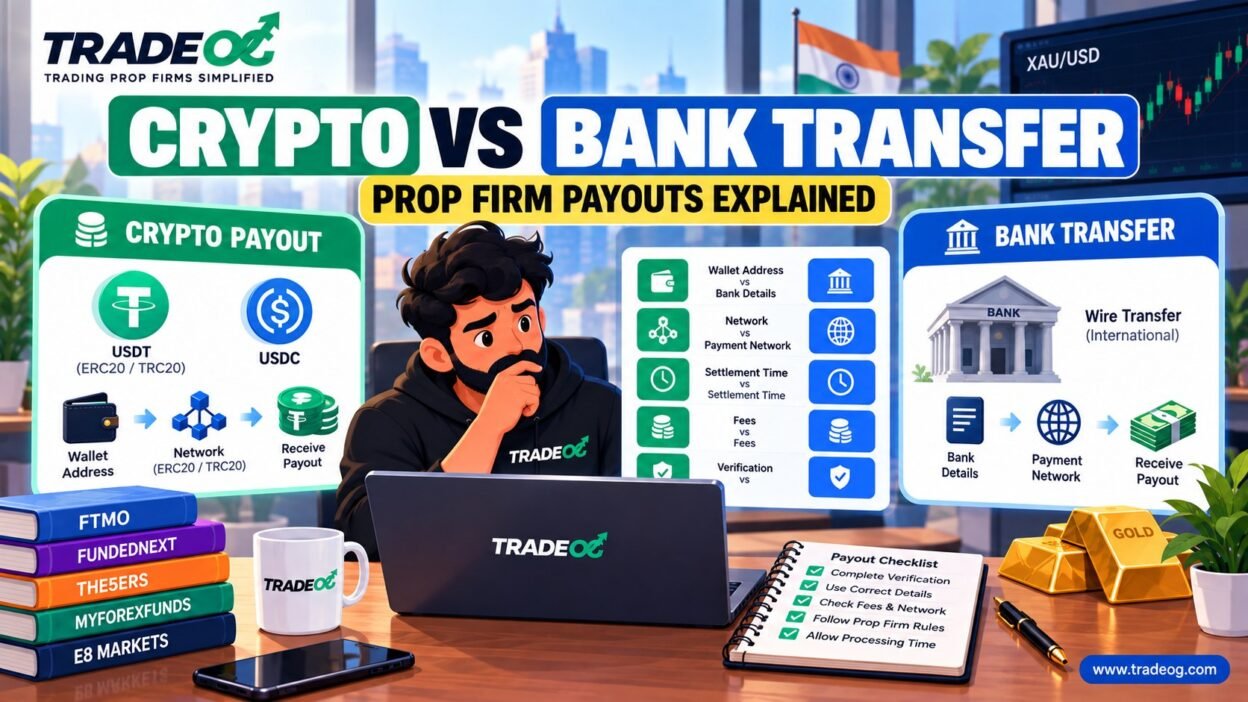
When a prop firm approves a payout, traders may be able to choose between crypto and bank transfer. The two methods can deliver the same trading reward, but the process is different from the moment you submit the request until the money reaches your wallet or bank account.
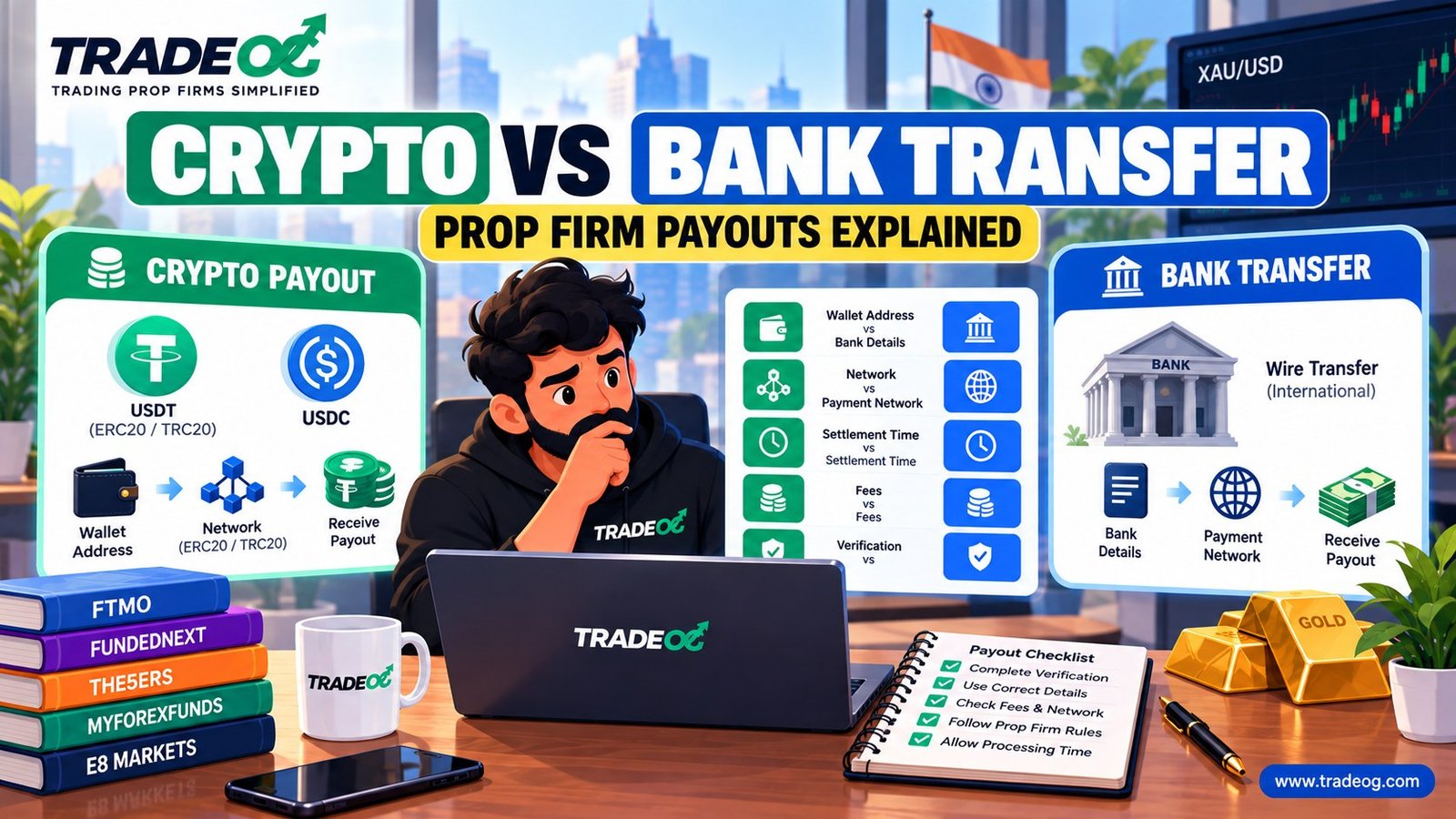
For Indian traders, the main differences are the information you provide, settlement route, fees, verification, conversion into INR, and the possibility of network or banking delays.
Crypto vs Bank Transfer: What Is the Main Difference?
Crypto payout: the prop firm sends the approved reward to a cryptocurrency wallet or supported crypto payment route. Depending on the firm, this may involve USDT, USDC or another supported asset and a specific blockchain network.
Bank transfer: the prop firm sends the approved reward through a banking or payment network to the bank details you provide. The receiving bank may then credit the funds after its own processing and compliance checks.
| Factor | Crypto Payout | Bank Transfer |
|---|---|---|
| Destination | Crypto wallet or supported payment provider | Bank account |
| Key detail | Wallet address + correct network | Correct bank and beneficiary details |
| Settlement dependency | Blockchain/payment network | Banking/payment network |
| Currency handling | Usually digital asset first | Usually fiat currency |
| Main error risk | Wrong wallet address or network | Wrong account or bank details |
| Extra conversion step | May be required to convert crypto into INR | May involve bank FX conversion if payout is in foreign currency |
How a Crypto Prop Firm Payout Works
The exact workflow depends on the prop firm, but a typical crypto payout looks like this:
- Complete payout eligibility. You first need to satisfy the firm’s trading-cycle, profit, drawdown and other payout conditions.
- Complete verification. Some firms require KYC before a reward can be requested.
- Select crypto. Choose the cryptocurrency and supported network offered by the firm.
- Enter the wallet details. Provide the destination wallet address exactly as required.
- Check the network. ERC20, TRC20 and other networks are not interchangeable. The receiving wallet must support the selected network.
- Confirm the request. Some firms use OTP or another confirmation process.
- Processing and settlement. The firm processes the request and the crypto transfer is completed through the relevant payment or blockchain route.
- Receive and manage the funds. You can keep the asset, transfer it, or use a compliant exchange/service to convert it into fiat where available.
FundedNext currently lists USDT on ERC20/TRC20, USDC, Confirmo, RiseWorks, bank transfer, card and direct deposit to FNmarkets among its payout methods for eligible accounts. Its help center says traders are responsible for transfer gateway charges. FundedNext withdrawal guidance.
Why the Crypto Network Matters
This is one of the most important differences between crypto and bank payouts.
If a prop firm asks for a USDT payout on TRC20, sending the funds to a wallet or platform that does not support that network can create a serious problem. The same applies to ERC20 and other networks.
Before submitting a crypto withdrawal, check:
- the exact asset, such as USDT or USDC;
- the exact blockchain network;
- the destination wallet address;
- whether the receiving exchange or wallet supports deposits on that network;
- any minimum deposit or withdrawal requirement on the receiving platform.
Never copy a wallet address from an old transaction without checking it again. A small address or network mistake can result in funds being delayed or potentially lost.
How a Bank Transfer Prop Firm Payout Works
A bank transfer follows a different route:
- Meet payout conditions.
- Complete KYC or account verification if required.
- Select bank transfer.
- Enter beneficiary details. This can include your name, bank account number, SWIFT/IFSC or other requested information depending on the route.
- Submit the payout request.
- Prop firm review. The firm checks the request and may verify the payment details.
- Transfer initiated. The payout is sent through the applicable banking/payment network.
- Receiving-bank processing. Your bank may perform its own checks before crediting the funds.
- Currency conversion if applicable. If the incoming payment is not in INR, the bank or payment provider may convert it according to its applicable process and rates.
FTMO currently says eligible CFD rewards can be paid through bank wire transfer, Visa Direct/Mastercard Send, Skrill or cryptocurrencies. FTMO also notes that the processing route and minimum profit requirements can differ by payment method. FTMO reward withdrawal guidance.
Crypto vs Bank Transfer for Indian Traders
For an Indian trader, the practical difference is often what happens after the prop firm sends the money.
With a bank transfer, the money normally enters a banking/payment channel and any applicable foreign-currency conversion, bank processing or compliance procedures occur within that route.
With crypto, the trader may receive USDT or another supported asset first. If the goal is INR in an Indian bank account, an additional conversion and withdrawal step may be required through a compliant service or exchange.
That means the headline payout amount is not always identical to the final amount you see in your bank account. Network fees, gateway charges, exchange spreads, conversion rates and other provider-specific costs can affect the final result.
Which Is Faster?
There is no universal winner because the actual time depends on the prop firm, account model, payment provider, verification status and destination.
For example, FundedNext currently states that its payout team processes eligible withdrawal requests within 24 hours, while its general withdrawal guidance says the usual timeframe can vary by method and may be around 24–72 hours. Bank-transfer requests can also be subject to banking-side processing. FundedNext payout processing timeframe.
FTMO currently says that after a reward request is submitted, it reviews the account within 1–2 business days, and after invoice approval the reward is typically sent within another 1–2 business days. FTMO withdrawal process.
Therefore, do not choose a method solely because someone says crypto is always instant or bank transfer is always slow. Check the current terms for your exact account.
Fees: What Should You Compare?
Do not look only at the prop firm’s advertised payout fee. Consider the complete route.
- Prop firm fee: whether the firm charges a payout or gateway fee.
- Crypto network cost: applicable blockchain or payment-provider charges.
- Exchange fee: if you convert crypto into fiat.
- Spread: the difference between the exchange’s buy and sell prices.
- Bank charges: receiving or intermediary-bank fees where applicable.
- FX conversion: the exchange rate used when foreign currency is converted into INR.
FundedNext currently states that traders are responsible for transfer gateway charges. FTMO currently states that it does not charge an additional commission for eligible CFD Reward withdrawals, while noting that transaction fees can create minimum-profit requirements for some methods. FundedNext withdrawals and payments and FTMO withdrawal FAQ.
Verification Is Important for Both Methods
Crypto does not automatically mean “no verification.” A prop firm can still require identity verification before releasing a reward.
FundedNext currently states that KYC verification must be completed and passed before a commission withdrawal can be requested. Payout-specific requirements can also vary by account model. FundedNext withdrawals and payments.
For bank transfers, accurate beneficiary information is particularly important. A mismatch in the account holder name, account number or other requested information can cause delays or a failed transfer.
Crypto Payout Example
Imagine an Indian trader is approved for a $2,000 reward and selects USDT.
The prop firm approves the request and sends the eligible amount through the supported crypto route. The trader checks the asset and network, receives the USDT, and then—if they want INR—uses a compliant conversion route. The final INR amount depends on the conversion rate and any applicable provider costs.
Bank Transfer Example
Now imagine the same trader chooses a bank transfer.
The trader enters the requested bank details, submits the payout, and waits for the prop firm to process it. Once the transfer reaches the banking/payment network, the receiving institution may apply its own processing or currency-conversion procedure before the money is credited.
The two routes can therefore start with the same $2,000 reward but involve different steps before the trader can spend the money in India.
Crypto vs Bank Transfer: Common Mistakes
1. Choosing the Wrong Crypto Network
USDT is not enough information by itself. Check whether the firm requires ERC20, TRC20 or another supported network.
2. Using Someone Else’s Wallet or Bank Account
Payment ownership requirements can vary by firm. Use only payment details permitted under the firm’s current rules.
3. Ignoring Conversion Costs
A crypto payout can require a later conversion to INR. A bank payout can involve foreign-exchange conversion. Compare the final amount, not just the headline fee.
4. Assuming All Prop Firms Offer the Same Methods
Payment options differ by firm, account model, country and payment provider. Always check the current withdrawal page for your account.
5. Forgetting to Verify Your Details
Check your name, bank details, wallet address, network and payment method before confirming the payout.
10-Point Payout Checklist for Indian Traders
- Confirm that your account is payout-eligible.
- Complete KYC before requesting the reward if required.
- Check the exact payout methods available for your account.
- For crypto, confirm the exact coin and network.
- For bank transfer, verify beneficiary and bank details.
- Check minimum payout requirements.
- Check payout caps and reward-cycle rules.
- Check gateway, network, bank and conversion costs.
- Keep the payout confirmation and transaction records.
- Check the latest official rules immediately before submitting the request.
Crypto vs Bank Transfer: Which Process Should You Understand?
The key point is that these are two different payment rails.
Crypto generally involves a wallet address, blockchain network and potentially a later conversion into fiat. Bank transfer generally involves beneficiary banking details, banking/payment networks and potentially foreign-currency conversion.
Neither process should be treated as universally faster, cheaper or simpler. The correct choice depends on the prop firm’s current options, your account model, your payment-provider access and how you ultimately want to receive and use the money.
Final Takeaway
If you are an Indian trader comparing crypto and bank-transfer prop firm payouts, focus on the entire journey from payout request → verification → processing → settlement → conversion → final usable funds.
For crypto, the biggest operational checks are the wallet address, supported asset, network and conversion route. For bank transfer, focus on beneficiary details, banking requirements, processing time and currency conversion.
Prop firm payment rules can change, so always verify the current official payout page for your exact account before submitting a withdrawal.
For related TradeOG guides, read Prop Firm Payout Verification Explained Step by Step, Can Prop Firm Payouts Be Split Into Multiple Withdrawals?, and Prop Firm Profit Split Explained: What 80/20 Really Means.
Disclaimer: Prop firm rules, payment methods, fees and processing times can change and may vary by firm, country, payment provider and account model. This article is for educational purposes only and is not financial, legal or tax advice.



[…] For related TradeOG guides, read Prop Firm Payout Verification Explained Step by Step, Prop Firm Payout Rejected: What Can Cause a Rejection?, and Crypto vs Bank Transfer for Prop Firm Payouts. […]