
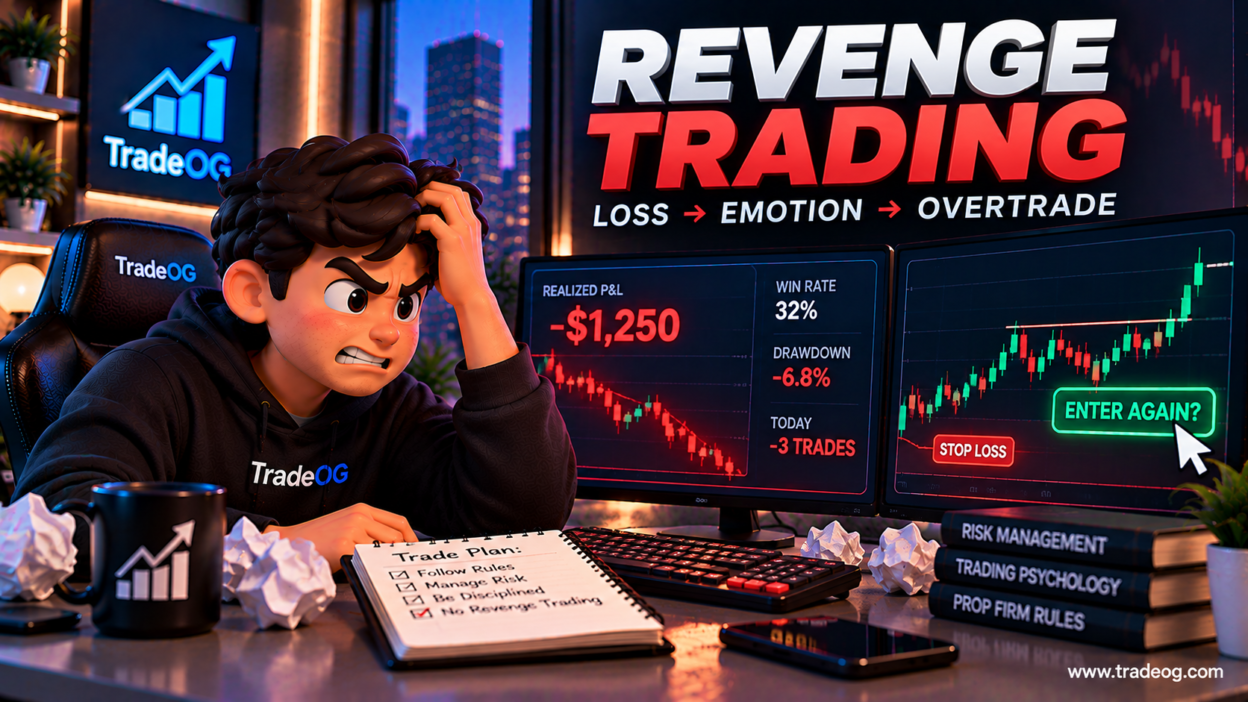
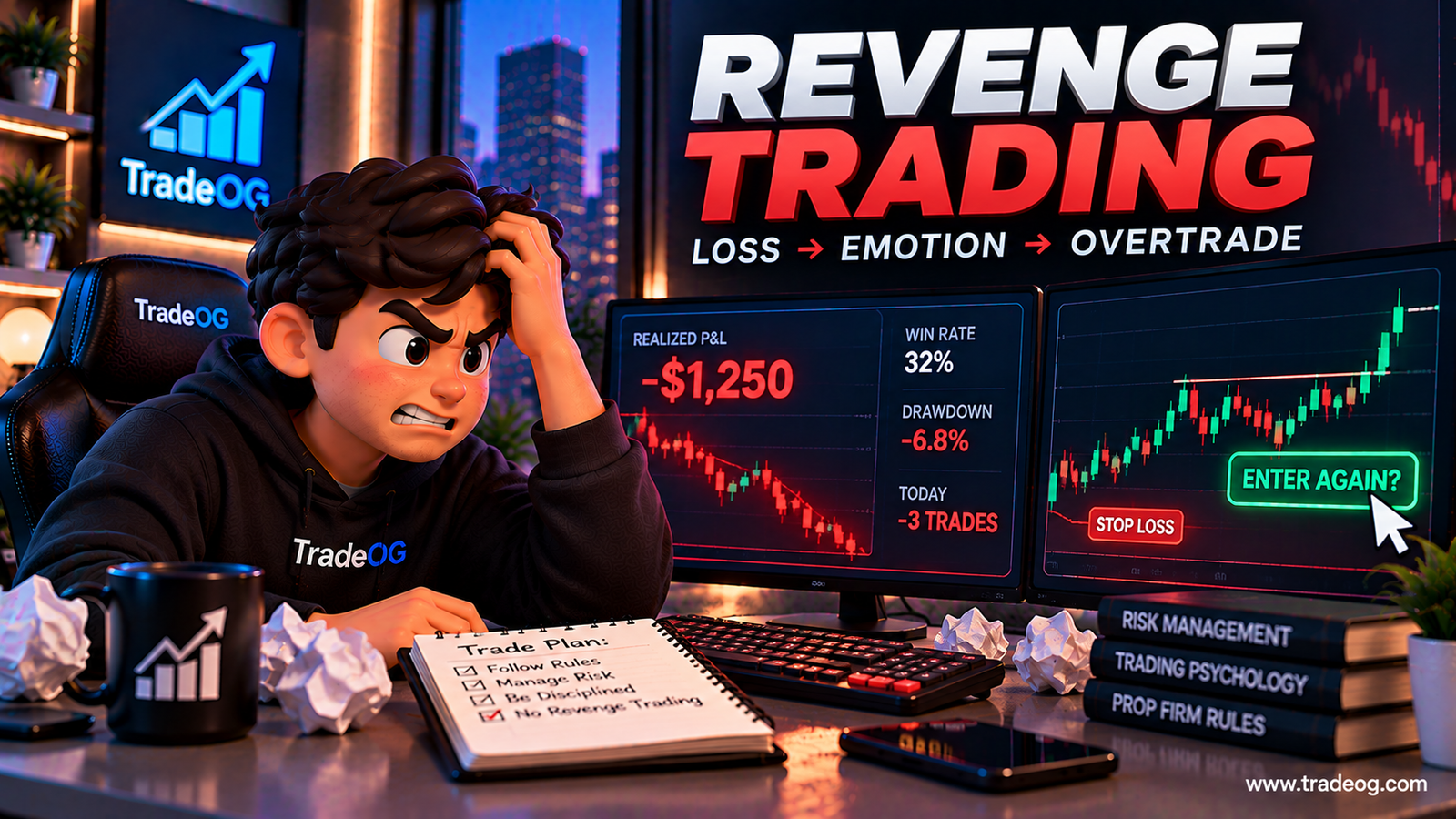
A losing trade is a normal part of trading. A trader can follow the plan, use the correct position size, place the intended stop and still lose money. The problem begins when the trader stops treating the loss as one trade in a larger sample and starts treating it as something that must be recovered immediately.
That behavior is commonly called revenge trading.
For prop firm traders, revenge trading can be particularly damaging because the account usually operates inside predefined loss limits, drawdown rules, position limits and other restrictions. A trader who increases size after a loss, abandons a stop or starts taking low-quality setups may consume the remaining drawdown much faster than expected.
This article explains why revenge trading happens after a prop firm loss, how the behavior develops, what it looks like in real trading, and how traders can build rules that interrupt the cycle before one losing trade becomes an account-level problem.
What Is Revenge Trading?
Revenge trading is the practice of taking additional trades primarily because of an emotional desire to recover a previous loss rather than because the new trade independently satisfies the trader’s strategy and risk rules.
The key distinction is motivation.
If a trader loses $200 and then later takes a valid setup that was already part of the trading plan, that is not automatically revenge trading. If the trader loses $200 and immediately doubles position size because they feel they need to make the $200 back, the motivation has changed from executing a system to repairing an emotional loss.
CME Group’s trading-psychology material emphasizes that losses are part of trading and that traders need a plan for dealing with losing positions rather than allowing emotions to drive subsequent decisions. Its risk-management guidance also shows how fixed-risk sizing can reduce the mathematical damage of a losing streak.
CME Group — Planning for Trading Losses
Why Revenge Trading Happens After a Prop Firm Loss
1. The trader wants the loss back immediately
The first psychological trigger is simple: the trader sees the account balance or available drawdown move in the wrong direction and wants to reverse it as quickly as possible.
Suppose a hypothetical prop account has a $2,000 maximum drawdown and the trader loses $400 on a morning trade. The trader may start thinking:
- “I only need one good trade to recover this.”
- “The next setup will make it back.”
- “I should increase size because I cannot waste the day.”
- “I was right about the market; the stop was just unlucky.”
The danger is that the next trade is now carrying an additional objective: recovering the previous loss. That objective was not part of the original strategy.
2. A loss feels different in a prop account
In a personal account, a trader may think about the percentage change in total capital. In a prop environment, the trader is often highly aware of the remaining distance to a daily loss limit or maximum drawdown threshold.
For example, if an account starts the day with $1,500 of available drawdown and a losing trade consumes $500, the trader may mentally frame the remaining $1,000 as a problem that needs to be solved.
That framing can produce urgency. Urgency can lead to larger size, more trades, wider stops and lower-quality entries.
3. The trader confuses being wrong with needing to be right
A trading loss can challenge a trader’s confidence. Instead of accepting “this setup did not work,” the trader may interpret the loss as evidence that they need to prove their market view.
This can produce a dangerous sequence:
Loss → frustration → need to prove the idea → larger trade → another loss → stronger emotional reaction.
CME’s trading-psychology material describes the importance of accepting that losses are part of trading rather than measuring trading ability by whether every individual prediction is correct.
4. The trader focuses on the account balance instead of the process
A professional-style trading process evaluates whether the trade followed the rules. Revenge trading evaluates whether the trade made back money.
Those are different measurements.
A losing trade can be a good process trade if it followed the written setup, planned stop, position-size rule and execution criteria. A profitable trade can be a bad process trade if it violated those rules and happened to work.
When the trader evaluates every trade only by P&L, a normal loss can feel like failure. That makes emotional recovery more difficult.
The Revenge Trading Cycle
Revenge trading often develops through a recognizable sequence.
- Normal loss: A planned trade reaches its stop.
- Emotional reaction: The trader becomes frustrated or disappointed.
- Urgency: The trader decides the loss must be recovered quickly.
- Rule bending: The next setup receives less scrutiny.
- Oversizing: Position size increases to accelerate recovery.
- Loss or small win: If the trade loses, frustration increases; if it wins, the trader may reinforce the belief that oversizing works.
- Escalation: More trades, larger exposure or wider stops appear.
- Account damage: Daily loss or maximum drawdown can be reached much faster.
The critical intervention point is usually between the first loss and the next trade. Once several emotional decisions have accumulated, stopping becomes harder.
What Revenge Trading Looks Like in Futures Prop Trading
Revenge trading is not limited to clicking the buy or sell button immediately after a loss. It can appear in several forms.
| Behavior | What It Can Look Like | Why It Is Risky |
|---|---|---|
| Oversizing | Moving from 2 MES contracts to 6 MES after a loss | One trade can consume several planned risk units |
| Overtrading | Taking every small movement after a stopped trade | Trade quality falls as the trader searches for recovery |
| Widening the stop | Moving the stop farther away because the position is losing | Original risk calculation becomes invalid |
| Removing the stop | Waiting for price to “come back” | Loss becomes open-ended relative to the original plan |
| Changing markets | Switching from ES to NQ or another instrument without preparation | Volatility and contract value may differ substantially |
| Chasing breakouts | Entering late because the trader missed the first move | Entry quality and stop placement can deteriorate |
| Ignoring daily limits | Trading close to the firm’s maximum loss threshold | A small additional loss may create a breach |
Why Increasing Position Size After a Loss Is Dangerous
One of the clearest signs of revenge trading is increasing position size specifically to recover a previous loss.
Consider a hypothetical example:
- Planned risk per trade: $150
- First trade loss: $150
- Trader increases the next trade’s planned risk to $300
- Second trade loses: $300
- Total loss: $450
The trader did not merely experience two normal losses. The second loss was deliberately made larger because of the first.
Now consider the same two losing trades with fixed $150 risk:
- Trade 1: -$150
- Trade 2: -$150
- Total: -$300
The point is not that a particular dollar amount is universally appropriate. The point is that a predefined risk unit prevents an emotional loss from automatically changing the size of the next loss.
CME’s risk-management material demonstrates the same mathematical principle: fixed-percentage risk can reduce the rate at which an account deteriorates during a losing streak because the position risk does not escalate as losses accumulate.
Revenge Trading vs a Normal Second Trade
Not every trade after a loss is revenge trading. This distinction matters because a trader could become so afraid of losing again that they stop taking valid setups.
A second trade may be part of the plan when:
- the setup existed independently of the previous loss;
- the same entry criteria still apply;
- position size remains within the predefined risk model;
- the stop and target are determined before entry;
- the trader is willing to accept another full planned loss;
- the trade would still be taken if the previous trade had been a winner.
A useful self-test is:
“If my previous trade had won, would I still take this exact trade at this exact size?”
If the honest answer is no, the previous result may be influencing the decision.
The Prop Firm Drawdown Problem
Revenge trading becomes particularly important when a trader is operating close to a drawdown threshold.
Imagine a hypothetical account with:
- $50,000 starting balance
- $2,000 maximum drawdown
- $800 already lost
- $1,200 remaining drawdown
The trader takes a normal $200-risk trade and loses. Remaining drawdown becomes $1,000.
Instead of accepting the loss, the trader increases the next position so the planned loss is $500. If that trade also fails, only $500 remains.
Nothing about the market required the second trade to be larger. The trader’s emotional response created the acceleration.
This is why prop trading requires thinking in terms of remaining risk capacity, not simply account balance.
Daily Loss Limits Can Make Revenge Trading Worse
Many prop programs use daily loss controls or other account-level risk restrictions. The exact rules vary by firm, account type and product, so traders should always verify the current program documentation.
Topstep, for example, currently describes its Daily Loss Limit as a mechanism designed to stop trading after a predefined daily loss is reached. Its current Responsible Trading Program also specifically identifies tilt, revenge trading, oversized positions, lack of stops and disrespecting daily limits as behaviors associated with unsustainable trading.
Topstep — What Is a Daily Loss Limit?
Topstep — Responsible Trading Program
These examples illustrate an important point: a trader should not treat the firm’s maximum permitted loss as the trader’s personal trading budget for the day.
Why “I Need to Make It Back Today” Is a Dangerous Thought
Markets do not know how much you lost earlier.
If a trader loses $300 at 9:45 AM, the market does not become more likely to give the trader $300 at 10:15 AM. The next setup still has its own probability distribution.
The loss changes the trader’s account state, but it does not automatically change the statistical characteristics of the next valid setup.
This is one reason CME’s educational material emphasizes mathematical expectation rather than trying to be correct on every individual trade.
CME Group — The Mathematics of Trading Success
How to Stop Revenge Trading After a Loss
1. Create a hard post-loss pause
Do not make the next trade immediately by default.
A pause can be time-based or condition-based. For example, a trader may require a short break after a stopped trade, a chart reset, or a written confirmation that the next setup meets the plan.
The objective is not to predict the market better. It is to create enough separation between the previous outcome and the next decision.
2. Keep the next trade at the same planned risk
One simple anti-revenge rule is:
A loss cannot increase the risk of the next trade.
If the normal plan allows a specific risk unit, the trader should not automatically multiply it because the previous trade lost.
3. Use a personal daily stop below the firm’s limit
The firm’s maximum loss is an external account rule. A personal stop is a behavioral rule.
For example, a trader might define a personal stopping point after a certain number of consecutive losses or after using a defined portion of the day’s planned risk budget. The exact number should come from the trader’s tested risk plan rather than being treated as a universal formula.
FTMO’s current educational guidance similarly discusses setting a personal stop-trading limit that can be tighter than the account’s maximum permitted loss.
FTMO — 5 Rules to Stop Breaching Your Challenge
4. Write down why the previous trade lost
Classify the loss before considering another entry:
- valid setup, normal stop;
- execution error;
- late entry;
- oversized position;
- rule violation;
- unexpected market event;
- poor liquidity or slippage;
- strategy condition not present.
This turns an emotional event into usable data.
5. Require a fresh setup
Do not let “recover the loss” become the setup.
A valid second trade should have an independent reason to exist. If the chart does not present the setup, no trade is required.
A Simple Anti-Revenge Trading Checklist
Before taking another trade after a loss, ask:
- Is this setup part of my written strategy?
- Would I take it if the previous trade had been profitable?
- Is my position size unchanged from the plan?
- Is the stop defined before entry?
- Can I accept another full planned loss?
- Am I trying to recover money or execute a setup?
- Am I within my personal daily loss limit?
- Am I still within the prop firm’s current rules?
- Has market volatility changed materially?
- Would skipping this trade damage my strategy, or simply delay my next opportunity?
If several answers point toward emotional recovery rather than strategy execution, stepping away may be more consistent with the written plan.
Use a “Loss Protocol” Instead of Relying on Willpower
Willpower is unreliable when the trader is frustrated. A written loss protocol can make the decision more mechanical.
A sample framework could look like this:
| Event | Action |
|---|---|
| First planned loss | Record result and take a short reset |
| Second consecutive loss | Review setup quality and current market conditions |
| Rule violation | Stop trading and document the mistake |
| Personal daily limit reached | End the session |
| Strong urge to increase size | No trade until the urge passes |
| Firm loss threshold approached | Stop and review the current account rules |
The exact thresholds are individual planning choices. The important concept is to decide them before emotional pressure appears.
Revenge Trading and Futures Position Sizing
Futures traders need to understand how contract value can amplify emotional decisions.
Suppose a trader normally uses a Micro contract because it allows finer position sizing. After a loss, switching into a larger contract can multiply dollar exposure even if the chart setup looks identical.
The underlying market direction has not changed simply because the trader is frustrated. What changed is the size of the financial consequence.
CME’s position and risk-management education recommends considering contract selection, number of contracts and stop placement as part of an overall risk plan rather than choosing size solely from available margin.
CME Group — Position and Risk Management
What About Trying to “Win It Back” With One Big Trade?
This is one of the most dangerous forms of revenge trading.
Suppose a trader is down $600 and normally risks $150. Taking a $600-risk trade because “one winner will put me back at breakeven” changes the risk profile dramatically.
Even if the trade has a favorable setup, the trader has transformed a four-loss recovery problem into a single-trade account-risk event.
The better analytical question is not “How fast can I recover?” It is:
“What risk model would I have followed if there had been no previous loss?”
That question separates strategy from emotional accounting.
How Journaling Can Detect Revenge Trading
A trading journal should record more than entry, exit and P&L.
Useful fields include:
- time since previous trade;
- result of previous trade;
- position size;
- planned risk;
- actual risk;
- setup name;
- market condition;
- reason for entry;
- emotional state before entry;
- whether the trade was planned before the previous loss;
- whether the trader followed the stop;
- whether the trade violated any rule.
After 50 or 100 trades, patterns may become easier to identify. A trader might discover that the largest rule violations occur within 10 minutes of a losing trade, or that position size increases after two consecutive losses.
That information is much more useful than simply writing “bad psychology” in a journal.
Three Metrics to Watch for Revenge Trading
1. Size change after a loss
Calculate the average position size after winning trades and compare it with the average position size after losing trades. A systematic increase after losses can be a warning sign.
2. Time between loss and next entry
If normal setups occur every 20–30 minutes but the trader repeatedly enters within seconds of a stop, review whether the second trade is genuinely independent.
3. Rule violations after losses
Track whether stop movement, late entries, maximum-position violations or unplanned instruments become more frequent after losing trades.
These metrics turn psychology into something measurable.
Revenge Trading Is Not the Same as Recovering From a Drawdown
A trader can recover from drawdown without revenge trading.
Recovery is a mathematical outcome that can occur across a series of normal trades. Revenge trading is a decision-making behavior in which the trader changes the process because of the previous loss.
For example, if a strategy has positive expectancy and the trader continues executing it at the same planned risk after a losing streak, the account may recover over time. There is no requirement to force the recovery through one oversized trade.
CME’s educational material notes that losses are inevitable in futures trading and that the amount required to recover a percentage loss is mathematically larger than the original percentage decline. That is another reason why protecting remaining capital matters.
How Prop Traders Can Build a Better Loss Mindset
The goal is not to become emotionless. A loss can be frustrating even for an experienced trader.
The objective is to prevent emotion from changing the trading process.
A useful mindset is:
- One trade is an observation, not a verdict.
- A stop-out does not require an immediate replacement trade.
- The market does not owe the trader a recovery.
- The next setup must qualify independently.
- Risk should be determined before emotion enters the decision.
- Preserving the ability to continue trading is more important than forcing one session to finish positive.
Common Revenge Trading Mistakes
“I will just trade one more time.”
One more trade can become several trades when the first recovery attempt loses. Define the stopping rule before the session.
“My analysis was correct, so I should stay in.”
Market direction and trade execution are different. A thesis can be correct eventually while the original trade is still invalid according to its risk plan.
“I will double size only this once.”
This is precisely the type of rule change that should be measured and tested before being used with real account constraints.
“The market is about to reverse.”
Prediction is not risk management. If the original stop has been reached, changing the stop because the trader wants the position to recover changes the trade after the fact.
“I need to finish the day green.”
A green day is an outcome, not a trading requirement. A trader can finish a session down while still executing the plan correctly.
Revenge Trading and Trading Psychology
CME describes trading psychology as a major challenge because losing money is inherently difficult for people to accept. Its educational material also emphasizes the role of a trading plan in reducing emotional decision-making.
CME Group — Trading Psychology
A useful trading plan therefore needs more than entry conditions. It should specify what happens after a loss.
That can include a cooldown period, maximum number of trades, personal daily loss threshold, fixed risk per trade, conditions for stopping after consecutive losses and a rule against increasing size to recover losses.
Final Takeaway
Revenge trading after a prop firm loss happens when the trader stops treating the next trade as an independent probability and starts using it as a tool to recover the previous loss.
The behavior can begin with something that looks harmless: one extra trade, a slightly larger position, a wider stop or a late entry. But in a prop account, these small deviations can compound quickly because the trader is operating within finite daily-loss and drawdown limits.
The most useful defense is not trying to eliminate every emotional reaction. It is building rules that prevent an emotional reaction from changing position size, stop placement, trade frequency or strategy selection.
A loss should be processed as information. The next setup should qualify on its own. The risk should already be defined. And if the written plan says to stop, the trader should not need the market to agree with that decision.
FAQs About Revenge Trading After a Prop Firm Loss
What is revenge trading in prop trading?
Revenge trading is taking trades primarily to recover a previous loss rather than because the new trade independently meets the trading strategy and risk rules.
Is trading again after a loss always revenge trading?
No. A valid setup after a loss can be completely normal. The key questions are whether the setup independently qualifies and whether the trader’s risk, stop and position size remain consistent with the plan.
Why is revenge trading dangerous for prop firm traders?
Prop firm accounts generally operate under specific loss, drawdown, position and other program rules. Increasing risk after a loss can therefore consume the remaining risk capacity faster and potentially trigger an account restriction or breach.
Should I increase my position size after a losing trade?
A trader should not automatically increase position size simply because the previous trade lost. Any sizing change should be part of a predefined, tested risk model rather than an emotional recovery decision.
How can I stop revenge trading?
Use a written post-loss protocol: pause, record the trade, reassess the market, verify the next setup independently, keep position size within the plan and stop trading when your personal risk limit is reached.
Can journaling help identify revenge trading?
Yes. Track position size, time between trades, previous trade result, rule violations and emotional state. Reviewing these fields over a meaningful sample can reveal whether losses are followed by changes in behavior.
What should I do after a large prop firm loss?
Follow the account’s current rules, stop if your personal plan requires it, document what happened and avoid making the next trade a forced recovery attempt. If the loss involved unusual execution or a possible platform/rule issue, review the relevant firm documentation before trading again.
TradeOG note: Prop firm rules, loss limits, drawdown calculations and trading conditions can vary by firm, account type, platform and product. Always verify the current official rules before trading.