
Morning Star and Evening Star patterns are three-candlestick reversal formations that traders use to identify a possible change in market direction. The Morning Star is associated with a potential bullish reversal after a decline, while the Evening Star is its bearish counterpart after an advance. Their real value, however, does not come from memorizing three candles. It comes from understanding the shift in momentum represented by the sequence.
For forex traders, these patterns can appear on major currency pairs, crosses and commodities such as XAU/USD. Because forex trades nearly 24 hours a day and does not normally produce the large daily gaps seen in some stock markets, the traditional “gap” requirement of a Morning Star or Evening Star is often less obvious. Traders therefore need to focus on the broader structure, the size of the candles, the location of the pattern and confirmation.
This guide explains Morning Star and Evening Star patterns, how to identify them, what the middle candle means, how to trade them, where to place invalidation levels, how to use support and resistance, and which mistakes can turn a promising reversal setup into a false signal.
What Is a Morning Star Pattern?
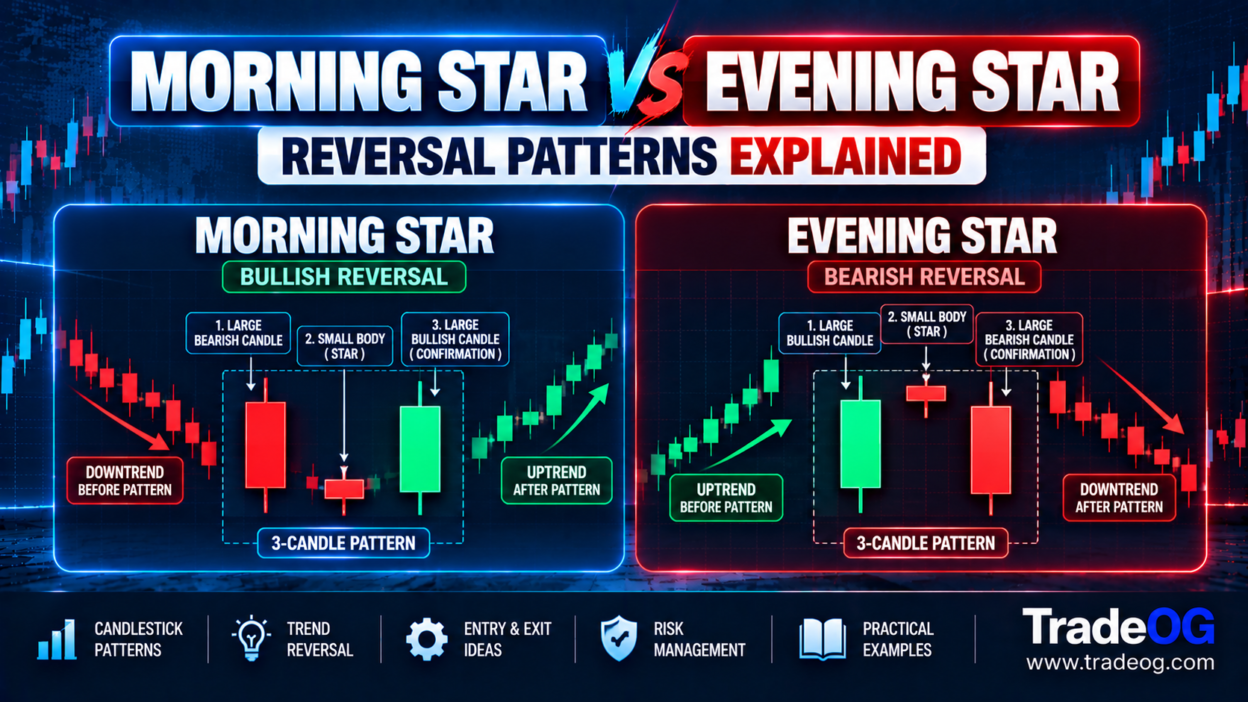
A Morning Star is a three-candle bullish reversal pattern that generally appears after a meaningful downtrend or decline.
The classic structure is:
- First candle: a relatively large bearish candle showing that sellers remain in control.
- Second candle: a small-bodied candle, often a doji or spinning top, showing that bearish momentum has weakened and the market has become uncertain.
- Third candle: a relatively large bullish candle that confirms buyers are taking control.
IG’s current candlestick guide describes the Morning Star as a large bearish candle followed by a small-bodied “star” and then a large bullish candle. The third candle provides the confirmation that buyers have started to regain control.
In simple terms, the pattern tells a story:
Sellers dominate → momentum slows → buyers regain control.
What Is an Evening Star Pattern?
An Evening Star is the bearish mirror image of the Morning Star. It normally develops after an uptrend or extended bullish move.
The classic structure is:
- First candle: a relatively large bullish candle showing strong buying pressure.
- Second candle: a small-bodied candle showing hesitation or loss of momentum.
- Third candle: a relatively large bearish candle that confirms sellers are taking control.
The sequence can be summarized as:
Buyers dominate → momentum stalls → sellers regain control.
IG identifies the Evening Star as the bearish counterpart of the Morning Star and describes it as a three-candle formation indicating a possible reversal of an uptrend.
Morning Star vs Evening Star: Quick Comparison
| Feature | Morning Star | Evening Star |
|---|---|---|
| Direction | Bullish reversal | Bearish reversal |
| Usually appears after | Downtrend | Uptrend |
| First candle | Large bearish candle | Large bullish candle |
| Middle candle | Small body / doji / spinning top | Small body / doji / spinning top |
| Third candle | Large bullish candle | Large bearish candle |
| Market message | Selling pressure is losing control | Buying pressure is losing control |
| Typical use | Potential long setup | Potential short setup |
| Best confirmation | Close into first candle’s body + structure break | Close into first candle’s body + structure break |
Why the Three Candles Matter
The strength of these patterns comes from the sequence rather than any individual candle.
Candle 1: The existing trend
The first candle demonstrates the dominant force. In a Morning Star, sellers push price lower with a relatively strong bearish candle. In an Evening Star, buyers push price higher with a relatively strong bullish candle.
Without a meaningful preceding trend, the pattern has less information because there is no clear trend to reverse.
Candle 2: The loss of momentum
The middle candle is the “star.” Its small body indicates that the market has temporarily lost directional conviction.
A doji can appear here, but it is not mandatory. A small bullish or bearish candle can also form the middle of the pattern. The important idea is that the aggressive movement represented by the first candle is no longer continuing with the same strength.
Candle 3: The confirmation
The third candle is critical. It should demonstrate that the opposite side has actually taken control rather than merely showing temporary hesitation.
A strong bullish third candle supports the Morning Star interpretation. A strong bearish third candle supports the Evening Star interpretation.
That is why treating the second candle alone as an entry signal can be dangerous. The market has shown uncertainty, not necessarily a reversal.
Morning Star Pattern Example
Imagine EUR/USD has been falling for several sessions and reaches a well-defined support zone.
The sequence develops like this:
- Candle 1 closes strongly bearish.
- Candle 2 has a very small body and longish wicks.
- Candle 3 opens near the star and rallies strongly.
- The third candle closes well into the body of Candle 1.
- Price then breaks a nearby lower-timeframe swing high.
This is more meaningful than seeing the same three candles in the middle of a random sideways range.
The combination is what matters:
Downtrend + support + loss of momentum + bullish confirmation.
Evening Star Pattern Example
Now imagine GBP/USD has been rising into a major resistance area.
- Candle 1 closes strongly bullish.
- Candle 2 becomes small-bodied and indecisive.
- Candle 3 sells off strongly.
- The third candle closes deep into the body of Candle 1.
- Price then breaks a nearby swing low.
The pattern becomes more convincing because the reversal occurs where sellers have a logical reason to appear.
The framework is:
Uptrend + resistance + loss of momentum + bearish confirmation.
Do Morning Star and Evening Star Patterns Need Gaps?
Traditionally, the middle candle of a Morning Star or Evening Star is expected to separate from the body of the preceding candle, creating a gap. The same idea applies to the transition into the third candle.
That requirement is much less practical in continuously traded markets such as forex. IG specifically notes that 24-hour markets generally produce fewer gaps, so traders often ignore the strict gap requirement when analysing forex candlestick patterns.
For forex traders, a better approach is to focus on the relative candle structure and momentum transition rather than rejecting an otherwise strong setup simply because there is no visible gap.
Morning Doji Star and Evening Doji Star
A Morning Star can contain a doji as its middle candle. This is commonly called a Morning Doji Star.
The bearish counterpart is the Evening Doji Star.
A doji means the open and close are very close relative to the candle’s range. It often represents indecision because neither buyers nor sellers managed to maintain control by the close.
IG notes that both Morning Star and Evening Star formations can use a doji in the middle, highlighting stronger indecision before the reversal confirmation.
However, a doji is not automatically bullish or bearish. Its meaning depends heavily on where it appears and what happens next.
How to Identify a High-Quality Morning Star
Use this checklist:
- A clear preceding bearish trend or decline.
- A meaningful support zone or demand area.
- A relatively large bearish first candle.
- A small second candle showing momentum compression.
- A strong bullish third candle.
- The third candle closes materially into the first candle’s body.
- Follow-through or a nearby structure break confirms the reversal.
The more of these conditions align, the more informative the pattern becomes. None of them guarantees a winning trade.
How to Identify a High-Quality Evening Star
For the bearish version, look for:
- A clear preceding bullish trend or advance.
- A meaningful resistance zone or supply area.
- A relatively large bullish first candle.
- A small second candle showing hesitation.
- A strong bearish third candle.
- The third candle closes materially into the first candle’s body.
- Follow-through or a nearby structure break confirms seller control.
An Evening Star in a strong uptrend at a major resistance area is more useful than the same formation appearing randomly inside a narrow range.
Where Should You Look for These Patterns?
Location is one of the most important filters.
Support and resistance
A Morning Star at support can indicate that sellers have pushed into an area where buyers are willing to defend price. An Evening Star at resistance can indicate the opposite.
Previous swing points
Prior highs and lows are useful because they show where the market previously changed direction.
Trendline or channel boundaries
A star pattern forming at a well-respected trendline or channel boundary can provide additional context.
Higher-timeframe levels
A reversal pattern on a 15-minute chart becomes more interesting when it forms around a clearly visible daily or 4-hour level.
Liquidity zones
In modern price-action analysis, traders may also look for a sweep of a previous high or low before the three-candle reversal develops. This can help distinguish a genuine rejection from a random pause.
How to Trade a Morning Star
There are several ways to approach the pattern. The safest general framework is to wait for confirmation rather than automatically buying the moment the third candle appears.
Entry method 1: Third-candle confirmation
A trader waits for the third bullish candle to close and enters after confirmation.
Advantage: more information about buyer control.
Disadvantage: the entry can be further from the invalidation level.
Entry method 2: Break of the confirmation candle
A trader waits for price to break the high of the bullish confirmation candle.
This adds another layer of confirmation but can result in a later entry during fast markets.
Entry method 3: Retest
After the bullish reversal, price may pull back toward the star or confirmation candle area. A successful retest can provide a more controlled entry.
But a retest is not guaranteed. Waiting for one can mean missing a strong trend reversal.
How to Trade an Evening Star
The same framework can be reversed.
Entry method 1: Third-candle confirmation
Wait for the bearish third candle to close and confirm seller control.
Entry method 2: Break of the confirmation candle
Wait for price to break the low of the bearish confirmation candle.
Entry method 3: Retest
Wait for price to pull back toward the reversal area and look for renewed selling pressure.
Again, the goal is not to find the earliest possible entry. The goal is to find an entry where the invalidation point and expected reward make sense.
Where to Place the Stop Loss
For a Morning Star, a common technical invalidation reference is below the pattern’s meaningful low or the support structure that produced the reversal.
For an Evening Star, the invalidation reference can be above the pattern’s meaningful high or the resistance structure.
The exact distance should depend on volatility and market structure. A stop should not be placed at an arbitrary fixed number of pips simply because the pattern looks similar on different days.
For volatile instruments such as XAU/USD, this becomes particularly important. A stop suitable for EUR/USD may be far too tight for gold.
How to Set Take Profit
There is no universal profit target for a Morning Star or Evening Star. Possible reference points include:
- Previous swing high or low
- Major support or resistance
- Opposite side of a trading range
- Higher-timeframe supply or demand
- A predefined risk-to-reward target
- A trailing stop when a larger trend develops
For example, a Morning Star at daily support might target the previous daily swing high rather than using an arbitrary 1:2 target. The correct target depends on the structure available on the chart.
Morning Star and Evening Star on Different Timeframes
| Timeframe | Typical use | Main consideration |
|---|---|---|
| 1–5 minute | Scalping | More noise and false signals |
| 15–30 minute | Intraday | Useful around session levels |
| 1 hour | Intraday / swing | Better structural context |
| 4 hour | Swing trading | Stronger broader-market context |
| Daily | Swing / position analysis | Fewer signals but larger structural relevance |
A common mistake is assuming a five-minute Morning Star has the same significance as a daily Morning Star. It does not. The timeframe changes the amount of market information represented by each candle.
Using Morning and Evening Stars With Forex Sessions
Session context can improve the quality of a candlestick setup.
For Indian forex traders, consider whether the pattern forms during:
- Asian session consolidation
- London session expansion
- London-New York overlap
- New York session volatility
A Morning Star that forms after a liquidity sweep during an active London-New York overlap can have a very different context from a similar pattern appearing during a quiet range.
For session timing, see Forex Trading Sessions in IST: London, New York and Tokyo Explained.
Using Morning and Evening Stars With XAU/USD
Gold can produce clean reversal structures, but it also moves rapidly around U.S. economic releases. That makes confirmation particularly important.
For XAU/USD, consider combining the pattern with:
- Asian high and low
- London high and low
- Previous-day high and low
- DXY direction
- U.S. Treasury yields
- Major support and resistance
- Economic-calendar events
- Current volatility
A Morning Star at major support while DXY is weakening can provide a stronger macro context than a Morning Star appearing randomly in the middle of a range. The same principle applies inversely to an Evening Star.
See XAU/USD price-action analysis on TradeOG for related concepts.
Morning Star vs Bullish Engulfing
Both can signal bullish reversals, but their structures differ.
| Feature | Morning Star | Bullish Engulfing |
|---|---|---|
| Candles | Three | Two |
| First phase | Bearish candle | Bearish candle |
| Indecision phase | Explicit middle candle | No separate middle candle |
| Confirmation | Third bullish candle | Second bullish engulfing candle |
| Core message | Downtrend slows, then reverses | Buying pressure overwhelms prior selling |
The Morning Star therefore provides an extra candle showing the transition from momentum to indecision to reversal.
Morning Star vs Hammer
A hammer is a one-candle pattern. A Morning Star is a three-candle pattern.
A hammer can show strong rejection of lower prices, but traders still need context and confirmation. A Morning Star provides more information because it shows the preceding bearish candle, the pause and the bullish confirmation.
Neither pattern should be treated as an automatic buy signal.
Evening Star vs Bearish Engulfing
An Evening Star requires three candles, while a bearish engulfing pattern requires two.
The Evening Star shows:
Bullish momentum → hesitation → bearish confirmation.
The bearish engulfing shows a more immediate transition:
Small bullish body → large bearish body overwhelms it.
Which one is better depends on market structure, location and confirmation rather than the name of the pattern.
False Morning Star and Evening Star Signals
No candlestick formation guarantees a reversal.
False signals are common when:
- The pattern forms in the middle of a range.
- There is no clear preceding trend.
- The third candle is weak.
- The pattern forms directly into strong opposing resistance or support.
- A major economic release invalidates the technical setup.
- Price immediately breaks the pattern’s structural extreme.
- The timeframe is too low and market noise dominates.
The best defense is context. Candlestick patterns should be treated as pieces of evidence, not standalone predictions.
Common Mistakes Traders Make
1. Trading every three-candle sequence
Not every three-candle formation is a Morning Star or Evening Star. The preceding trend and relative candle structure matter.
2. Entering before the third candle closes
The middle candle only shows hesitation. Without confirmation, the market may continue the original trend.
3. Ignoring market structure
A beautiful Morning Star in the middle of nowhere is less useful than one at a major support level.
4. Demanding a perfect textbook gap in forex
Because forex trades continuously through the week, traditional gap characteristics are often less visible. Focus on the momentum transition instead.
5. Using fixed stops regardless of volatility
Different currency pairs and different market conditions require different amounts of room.
6. Confusing probability with certainty
A reversal pattern can improve a trade’s context without guaranteeing the next move.
A Practical Trading Checklist
| Question | Morning Star | Evening Star |
|---|---|---|
| Is there a clear preceding trend? | Downtrend | Uptrend |
| Is there a meaningful level? | Support | Resistance |
| Is Candle 1 strong? | Bearish | Bullish |
| Is Candle 2 small? | Yes | Yes |
| Does Candle 3 confirm? | Strong bullish close | Strong bearish close |
| Is there follow-through? | Preferred | Preferred |
| Is the invalidation level clear? | Below structure | Above structure |
| Is major news nearby? | Check calendar | Check calendar |
Should Beginners Trade Morning Star and Evening Star Patterns?
Beginners can study these patterns, but they should not treat them as standalone entry buttons.
A better learning process is:
- Learn the three-candle structure.
- Find examples on historical charts.
- Mark the preceding trend.
- Mark nearby support or resistance.
- Record whether the third candle confirmed the reversal.
- Track what happened over the next 5, 10 and 20 candles.
- Only then consider using the setup in a live trading plan.
This turns pattern recognition into a measurable process instead of relying on visual excitement.
Final Takeaway
The Morning Star and Evening Star are best understood as stories about changing market control. The first candle shows the existing trend, the small middle candle shows hesitation, and the third candle confirms that the opposite side may be taking control.
The Morning Star is the bullish version after a decline. The Evening Star is the bearish version after an advance. Their strongest applications generally occur when the pattern forms at meaningful support or resistance, aligns with the broader market structure and receives confirmation from the third candle or subsequent price action.
For forex traders, remember that a textbook gap is less important than it is in markets with daily session gaps. What matters more is the transition from strong directional movement to indecision and then confirmed reversal. IG’s current educational material also emphasizes the importance of the preceding trend and the three-candle structure when interpreting these formations.
For XAU/USD and other volatile instruments, add one more filter: risk management. A strong-looking reversal pattern can still fail quickly when a major economic release, unexpected headline or liquidity shock hits the market.
FAQs
What is a Morning Star candlestick pattern?
A Morning Star is a three-candle bullish reversal formation that usually appears after a decline. It consists of a large bearish candle, a small-bodied middle candle and a strong bullish confirmation candle.
What is an Evening Star candlestick pattern?
An Evening Star is a three-candle bearish reversal formation that usually appears after an advance. It consists of a large bullish candle, a small-bodied middle candle and a strong bearish confirmation candle.
Is a Morning Star bullish?
Yes, it is generally interpreted as a potential bullish reversal pattern, especially when it forms after a clear decline and near meaningful support.
Is an Evening Star bearish?
Yes. It is generally interpreted as a potential bearish reversal pattern after an uptrend, particularly when it forms near resistance.
Does a Morning Star need a doji?
No. The middle candle can be a doji, spinning top or another small-bodied candle. A doji creates stronger visual evidence of indecision but is not mandatory.
Can Morning Star and Evening Star patterns work in forex?
Yes, but their reliability depends on context. Forex traders should consider trend, support and resistance, session conditions, volatility and economic news rather than trading the three candles alone.
Which timeframe is best for Morning Star and Evening Star?
There is no universal best timeframe. Higher timeframes generally provide more structural context, while lower timeframes offer more signals but also more noise. Many traders use a higher timeframe for context and a lower timeframe for execution.
Sources and further reading: IG: Japanese Candlestick Trading Guide, IG: Candlestick Patterns, and CME Group: Candlestick Charts.