

If you are new to forex trading in the United States, one of the first terms you will see is leverage. A broker may advertise leverage such as 50:1 or 20:1, but that number is easy to misunderstand.
Leverage does not mean the broker gives you free money. It means you can control a larger notional forex position with a smaller amount of capital held as margin. The same mechanism that increases your potential buying power also increases the speed at which losses can affect your account.
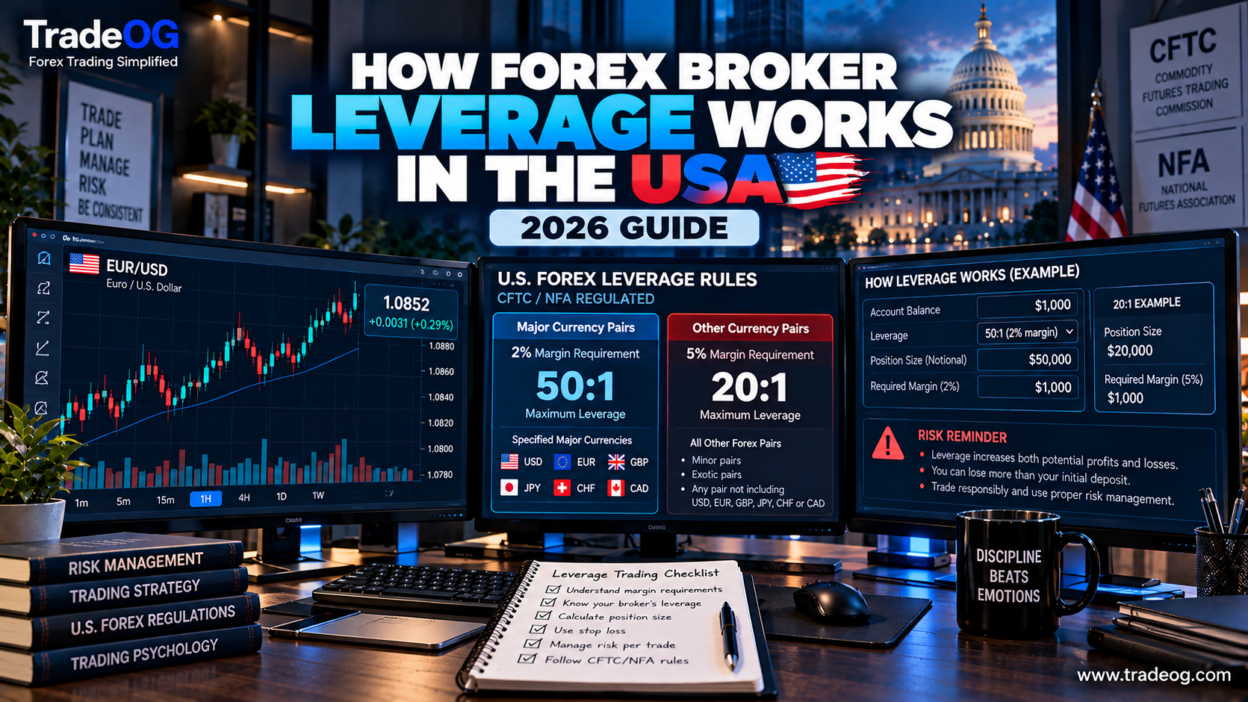
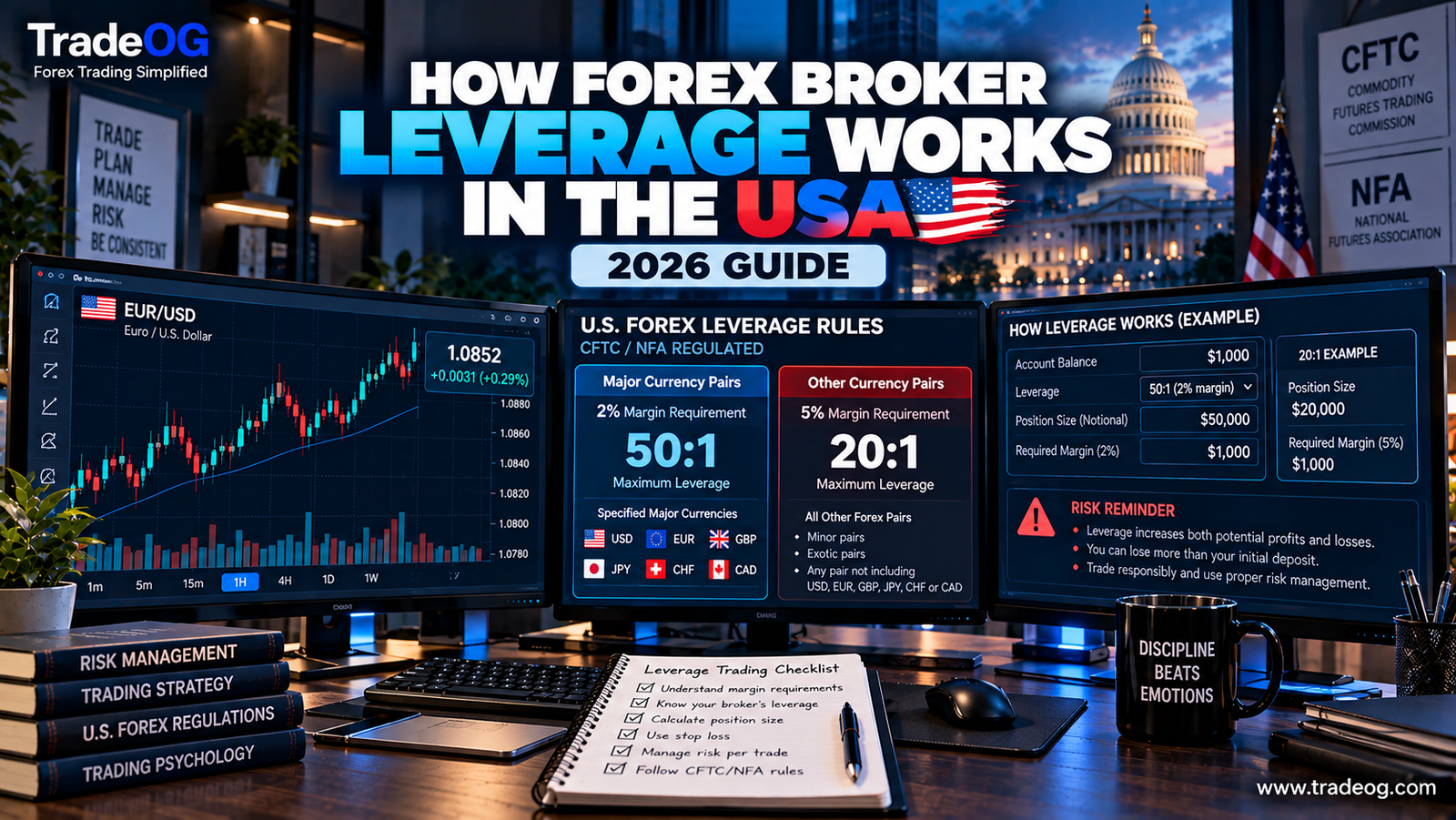
For U.S. retail forex customers, leverage is subject to regulatory security-deposit requirements. Under the current NFA Forex Dealer Member rules effective March 18, 2026, the minimum security deposit is 2% of notional value for specified major currencies and 5% for other forex transactions. In simple terms, that corresponds to up to 50:1 leverage for those specified major currencies and 20:1 leverage for other transactions, subject to applicable rules and broker requirements.
Quick Answer: How Does Forex Leverage Work in the USA?
Think of leverage as a relationship between your account equity, required margin and position size.
| U.S. Retail Forex Rule | Margin Requirement | Equivalent Maximum Leverage |
|---|---|---|
| Specified major currencies | 2% | 50:1 |
| Other forex transactions | 5% | 20:1 |
The NFA’s current rule identifies the British pound, Swiss franc, Canadian dollar, Japanese yen, euro, Australian dollar, New Zealand dollar, Swedish krona, Norwegian krone and Danish krone in the 2% category. Other forex transactions are subject to the 5% minimum security deposit. Brokers can impose stricter requirements, and requirements can also be increased under extraordinary market conditions.
Important: the exact amount of leverage you receive is determined by the broker, product and applicable regulatory requirements. Never assume that a broker offering forex internationally will provide the same leverage to a U.S. resident.
What Is Forex Leverage?
Forex leverage allows a trader to control a position whose notional value is larger than the cash being committed as margin.
For example, if a forex position has a notional value of $50,000 and the applicable margin requirement is 2%, the required margin would be:
$50,000 × 2% = $1,000
The $1,000 is not the maximum amount you can lose simply because it is the margin. It is the amount required to support the position under the applicable margin requirement. The position can still generate losses that materially reduce your account equity.
Leverage vs Margin: What Is the Difference?
Leverage and margin describe the same relationship from opposite directions.
- Leverage tells you how much position exposure you can control relative to the required margin.
- Margin is the amount of account capital that must be maintained to support the position.
The basic relationship is:
Margin Requirement = 1 ÷ Leverage
So:
- 50:1 leverage = 2% margin.
- 20:1 leverage = 5% margin.
- 10:1 leverage = 10% margin.
- 5:1 leverage = 20% margin.
This is why a lower leverage setting generally requires more capital for the same position size.
What Does 50:1 Forex Leverage Mean?
50:1 leverage means that, under a 2% margin requirement, approximately $1 of margin can support $50 of notional position value.
For example:
| Account Capital Used as Margin | 50:1 Notional Exposure |
|---|---|
| $100 | $5,000 |
| $500 | $25,000 |
| $1,000 | $50,000 |
| $2,000 | $100,000 |
| $5,000 | $250,000 |
These are mathematical examples of maximum exposure based on the 2% requirement. They are not recommendations for position sizing.
A beginner should not interpret a $1,000 account and 50:1 leverage as a reason to trade a $50,000 position. The maximum allowed exposure and the sensible exposure are two very different things.
What Does 20:1 Forex Leverage Mean?
At a 5% margin requirement, the equivalent leverage relationship is 20:1.
For example, a $1,000 margin requirement can support a $20,000 notional position under a 5% requirement:
$20,000 × 5% = $1,000
Again, this does not mean a trader should use the entire amount of available leverage. It only explains the relationship between the required margin and notional exposure.
Why Does the USA Limit Forex Leverage?
Retail forex is a leveraged product. Without margin restrictions, a small account could potentially control a very large position. A relatively small market move could therefore create an extremely large percentage gain or loss.
U.S. regulators use capital, registration, disclosure, conduct and security-deposit requirements to create a framework around retail forex activity.
The CFTC explains that retail OTC forex customers trade against their dealer rather than on an open exchange. The agency also warns that leverage amplifies both gains and losses and that customers can potentially lose all of their margin and may be liable for additional losses depending on the circumstances and account agreement.
Read the CFTC forex customer advisory.
How a Forex Broker Calculates Required Margin
For a simplified example, suppose you want to open a $100,000 forex position and the applicable margin requirement is 2%.
Required Margin = $100,000 × 0.02 = $2,000
If the applicable requirement is 5%:
Required Margin = $100,000 × 0.05 = $5,000
Your broker may also apply additional margin requirements based on its risk controls, the currency pair, account conditions, market volatility or other factors.
Leverage Does Not Change the Value of a Pip
This is a major beginner mistake.
Leverage changes how much margin is required to establish a position. It does not magically reduce the market value of the position’s price movement.
If you control a larger position, a given price movement can produce a larger dollar profit or loss.
For example, suppose a position produces a hypothetical $10 gain or loss per pip. Increasing leverage does not change that pip value. What changes is how much account capital you used to support the position.
This is why leverage should be treated as a capital-efficiency tool, not a profit multiplier you should automatically maximize.
Leverage Example With a $1,000 Account
Imagine you have a $1,000 account and the applicable margin requirement is 2%.
Mathematically, the 2% requirement could support up to approximately $50,000 of notional exposure:
$50,000 × 2% = $1,000
Now imagine the position moves against you. The $1,000 margin does not cap the position’s market loss at $1,000. If the position loses $500, your account equity falls by $500 before considering other costs. If it loses $900, only $100 of equity remains before other effects.
This is the central idea to remember:
Margin is the amount required to hold the position. It is not your maximum possible loss.
What Happens When Your Account Falls Below the Required Margin?
If your account no longer has enough equity or security deposit to satisfy applicable requirements, the broker may require additional funds or liquidate positions.
The NFA rules require Forex Dealer Members to collect additional security deposits from retail forex customers or liquidate positions when the customer’s maintained security deposits are insufficient to meet the applicable requirement.
That means you should never assume you can simply “wait for the market to come back.” A leveraged position can be reduced or closed when margin requirements are no longer satisfied.
See the current NFA security-deposit rule.
What Is a Margin Call?
A margin call is generally a warning or demand associated with insufficient account equity or available margin. The exact process varies by broker and account agreement.
Modern brokers can also use automated liquidation systems. You should therefore read the broker’s margin policy before trading instead of waiting to discover its rules during a fast market.
Before opening a position, know:
- Initial margin requirement.
- Maintenance or ongoing margin requirement.
- Available margin.
- Margin close-out or liquidation rules.
- Whether the broker can increase margin during volatile conditions.
- Whether negative balances are possible under the account agreement.
Does More Leverage Mean More Profit?
No.
Leverage increases the amount of market exposure you can establish relative to your margin. It does not create a trading edge.
If your strategy has no positive expectancy, increasing leverage does not make the strategy profitable. It simply allows the same strategy to affect a larger amount of capital more quickly.
Consider two traders who both earn or lose 1% on the same notional position. The trader using more leverage has committed less margin relative to the position, so the return or loss relative to their committed capital can look much larger.
This is why high leverage can make a winning trade look spectacular while making a losing trade psychologically and financially difficult to manage.
What Leverage Should a Beginner Use?
There is no single leverage number that is right for every trader.
A better approach is to decide your maximum dollar risk per trade first and then calculate position size from the stop-loss distance.
For example, if your account is $2,000 and you decide that your maximum planned loss on one trade is 1%, your risk budget is:
$2,000 × 1% = $20
You would then choose a position size and stop-loss distance that keep the planned loss around that amount, rather than choosing the largest position the broker permits.
Leverage vs Position Size
These concepts are related but should not be confused.
| Concept | What It Controls |
|---|---|
| Leverage | How much notional exposure can be supported by available margin |
| Position size | How much market exposure you actually take |
| Stop loss | Where you plan to exit if the trade moves against you |
| Risk per trade | How much account capital you are willing to lose if the stop is reached |
A trader can have access to 50:1 leverage while using only a small fraction of that available exposure.
Can U.S. Forex Brokers Offer 100:1 or 500:1 Leverage?
Be very careful with claims like this.
For a U.S. retail forex customer dealing with a regulated U.S. Forex Dealer Member, the applicable security-deposit requirements translate to 50:1 for specified major currencies and 20:1 for other transactions under the current NFA framework.
If a website specifically targeting U.S. residents advertises 100:1, 200:1 or 500:1 retail forex leverage, that should trigger a serious verification step.
The CFTC specifically lists offering leverage higher than legally allowed in the United States as a warning sign associated with potentially fraudulent or unregistered forex dealers.
See CFTC forex fraud warnings.
Why Offshore Forex Brokers Advertise Higher Leverage
International forex markets can have different regulatory regimes and leverage limits. Some offshore brokers advertise leverage far above the limits applicable to U.S. retail forex customers.
That does not mean the offshore broker is a better choice.
The CFTC warns consumers about unregistered offshore dealers, including situations where customers were unable to withdraw money or were asked to pay additional money before receiving withdrawals.
For a U.S. resident, legal availability and regulatory status should come before a headline leverage number.
How to Check Whether a Forex Broker Is Legitimate in the USA
Before depositing money, verify the firm.
- Identify the legal entity behind the broker.
- Check whether it is registered with the appropriate U.S. regulators.
- Search the firm’s NFA BASIC record.
- Review disciplinary history and regulatory information.
- Read the broker’s forex risk disclosure.
- Review funding and withdrawal rules.
- Confirm that the exact product is available to U.S. residents.
The CFTC recommends checking registration and disciplinary information before depositing money with a forex dealer.
Check NFA BASIC and check registration through the CFTC.
Does Forex Leverage Apply to Gold?
Do not automatically apply the 50:1 or 20:1 forex leverage rules to gold.
Gold and forex can be completely different products. A U.S. trader may access gold through futures, ETFs, physical/spot products or other regulated instruments. Each product has its own contract specifications, margin rules and risk characteristics.
For example, COMEX gold futures are exchange-traded futures contracts rather than retail OTC forex transactions. A broker’s margin requirement for gold futures is therefore not simply the same thing as the 2% or 5% forex security-deposit rule.
This distinction is particularly important if you trade XAU/USD outside the United States and then move to a U.S. broker. The product, leverage and margin framework may be completely different.
Leverage and Gold Futures: Why Beginners Get Confused
Gold futures can look attractive because the contract controls a large amount of gold relative to the margin required. But futures margin is not the same concept as buying the full notional value of the underlying asset with cash.
Before trading GC, MGC or smaller gold futures contracts, understand:
- Contract size.
- Minimum tick size.
- Dollar value per tick.
- Initial margin.
- Maintenance margin.
- Expiration and settlement.
- Intraday margin policies.
- Broker liquidation rules.
Leverage and Stop Loss: The Connection
A stop loss does not make leverage safe by itself.
Suppose a trader chooses a position based on the maximum leverage available and then places a stop loss. If the position is too large, normal spread widening, slippage or a fast market can produce a much larger loss than expected.
A more robust process is:
- Determine account equity.
- Set maximum acceptable risk.
- Choose the stop-loss location based on market structure or strategy.
- Calculate the position size required to keep the dollar risk within the limit.
- Check the broker’s margin requirement.
- Only then place the trade.
This puts risk first and leverage second.
Common Forex Leverage Mistakes
Mistake 1: Using maximum leverage because it is available
Maximum available leverage is a limit, not a target.
Mistake 2: Thinking margin equals maximum loss
Margin is collateral or security deposit required to support the position. It is not necessarily the maximum loss.
Mistake 3: Ignoring broker-specific requirements
A broker can impose stricter requirements than the regulatory minimum.
Mistake 4: Comparing U.S. leverage with offshore leverage
A 500:1 international offer does not mean a U.S. resident can legally receive the same terms from a regulated U.S. retail forex dealer.
Mistake 5: Confusing forex leverage with gold leverage
Gold futures, ETFs and other gold products follow their own rules. Do not assume the forex margin framework applies.
Mistake 6: Ignoring news volatility
Major economic releases can create rapid price movements, wider spreads and slippage. A position that looks comfortable under normal conditions may become much more difficult to manage during a fast market.
How Much Leverage Is Safe?
There is no universally safe leverage number.
A trader using 50:1 leverage with a tiny position may have less practical risk than a trader using 10:1 leverage with an oversized position.
The more useful question is:
“How much can I lose if my stop is triggered?”
If you cannot answer that question before entering a trade, your position size is probably not sufficiently controlled.
A Simple U.S. Forex Leverage Checklist
- ☐ Is the broker authorized to serve U.S. retail forex customers?
- ☐ Did I check the firm through NFA BASIC?
- ☐ Do I understand the applicable margin requirement?
- ☐ Do I know my exact position size?
- ☐ Do I know the approximate dollar value of a price move?
- ☐ Is my stop-loss distance defined?
- ☐ Is my maximum dollar risk defined?
- ☐ Do I understand the broker’s liquidation rules?
- ☐ Have I checked funding and withdrawal conditions?
- ☐ Am I using leverage as a tool rather than a reason to oversize?
Final Verdict
Forex broker leverage in the USA is essentially a margin system that determines how much notional currency exposure can be supported by your account. Under the current NFA security-deposit framework effective March 18, 2026, the minimum requirement is 2% for specified major currencies and 5% for other forex transactions, equivalent to 50:1 and 20:1 respectively.
But the most important lesson is that maximum leverage is not the same as sensible leverage. Your actual position size, stop loss, account equity and dollar risk determine how dangerous a trade is.
Before opening a U.S. forex account, verify the broker’s regulatory status, read its risk disclosure, understand its margin and liquidation policies, and calculate your position size before you click Buy or Sell.
TradeOG Risk Disclaimer
Forex trading involves substantial risk and is not suitable for every investor. Leverage can magnify both gains and losses, and losses may exceed the amount initially deposited depending on the product, broker and account agreement. This article is for educational purposes only and is not financial, investment, tax or legal advice. Regulatory requirements, broker policies, margin requirements and product availability can change. Verify current information directly with the broker, CFTC and NFA before opening or funding an account.
Frequently Asked Questions
What is the maximum forex leverage in the USA?
For U.S. retail forex transactions, the current NFA minimum security-deposit framework is 2% for specified major currencies and 5% for other transactions. Those requirements correspond to 50:1 and 20:1 maximum leverage equivalents respectively, although individual brokers can require more margin.
Is 50:1 leverage legal in the USA?
Yes, 50:1 corresponds to a 2% security-deposit requirement for the specified major currencies covered by the NFA rule. A broker may impose stricter limits.
Can I get 500:1 forex leverage in the USA?
Do not assume so. A U.S. retail customer should be highly cautious about any dealer offering leverage above the applicable U.S. limits. The CFTC identifies unusually high leverage as a warning sign when dealing with unregistered or offshore forex dealers.
What is the difference between 50:1 and 20:1 leverage?
50:1 corresponds to a 2% margin requirement, while 20:1 corresponds to a 5% requirement. With the same notional position, 20:1 requires more margin than 50:1.
Does higher leverage increase my profit?
Leverage does not create a trading edge. It allows a larger position to be supported with less margin. If the position is larger, gains and losses relative to your account can become larger and faster.
Does forex leverage apply to XAU/USD?
Not automatically. XAU/USD availability and margin treatment depend on the specific product and jurisdiction. Gold futures, ETFs and spot/OTC products can have different rules.
Is margin the same as the amount I can lose?
No. Margin is the amount required to support a position. It is not necessarily the maximum loss. A leveraged position can lose substantially more than its initial margin requirement depending on the market and account terms.