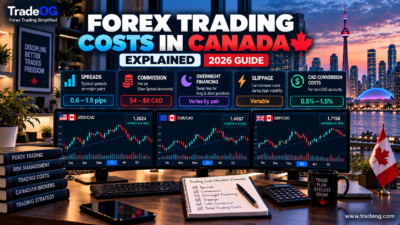



Forex trading costs in Canada are more than just the spread you see on a currency pair. A realistic cost calculation can include the bid-ask spread, commission, overnight financing, slippage, currency conversion and account-related charges.
For Canadian traders, there is another important layer: the broker’s Canadian legal entity, CIRO requirements, provincial availability and the currency in which your account is funded. This guide explains the main costs in Canadian dollars (CAD) and shows how to compare brokers without being distracted by headline “from 0.0 pip” pricing.
Quick Answer: What Does It Cost to Trade Forex in Canada?
For a typical retail forex trade, your direct transaction cost is usually the spread, with some account structures adding a separate commission. If you keep a leveraged position open after the broker’s daily rollover, you can also pay or receive overnight financing. Canadian traders can additionally face currency-conversion costs when the trading instrument or resulting profit/loss is in a currency different from the account’s home currency.
| Cost | When You Pay It | Why It Matters |
|---|---|---|
| Spread | When entering/exiting | Main cost on spread-based accounts |
| Commission | Usually per trade or per side | Common on raw-spread accounts |
| Overnight financing | When positions remain open after rollover | Important for swing traders |
| Slippage | When execution differs from expected price | Can increase effective cost |
| Currency conversion | When P&L or transactions require conversion | Relevant to CAD-funded accounts |
| Account fees | Depends on broker/activity | May matter for inactive traders |
1. Forex Spread: The Cost Every Beginner Should Understand
The spread is the difference between the bid and ask price. If USD/CAD is quoted at 1.3520 bid and 1.3522 ask, the displayed spread is 0.0002, or 2 pips under the standard pip convention.
You effectively cross the spread when you enter and later close a trade. That is why a broker advertising a low minimum spread does not automatically mean it is the cheapest broker for your strategy.
Minimum spreads can occur only under favourable liquidity conditions. Actual spreads can widen around major economic releases, market openings and other periods of reduced liquidity. CMC Markets Canada explicitly notes that spreads can widen when the underlying market spread widens or outside normal trading hours.
2. Commission: Is a 0.0-Pip Spread Actually Cheaper?
Not necessarily. Some brokers offer a traditional spread-only account, while others offer a tighter raw spread plus a separate commission.
CMC Markets Canada, for example, currently lists a Standard account with spread-based pricing and no separate forex commission, while its FX Active account offers selected FX spreads from 0.0 pips and a fixed commission of C$2.50 per C$100,000 notional value per side.
The correct comparison is therefore:
Total trading cost = spread cost + commission + any applicable execution/conversion costs.
3. Overnight Financing and Swap Costs in Canada
If you hold a leveraged forex position beyond the broker’s daily rollover time, financing can be charged or credited. The amount depends on the currency pair, position direction, market funding rates and the broker’s pricing structure.
OANDA Canada states that positions open at 5 p.m. ET are treated as overnight and are subject to a financing charge or credit based on the applicable funding rate and position size.
CMC Markets Canada similarly calculates FX holding costs using the tom-next rate plus its stated charge. It also applies triple holding costs on a specified weekday depending on the currency pair.
This is especially important for swing traders. A spread that looks attractive for a five-minute trade may be much less important than financing if you plan to hold the position for several days.
4. Currency Conversion Costs for Canadian Traders
Canadian traders often fund accounts in CAD while trading pairs such as EUR/USD or instruments quoted in USD. If the broker has to convert realised profit, loss, fees or other cash movements into CAD, a conversion spread or fee can become part of your total cost.
OANDA Canada states that when an instrument is denominated in a currency different from the account’s home currency, realised P&L and related adjustments are converted using its prevailing exchange rate, with a stated markup or markdown on certain account types.
Before choosing a broker, check:
- Whether your account can be denominated in CAD.
- Whether CAD deposits and withdrawals are supported.
- How USD-denominated trading profits are converted into CAD.
- Whether the broker adds a conversion markup.
- Whether the conversion rate is shown clearly on your statement.
5. Slippage: The Cost That Does Not Appear in the Spread
Slippage occurs when your order executes at a different price from the one you expected. It can be positive or negative, but traders should pay particular attention to negative slippage during fast markets.
Major economic releases, central-bank announcements and sudden geopolitical developments can cause liquidity to change rapidly. A broker may advertise a tight spread while the actual fill on a market order is affected by volatility.
For this reason, experienced traders compare execution quality and typical trading conditions rather than judging a broker from one minimum-spread figure.
6. Example: What Does a Forex Trade Cost in CAD?
Suppose you trade USD/CAD with a position size of 10,000 USD and the effective spread is 1.0 pip. For USD/CAD, one pip on 10,000 units is approximately C$1 under the standard pip convention.
A 1-pip spread would therefore represent roughly C$1 of spread cost on that position, before considering any commission, slippage, financing or conversion.
Now imagine a raw-spread account with an effective 0.2-pip spread plus a separate commission. The 0.2-pip figure alone cannot tell you whether it is cheaper. You must convert the commission into a comparable cost and then add it to the spread.
7. Spread-Only vs Commission Accounts in Canada
| Pricing Model | Typical Structure | Good For | Main Issue |
|---|---|---|---|
| Spread-only | Broker earns through wider spread | Beginners and simplicity | Spread may be wider |
| Raw spread + commission | Low spread plus separate commission | Active traders | More calculation required |
| Hybrid pricing | Different pricing by account/product | Traders comparing plans | Terms can be harder to compare |
Neither model is automatically better. The cheapest choice depends on your average trade size, number of trades, currency pair and holding period.
8. Current Canadian Broker Cost Examples
CMC Markets Canada
CMC currently lists a Standard CFD account with spread-based pricing and no separate forex commission, plus an FX Active account with selected major-pair spreads from 0.0 pips and a C$2.50 commission per C$100,000 per side. Its platform also states that spreads can widen outside normal conditions.
OANDA Canada
OANDA publishes financing costs for forex and other leveraged products and states that financing rates can vary by instrument and change over time. It also publishes account-related charges, including an inactivity fee of up to C$20 per client per month after 12 months without trading, subject to its stated conditions.
FOREX.com Canada
FOREX.com Canada publishes margin requirements by product and currency pair. For CAD-based accounts, the current published table includes different margin requirements across currency pairs; for example, USD/CAD is listed at 2%, while EUR/USD and GBP/USD are listed at 5% on the referenced schedule. Margin requirements can change, so traders should check the broker’s live schedule before opening positions.
9. Does Leverage Make Forex Trading Cheaper?
No. Leverage changes the amount of capital required as margin; it does not remove the underlying spread, commission or financing cost.
For example, if a broker requires 5% margin, a trader can control a position whose notional value is much larger than the cash posted as margin. But the profit and loss still relate to the larger position. CIRO publishes FX margin schedules for Canadian dealers and can adjust requirements when currency volatility changes.
Think of leverage as a capital-efficiency mechanism, not a discount on trading costs.
10. What Does a C$1,000 Forex Account Actually Pay?
Imagine a Canadian trader with a C$1,000 account who makes 20 round-trip trades in a month. If the average all-in spread and commission cost is C$2 per trade, direct transaction costs would be about C$40 before financing, slippage and conversion.
That is only an example, not a broker quote. The purpose is to show why high-frequency trading can make apparently small per-trade costs significant over time.
If the same trader holds positions overnight, financing can materially change the monthly total.
11. Forex Trading Costs by Trading Style
Scalping
Scalpers are highly sensitive to spreads, commissions and slippage because they may enter and exit many positions. A small cost repeated dozens of times can consume a meaningful portion of gross profit.
Day trading
Day traders usually care heavily about spreads and execution quality while trying to avoid overnight financing by closing positions before rollover.
Swing trading
Swing traders may care less about a fraction of a pip in entry cost and more about overnight financing, weekend exposure and larger market gaps.
Position trading
Longer-term traders should calculate financing over the expected holding period and consider whether a leveraged CFD or another gold/currency investment structure is more appropriate.
12. How to Compare Canadian Forex Brokers by Total Cost
- Choose your main currency pair. USD/CAD, EUR/USD and GBP/USD can have different costs.
- Estimate your normal position size. A broker’s pricing may change with volume.
- Record the typical spread. Do not use only the minimum advertised spread.
- Add commission. Convert it into a comparable per-trade or per-pip cost.
- Estimate financing. This matters if positions stay open overnight.
- Check CAD conversion. Especially if the account or instrument involves USD.
- Consider slippage. Particularly if you trade during major news.
- Check account fees. Include inactivity, withdrawal or other charges where applicable.
13. How to Reduce Forex Trading Costs in Canada
- Trade liquid major currency pairs when they fit your strategy.
- Avoid unnecessary overtrading.
- Compare typical rather than headline minimum spreads.
- Understand whether a commission account is actually cheaper for your trade size.
- Reduce unnecessary overnight positions if financing is hurting your strategy.
- Understand CAD/USD conversion before funding or withdrawing.
- Use limit orders where appropriate instead of assuming every market order will fill at the displayed price.
- Review your monthly statement and calculate your real cost per trade.
14. Common Mistakes Canadian Beginners Make
Choosing the lowest advertised spread
A 0.0-pip minimum spread is not the same as a 0.0-pip average trading cost.
Ignoring commission
Raw spreads can look extremely attractive until the commission is added.
Ignoring financing
Holding a leveraged position for several days can create a meaningful financing cost.
Forgetting CAD conversion
Currency conversion can quietly reduce the amount credited to your Canadian-dollar account.
Confusing margin with cost
Margin is collateral required to maintain a leveraged position. It is not the broker’s trading fee.
Trading too frequently
Even a competitive per-trade cost becomes expensive when the strategy generates excessive turnover.
15. Is Forex Trading Expensive in Canada?
It can be relatively inexpensive per transaction when trading liquid currency pairs with competitive pricing, but the total cost depends heavily on your trading frequency and holding period.
A beginner making a few carefully planned trades may spend little on direct transaction costs. A high-frequency trader can pay considerably more because spreads, commissions and slippage accumulate quickly.
Frequently Asked Questions
What is the biggest forex trading cost in Canada?
For many short-term traders, the spread is the most visible direct cost. Commission, slippage, financing and currency conversion can become equally important depending on the account and strategy.
Is 0.0 spread really free?
No. A 0.0-pip raw spread can still have a separate commission, and actual spreads can vary with market conditions.
Does forex trading in Canada have commission?
Some Canadian broker accounts charge no separate forex commission and build costs into the spread, while other account types use tighter spreads plus commission.
What is the cheapest forex broker in Canada?
There is no universal cheapest broker. Compare the total cost for your currency pair, position size, trade frequency and holding period.
Can I trade forex with a CAD account?
Yes, where the broker supports CAD as an account or funding currency. Trading a USD-quoted pair can still create currency-conversion costs.
Do Canadian forex brokers charge overnight fees?
Leveraged positions held beyond the broker’s daily rollover can incur financing charges or credits. The exact calculation varies by broker and instrument.
Are forex trading costs tax deductible in Canada?
Tax treatment depends on your circumstances, trading activity and whether your gains or losses are treated as capital or income. Do not rely on a broker’s fee page as tax advice; consult a qualified Canadian tax professional for your situation.
Final Checklist
- Compare the real spread, not only the minimum spread.
- Calculate commission when using raw-spread pricing.
- Check overnight financing before holding positions.
- Understand CAD/USD conversion costs.
- Review slippage during volatile markets.
- Check account and withdrawal fees.
- Verify the Canadian broker entity and current CIRO status.
- Choose position size based on risk, not maximum leverage.
Official references: CIRO, OANDA Canada, CMC Markets Canada and FOREX.com Canada. Broker pricing, margin requirements, financing rates and account terms can change, so verify the latest terms directly with the provider.
Risk disclosure: Leveraged forex trading is high risk and can result in rapid losses. This article is for educational purposes only and is not financial, investment or tax advice.