

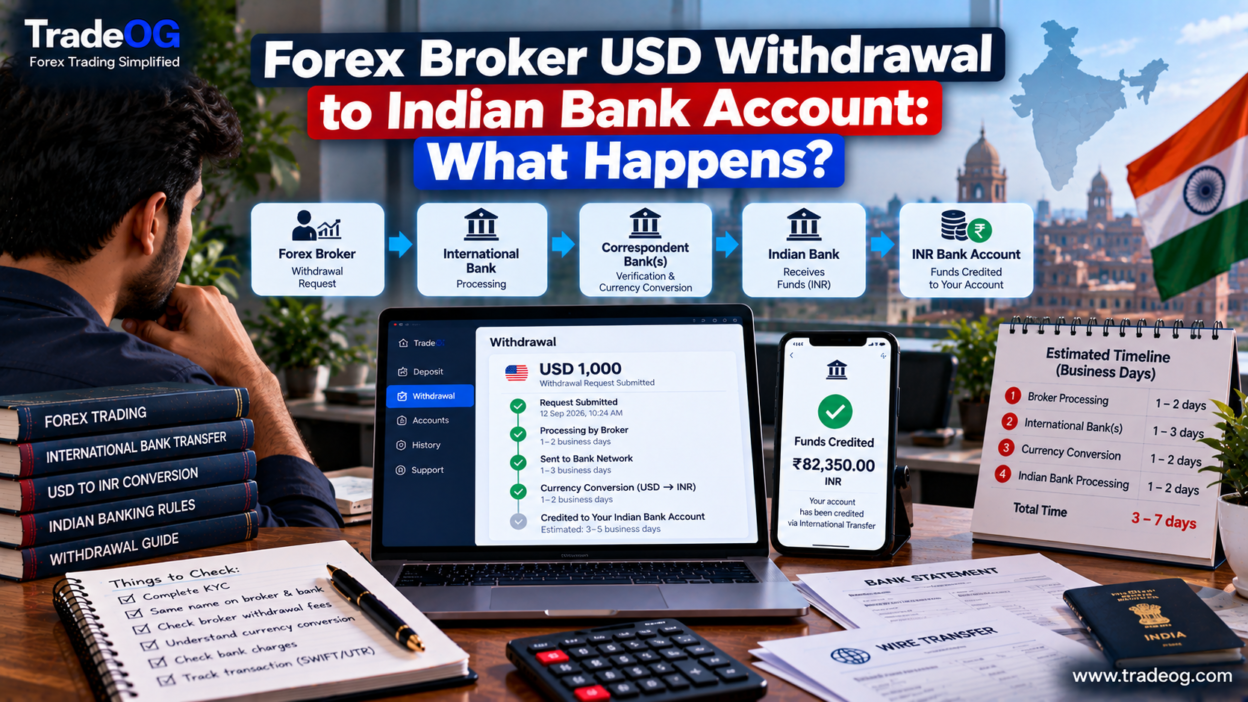
It can be confusing when a forex platform shows one withdrawal amount but your Indian bank statement shows a different amount. You may see a withdrawal marked as $1,000 on the trading platform, while the amount credited to your bank account in India is lower or appears at a different INR value.
This does not automatically mean that the forex platform has short-paid you. Currency conversion, the exchange rate used by the bank, intermediary or correspondent-bank charges, receiving-bank charges, and the timing of the conversion can all affect the final amount credited.
For Indian traders, there is also an important compliance point: residents should use forex platforms and transactions that are permitted under applicable FEMA/RBI rules. RBI has specifically cautioned residents against unauthorised electronic trading platforms and unauthorised forex transactions.
Why Is My Forex Withdrawal Amount Different From My Bank Credit?
The simplest explanation is that the amount displayed by your forex platform and the amount credited by your bank may represent different stages of the transaction.
- Forex platform withdrawal: USD 1,000
- Exchange rate used for conversion: ₹83.50 per USD
- Gross INR equivalent: ₹83,500
- Possible bank/intermediary deductions: Variable
- Final bank credit: Potentially lower than the gross INR equivalent
The actual amount depends on the payment route, currency, banks involved, exchange rate, and applicable charges. Do not treat the example above as a standard fee schedule.
1. The Forex Platform May Show the Withdrawal in USD
Many international trading platforms display withdrawals in the original settlement currency, such as USD, EUR or GBP. For a related guide, see Forex Broker USD Withdrawal to Indian Bank Account. Your Indian bank account, however, may ultimately receive INR.
That means you should not compare a USD withdrawal figure directly with the INR amount appearing in your bank statement.
2. Your Bank Uses Its Own Exchange Rate
One of the most common reasons for a difference is currency conversion.
The exchange rate shown on Google, a financial website or a trading platform may not be the exact rate your Indian bank uses when converting an incoming foreign-currency payment into INR.
Banks can apply their applicable forex conversion rate rather than a public mid-market rate. SBI’s customer-rights documentation states that customers should be informed about the original amount received and applicable charges for inward remittances.
3. Bank Forex Spread Can Reduce the INR Amount
A bank’s foreign-exchange rate can include a spread compared with the market reference rate. Even when the USD amount arriving from overseas is correct, the INR credited to your account can therefore be different from a simple USD × online exchange-rate calculation.
For this reason, calculating your expected credit using a Google exchange rate is useful only as an estimate.
4. Intermediary or Correspondent Bank Charges
International payments can pass through correspondent banks before reaching your Indian bank. Depending on the payment arrangement, charges may be deducted while the funds are in transit.
Indian banks warn that correspondent banks can deduct their own charges from cross-border payments. This is one reason a platform can show a withdrawal as successfully processed while your bank statement shows a smaller final credit.
5. Your Receiving Bank May Apply Charges
Some banks charge fees for specific inward-remittance services, while others may offer particular inward-remittance routes at no charge. The exact treatment depends on the bank, account type, transaction route and purpose.
Published bank schedules show that inward-remittance charges can differ between banks and transaction types. Always check your own bank’s current schedule of charges instead of assuming that every Indian bank applies the same fee.
6. The Withdrawal May Have Been Converted Before It Reached Your Bank
Sometimes the platform, payment processor or banking chain may convert the funds before the money reaches your Indian account. In that situation, the amount that finally appears in your bank statement may already reflect a conversion rate and deductions.
This can make the transaction difficult to reconcile if you only look at the final INR credit.
7. Withdrawal Date and Bank Credit Date Can Be Different
A forex withdrawal may be approved on one date, processed on another date, and credited by your bank later. If your withdrawal is taking longer than expected, see Why Is My Forex Broker Withdrawal Taking Longer in India?.
If currency conversion occurs during that process, the exchange rate applicable at settlement can differ from the rate you saw when requesting the withdrawal.
Example: $1,000 Forex Withdrawal to an Indian Bank
Suppose a trader requests a $1,000 withdrawal.
| Stage | Illustrative amount |
|---|---|
| Withdrawal requested | $1,000 |
| Illustrative conversion rate | ₹83.50/USD |
| Gross INR equivalent | ₹83,500 |
| Intermediary/bank deductions | Variable |
| Final bank credit | May be below ₹83,500 |
The example is only for explaining the calculation. Actual exchange rates and charges vary by bank and payment route.
How to Find Out Where the Missing Amount Went
If the difference is larger than you expected, do not guess. You can also compare this with our guide to forex broker charges when depositing from India. Reconcile the transaction step by step.
- Open the forex platform’s withdrawal history.
- Record the exact withdrawal currency and amount.
- Check whether the platform deducted a withdrawal or processing fee.
- Look for a transaction ID, payment reference or remittance reference.
- Check whether the payment was sent through a third-party payment processor.
- Ask your Indian bank for the original foreign-currency amount received.
- Ask which exchange rate was applied.
- Ask whether any bank or correspondent-bank charges were deducted.
- Compare the gross amount with the final INR credit shown on your statement.
What Should You Ask Your Bank?
- What was the original foreign-currency amount received?
- What exchange rate was applied?
- What was the value date?
- Were any inward-remittance charges deducted?
- Were correspondent-bank or SWIFT charges deducted?
- Was GST or another applicable charge included?
- What is the transaction or remittance reference number?
SBI’s published customer-rights documentation states that for inward remittances customers should be told the original amount received and any charges levied.
What If the Forex Platform Says $1,000 Was Sent but the Bank Says It Received Less?
Ask the platform for proof of the actual amount released by its payment provider or bank. A withdrawal status such as “completed” does not by itself tell you the exact amount that reached your Indian bank.
The most useful documents are usually the withdrawal confirmation, payment reference, remittance advice or transfer confirmation.
If the platform’s records show that $1,000 was released but your bank confirms that a lower amount was received, an intermediary deduction may have occurred. Your bank can often tell you whether the incoming payment arrived with deductions or a different settled amount.
Is a Different Bank Credit Amount a Sign of a Scam?
Not necessarily.
A difference can be legitimate when it is caused by currency conversion, bank spreads or cross-border charges. However, a significant unexplained difference should be investigated.
Be especially careful if a platform asks you to pay an additional “release fee,” “tax,” “security deposit,” or “verification payment” to unlock a withdrawal. Do not send additional money simply because someone claims the withdrawal cannot be released without another payment. Verify the requirement independently with the platform and your bank.
Important: Forex Rules for Indian Residents
The withdrawal question should not be separated from the legality of the underlying forex activity.
RBI has stated that resident persons may undertake forex transactions only with authorised persons and for permitted purposes, and has cautioned against unauthorised ETPs. RBI has also stated that remittances for margins to overseas exchanges or overseas counterparties are not permitted under the LRS.
Therefore, Indian traders should verify the regulatory status and permitted nature of the platform and transaction rather than assuming that an international trading website is automatically permitted for Indian residents.
How to Calculate Your Expected Bank Credit
A useful reconciliation formula is:
Expected INR credit ≈ Foreign-currency amount received × applicable bank conversion rate − applicable deductions
For example, if $1,000 is actually received and the bank’s applicable conversion rate is ₹83.20, the gross conversion would be ₹83,200 before any applicable deductions.
Do not use the platform’s displayed exchange rate or Google’s rate as the final bank-credit rate unless the bank confirms that rate was actually applied.
Forex Withdrawal vs Bank Statement: What Matters?
| Item | What it tells you |
|---|---|
| Platform withdrawal amount | Amount requested or processed by the platform |
| Payment confirmation | Amount released through the payment route |
| Bank remittance advice | Amount received and conversion details |
| Bank statement | Final amount credited/debited in your account currency |
| Bank charges | Potential deductions from the transaction |
Frequently Asked Questions
Why did I withdraw $1,000 but receive less INR?
The difference can result from the exchange rate used by your bank, forex spreads, intermediary-bank charges, receiving-bank charges or other applicable deductions.
Does the Google USD/INR rate determine my bank credit?
No. Online reference rates are useful for estimating the conversion, but your bank may use its own applicable rate for the transaction.
Can an intermediary bank deduct money from a forex withdrawal?
Yes. Cross-border payments can pass through correspondent banks, and applicable charges may reduce the amount ultimately received.
Can my Indian bank charge for receiving a foreign remittance?
It depends on the bank, account, transaction type and payment route. Check your bank’s current forex and inward-remittance tariff.
What should I do if the difference is very large?
Request the transaction reference and payment/remittance advice from the platform, then ask your bank for the original amount received, exchange rate and all deductions.
Is every forex withdrawal from an overseas platform legal for an Indian resident?
No. The legality depends on the platform, transaction and applicable FEMA/RBI rules. RBI advises residents to use authorised persons and permitted channels and has cautioned against unauthorised forex platforms.
Final Takeaway
A forex withdrawal amount and the amount appearing in an Indian bank statement are not always identical because they can represent different stages of an international payment.
The main causes are currency conversion, bank exchange rates, forex spreads, intermediary-bank deductions, receiving-bank charges and settlement timing. The best way to identify the difference is to reconcile the platform withdrawal confirmation with the bank’s remittance details rather than comparing the final INR credit with an online exchange-rate calculator.
For Indian residents, always verify that the underlying forex transaction and platform are permitted under applicable RBI/FEMA requirements before depositing or withdrawing funds. For broader context, read Foreign Currency Prop Firm Payments and Indian Traders and Forex Trading Income vs Prop Firm Payouts in India.
Disclaimer: This article is for general educational and informational purposes and does not constitute financial, tax or legal advice. Forex and cross-border payment rules can change. Verify the current position with RBI, your authorised bank, and qualified professional advisers where appropriate.