

When you browse prop firm websites, marketing banners compete with massive numbers: $100,000 Accounts, $200,000 Challenges, $400,000 Instant Funding.
For retail traders, these six-figure numbers create a powerful psychological anchor. In your mind, you believe you are managing $100,000 of risk capital. You think: “If I have $100k, risking $1,000 per trade is only 1%—that is textbook conservative risk management.”
That single assumption is the primary mathematical reason over 90% of evaluation accounts are liquidated within their first two weeks.
In prop trading, Account Size is an optical illusion. You do not have $100,000 of capital you can afford to lose. Your actual risk capital is strictly defined by the distance between your starting balance and the liquidation floor. If you want to build a sustainable, long-term funded trading career, you must unlearn nominal account balances and evaluate opportunities through the lens of Real Risk Capital.
Prop Firm Account Size vs. Maximum Drawdown
Related: daily vs maximum drawdown and position sizing based on drawdown.
To understand why nominal account size is deceptive, compare a personal cash trading account with a standard prop firm challenge account:
- Personal Brokerage Account ($100,000 Cash): You can lose $10,000, $20,000, or even $50,000 before your broker liquidates you on a margin call. Your failure buffer is virtually the entire deposit.
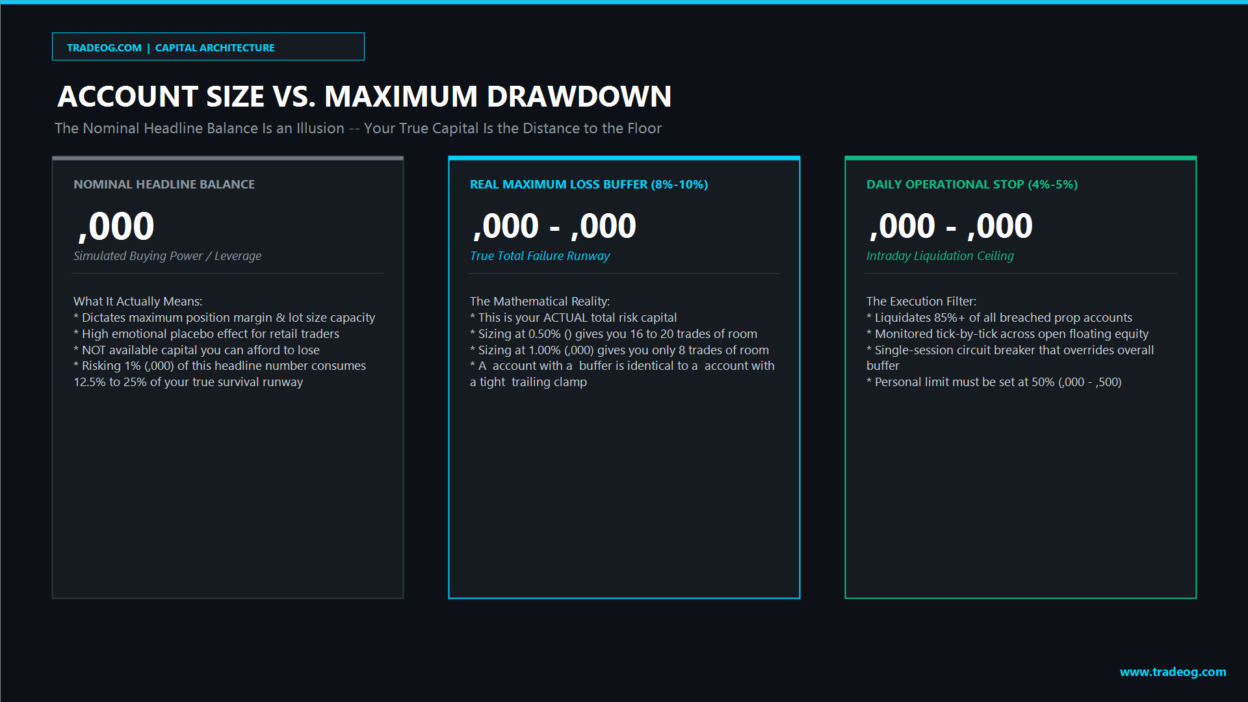
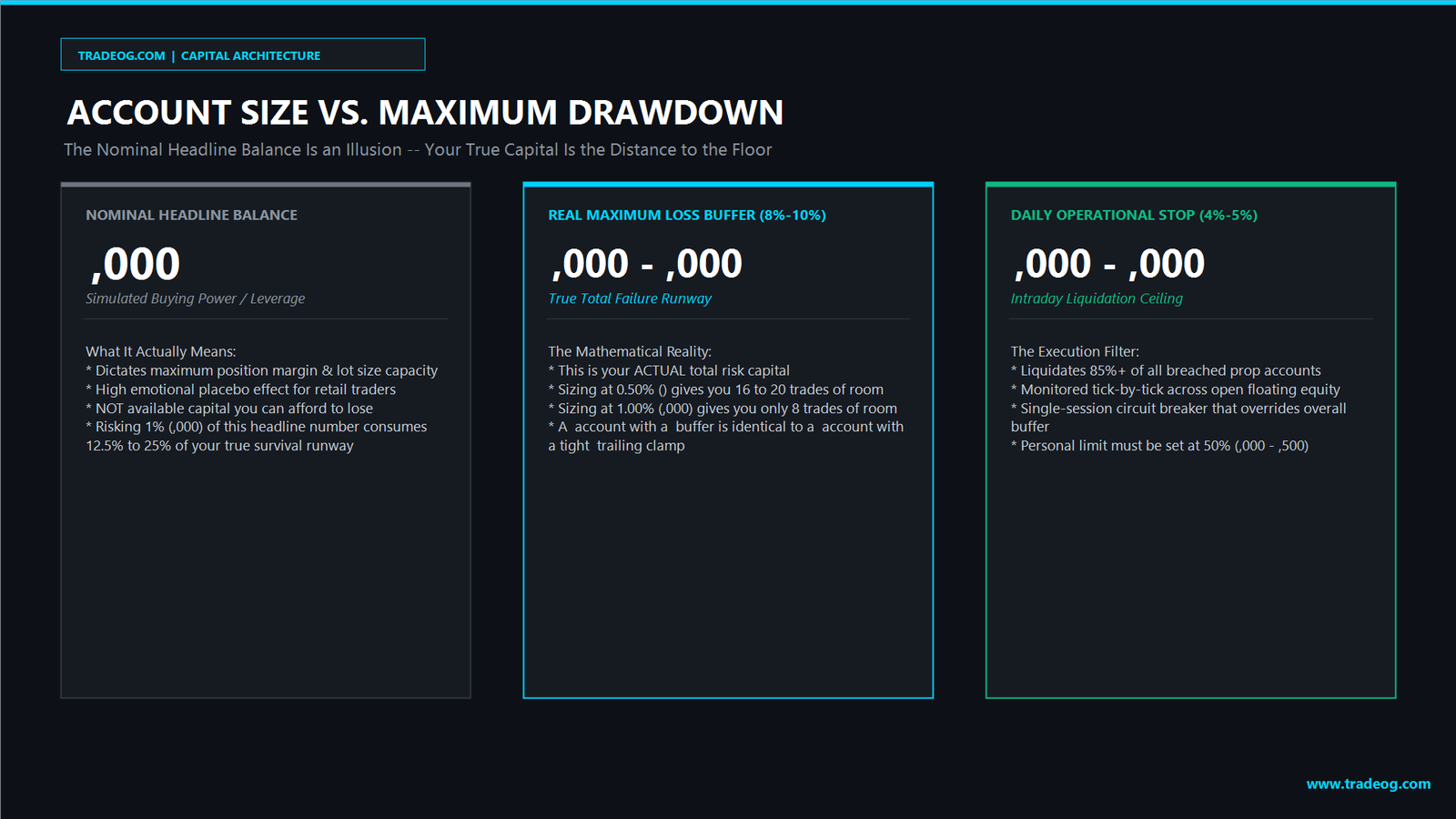
- Prop Firm Evaluation Account ($100,000 Nominal): The firm enforces an 8% to 10% Maximum Drawdown ($8,000 to $10,000) and a 4% to 5% Daily Loss Limit ($4,000 to $5,000).
The moment your live equity dips by $8,000, your account is terminated permanently. That means on a “$100,000” account, your actual total risk runway is exactly $8,000. The remaining $92,000 is simply simulated buying power provided to enable leverage.
When you risk 1% ($1,000) on a trade, you are not risking 1% of your available capital. You are risking 12.5% of your entire account lifecycle and 25% of your daily limit on a single idea.
Evaluating Cost Efficiency: The “Cost per $1,000 of Risk Capital” Matrix
When comparing different prop firms or challenge tiers, professional traders do not compare the price tag to the nominal balance. They compare the challenge fee to the dollar amount of actual drawdown protection:
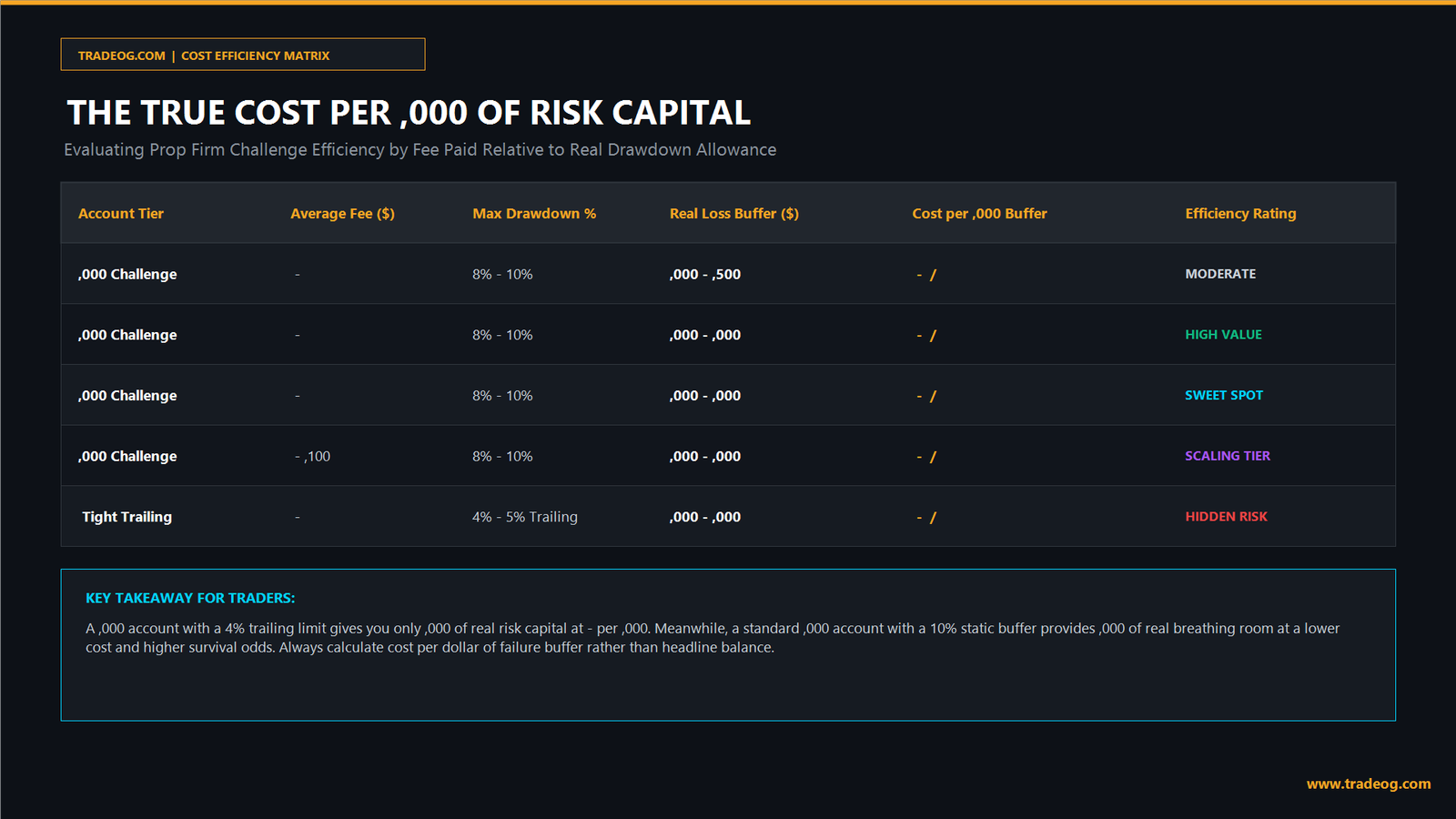
| Account Tier | Average Fee | Max Drawdown % | Real Loss Buffer ($) | True Cost per $1,000 Buffer | Efficiency Analysis |
|---|---|---|---|---|---|
| $25,000 Challenge | $150 – $200 | 8% – 10% Static | $2,000 – $2,500 | $75 – $100 / $1k | Higher relative cost, smaller error margin |
| $50,000 Challenge | $250 – $320 | 8% – 10% Static | $4,000 – $5,000 | $50 – $64 / $1k | High value for intermediate traders |
| $100,000 Challenge | $480 – $540 | 8% – 10% Static | $8,000 – $10,000 | $48 – $54 / $1k | The Industry Sweet Spot |
| $200,000 Challenge | $950 – $1,100 | 8% – 10% Static | $16,000 – $20,000 | $47 – $55 / $1k | Ideal for scaling established edges |
| $100k Tight Trailing | $300 – $380 | 4% – 5% Trailing | $4,000 – $5,000 | $75 – $95 / $1k | Hidden Risk Trap (Low price, tiny buffer) |
The “Cheap Challenge” Trap
Notice the bottom row of the table. Many budget prop firms advertise a “$100,000 Account for only $300!” It looks like an incredible bargain compared to a standard $500 fee. But when you inspect the rulebook, that account enforces a 4% intraday trailing drawdown ($4,000 buffer).
You paid $300 for a $4,000 failure buffer ($75 per $1,000 of risk). Meanwhile, a standard $50,000 account with an 8% static buffer gives you $4,000 of breathing room for $250 ($62.50 per $1,000 of risk) without a punitive trailing floor. The cheaper $100k account was actually 20% more expensive and significantly harder to survive.
Static Drawdown vs. Trailing Drawdown: Why the Model Dictates Account Value
Two accounts with identical nominal sizes and identical drawdown percentages can have drastically different survival probabilities depending on the drawdown calculation model:
A. Static Drawdown (The Gold Standard)
On a $100,000 account with a 10% static drawdown, the liquidation floor is permanently fixed at $90,000. When your account equity reaches $106,000, your distance to the floor expands to $16,000. Your buffer grows with your profitability, giving you expanding room to absorb normal losing streaks.
B. Intraday Trailing Drawdown (The Squeeze Engine)
On a $100,000 account with a 10% trailing drawdown, the floor trails your peak open equity tick-by-tick. If your trade surges to $106,000, your floor moves up to $96,000. If the trade retraces to break-even ($100,000), you have only $4,000 of remaining buffer left. Your cushion never expands—it only tightens.
Rule of Thumb: A $50,000 Static Drawdown account provides greater statistical longevity than a $100,000 Intraday Trailing account for multi-day swing and trend-following strategies.
The Buffer-First Position Sizing Blueprint
To eliminate the nominal account size bias from your execution, adopt this 4-step buffer-first sizing framework:
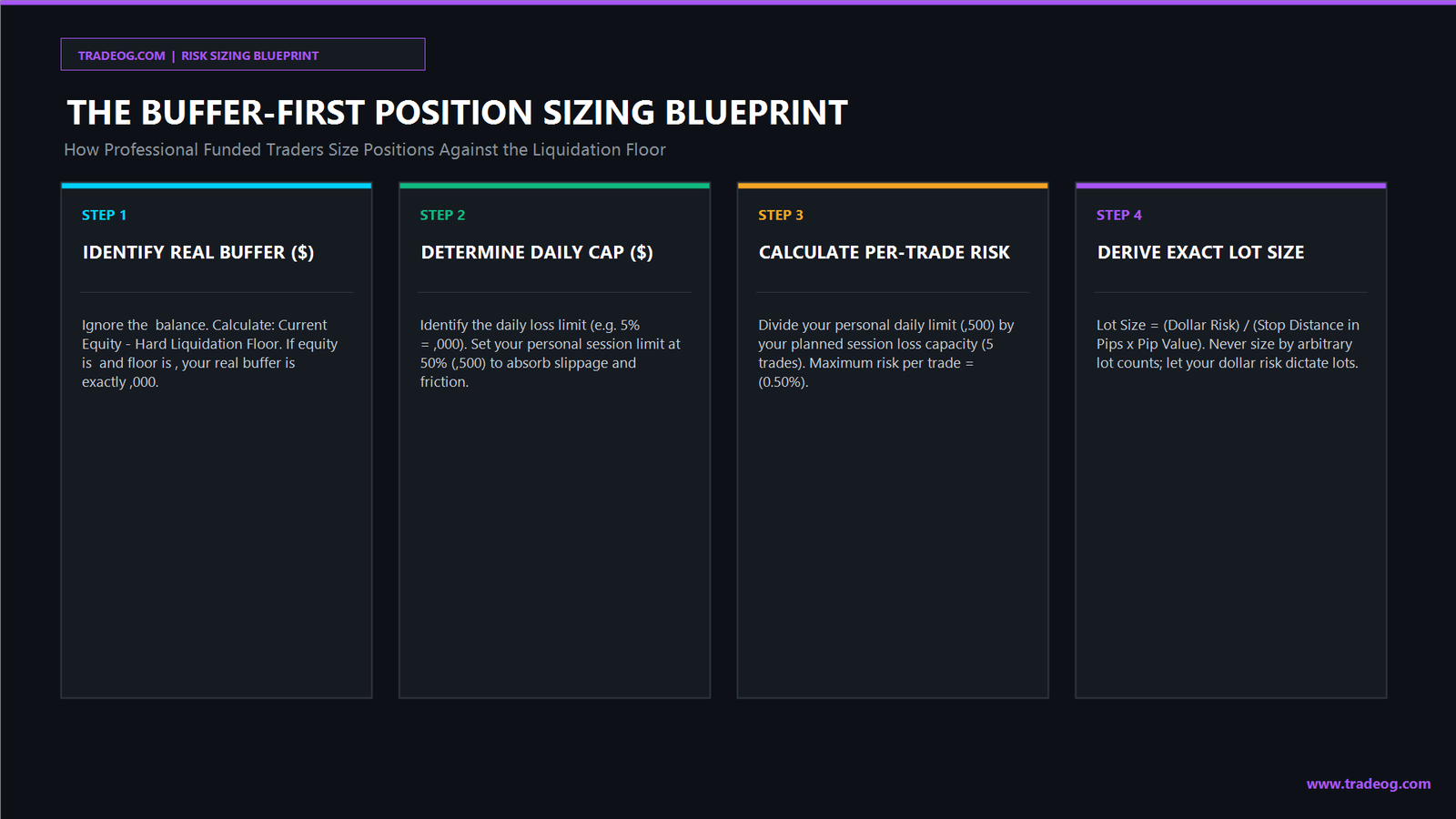
- Step 1: Calculate Your Hard Failure Runway ($): Subtract the liquidation floor from your current equity. On a $100k account with a $92k static floor, your real buffer is $8,000.
- Step 2: Establish Your Personal Session Limit ($): Identify the firm’s daily loss limit (e.g. 5% = $5,000). Set your personal circuit breaker at 50% of the firm’s limit ($2,500) to insulate against slippage, news spikes, and commissions.
- Step 3: Derive Maximum Per-Trade Dollar Risk: Divide your personal session limit ($2,500) by your planned daily loss capacity (5 consecutive trades). Your maximum risk per trade is $500 (0.50%).
- Step 4: Calculate Exact Position Lot Size:
Lot Size = Target Dollar Risk / (Stop Distance in Pips × Pip Value)Never choose a lot size first and adjust your stop loss to fit. Let your calculated dollar risk dictate the lot size.
Frequently Asked Questions (FAQ)
Should I buy a $200k account or two $100k accounts?
Purchasing two $100k accounts is almost always mathematically superior. It allows you to diversify risk, execute different strategies across accounts, or request staggered payouts. If one account experiences a drawdown streak, the second account remains completely unaffected.
Why do prop firms market nominal account sizes instead of drawdown buffers?
Psychology. Marketing a “$100,000 Account” attracts significantly more retail buyers than marketing an “$8,000 Risk Buffer Challenge.” Understanding this marketing disconnect gives you a major edge over the average retail participant.
Does higher leverage compensate for a smaller drawdown buffer?
No. High leverage only allows you to open larger lot sizes; it does not expand the dollar distance between your balance and the liquidation floor. In fact, high leverage combined with a tight drawdown buffer drastically accelerates account failure.
Summary
The next time you evaluate a prop firm challenge, ignore the headline account size. Look at the maximum drawdown buffer, check whether the floor is static or trailing, calculate your true cost per $1,000 of risk capital, and size your positions strictly against the liquidation floor. That is how funded professionals protect capital, survive statistical variance, and build consistent payout streams.

[…] Your real risk capital is $10,000, not $100,000. The remaining $90,000 is buying power leverage provided by the firm’s liquidity configuration. To dive deeper into this fundamental distinction, read our analysis on prop firm account size vs maximum drawdown: what actually matters. […]