

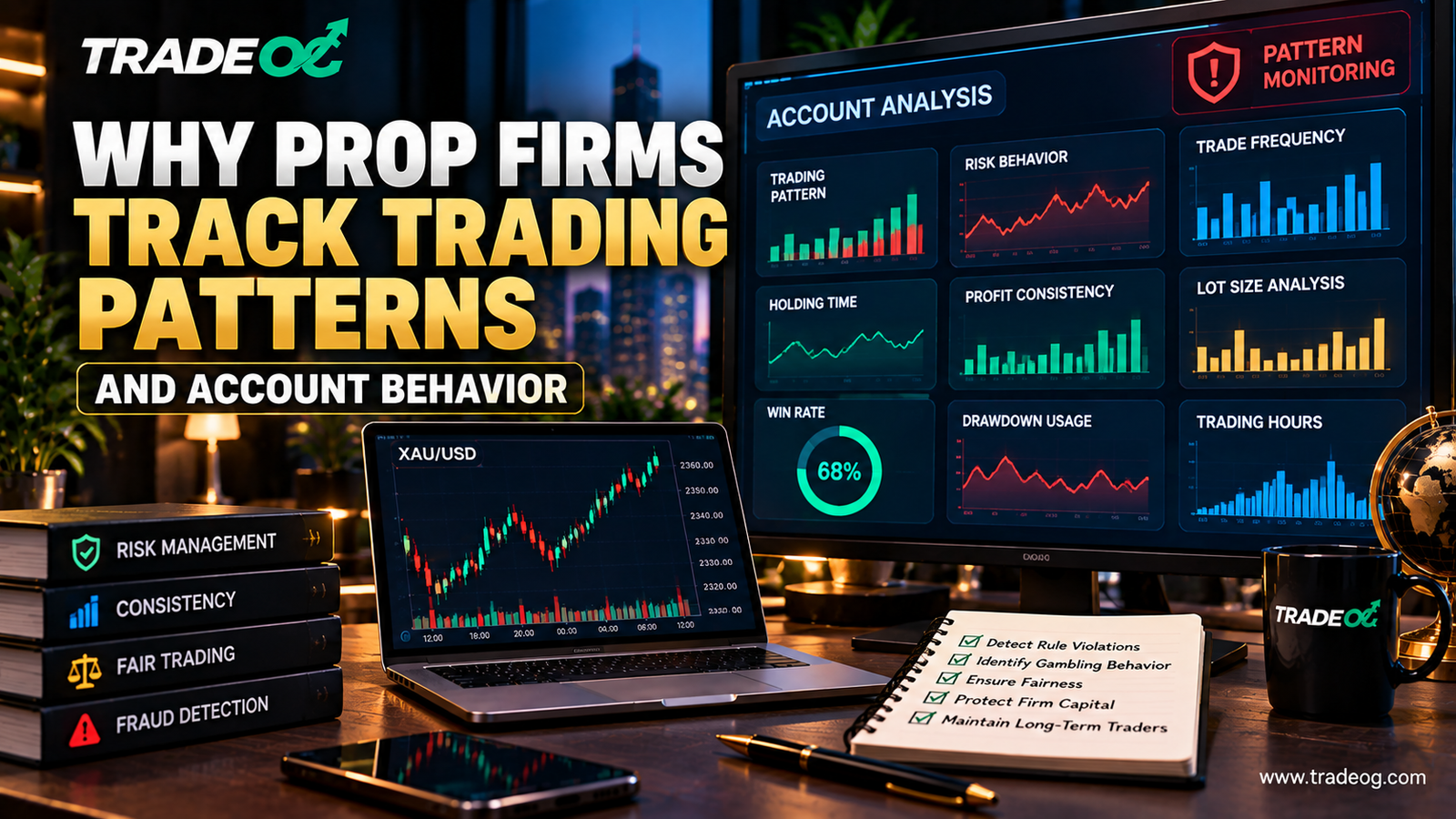
Prop firms do not look only at whether a trader makes a profit. Many firms also review how that profit was generated, including position size, trade frequency, risk changes, account-to-account activity, execution patterns and whether the strategy appears consistent with the firm’s trading rules.
This is why a trader can be profitable and still receive a review or warning. The purpose of behavioural monitoring varies by firm, but current rules from firms such as FTMO and FundedNext show a common theme: trading should be genuine, sustainable and compatible with the firm’s stated risk and market-conduct requirements.
What Do Prop Firms Mean by “Trading Patterns”?
A trading pattern is simply the way an account behaves over time. A firm may have access to data such as:
- Position size and changes in lot size
- Number of trades and order modifications
- Trade duration
- Entry and exit timing
- Risk concentration around news events
- Use of multiple accounts
- Changes between evaluation and funded stages
- Use of EAs, automated tools or trade copiers
- Very unusual winning or losing sequences
- Potential exploitation of platform or pricing behaviour
Monitoring does not automatically mean that every unusual trade is a violation. FTMO, for example, says it does not impose a universal position-size limit and acknowledges that occasional larger positions can be part of a legitimate strategy when the overall approach remains sustainable and within its rules.
Why Do Prop Firms Monitor Account Behaviour?
1. To Detect Rule Violations
The most direct reason is compliance. Firms need to identify behaviour that their terms prohibit, such as unauthorized copy trading, cross-account hedging, arbitrage, latency exploitation, account sharing or other forms of simulated-market abuse.
FundedNext currently lists prohibited practices including latency trading, arbitrage, tick scalping, grid trading, one-sided betting, cross-account hedging, account sharing and third-party copy trading.
2. To Identify Unsustainable Risk
A trader who repeatedly risks a very large portion of the account’s permitted loss in a single position may be displaying a very different behaviour from someone using controlled position sizing.
FTMO’s current behavioural guidance specifically discusses inconsistent position sizing, excessive concentration around news events and major differences between evaluation trading and later simulated-funded trading as patterns that can be relevant to sustainability.
FundedNext similarly describes gambling-style behaviour as including over-risking, repeated heavy leverage, concentrated exposure and unrealistic profit targets without sustained consistency.
3. To Protect the Integrity of the Evaluation
A prop firm challenge is designed to evaluate a trader under defined conditions. If a strategy depends on a technical error, delayed price feed, unusual execution condition or another feature that would not exist in a normal live market, the result may not represent the skill the program is intended to measure.
FTMO says traders must not exploit errors, delayed feeds or characteristics of a simulated environment that would not be present in live futures markets. FundedNext also prohibits exploitation of platform errors, slow data and other simulated-market weaknesses.
4. To Prevent Cross-Account Abuse
Multiple accounts can create additional risks for a prop firm. For example, coordinated opposite positions across accounts could reduce the trader’s overall directional exposure while shifting risk between accounts.
FTMO Futures currently prohibits coordinated hedging across accounts and also prohibits copying another trader’s decisions through signals, master accounts, trade copiers or similar arrangements. FundedNext likewise restricts cross-account hedging and unauthorized third-party copying.
What Trading Behaviours Can Trigger a Review?
| Behaviour | Why It May Matter |
|---|---|
| Sudden huge position size | May indicate concentrated or inconsistent risk. |
| Extreme trade frequency | Can resemble hyperactivity or HFT depending on the rules. |
| Opposite trades across accounts | May create prohibited cross-account hedging. |
| Copying another trader | Can violate personal-use or copy-trading rules. |
| Trading around every major news release | May be reviewed when the pattern is inconsistent with the broader strategy. |
| Exploiting price/feed delays | Can be treated as platform or latency exploitation. |
| Switching strategy after evaluation | Some firms require continuity between evaluation and funded stages. |
| Account/device sharing | Can violate identity and personal-use requirements. |
Does a Large Lot Size Automatically Mean a Violation?
No. A large position by itself does not automatically prove misconduct.
FTMO explicitly says there is no fixed universal limit for position size or reward-to-risk ratio in its CFD environment. Its focus is whether the trader remains within the Trading Objectives and whether the overall behaviour is sustainable and legitimate.
The more important issue is often the pattern. For example, a trader who normally risks a small amount and occasionally takes a larger position based on a documented strategy is different from an account that repeatedly jumps from normal position sizes to extremely large bets with the apparent goal of passing or recovering an account.
Why Prop Firms Compare Your Trading History
Historical data gives firms a broader picture than a single trade. Suppose an account normally trades XAU/USD with consistent position sizes, but suddenly begins opening extremely large positions immediately before major economic releases. The individual trade may be profitable, but the change in behaviour can still be relevant under rules concerning sustainability or news concentration.
FTMO’s current guidance specifically mentions reviewing behaviour that differs materially from a trader’s broader activity, including inconsistent position sizing, news-event concentration and differences between evaluation and simulated-funded trading.
Why XAU/USD Traders Should Pay Attention
Gold can move quickly around CPI, NFP, FOMC decisions and other major events. That can make position size, stop distance and execution behaviour change dramatically within seconds.
For example, a trader might normally trade 0.5 lots of XAU/USD and suddenly open several much larger positions immediately before a major release. The issue is not simply that the trade is large. The change may be inconsistent with the trader’s normal risk profile and could deserve additional review under a firm’s specific rules.
This is particularly important for prop firm traders because a high-volatility trade can combine several risks at once: wider spreads, slippage, rapid drawdown changes and a potentially large position relative to the account’s loss limits.
Do Prop Firms Use Automated Monitoring?
Many modern trading platforms and prop firms can analyse large amounts of account data automatically. FundedNext’s current rules say certain prohibited patterns are monitored automatically and may then be reviewed manually before action is taken.
Automated monitoring can flag unusual activity without automatically proving that a rule was broken. A review can then consider the account history, relevant rules and circumstances.
This is why traders should not assume that changing a small detail of an order will make a prohibited strategy acceptable. Firms can evaluate the broader behaviour rather than a single trade.
What About EAs and Trading Bots?
Automated trading is not automatically prohibited at every prop firm. The rules differ by firm and account type.
FTMO Futures currently allows automated trading but prohibits automated systems that manipulate or abuse the service, including high-frequency or latency-arbitrage approaches. FundedNext has its own EA conditions and states that EAs designed specifically to pass prop-firm challenges are prohibited.
The important lesson is to read the firm’s current EA policy rather than assuming “bot allowed” means every automated strategy is allowed.
What Is Account Behaviour Consistency?
Consistency does not necessarily mean taking the same trade every day. It means that your overall approach remains explainable and compatible with the program rules.
A consistent trader can still have winning and losing days, different trade durations and different position sizes. The concern arises when behaviour becomes materially different in a way that suggests excessive risk, rule circumvention or reliance on a feature of the simulated environment.
How Indian Traders Can Avoid Unnecessary Problems
- Use a defined risk model. Know your maximum risk before entering a trade.
- Avoid sudden all-in trades. Do not try to pass or recover an account through one oversized position.
- Keep accounts separate. Do not coordinate opposite trades between accounts unless the firm’s rules explicitly permit the activity.
- Do not share accounts. Use your own login, device and trading access according to the firm’s terms.
- Check news rules. Especially if you trade XAU/USD around CPI, NFP or FOMC.
- Read EA rules. Automation policies can differ by platform and account size.
- Keep your strategy explainable. Your trades should reflect a genuine trading process rather than an attempt to exploit the challenge.
- Save the current rules. Prop firm policies can change, so review the official terms applicable to your account.
Does Prop Firm Monitoring Mean They Are Watching Every Trader?
Monitoring should be understood as analysis of trading and account data against the firm’s rules and risk framework. It does not mean that every normal trade is treated as suspicious.
FTMO says its monitoring is focused on behaviour that conflicts with professionalism and long-term sustainability, rather than imposing a universal risk limit on every trader.
For traders, the practical takeaway is straightforward: trade in a way that would make sense as a repeatable strategy under real market conditions and stay within the exact rules of your account.
Final Takeaway
Prop firms track trading patterns because the way an account generates results can matter as much as the final profit number. Position sizing, trade frequency, account relationships, automation, news concentration and unusual execution patterns can help firms identify whether activity fits their rules and intended trading environment.
A profitable account is not automatically a compliant account, and an unusual trade is not automatically a violation. What matters is the firm’s current rulebook, the complete trading pattern and whether the behaviour is consistent with legitimate, sustainable trading.
For Indian traders, the safest practical approach is to understand the rules before trading, use controlled risk, avoid account coordination or platform exploitation, and keep your trading behaviour consistent with the strategy you intend to use long term.
Official sources: FTMO: Why FTMO Monitors Trading Behaviour, FTMO Futures Forbidden Trading Practices, FundedNext Restricted & Prohibited Strategies, and FundedNext CFD General Rules.
Prop firm rules can change. Always check the current terms for your specific account before trading.

[…] For related TradeOG guides, read Prop Firm Profit Split Explained, Can You Withdraw Profit Before Completing a Scaling Step?, and Why Prop Firms Track Trading Patterns and Account Behavior. […]