
A winning trade feels like confirmation. The setup worked, the account moved higher, and confidence increases. For some traders, that confidence quickly turns into a decision to trade more contracts on the next position.
The thinking can sound reasonable:
- “I am reading the market correctly.”
- “This setup is working.”
- “I have some profit to protect.”
- “I can afford to risk more now.”
- “I am on a hot streak.”
But increasing position size after a winning trade changes the risk profile of the next trade. If the next trade loses, the trader may give back a large portion of the previous gain or create a loss that is larger than the normal strategy risk.
This behaviour is especially important for futures and prop firm traders because contract size directly changes dollar exposure. CME Group explains that the number of futures contracts increases market exposure and that contract count should be based on risk scenarios rather than simply the maximum number permitted by margin requirements. CME Group — Position and Risk Management.
So why does this happen, and what can traders do about it?
Why Winning Trades Can Lead to Bigger Position Sizes
Increasing size after a win is not caused by one single psychological factor. It can result from overconfidence, profit-protection thinking, the desire to capitalize on momentum, changes in perceived risk, recent performance, or a belief that previous gains are somehow less valuable than the original capital.
Research on overconfidence in trading has found a relationship between relatively larger position sizes and poorer trade timing, making position size an important behaviour to monitor when studying overconfidence. Research on Overconfidence, Position Size and Trading Performance.
For a trader, the key issue is not whether confidence is good or bad. Confidence can help a trader execute a tested plan. The problem begins when confidence changes the risk parameters of the plan without supporting evidence.
1. Overconfidence After a Winning Trade
The most obvious explanation is overconfidence.
A trader wins a trade and interprets the outcome as evidence that their market reading is unusually accurate.
For example:
Trade 1: 1 contract → +1R
The trader then thinks:
“The market is behaving exactly as I expected.”
Instead of taking the next trade with the same predefined risk, they increase to two contracts.
The problem is that a winning outcome does not necessarily prove that the trader has better information about the next market movement.
The trade may have worked because:
- the setup had positive expectancy;
- market conditions happened to favour the setup;
- the entry was well timed;
- random variation produced a favourable outcome.
One successful outcome does not automatically justify a larger position.
2. The “Hot Hand” Feeling
After several winning trades, some traders begin to believe that they are in a special period where their decisions are more likely to work.
The internal narrative becomes:
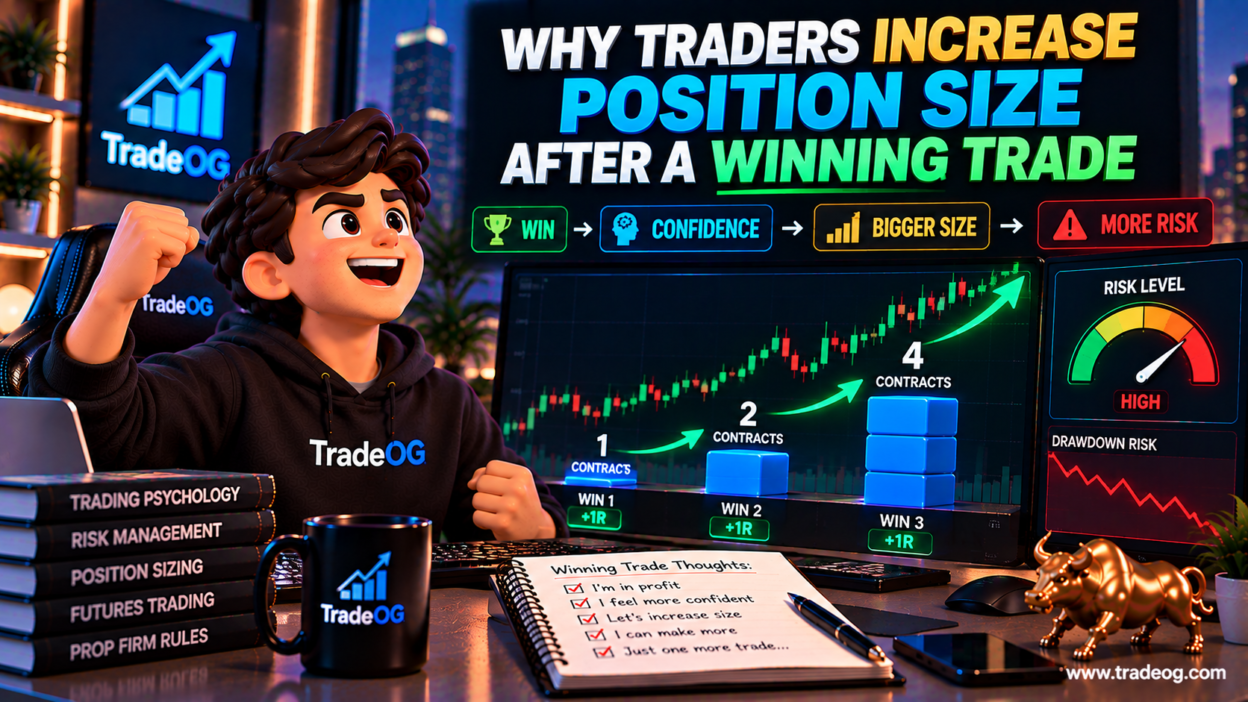
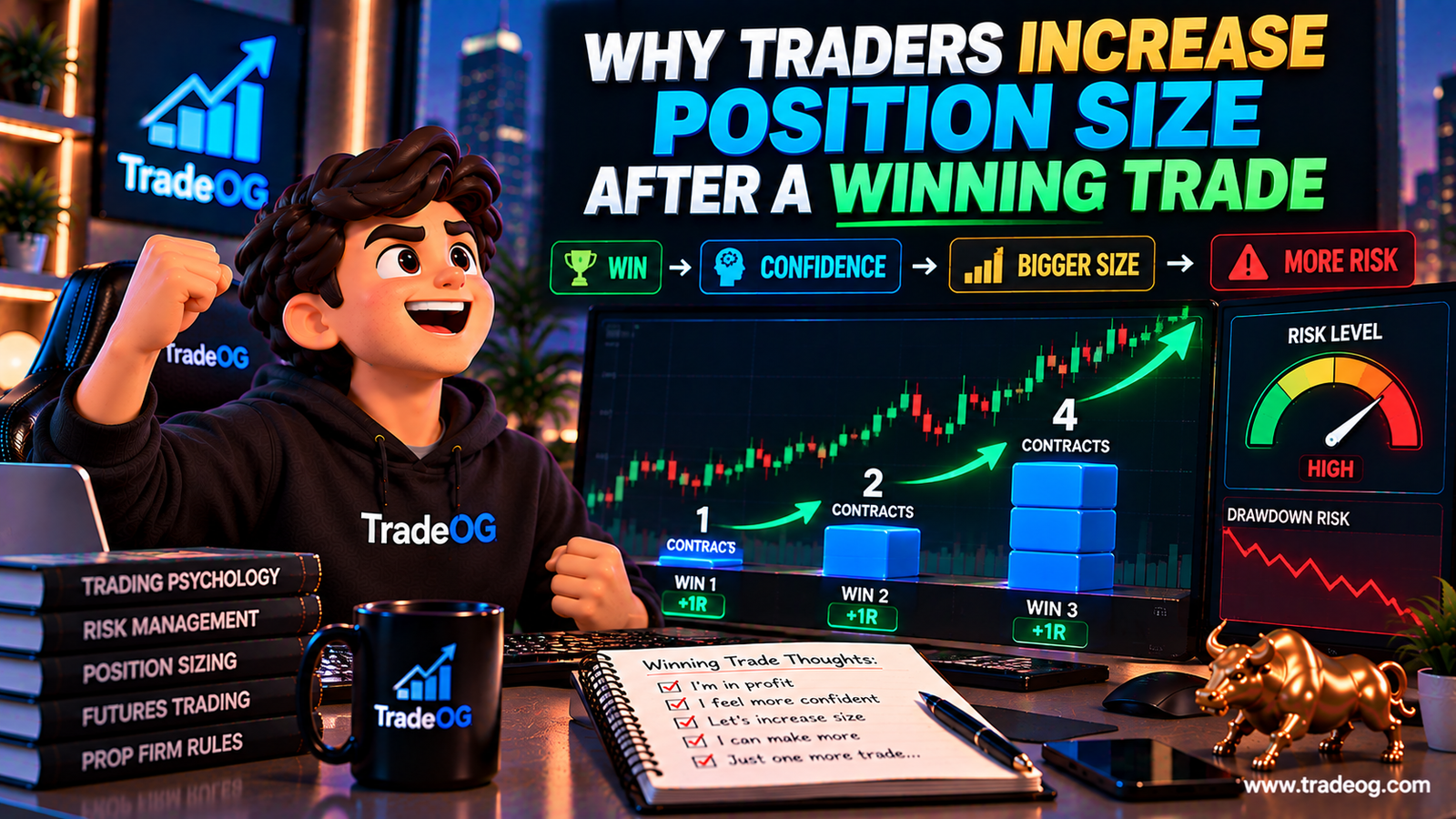
Win → confidence → larger size → another win → even more confidence.
This can create a feedback loop.
The danger is that the size increase itself can make the next loss disproportionately important.
A trader who normally risks $100 may decide to risk $200 after a winning trade. If the next trade loses, the trader has not simply lost one normal unit of risk. The trader has changed the statistical distribution of results.
3. “I Am Trading With House Money”
Another common thought is:
“I already made $500 today, so I can risk $300 on the next trade.”
The psychological separation between original capital and recent profit can make the profit feel less valuable.
But once profit is credited to the account, it is part of the account equity.
From a risk-management perspective, the source of the money does not make a future loss less real.
If a trader starts the session at $50,000, makes $500, and then increases size so that the next trade risks $500, the second trade can erase the entire session gain.
The account does not know whether the $500 being lost was “original money” or “profit money.”
4. Profit Target Pressure Can Encourage Size Increases
Prop firm traders can experience another version of this behaviour.
Suppose a trader is approaching a hypothetical profit target:
- Starting balance: $50,000
- Current balance: $52,000
- Target: $53,000
The trader may think:
“I am close. I can increase size and finish faster.”
This is where a previously consistent strategy can suddenly become inconsistent.
The trader may double position size, reduce the required confirmation, take more setups, or trade outside the normal session.
The objective has changed from executing the strategy to reaching a number.
That distinction matters because prop firm rules can include drawdown and loss limits that continue to apply regardless of how close the trader is to a target.
5. Recent Profits Change Perceived Risk
A winning trade can make the next trade feel safer than it actually is.
Consider two identical setups:
Setup A: taken after a $500 loss.
Setup B: taken after a $500 gain.
The market setup may be identical, but the trader’s perception can be completely different.
After the gain, the trader may perceive more room for error.
This is a psychological change in perceived risk, not necessarily a change in actual market risk.
6. Traders Want to Capitalize on Momentum
Sometimes the position-size increase is not purely emotional.
A trader may observe a strong trend and conclude that the market is offering an unusually attractive opportunity.
The reasoning is:
“The market is moving strongly, so I should increase size while the opportunity is there.”
That can be a legitimate strategy decision if larger size is part of a tested volatility or signal-based model.
The problem occurs when the size increase is discretionary and has not been tested.
There is a major difference between:
Rule-based sizing: “When volatility and setup quality meet predefined criteria, risk changes from X to Y.”
and:
Emotion-based sizing: “I just won, so this next trade looks even better.”
The first can be tested. The second is difficult to measure and often changes with mood.
7. Winning Makes Traders Forget Their Normal Risk Limits
Risk rules are easiest to follow when the trader is uncomfortable.
After a loss, many traders become cautious.
After a win, caution can disappear.
A trader who normally uses one Micro contract may move to two or four because the previous trade worked.
This is why position-size rules should be written down rather than remembered emotionally.
CME’s position-sizing guidance emphasizes determining position size from the stop location and the dollar or percentage amount the trader is willing to risk. CME Group — Proper Position Size.
8. The Position Size Increase Can Be Larger Than the Trader Realizes
Moving from one to two contracts feels like a small change.
Mathematically, however, it can represent a 100% increase in exposure.
| Contracts | Risk Per Contract | Total Planned Risk |
|---|---|---|
| 1 | $100 | $100 |
| 2 | $100 | $200 |
| 3 | $100 | $300 |
| 4 | $100 | $400 |
The market has not become more predictable simply because the previous trade won.
The dollar consequence of the next loss has increased.
9. Futures Traders Need to Think in Contract Risk
Futures position sizing is particularly sensitive to contract specifications.
Different contracts have different point and tick values, so the same number of contracts can represent very different dollar exposure.
CME notes that different futures markets can have different volatility and tick values, and that traders should consider those characteristics when selecting contracts and position size. CME Group — Position and Risk Management.
For example, moving from one Micro contract to two Micros doubles exposure. Moving from a Micro contract to a Mini can increase exposure much more substantially, depending on the product.
Therefore, “I only increased by one contract” is not a sufficient risk analysis.
10. Prop Firm Drawdown Makes the Problem More Important
Prop firm traders do not usually have unlimited room for variance.
A trader can have a profitable trade, increase size, take one loss, and suddenly give back a large percentage of the available drawdown.
The relevant number is not simply the account’s advertised size.
The trader should monitor:
- current equity;
- remaining drawdown;
- daily loss limit;
- maximum loss threshold;
- current position risk;
- open floating P&L.
A winning trade can increase account equity while simultaneously creating overconfidence. If the trader responds by increasing size too aggressively, the additional exposure can consume the newly created cushion quickly.
11. The “Give Back” Problem
Imagine a trader begins the day at $50,000.
They make:
Trade 1: +$400
Now they are at $50,400.
They increase size.
Trade 2: -$400
Now they are back at $50,000.
Emotionally, the second result can feel much worse than a normal $400 loss because the trader experiences it as giving back a win.
This can lead to another mistake:
“I need to get that $400 back.”
Now the trader can enter a revenge cycle.
The original mistake was not necessarily the losing trade. It was the decision to increase risk because the previous trade won.
12. Why One Bigger Loss Can Erase Several Smaller Wins
Suppose a trader normally risks $100.
They make five consecutive +$100 trades:
+$500 total.
Then they increase position size and risk $500 on one trade.
A single loss can erase all five previous gains.
This is why consistent position sizing matters.
Winning streaks should not automatically cause risk to accelerate faster than account growth.
13. Position Size Should Usually Follow a Rule, Not a Feeling
A trader can use several systematic approaches to position sizing.
Fixed-dollar risk
Example:
Maximum planned risk = $150 per trade.
The trader calculates contract quantity based on stop distance and contract value.
Fixed-percentage risk
Example:
Maximum planned risk = 0.5% of the defined risk base.
If the risk base changes, the dollar risk changes according to the predefined formula.
Volatility-adjusted risk
The trader changes position size according to a predefined volatility model.
This can be systematic, but it needs to be tested.
The key point is that none of these methods says:
“Increase size because the previous trade was profitable.”
14. Fixed Risk Can Prevent Emotional Size Changes
Suppose a trader defines a maximum risk of $200.
The next trade can produce:
- +$400;
- -$200;
- +$100;
- -$200.
The risk rule remains $200.
This makes the result distribution easier to evaluate because one winning trade does not change the risk on the next trade.
CME’s risk-management material emphasizes predefined loss parameters and adherence to those parameters. CME Group — The 2% Rule.
The exact percentage or dollar amount is not universal. The important principle is consistency with the trader’s tested plan and account constraints.
15. Winning Streaks Can Create a False Sense of Skill
A short winning streak can be caused by a combination of:
- strategy edge;
- favourable market regime;
- good execution;
- random variation.
The trader sees only the outcome.
That can produce an exaggerated perception of skill.
For example, a strategy with a 50% win rate can produce four or five consecutive wins. The streak is exciting, but it does not mean the next trade has a higher probability of winning simply because the previous trades won.
This is one reason why position sizing should be based on the strategy’s long-run characteristics rather than a handful of recent outcomes.
16. The “I Have Earned the Right to Risk More” Mentality
Another common thought is:
“I followed my plan and earned $1,000, so I can take more risk now.”
The problem is that the first trade and second trade are separate events.
The profit does not automatically increase the probability of success on the next setup.
If the trading plan allows risk to increase after reaching a specific equity milestone, that is different. The increase is then part of a predefined system.
If the increase happens because the trader feels they have earned it, the rule is emotional rather than systematic.
17. Overconfidence Can Affect Entry Quality Too
Position size is not the only thing that changes after a win.
Confidence can also affect:
- entry timing;
- stop placement;
- target selection;
- trade frequency;
- confirmation requirements.
A trader who feels unusually confident may enter earlier because they believe they can anticipate the move.
That can create a dangerous combination:
Bigger size + weaker confirmation + wider exposure.
This is more important than position size alone.
18. How to Detect Post-Win Position Sizing
Your trading journal can answer this objectively.
Add a field called:
Position size after previous trade
Then compare the size after:
- a winning trade;
- a losing trade;
- a breakeven trade.
For example:
| Previous Result | Average Next Position |
|---|---|
| Win | 3.2 contracts |
| Loss | 1.8 contracts |
| Breakeven | 2.0 contracts |
If the pattern persists across a meaningful sample, it may indicate that recent outcomes are influencing position size.
This is much more useful than relying on memory.
19. Track “Risk After Win” Separately
Another useful journal metric is:
Next-trade risk after a win ÷ normal planned risk.
If normal risk is $200:
- $200 after a win = 1.0× normal risk
- $250 after a win = 1.25×
- $300 after a win = 1.5×
- $400 after a win = 2.0×
Now the behaviour becomes measurable.
20. Winning Trade Followed by Larger Size: Example
Consider a hypothetical futures trader.
| Trade | Size | Result | Next Decision |
|---|---|---|---|
| 1 | 1 Micro | +1R | Increase to 2 |
| 2 | 2 Micros | +1R | Increase to 4 |
| 3 | 4 Micros | -1R | Keep 4 |
| 4 | 4 Micros | -1R | Increase to 6 to recover |
The problem is not that the trader had a winning streak.
The problem is that position size became dependent on recent results.
At trade four, the behaviour has moved from confidence to potential loss-chasing.
21. Winning Streak vs Position-Size Escalation
These are not the same thing.
A trader can have a winning streak while maintaining identical risk.
For example:
- Trade 1: +1R, risk 0.5%
- Trade 2: +1R, risk 0.5%
- Trade 3: +2R, risk 0.5%
- Trade 4: +1R, risk 0.5%
The trader’s confidence may increase, but the risk model does not change.
That allows the performance data to remain comparable.
22. When Increasing Size After a Win Can Be Systematic
There are situations where a larger position after a winning trade may be completely rule-based.
For example, a strategy could specify:
- increase risk after the account reaches a predefined equity level;
- increase size only when volatility falls within a tested range;
- increase size after a portfolio-level signal;
- use a predefined compounding formula.
In these cases, the size increase is not based solely on the fact that the previous trade won.
The important distinction is causal rule vs recent emotional outcome.
23. Compounding Is Different From Emotional Oversizing
Compounding can legitimately increase position size as account equity changes.
Suppose a strategy risks a fixed percentage of equity and the account grows. The dollar amount at risk may increase gradually.
That is different from saying:
“I won the last trade, so I will double my contracts on this trade.”
Compounding follows a formula.
Emotional oversizing follows a feeling.
24. The Difference Between Confidence and Overconfidence
Confidence: “I know my setup and I will execute it according to plan.”
Overconfidence: “My last trades worked, so I can take more risk than my plan allows.”
Confidence can improve discipline.
Overconfidence can weaken risk controls.
The objective is not to eliminate confidence. It is to prevent confidence from changing the risk model without evidence.
25. A Simple Post-Win Position-Size Rule
A practical rule can be:
The next trade uses the same predefined risk unless a documented sizing rule says otherwise.
This removes the decision from the emotional part of the trading process.
After a win, the trader does not need to decide whether they “feel confident enough” to increase size.
The plan decides.
26. Review Your Last 50–100 Trades
To determine whether this behaviour actually exists, review a meaningful sample of trades rather than a few memorable winners.
Record:
- previous trade result;
- next trade size;
- next trade risk;
- next trade result;
- setup quality;
- market condition.
Then compare average position size after wins and losses.
For example:
| Condition | Average Risk | Average Result |
|---|---|---|
| After win | 0.72% | -0.08R |
| After loss | 0.48% | +0.21R |
| After breakeven | 0.50% | +0.04R |
This is only a hypothetical example, but it illustrates the kind of analysis a trading journal can provide.
27. Review Position Size Relative to Remaining Drawdown
For prop traders, position size should also be evaluated against remaining drawdown.
Suppose:
- remaining drawdown = $1,500;
- normal trade risk = $150;
- post-win trade risk = $300.
The second risk level consumes twice as much of the available drawdown per stopped trade.
The previous win does not change that arithmetic.
Therefore, the correct question is not:
“How much profit did I just make?”
It is:
“How much of my remaining risk budget does this position consume?”
28. Winning Trades Can Cause Risk Creep
Risk creep occurs when position size gradually increases without a formal decision.
It can look like:
- 1 contract;
- 1 contract;
- 2 contracts;
- 2 contracts;
- 3 contracts;
- 4 contracts.
At each individual step, the increase may seem small.
Across the entire sequence, however, exposure can become dramatically larger than the original plan.
Journal-based limits can catch this before it becomes a serious problem.
29. What to Do After a Winning Trade
Instead of immediately thinking about the next trade’s size, run a short checklist.
- Was the previous trade executed correctly?
- Did the setup meet the written criteria?
- Is the next setup independent of the previous result?
- What is the predefined risk?
- How many contracts does that risk allow?
- Where is the invalidation point?
- What is the remaining drawdown?
- Are there any relevant market or firm restrictions?
If the answer to the risk question is already written in the plan, there is no need to negotiate with yourself.
30. A Winning Trade Should Not Rewrite the Strategy
The same principle that applies after losses applies after wins.
Do not change a strategy based on a tiny sample.
One winning trade does not prove the strategy is suddenly better.
One losing trade does not prove it is suddenly worse.
The purpose of a trading system is to create a repeatable process across many observations.
31. Five Warning Signs of Post-Win Oversizing
- You think about size immediately after closing a winner.
- You describe the next trade as “easy money.”
- You increase contracts without changing the stop or risk calculation.
- You use recent profits as the reason for taking more risk.
- You cannot explain the size increase using a written rule.
If several of these occur repeatedly, record the behaviour in your journal.
32. A Practical Position-Size Framework for Prop Traders
A simple framework is:
Maximum dollar risk ÷ dollar risk per contract = maximum contracts
Where:
Dollar risk per contract = stop distance × dollar value per point
Then apply the smaller of:
- your risk-based contract limit;
- the prop firm’s current contract limit;
- your personal maximum exposure.
CME’s position-sizing material similarly starts with the stop location and the amount of account capital the trader is willing to risk. CME Group — Proper Position Size.
33. Example With a Futures Prop Account
Consider a hypothetical trader with a predefined maximum risk of $200.
The setup has a stop distance that creates $100 risk per Micro contract.
The formula gives:
$200 ÷ $100 = 2 Micro contracts
The trader wins the previous trade by $400.
The next trade still has a $200 risk budget.
Therefore, the size remains two contracts unless the written strategy contains a separate rule that changes the risk budget.
The previous $400 win does not change the stop distance or contract value.
34. Why Consistency Makes Your Data More Useful
If position size changes randomly after wins, your journal becomes harder to interpret.
Suppose one trade risks $100, another $200, another $350, and another $150.
When performance changes, it becomes difficult to determine whether:
- the strategy changed;
- the market changed;
- position size changed;
- execution changed.
Consistent risk creates cleaner data.
Cleaner data makes strategy evaluation easier.
35. Do Not Confuse More Contracts With Better Trading
More contracts can increase profit when the market moves favourably.
They can also increase losses when the market moves against the position.
CME explicitly notes that trading more contracts increases market exposure and that contract count should be selected according to risk scenarios rather than maximum permitted margin. CME Group — Position and Risk Management.
Therefore:
More size is not more skill.
It is more exposure.
36. How to Build a Post-Win Journal Metric
Add these columns to your trading journal:
| Column | Purpose |
|---|---|
| Previous Result | Win, loss or breakeven |
| Current Size | Contracts/shares/lots |
| Planned Risk | Normal risk budget |
| Actual Risk | Risk actually taken |
| Size Change | Increase/decrease from previous trade |
| Reason for Change | Rule-based or discretionary |
| Setup Quality | Normal classification |
| Current Drawdown | Available risk cushion |
After 50–100 trades, review whether winning trades consistently lead to larger positions.
37. What If the Trader Actually Performs Better With Larger Size?
That possibility should not be dismissed.
If a trader’s data shows that a particular size performs better, the correct response is not to automatically increase size after every win.
Instead:
- define the larger size objectively;
- test it across a meaningful sample;
- measure drawdown;
- measure expectancy;
- measure execution quality;
- evaluate whether it remains compatible with account rules;
- write the new sizing rule into the trading plan.
That converts a behavioural observation into a testable hypothesis.
38. A Better Mental Model: Every Trade Starts Fresh
A useful mental model is:
The previous trade is information, not permission.
A winning trade can tell you that the previous setup worked.
It does not automatically tell you that the next setup deserves more capital.
The next position should be evaluated using its own setup, stop, volatility, risk budget and account constraints.
39. Winning Streaks and the Risk of Giving Back Gains
A winning streak can create a large psychological temptation to protect the feeling of being right.
The trader may respond by:
- increasing size to accelerate profits;
- taking more trades;
- holding longer;
- loosening entry criteria;
- moving stops.
These changes can make the final trade of a winning streak much larger than the first.
The resulting loss can therefore be disproportionately large compared with the earlier wins.
40. The Main Lesson for Prop Traders
Winning trades should increase confidence in the process only when the process was followed.
They should not automatically increase the risk assigned to the next trade.
A prop trader should know before entering:
- maximum planned risk;
- position size;
- stop location;
- remaining drawdown;
- daily loss constraints;
- product-specific limits;
- conditions under which size can change.
If those variables are predefined, the emotional impact of the previous trade becomes less important.
Final Takeaway
Why do traders increase position size after a winning trade?
Usually because a win changes perception.
Confidence rises. Risk feels smaller. Recent profits feel available to risk. The trader may believe they are in a hot streak or that the next opportunity deserves more exposure.
But the market does not owe the trader another winner because the previous trade was profitable.
For futures and prop traders, the better approach is to separate confidence from position sizing. Let the trading plan determine size through predefined risk, stop distance, contract value, volatility and account constraints.
As CME explains, position size should be tied to risk scenarios, while proper position sizing begins with the stop and the amount of capital the trader is willing to risk. CME Group — Proper Position Size.
The goal is not to stop winning trades from increasing your account. The goal is to prevent one winning trade from changing your risk model without a tested reason.
A win should improve your confidence in your process—not automatically increase your exposure.
FAQs
Why do traders increase position size after a win?
Common reasons include overconfidence, a hot-hand feeling, profit-target pressure, the belief that recent profits can be risked, and the desire to capitalize on perceived momentum. The behaviour becomes risky when the size increase is not part of a predefined and tested rule.
Is increasing position size after a winning trade always wrong?
No. A systematic strategy may increase size based on equity, volatility or another predefined condition. The key distinction is whether the change follows a documented rule or is simply a reaction to the previous outcome.
Should I increase my futures contracts after a winning trade?
Do not use the previous win by itself as the reason to increase contracts. Calculate position size from the predefined risk budget, stop distance, contract value and applicable account rules.
What is overconfidence in trading?
Overconfidence occurs when a trader’s perceived ability or certainty becomes greater than the evidence supports. In practice, it can appear as larger positions, weaker confirmation, more frequent trades or greater willingness to ignore risk limits.
How can I tell if I increase size after wins?
Add the previous trade result and current position size to your journal. After a meaningful sample, compare average position size following wins, losses and breakeven trades.
Can a winning streak cause a prop firm breach?
Indirectly, yes. The winning streak itself is not necessarily the issue. The risk increase that follows it can create larger losses, and those losses may interact with the account’s drawdown or daily loss rules.
Should position size stay constant forever?
Not necessarily. A tested risk model may adjust size as account equity, volatility or other predefined variables change. The adjustment should be systematic rather than driven solely by the last trade’s outcome.
What should I do immediately after a winning trade?
Reset mentally, review whether the trade followed the plan, and evaluate the next setup independently. Then apply the predefined position-sizing formula rather than negotiating size based on how confident you feel.
TradeOG note: Futures contract specifications, prop firm rules, drawdown limits, position limits and permitted trading practices can vary by product, firm and account type and can change over time. Always verify the current official rules for your specific account before trading.