

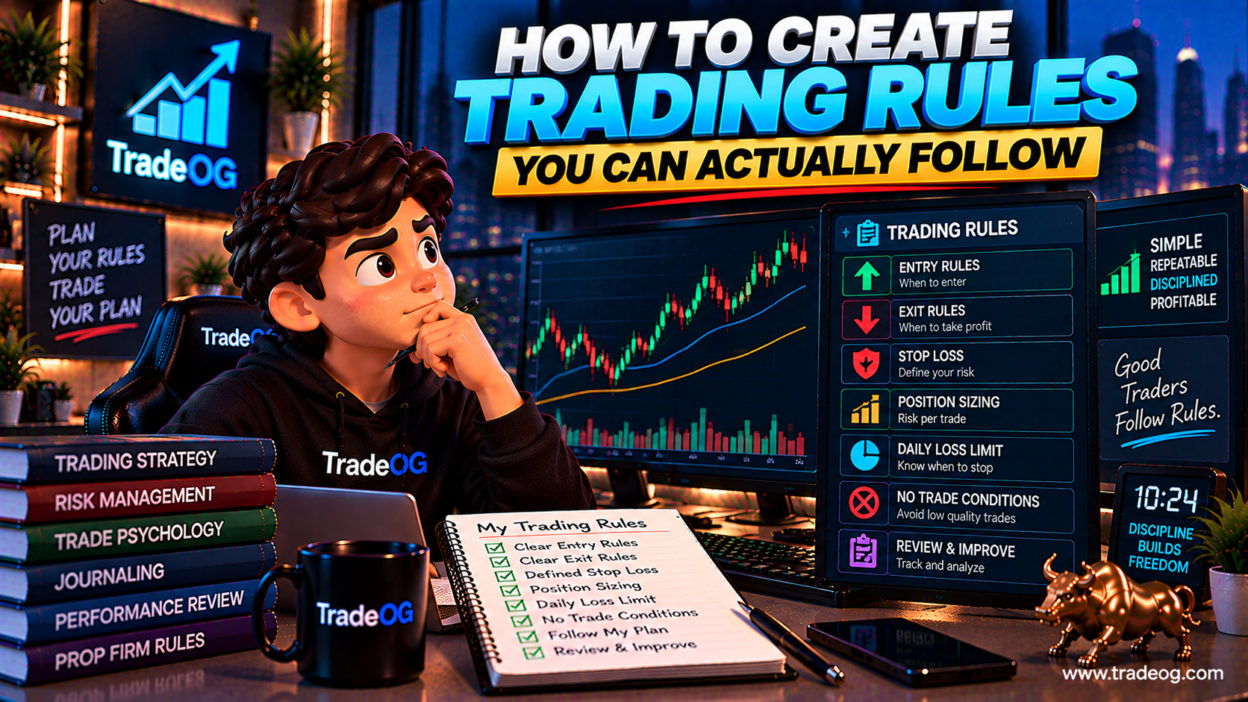
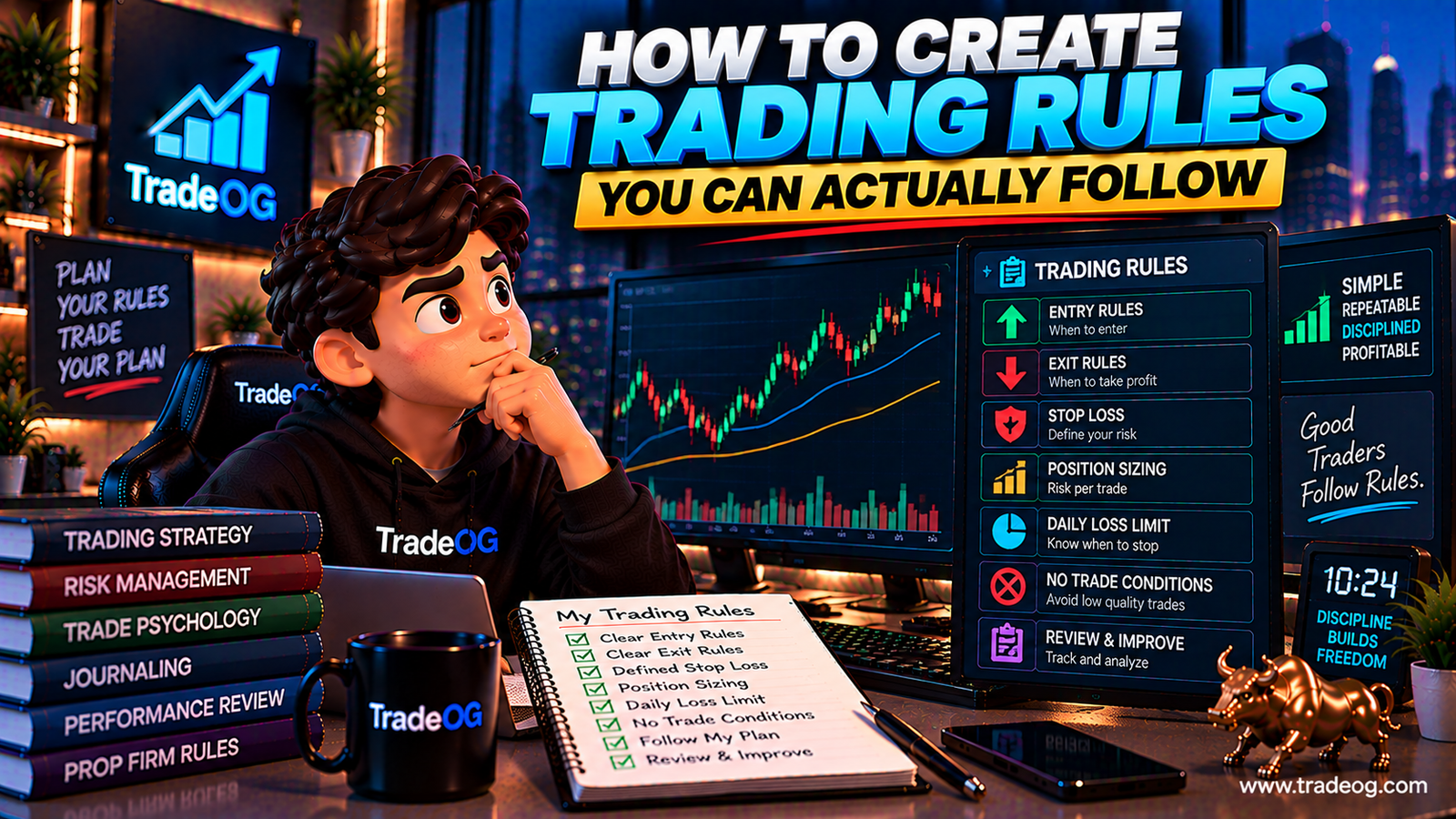
Trading rules sound simple until you try to follow them in a fast-moving market. A rule such as “do not overtrade” is easy to write but difficult to execute. A rule such as “risk less after a losing streak” can also become vague if you have not defined exactly when the reduction happens, how much size changes, and when normal size returns.
The difference between having trading rules and having usable trading rules is implementation. A good rule should be clear before the trade, observable while the trade is developing, realistic enough to follow under pressure, and measurable afterward.
For futures traders, this matters because leverage and contract specifications can make a small change in position size materially change dollar exposure. CME Group’s trading-plan material recommends defining objectives, methodology, risk management, trading strategies and a trader log, while its risk-management guidance emphasizes defining maximum trade loss, maximum day loss and other risk parameters before trading. CME Group — Building a Trade Plan and CME Group — Risk Management and Your Trade Plan
This guide explains how to create trading rules that are specific enough to execute, simple enough to remember, and structured enough to review.
What Makes a Trading Rule Actually Followable?
A practical trading rule has five characteristics:
- Specific: it says exactly what should happen.
- Observable: you can determine whether the condition exists.
- Actionable: it tells you what to do.
- Time-bound: when relevant, it defines the session or timeframe.
- Measurable: you can later determine whether you followed it.
Compare these two examples:
Weak: “Avoid bad trades.”
Stronger: “Do not enter unless the setup’s predefined entry trigger has completed and the stop and position size have been calculated before the order is submitted.”
The second rule is not necessarily a profitable strategy by itself. Its advantage is that you can test whether you followed it.
Trading Rules vs Trading Strategy
A trading strategy explains how a particular trade is identified and managed. Trading rules can be broader and include behavior, risk, schedule and operational constraints.
| Category | Example Rule |
|---|---|
| Market selection | Trade only predefined futures contracts. |
| Session | Trade only during a specified time window. |
| Entry | Enter only after the defined setup trigger. |
| Stop | Place the stop at the predefined invalidation level. |
| Position size | Calculate contracts from maximum planned risk. |
| Daily risk | Stop trading after the personal daily loss threshold. |
| Behavior | Do not increase size to recover a loss. |
| Review | Record every valid setup and rule violation. |
A strong trading system therefore has rules around both the market and the trader’s behavior.
Why Traders Create Rules They Cannot Follow
Many trading rules fail before the first trade because they were designed as ideals rather than operating instructions.
1. The rule is too vague
“Trade with discipline” is a principle, not an operational rule.
2. There are too many rules
If your checklist contains dozens of conditions, you may stop reading it when the market becomes fast.
3. The rule conflicts with the strategy
A strategy that requires volatility cannot simultaneously contain a blanket rule to avoid all volatile conditions without creating confusion.
4. The risk limit is unrealistic
A rule that requires you to risk an amount that does not match your account, contract or tested strategy is unlikely to remain consistent.
5. There is no consequence
If breaking a rule has no defined response, the rule can gradually become optional.
6. The trader changes the rule after the result
If every losing trade produces a new rule, you are not building a stable process. You are reacting to individual outcomes.
Step 1: Define What You Are Trying to Control
Before writing rules, identify the behavior or risk you are trying to control.
Common objectives include:
- Reducing overtrading.
- Preventing oversized positions.
- Stopping revenge trades.
- Reducing FOMO entries.
- Protecting daily drawdown.
- Keeping stops consistent.
- Trading only tested setups.
- Preventing trades outside the planned session.
- Improving journal quality.
Each objective should become a small number of concrete rules.
Step 2: Convert General Principles Into If-Then Rules
One of the simplest ways to make a rule actionable is to use an if-then structure.
Instead of:
“I will not revenge trade.”
Write:
“If I take a full planned loss, I wait for the next predefined setup and cannot increase position size because of the previous result.”
Instead of:
“I will stop when I have lost too much.”
Write:
“If my personal daily loss threshold is reached, I close or manage existing positions according to my plan and take no new trades for the session.”
The exact thresholds should be determined by your own risk model and account structure rather than copied from another trader.
Step 3: Create a Small Set of Non-Negotiable Rules
Not every rule needs equal importance.
Create a short list of rules that cannot be overridden during normal trading.
For example:
- Never enter without a defined stop.
- Never exceed the predefined position-size limit.
- Never increase size to recover a loss.
- Never take an entry outside the tested setup.
- Stop new trading after the personal daily loss limit.
- Record every trade.
These rules are easier to remember than a 30-item behavioral manifesto.
Step 4: Build Clear Entry Rules
Entry rules are often where traders become subjective.
Words such as “strong momentum,” “clean breakout,” “good setup,” and “high probability” can mean different things to different people.
Turn them into observable conditions.
A playbook might define a breakout entry using:
- A specific market.
- A specific timeframe.
- A defined range or reference level.
- A required close or trigger.
- A specific session.
- A maximum distance from the breakout level.
- A predefined invalidation condition.
CME’s strategy-planning guidance recommends establishing clear entry and exit criteria and defining the precise setup and trigger conditions rather than making decisions from emotional reactions. CME Group — Trading Strategies in Your Trade Plan
Step 5: Create Rules for When You Are Not Allowed to Enter
This is one of the most important improvements you can make.
A trading system should not only explain how to enter. It should explain when to stay out.
Possible no-entry conditions include:
- The setup trigger has not completed.
- The price has already moved too far from the planned entry.
- The stop would be too large for the risk limit.
- The market is outside the permitted session.
- The maximum number of trades has been reached.
- The daily risk limit has been reached.
- A required confirmation is missing.
- The setup is outside the conditions tested historically.
- A platform or data issue makes execution unreliable.
A no-trade rule is often more useful than another indicator because it directly controls unwanted decisions.
Step 6: Make Stop-Loss Rules Mechanical
“I will use a stop” is not enough.
Your rule should explain:
- Where the stop is placed.
- What determines the distance.
- When the stop becomes invalid or needs review.
- Whether the stop can be moved farther away.
- Whether the stop can move to breakeven.
- Whether trailing is permitted.
CME’s futures risk guidance identifies the stop as one of the core variables used to control risk. The distance between entry and stop, together with the contract’s dollar value, helps determine the capital at risk. CME Group — Position and Risk Management
A useful behavioral rule is: never widen the stop simply because the market is approaching it. If your tested strategy allows a stop adjustment, define the exact condition before the trade.
Step 7: Build Position-Size Rules
Position size should follow risk, not confidence.
A basic calculation is:
Contracts = Maximum Planned Dollar Risk ÷ Dollar Risk Per Contract
Where:
Dollar Risk Per Contract = Stop Distance × Dollar Value Per Point
For example, assume a hypothetical trade allows $240 of planned risk and one contract would lose $120 if the stop is reached. The theoretical position size is:
$240 ÷ $120 = 2 contracts
If the calculation produces a fraction, the trader must round down to an allowed whole contract rather than exceed the planned risk.
CME notes that traders should determine contract count based on risk scenarios rather than simply using the maximum number of contracts permitted by available margin. CME Group — Position and Risk Management
Step 8: Separate Risk Rules From Strategy Rules
This distinction is useful.
Strategy rule: “This setup requires a close above the defined resistance level.”
Risk rule: “The trade cannot exceed the predefined dollar-risk limit.”
The strategy determines whether the trade exists. The risk framework determines whether you can afford to take it.
If a valid setup requires a stop that makes the position too large for your risk limit, the correct response is not necessarily to force the trade smaller than the strategy requires. The trade may simply be unsuitable under your current risk constraints.
Step 9: Create a Daily Loss Rule
A daily loss rule prevents one difficult session from turning into an uncontrolled sequence of trades.
The rule should specify:
- The maximum personal loss for the day.
- Whether realized and unrealized losses count.
- Whether commissions are included.
- What happens when the limit is reached.
- When trading can resume.
CME’s trade-plan material specifically encourages traders to define maximum trade loss and maximum day loss as part of their risk framework. CME Group — Risk Management and Your Trade Plan
For prop-firm trading, your personal daily limit should also be distinguished from the firm’s hard daily-loss or maximum-loss rule. Firm rules vary by program and can change.
Step 10: Add a Maximum Trade-Frequency Rule
Many traders focus on how much they can lose but never define how many decisions they are allowed to make.
A trade-frequency rule can help control:
- Revenge trading.
- FOMO.
- Repeated entries after a failed breakout.
- Overtrading during sideways markets.
- Boredom-driven trades.
For example, you might define a maximum number of planned attempts per session. The exact number should be based on your strategy’s normal trade frequency rather than an arbitrary universal standard.
Step 11: Create Rules for Losing Streaks
Losing streaks are normal in many trading systems. The important question is what you do when they occur.
Possible process rules include:
- Do not increase position size after a loss.
- Review the last few trades after a predefined number of consecutive losses.
- Stop the session if the personal daily limit is reached.
- Check whether the losses followed valid rules.
- Do not modify the strategy because of a single outcome.
A review rule is often better than an emotional rule. Instead of “I must win the next trade,” the process becomes “I will review whether the previous trades followed the plan.”
Step 12: Create Rules for Winning Streaks Too
Risk control should not disappear after winning.
A trader can become more aggressive after several winners because recent profits make additional risk feel less significant.
Useful rules can include:
- Do not increase size unless the written plan permits it.
- Do not add setups simply because the session is profitable.
- Do not extend the session solely because you are winning.
- Use the same position-sizing formula after wins and losses.
This keeps position size connected to the risk model rather than the trader’s recent emotional state.
Step 13: Make Rules Short Enough to Remember
If a rule requires a paragraph to understand during a live trade, rewrite it.
Use a short primary rule and keep the explanation in the playbook.
For example:
Primary rule: “No setup, no trade.”
Definition: “A setup exists only when the market, session, context, trigger and risk conditions listed on Setup Card A are all present.”
This gives you a fast rule during execution and a detailed reference during review.
Step 14: Use Checklists Instead of Memory
Human memory becomes less reliable when decisions are made quickly and repeatedly.
A pre-trade checklist can reduce the number of decisions you must make from scratch.
Example:
- ☐ Correct market?
- ☐ Correct session?
- ☐ Valid market context?
- ☐ Setup confirmed?
- ☐ Entry price defined?
- ☐ Stop defined?
- ☐ Target defined?
- ☐ Risk calculated?
- ☐ Contract size calculated?
- ☐ No-trade condition present?
If any critical box is unchecked, the order waits.
Step 15: Create Rules for Open Trades
The moment after entry is when many traders abandon their rules.
Your open-trade rules should answer:
- Can I move the stop?
- Can I take partial profit?
- Can I add to the position?
- Can I close early?
- What happens if price reaches the first target?
- What happens if price stalls?
- What happens near a scheduled event?
CME’s trading-strategy guidance explicitly recommends defining how open trades will be managed because emotional responses can influence decisions after entry. CME Group — Trading Strategies in Your Trade Plan
Step 16: Build Rules for FOMO
FOMO rules should focus on what happens after you miss an entry.
A practical rule could be:
“If the planned entry is missed and price has moved beyond the predefined chase threshold, do not enter. Wait for the next valid setup.”
This is much easier to follow than “don’t chase.”
You can also record missed trades in the journal. A missed trade is not automatically a bad decision. Sometimes staying out because the entry window has passed is exactly what the rule was designed to achieve.
Step 17: Build Rules for Revenge Trading
Revenge trading usually involves making the next decision partly because of the previous result.
Turn that into observable behavior.
Potential rules:
- No size increase after a loss.
- No immediate re-entry unless the original setup rules create a new valid signal.
- No trading outside the planned session to recover money.
- No changing the target to force a winning outcome.
- If emotional pressure becomes noticeable, pause and review the checklist.
The purpose is not to eliminate emotion. It is to prevent emotion from becoming an undocumented trading rule.
Step 18: Create a Rule for Rule Violations
This is frequently missing from trading plans.
Suppose you take an unauthorized trade. What happens next?
Do not leave the answer to the moment.
Your plan could require:
- Record the violation.
- Identify which rule was broken.
- Record why it happened.
- Do not immediately increase or decrease size because of the outcome.
- Review the violation after the session.
- Apply a predefined consequence if your plan includes one.
This turns a mistake into data.
Step 19: Test Rules Before Trusting Them
A rule can sound sensible but still be poorly designed.
For strategy rules, use historical testing and forward testing. For behavioral rules, track compliance over a meaningful sample.
For example, if you create a rule that says “stop trading after two consecutive losses,” record how often it triggers and whether the resulting reduction in activity actually addresses the behavior you were trying to control.
Do not assume a rule is useful simply because it sounds disciplined.
Step 20: Measure Rule Adherence Separately From P&L
This is one of the most useful ways to review your trading.
| Metric | Question |
|---|---|
| Rule adherence | Did I follow the written process? |
| Setup quality | Was the trade actually valid? |
| Execution quality | Did I execute at the planned level? |
| Risk adherence | Did I stay within planned risk? |
| Trade frequency | Did I take only permitted attempts? |
| Emotional deviation | Did emotion change a decision? |
| Financial outcome | What was the result? |
A winning trade that violated the plan is not automatically a good trade from a process perspective. A losing trade that followed the plan is not automatically evidence that the rule was wrong.
Step 21: Use a Rule Hierarchy
Not all rules have the same priority.
A useful hierarchy is:
- Account protection: maximum loss and hard risk boundaries.
- Position risk: stop and contract size.
- Strategy validity: setup and entry conditions.
- Trade management: target, trailing and exit rules.
- Behavior: FOMO, revenge and overtrading controls.
- Optimization: performance improvements.
This prevents a lower-priority rule from overriding a higher-priority risk control.
Step 22: Design Rules Around Real Trading Conditions
A rule must work in the environment where you actually trade.
For futures, consider:
- Contract tick size.
- Dollar value per tick or point.
- Volatility.
- Trading session.
- Liquidity.
- Slippage.
- Commissions.
- Economic releases.
- Contract expiration and rollover.
- Prop-firm restrictions if applicable.
CME emphasizes that contract selection, number of contracts and stop placement are three important variables in futures risk management. CME Group — Position and Risk Management
Step 23: Create Rules You Can Execute Under Pressure
Test your rules in the exact environment where you expect to use them.
If your strategy operates on a 1-minute chart, a rule requiring five minutes of complex analysis before every entry may not be operationally realistic.
If you trade several markets simultaneously, your checklist needs to be fast enough to use across them.
If you trade a prop-firm account with a strict drawdown structure, your risk rules must be based on the remaining risk buffer rather than simply the original account headline.
Good rules fit the trader’s actual workflow.
Step 24: Review Rules Without Constantly Rewriting Them
Review your rules on a scheduled basis rather than after every trade.
A weekly review can ask:
- Which rules were broken?
- Which rules were difficult to interpret?
- Which rules prevented unnecessary trades?
- Which rules were redundant?
- Which rules conflicted with another rule?
- Which violations repeated?
- Did the strategy behave as expected?
If a rule needs modification, document the old version, the new version and the reason for the change. Then test the revised rule rather than quietly changing it during live trading.
Example: Turning a Bad Rule Into a Usable Rule
Consider the rule:
“Don’t trade when the market is too volatile.”
It sounds responsible but is difficult to follow because “too volatile” has no definition.
A more testable version might be:
“Do not initiate this setup when the current volatility condition exceeds the maximum range condition used in the strategy’s validated test.”
The exact measurement could be a predefined range, ATR condition, session range or another objective metric. The important point is that the measurement must be specified before the trade.
Example: Creating a Complete Trade Rule
Instead of writing:
“Buy pullbacks in an uptrend.”
Define:
- Market: MNQ.
- Session: predefined U.S. morning window.
- Trend condition: predefined higher-timeframe structure.
- Pullback condition: price returns to the tested reference zone.
- Trigger: predefined confirmation candle or price event.
- Stop: below the setup invalidation level.
- Position size: calculated from the maximum dollar risk.
- Target: predefined exit method.
- No trade: if the entry is already beyond the maximum chase distance.
Now the setup can be tested, journaled and reviewed.
Trading Rules for Prop Firm Challenges
Prop-firm traders need two layers of rules.
Firm rules are external requirements such as maximum loss, daily loss, contract limits, trading hours or permitted instruments.
Personal rules are your internal limits, which can be more conservative than the firm’s hard boundaries.
Do not confuse the two.
A prop firm might allow a certain maximum contract size, but that does not mean your strategy should always use it. Similarly, a firm’s maximum loss is a breach boundary, not necessarily an appropriate personal daily stop.
Always verify the current rules of the specific account model because prop-firm rules can vary and change.
A Simple Daily Trading Rules Card
You can reduce the entire framework to one page:
| Rule Area | My Rule |
|---|---|
| Markets | Only predefined contracts |
| Session | Only predefined trading window |
| Setups | Only validated setups |
| Entry | Trigger must be complete |
| Stop | Defined before entry |
| Position size | Calculated from risk |
| Daily loss | Predefined personal limit |
| Trade count | Predefined maximum |
| FOMO | No chase beyond defined threshold |
| Revenge | No size increase after loss |
| Rule violation | Record and review |
| Review | Scheduled, not emotional |
The “Can I Actually Follow This?” Test
Before adding a rule to your playbook, ask seven questions:
- Can I understand this rule in five seconds?
- Can I determine whether it applies without guessing?
- Can I execute it during my trading session?
- Can I record whether I followed it?
- Does it conflict with another rule?
- Is it realistic for my account and contract?
- Have I tested the consequence of following it?
If the answer to several questions is no, simplify the rule.
Common Mistakes When Creating Trading Rules
Writing rules after losses
This can turn temporary frustration into permanent restrictions. Review patterns across a meaningful sample instead.
Using too many indicators
More conditions do not automatically create better decisions.
Making risk rules vague
“Small risk” means different things to different traders. Define the amount or calculation method.
Ignoring execution
A chart-based rule can look perfect while being difficult to execute at the required price.
Having no consequence for violations
If breaking a rule changes nothing, the rule can become optional.
Changing rules during the session
Live markets are a poor environment for redesigning your system.
Confusing a losing trade with a bad trade
A valid trade can lose. A profitable trade can violate the plan. Review process and outcome separately.
Final Thoughts
The best trading rules are not the most complicated ones. They are the rules you can understand before the market moves, execute while the market is moving, and evaluate after the session ends.
Start with the decisions that create the most damage when left undefined: entry, stop, position size, daily loss, trade frequency and no-trade conditions. Then add behavioral rules for FOMO, revenge trading, overconfidence and rule violations.
CME’s educational material repeatedly emphasizes planning risk, defining entry and exit criteria, setting limits before trading and documenting activity in a trade plan or log. CME Group — Building a Trade Plan
For a futures trader, the objective is not to create a document that looks professional. The objective is to create a process that remains usable when the chart is moving quickly and emotions are strongest.
A simple rule that you follow consistently is more useful than a sophisticated rule that you abandon when conditions become uncomfortable.
Frequently Asked Questions
What are the most important trading rules?
Common core rules cover valid setups, entry triggers, stop placement, position sizing, maximum loss, trade frequency and no-trade conditions. The exact rules depend on the strategy and account.
How many trading rules should I have?
There is no universal number. Keep the critical live-execution rules short enough to remember, and place detailed definitions in the full playbook.
How do I stop breaking my trading rules?
Make rules observable, use a checklist, define consequences for violations, record every trade and review rule adherence separately from P&L.
Should trading rules be based on indicators?
They can be, but they do not have to be. Rules can use price structure, levels, volatility, time, volume, market context, risk limits or combinations of these.
Should I change my rules after a losing streak?
Do not automatically change them because of a short losing streak. First determine whether the trades followed the rules and whether the observed performance is materially different from the strategy’s tested behavior.
Can trading rules guarantee discipline?
No. Rules create structure, but following them remains a behavioral process. Checklists, automation where appropriate, journaling and predefined consequences can make adherence easier to measure.
What is the best rule for futures position sizing?
There is no universal position size. A useful framework is to calculate contract count from the maximum planned dollar risk, stop distance and the contract’s dollar value per point or tick, while respecting applicable account and firm limits.
Are trading rules different for prop firms?
The core risk and execution principles can be similar, but prop-firm accounts may impose additional rules around drawdown, daily loss, contracts, instruments, sessions or other conditions. Always verify the current rules of the specific program.