
You requested a forex withdrawal, the broker says it is pending, and now you are wondering: “Why is my money taking so long to reach me in India?”
This is a common concern, but a slow withdrawal does not automatically mean that your broker has a problem. A withdrawal can pass through several stages before the money reaches your Indian bank account.
For example, OANDA says withdrawals can normally take one to five business days in its U.S. withdrawal guidance, while the receiving bank may take additional time. Exness explains that even when a transaction is processed automatically, the selected payment provider can take longer to complete it.
First: Don’t Panic — Find the Exact Withdrawal Status
Before contacting support, open your broker’s withdrawal page and check the exact status.
| Status | What it usually means | What you should do |
|---|---|---|
| Pending | The request may still be under review or waiting to be processed | Check KYC, account messages and the stated processing time |
| Processing | The broker is working on the withdrawal | Wait through the broker’s stated processing window |
| Completed | The broker may have released the payment | Ask for the transaction/reference number if money has not arrived |
| Failed | The payment could not be completed | Read the reason and correct the issue before resubmitting |
| Rejected | The broker has stopped or declined the request | Contact official support and ask for the exact reason |
The word “completed” is especially important. It does not necessarily mean that the money is already visible in your Indian bank account. The broker and the banking/payment system can have separate processing stages.
1. Your KYC Is Not Fully Completed
One of the most common reasons for a delayed withdrawal is incomplete verification.
A broker may need to confirm your identity, address, payment method or bank-account ownership before releasing funds.
Check whether your broker has requested:
- PAN or other identity information
- Passport, Aadhaar or another accepted ID
- Proof of address
- Bank statement
- Proof that the bank account belongs to you
- Proof of the original deposit
- Source-of-funds information
For example, OANDA requires the name and address on the trading account to match the destination bank account for certain wire withdrawals and may request bank documentation when the account has not previously been used for deposits.
What to do: Check your email, broker notification centre and withdrawal page. A small verification request can keep a withdrawal waiting until you respond.
2. Your Bank Account Name Does Not Match
This is a simple issue that can cause a surprisingly large delay.
Suppose your broker account says:
Rahul Kumar Sharma
But the receiving bank account is:
Rahul K. Sharma
Whether this is acceptable depends on the broker’s verification rules. If the difference is significant, the broker or payment provider may ask for additional documents.
Many brokers also do not allow withdrawals to third-party accounts. Exness, for example, says payment accounts used for deposits and withdrawals must belong to the customer.
Best practice: use a bank/payment account in your own name and keep your personal information consistent across the broker and payment provider.
3. The Broker Has Not Released the Money Yet
Sometimes the delay is entirely on the broker side.
A withdrawal request may first enter a queue. The broker may then perform automated or manual checks before releasing the funds.
This can be more noticeable when:
- You are making your first withdrawal
- The withdrawal amount is unusually large
- Your account has recently changed its personal information
- You changed your payment method
- The broker needs additional source-of-funds information
- Your account has a compliance review
Do not judge the withdrawal only by the time shown on your broker’s marketing page. Check the processing time for the exact withdrawal method available in your account.
4. Your Payment Provider Is Taking Longer
This is one of the most misunderstood parts of withdrawals.
Your broker may process the request quickly, but another company may actually move the money.
The route can look something like:
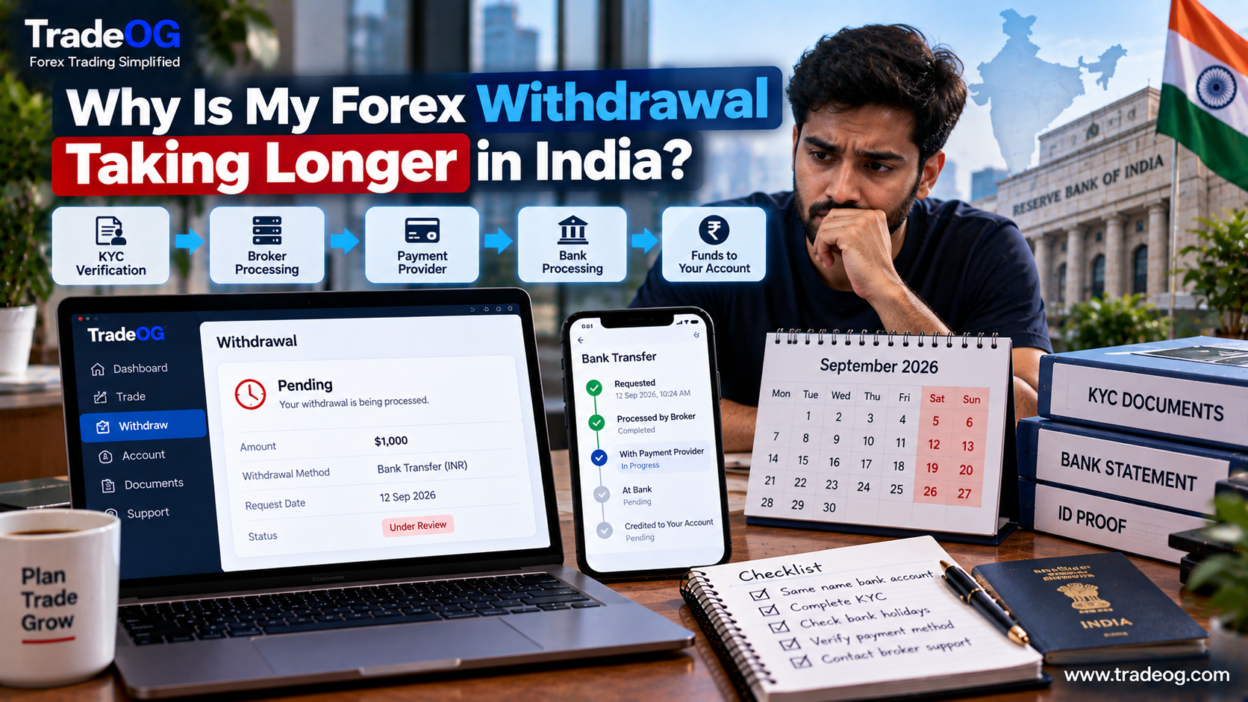
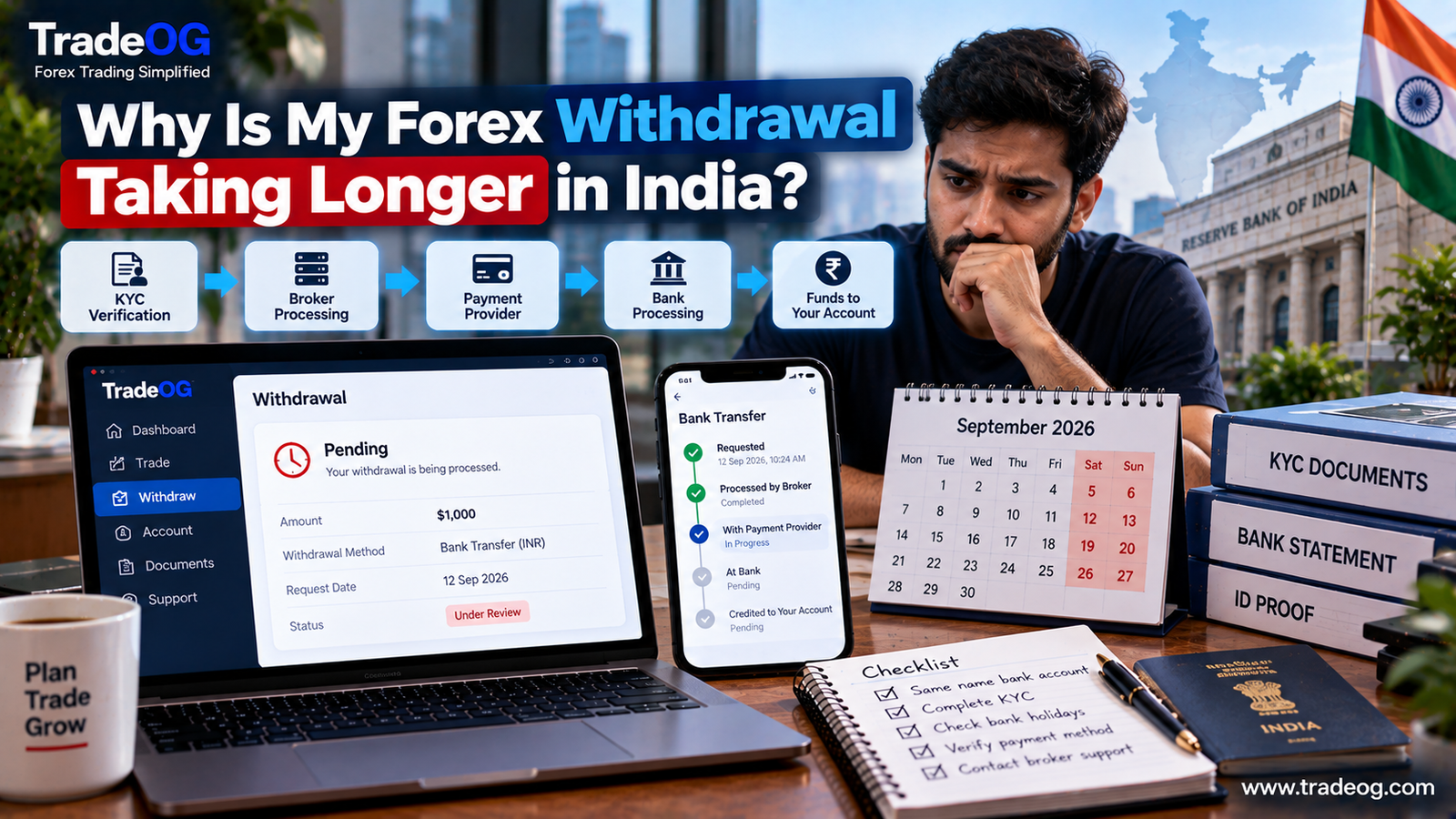
Broker → Payment Provider → Bank/Intermediary → Indian Bank → Your Account
Each stage can have its own processing time.
Exness specifically explains that the broker can approve or process a transaction while the payment method itself can take longer to send or receive the funds.
So if your broker says “completed,” ask for the transaction reference rather than immediately assuming something is wrong.
5. International Bank Transfer Is Slower
If your withdrawal is being sent internationally, there may be more institutions involved than with a simple domestic transfer.
For example:
Broker → Sending Bank → Correspondent Bank → Indian Bank → Your Account
OANDA notes that international bank-wire withdrawals can take longer than domestic withdrawals and that the receiving bank can take additional time.
This is why a withdrawal that looks “finished” at the broker may still be travelling through the banking system.
6. Weekend or Indian Bank Holiday
Always count business days, not simply calendar days.
If you request a withdrawal on Friday, Saturday and Sunday may not count as normal bank-processing days.
The same applies to relevant public holidays.
For example:
| Request date | What you might see |
|---|---|
| Friday | Withdrawal submitted |
| Saturday | Usually no normal banking settlement |
| Sunday | Usually no normal banking settlement |
| Monday | Processing resumes |
| Tuesday | Possible bank/payment credit depending on the route |
This is only an example. The exact timing depends on the broker, payment method and banks involved.
7. The Broker Requires You to Withdraw Through the Original Funding Method
Some brokers use a withdrawal hierarchy.
This means you may not be free to choose any payment method you want for every withdrawal.
OANDA, for example, states that withdrawals are subject to a hierarchy and that deposited funds may need to be returned through the original funding source before an alternative method is used.
This can create confusion when a trader expects to deposit using one method and withdraw everything through another.
Check your broker’s rules before submitting the request.
8. You Are Trying to Withdraw More Than Your Available Balance
Your account balance and your available-to-withdraw amount are not always the same.
You may have open positions, unsettled funds, reserved margin or other account restrictions.
For example, if your account shows $2,000 but $800 is required as available margin for open positions, you should not assume that the full $2,000 is immediately withdrawable.
OANDA lists insufficient available margin as one reason a withdrawal may not be processed.
Before withdrawing, check:
- Balance
- Equity
- Free margin
- Available-to-withdraw amount
- Open positions
9. Your Source of Funds Needs to Be Verified
A broker or financial institution may ask where your deposited or withdrawn money came from.
This can happen as part of anti-money-laundering or compliance procedures.
For a normal trader, the request can feel frustrating, especially when the money is genuinely yours. But sending documents is often better than ignoring the request.
Keep records of:
- Deposit confirmations
- Bank statements
- Broker statements
- Withdrawal confirmations
- Trade history
- Payment references
These records can help explain the transaction if the broker or bank asks questions.
10. Currency Conversion Can Add Another Step
If the broker sends USD but you ultimately receive INR, currency conversion may be involved.
The conversion can happen through the broker, payment provider, intermediary bank or receiving bank depending on the payment route.
That can affect both timing and the final amount you receive.
Do not assume that:
USD withdrawal × Google USD/INR rate = exact INR credited
There can be a different conversion rate and applicable banking or payment charges.
11. Your Bank Is Reviewing the Incoming Payment
Sometimes the broker has already released the money and the remaining delay is on the receiving side.
A bank may have its own checks for an incoming international transaction or another payment that requires additional information.
If the broker confirms that the payment has been released, ask them for the transaction reference and give that reference to your bank if the funds do not arrive within the expected window.
12. The Payment Method Is Temporarily Unavailable
Payment systems can occasionally be disabled for maintenance or operational reasons.
Exness notes that some payment systems can be temporarily turned off for maintenance and that payment-method availability can change.
If the withdrawal option suddenly disappears, do not immediately create multiple withdrawal requests. First ask the broker which payment method is currently available for your account.
13. Your Broker Is Doing an Additional Compliance Review
Not every delay has an obvious explanation in the withdrawal screen.
A broker can place an account under additional review because of transaction patterns, account changes, payment-source questions or other compliance considerations.
This does not automatically mean you have done anything wrong.
The right response is to ask for the exact documentation or action required and provide it through the broker’s official support channel.
14. You Requested the Withdrawal at a Bad Time
Timing matters more than many beginners realise.
A withdrawal requested late on Friday, just before a weekend or before a banking holiday, can appear much slower than the same withdrawal requested early on a normal business day.
If you have an important financial commitment, do not plan around the fastest possible withdrawal time.
Use the broker’s normal or conservative processing estimate instead.
Example: Why a $1,000 Withdrawal Can Take Longer Than Expected
Imagine an Indian trader requests a $1,000 withdrawal on Friday.
| Stage | Possible timeline |
|---|---|
| Friday | Withdrawal request submitted |
| Monday | Broker completes review |
| Tuesday | Payment released |
| Wednesday | Payment provider processes transfer |
| Thursday | Indian bank receives/starts processing |
| Thursday or Friday | Funds credited, depending on the route |
The trader may think, “My withdrawal has taken almost a week.”
But the actual processing may have involved only a few business days.
This is why you should separate calendar time from business processing time.
What Should You Do If Your Withdrawal Is Pending?
Follow this order. It is much better than repeatedly contacting support without checking the basics.
Step 1: Check the withdrawal status
Take a screenshot showing the amount, date, method and current status.
Step 2: Check your email
Look for KYC, AML, bank-account or payment-verification requests.
Step 3: Check the processing estimate
Look inside the broker’s current withdrawal page. Do not rely on an old forum post.
Step 4: Check your bank details
Confirm that the account number, name and other requested details are correct.
Step 5: Check business days
Remove weekends and relevant holidays from your calculation.
Step 6: Contact official support
Ask whether the withdrawal has been released and request the transaction reference if it has.
Step 7: Contact your bank if necessary
If the broker confirms that the payment has been released, give the bank the transaction reference and ask them to trace the incoming payment.
What Message Should You Send to Your Broker?
Keep the message simple and factual.
Subject: Withdrawal Status Request
Hello,
I requested a withdrawal of [amount] on [date] using [payment method]. My withdrawal ID is [ID], and the current status is [status].
Please confirm whether the funds have been released to the payment provider/bank. If the payment has been released, please provide the transaction or payment reference so I can trace it with my bank.
Thank you.
This gives support the information they need without creating unnecessary confusion.
When Should You Actually Be Concerned?
A delayed withdrawal deserves more attention when:
- The broker’s stated processing time has clearly passed
- Support stops giving clear answers
- Your withdrawal status keeps changing without explanation
- The broker asks for unusual payments to “unlock” your funds
- You are repeatedly told to deposit more money before withdrawing
- The company cannot provide a transaction reference after claiming the payment was released
- You cannot independently verify the broker’s regulatory or legal status
One or two extra business days does not automatically mean fraud. But repeated unexplained obstacles should make you slow down and investigate.
Never Pay a Fake “Withdrawal Release Fee”
This is especially important for Indian traders using unfamiliar offshore platforms.
Be extremely cautious if somebody tells you:
- “Pay 10% tax before withdrawal.”
- “Deposit ₹20,000 to unlock your profits.”
- “Pay a verification deposit.”
- “Pay a blockchain release fee.”
- “Your account will be activated after one more deposit.”
Do not send money simply because a person on WhatsApp, Telegram or social media says it is required.
Verify the request through the broker’s official website and official support channel.
Important for Indian Traders: Check the RBI/FEMA Position
Withdrawal speed is not the only issue Indian residents need to consider.
The RBI says resident persons can undertake forex transactions only with authorised persons and for permitted purposes under FEMA. The RBI has also cautioned residents against unauthorised electronic trading platforms and states that remittances for margins to overseas exchanges or overseas counterparties are not permitted under the LRS framework.
That means you should not assume that an international broker is automatically suitable for an Indian resident just because it accepts Indian customers or allows deposits and withdrawals.
Before sending money, check the current RBI position, the broker’s legal entity and whether the particular trading activity is permitted for you.
How to Prevent Withdrawal Delays in the Future
Complete verification early
Finish KYC before you need to withdraw a large amount.
Use your own payment account
Where required by the broker, the bank/payment account should belong to you.
Keep your details consistent
Use the same legal name and accurate personal information across your trading and payment accounts.
Understand the withdrawal hierarchy
Know whether the broker requires funds to return through the original deposit method first.
Keep records
Save deposit receipts, statements, withdrawal IDs and transaction references.
Do not rely on screenshots
Payment methods and processing times can change. Check the current broker documentation for your exact account.
Forex Withdrawal Delay Checklist for Indian Traders
- ☐ Is KYC completely approved?
- ☐ Does my bank account name match my broker account?
- ☐ Am I withdrawing through an allowed payment method?
- ☐ Has the broker actually released the funds?
- ☐ How many business days have passed?
- ☐ Was there a weekend or bank holiday?
- ☐ Did the broker request additional documents?
- ☐ Is the payment provider currently working?
- ☐ Do I have a transaction/reference number?
- ☐ Have I checked the current RBI/FEMA requirements?
Frequently Asked Questions
Why is my forex withdrawal pending in India?
The most common reasons include broker processing, KYC checks, payment-provider delays, bank processing, incorrect account details, withdrawal-method restrictions and compliance reviews.
How long should I wait before contacting the broker?
Use the processing timeframe shown by the broker for your specific withdrawal method. If that window has passed, contact official support and ask for the exact status and transaction reference.
Why does my broker say completed but my bank has not received the money?
The broker may have released the payment while the payment provider, intermediary bank or receiving bank is still processing it.
Can a name mismatch delay my withdrawal?
Yes. Brokers can require the destination payment or bank account to belong to the same person as the trading account and may request additional documents when details do not match.
Can weekends make a forex withdrawal look delayed?
Yes. Many bank and payment processes are measured in business days, so weekends and holidays can extend the calendar time.
Why is my first withdrawal slower?
A first withdrawal may involve additional identity, payment-account or source-of-funds verification.
Can I withdraw to my friend’s Indian bank account?
Do not assume this is allowed. Many brokers prohibit third-party withdrawals. Check the broker’s current rules before submitting the request.
Should I deposit more money to unlock my withdrawal?
Do not do this simply because someone tells you to. Verify the request through the broker’s official support and independently check the firm’s regulatory status.
Is a slow withdrawal proof that a broker is a scam?
No. Legitimate bank and payment processing can take time. However, repeated unexplained delays, pressure for additional deposits and unverifiable company information are serious warning signs.
Final Takeaway
If your forex broker withdrawal is taking longer in India, the best approach is to find the exact stage where the payment is waiting.
Check KYC first. Then check the broker’s processing status, payment method, business days, bank details and any compliance messages. If the broker says the money has already been released, ask for a transaction reference and use it to trace the payment.
Most importantly, do not confuse a slow payment with permission to use any forex platform you want. Indian residents should verify the current RBI/FEMA rules and use authorised channels and permitted transactions.
A good withdrawal should not require you to keep depositing more money. If a platform demands an unexplained “release fee,” “unlock payment” or additional deposit before allowing you to access your own funds, stop and verify the situation before sending anything.
Official Sources
- Reserve Bank of India — Official Website
- RBI — Caution Against Unauthorised Forex Trading Platforms
- OANDA — Funding and Withdrawals
- OANDA — Withdrawal Methods
- Exness — Deposits and Withdrawals
Risk disclosure: Forex and leveraged trading involve substantial risk of loss. This article is for general educational purposes only and is not financial, legal or tax advice. Broker policies, payment methods, processing times and Indian regulations can change. Always verify current information with the relevant broker, bank and official Indian authorities.