

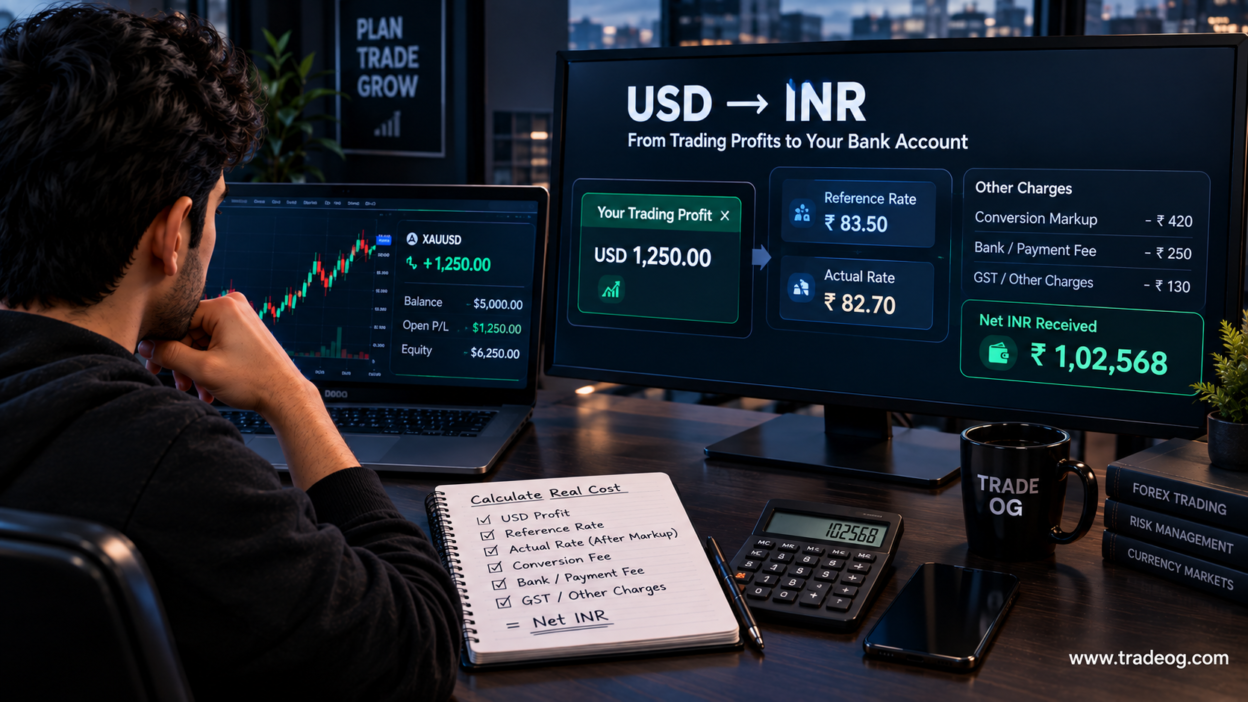
Making a $1,250 trading profit does not automatically mean you have earned the same value in Indian rupees that a public USD/INR quote suggests. When a USD trading profit is converted into INR, the amount you finally receive can be reduced by the exchange-rate spread, conversion markup, withdrawal charges, correspondent-bank fees and other applicable charges.
For Indian traders, the useful number is therefore not simply the USD profit. It is the net INR received after conversion.
What Is the Real Cost of Converting USD Trading Profits Into INR?
The real conversion cost is the difference between what your USD profit would be worth at a transparent reference exchange rate and what actually reaches your Indian bank account after the applicable conversion rate and charges.
A simple way to calculate it is:
Real Conversion Cost = Reference INR Value − Net INR Received
Where:
- Reference INR Value = USD amount × reference USD/INR rate
- Net INR Received = actual USD amount × applied conversion rate − applicable fees and charges
This approach is more useful than looking at a single “conversion fee” because a provider can charge little or no visible fee while giving you a less favourable exchange rate.
Step 1: Start With Your Actual USD Trading Profit
Use the amount you are actually withdrawing or converting, not the headline account profit shown on your trading platform.
For example, suppose your trading account shows:
- Trading profit available for withdrawal: $1,250
- Currency: USD
- Destination: Indian bank account
If you withdraw the entire amount, $1,250 becomes the starting point for your conversion calculation.
If your broker, prop firm or payment provider deducts a withdrawal fee before the USD is converted, subtract that amount first. This prevents you from comparing the wrong USD balance with the final INR credit.
Step 2: Find a Reference USD/INR Rate
You need a benchmark against which to compare the rate actually used for your transaction.
A bank, authorised dealer or other provider may use its own customer exchange rate rather than the mid-market or indicative rate you see on a public financial website. FEDAI publishes indicative USD/INR spot information and also points users toward bank-specific foreign-exchange rates and charges. FEDAI USD/INR reference information.
For an educational example, assume the reference rate is:
1 USD = ₹96.35
This is only an illustrative benchmark. Always use the rate relevant to your actual transaction when calculating a real withdrawal.
Step 3: Calculate the INR Value Before Conversion Costs
Now multiply the USD amount by the reference rate.
$1,250 × ₹96.35 = ₹1,20,437.50
So, before considering the provider’s actual conversion rate and other charges, the reference value of the withdrawal is ₹1,20,437.50.
This is your comparison point—not necessarily the amount that will reach your bank account.
Step 4: Check the Actual USD/INR Rate Applied to Your Transaction
This is one of the most important steps.
Suppose the provider converts your $1,250 at:
1 USD = ₹95.80
The gross INR produced by the actual conversion is:
$1,250 × ₹95.80 = ₹1,19,750
The exchange-rate difference alone is:
₹1,20,437.50 − ₹1,19,750 = ₹687.50
That ₹687.50 is an economic cost of receiving a less favourable conversion rate, even before adding separate withdrawal or bank charges.
Step 5: Add Fixed Withdrawal and Banking Charges
Next, identify every separate charge connected with the transaction.
Depending on the payment route, these may include:
- Broker or platform withdrawal fee
- Payment-provider fee
- Currency conversion markup
- Receiving-bank charge
- Correspondent-bank or intermediary charge
- Applicable taxes or GST on fees or services
- Other transaction-specific charges
Bank schedules demonstrate why it is important to check the actual tariff rather than assuming every foreign-currency transaction has the same cost. For example, Central Bank of India publishes separate charges for inward remittances, outward remittances, SWIFT and other foreign-exchange services, while noting that correspondent-bank and other out-of-pocket expenses can also apply. Central Bank of India forex charges and its cross-border transaction guidance.
Worked Example: Real Cost on a $1,250 Trading Profit
Assume the following hypothetical transaction:
| Item | Amount |
|---|---|
| USD trading profit withdrawn | $1,250 |
| Reference USD/INR rate | ₹96.35 |
| Reference INR value | ₹1,20,437.50 |
| Actual conversion rate | ₹95.80 |
| INR after conversion rate | ₹1,19,750 |
| Other applicable charges in example | ₹750 |
| Net INR received | ₹1,19,000 |
The real cost compared with the reference value is:
₹1,20,437.50 − ₹1,19,000 = ₹1,437.50
So the trader did not lose ₹1,437.50 from the trading strategy itself. The amount represents the combined effect of the less favourable conversion rate and the assumed transaction charges.
Calculate the Effective USD/INR Rate You Actually Received
Another useful calculation is to reverse the transaction and find your effective rate.
Effective USD/INR Rate = Net INR Received ÷ USD Withdrawn
Using the example:
₹1,19,000 ÷ $1,250 = ₹95.20 per USD
Although the provider’s quoted conversion rate in the example was ₹95.80, the final economics of the transaction were equivalent to receiving only ₹95.20 per USD after the additional charges.
This effective rate is often the easiest number to compare across different withdrawal methods.
How to Calculate the Percentage Cost
To understand whether the cost is small or significant, convert it into a percentage.
Real Conversion Cost % = (Reference INR Value − Net INR Received) ÷ Reference INR Value × 100
For the example:
(₹1,20,437.50 − ₹1,19,000) ÷ ₹1,20,437.50 × 100 ≈ 1.19%
That means the combined conversion and transaction cost is approximately 1.19% of the reference INR value in this hypothetical example.
Why the Same Fee Hurts Small Trading Profits More
A fixed ₹750 charge has a very different impact depending on the withdrawal size.
| Withdrawal | Fixed Cost | Cost as % of INR Value* |
|---|---|---|
| $250 | ₹750 | Much higher |
| $1,250 | ₹750 | Lower |
| $5,000 | ₹750 | Much lower |
*Illustrative comparison; the actual percentage depends on the exchange rate and all applicable charges.
This is why frequent small withdrawals can be inefficient. A fixed fee gets spread across a smaller amount of USD.
TradeOG’s guide on why forex withdrawal fees matter more for small trading accounts covers this percentage effect in more detail.
Do Not Confuse Trading Return With Currency Return
Your trading result and your INR result are two different calculations.
For example, you can make a 10% return in a USD-denominated account while the INR value of the withdrawal changes because USD/INR moved between the time you earned the profit and the time you converted it.
This is particularly relevant for Indian traders because the final purchasing power of a foreign-currency profit depends on the conversion rate at the time the money is actually converted.
For a deeper explanation, see Why Indian Traders Should Separate Trading Returns From Currency Returns.
Reference Rate vs Provider Rate: What You Should Compare
Do not compare only the provider’s advertised fee.
Compare these four numbers:
- USD amount sent or converted
- Reference USD/INR rate at the relevant time
- Actual USD/INR rate applied
- Final INR credited to your bank account
Then calculate the effective rate and total cost. This captures both visible fees and the less obvious cost embedded in the exchange rate.
Some Indian banks explicitly publish exchange mark-up or foreign-exchange pricing information. For example, Union Bank’s FX-Retail information states that an exchange mark-up margin may apply, demonstrating why the quoted market rate and customer execution rate should not automatically be treated as identical. Union Bank FX-Retail information.
What About GST on Currency Conversion?
GST treatment depends on the nature of the foreign-exchange service and the transaction structure. Banks publish specific GST schedules for foreign-currency transactions, and the applicable calculation can depend on the amount and type of service.
For example, Standard Chartered India’s published information describes GST treatment for foreign-currency conversion using transaction-value slabs. Standard Chartered India GST information for forex transactions.
Do not simply subtract a generic “18% GST” from your entire USD trading profit. If GST is applicable, identify exactly what service or fee it is being charged on and use the relevant bank or provider statement.
How to Track the Real Cost of Every USD Trading Withdrawal
Create a simple withdrawal log with these columns:
- Withdrawal date
- USD amount
- Reference USD/INR rate
- Provider conversion rate
- USD withdrawal fee
- Bank or payment charges
- Applicable taxes
- Net INR received
- Effective INR/USD rate
- Total conversion cost in INR
- Total conversion cost percentage
After five or ten withdrawals, you will have a much better picture of your actual cost than you would get from reading a provider’s headline fee page.
A Simple Formula You Can Reuse
For every USD trading withdrawal, use this sequence:
1. Reference INR Value = USD × Reference Rate
2. Converted INR = USD × Actual Applied Rate
3. Net INR = Converted INR − Fees − Applicable Charges
4. Real Cost = Reference INR Value − Net INR
5. Effective Rate = Net INR ÷ USD
6. Real Cost % = Real Cost ÷ Reference INR Value × 100
This gives you a consistent way to compare withdrawals, payment providers and bank routes without relying on the advertised fee alone.
Final Takeaway
The real cost of converting USD trading profits into INR is not necessarily the fee displayed on the withdrawal screen. The biggest hidden component can be the difference between a reference exchange rate and the actual rate used for your conversion.
For Indian traders, the best metric is therefore the net INR received per USD withdrawn. Track the reference rate, actual applied rate, fixed charges, bank charges and applicable taxes together. Once you calculate the effective INR/USD rate for every withdrawal, you can see exactly how much of your trading profit survives the conversion process.
Frequently Asked Questions
What is the real cost of converting USD to INR from trading profits?
It is the difference between the INR value of your USD at a chosen reference rate and the net INR you actually receive after the applied conversion rate and applicable charges.
How do I calculate my effective USD to INR rate?
Divide the final INR credited to your bank account by the original USD amount converted. This incorporates both the exchange-rate effect and fixed charges.
Is the Google USD/INR rate the same rate my bank will use?
Not necessarily. A public reference rate and a bank or payment provider’s customer conversion rate can differ because providers may apply their own exchange pricing, spreads or markups.
Should I include bank charges in my conversion cost?
Yes. If a bank, payment provider or intermediary deducts a charge from the transaction, include it when calculating the amount that actually reached your account.
Does a higher USD/INR rate always mean I received more money?
Not necessarily. A higher quoted rate can be offset by a larger withdrawal fee, conversion markup or other transaction charge. Compare the final net INR received.
Disclaimer: This article is for educational purposes only. Foreign-exchange rates, bank charges, provider fees, tax treatment and regulatory requirements can change. Check the current terms and transaction statement of your broker, payment provider and Indian bank before making financial decisions.