
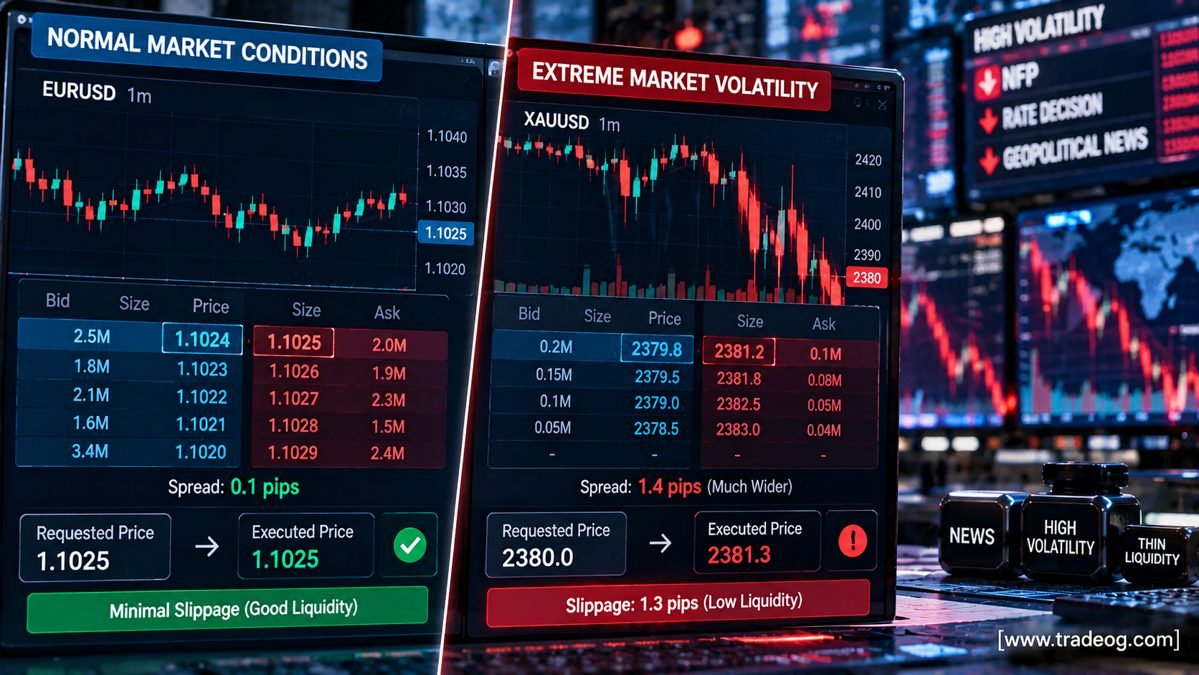
Slippage becomes much more noticeable when financial markets move extremely fast. A trader may click buy or sell at one price and receive an execution at a slightly different price. During calm conditions, that difference may be small. During a major volatility spike, however, the difference can become much larger.
This happens because the price available when an order is actually executed can change before the order reaches the available liquidity. Rapid price movement, changing liquidity, wider spreads, large orders, market gaps and execution conditions can all contribute to slippage.
Understanding this matters for forex, gold, indices and other fast-moving instruments because a strategy that looks profitable using ideal entry and exit prices can produce very different results when realistic execution is included.
What Is Slippage in Trading?
Slippage is the difference between the price a trader expects when placing an order and the price at which the order is actually executed.
For example, suppose EUR/USD is displayed around 1.10500 and you send a market buy order. If the order is filled at 1.10503, you experienced three points of positive or negative execution difference depending on the direction and reference price.
Slippage is not automatically evidence that a broker has done something wrong. It can occur because market prices are constantly changing and orders need available liquidity to be executed.
Why Does Slippage Increase During High Volatility?
The simplest explanation is that the market can move faster than the execution process can obtain the originally displayed price.
During extreme volatility, several things can happen at the same time:
- prices change rapidly;
- available liquidity at individual price levels can change;
- spreads can widen;
- large numbers of traders may send orders simultaneously;
- market orders may consume available liquidity;
- quotes can change before an order reaches the market;
- some price levels may disappear very quickly; and
- news can cause sudden repricing.
The result is that the price shown on the screen when the order is initiated may no longer be available when the order is filled.
How Fast Price Movement Creates Slippage
Execution involves time, even when that time is measured in milliseconds. In a quiet market, a tiny delay may have little practical effect. During a rapid move, the same delay can correspond to several price changes.
Imagine gold is trading near $2,650 and suddenly jumps higher after major economic news. A trader sends a market buy order expecting a fill close to $2,650. If the available offers are already moving upward, the actual execution may occur at a higher level.
The trader did not necessarily receive a random price. The market changed between the requested and executed prices.
Liquidity Is One of the Biggest Factors
Liquidity describes how easily orders can be executed without causing a large price impact. During normal conditions, many price levels may have sufficient available liquidity.
During an extreme event, liquidity can change quickly. Some market participants may reduce their exposure, cancel quotes or become more selective about the prices at which they are willing to trade.
When available liquidity becomes thinner, an order may need to reach a less favourable price to find enough available volume.
This is particularly important for larger orders because a small order may be filled at the best available level while a larger order may interact with multiple price levels.
Why Spreads Can Widen During Volatility
The bid is the price available to sell at, while the ask is the price available to buy at. The difference between them is the spread.
During major news events or unusually fast markets, spreads can widen because liquidity conditions and risk change.
A wider spread does not necessarily mean the same thing as slippage, but the two can appear together and both increase the cost of entering or exiting a position.
| Concept | What It Means |
|---|---|
| Spread | Difference between bid and ask |
| Slippage | Difference between expected and actual execution price |
| Volatility | Speed and magnitude of price movement |
| Liquidity | Availability of executable prices and trading volume |
Why News Releases Can Cause Severe Slippage
Scheduled economic events such as inflation data, employment reports, central-bank decisions and unexpected policy announcements can produce sudden repricing.
Before the announcement, a market may be trading normally. Immediately after the information is released, thousands of participants may reassess prices at the same time.
A market order submitted during that period can therefore be filled at a materially different price from the quote visible immediately before the release.
This is one reason news trading requires more than simply knowing the direction of the expected announcement.
Market Gaps Can Make Slippage Even Larger
In some situations, price does not trade continuously through every level between two quoted prices. Instead, it can jump from one area to another.
If a stop order is triggered during such a move, the execution price may be substantially different from the stop level.
For example, a trader may place a stop at 2,640 on gold, but if the market rapidly moves through that level and the next available executable price is 2,636, the position could be closed around 2,636 rather than exactly at 2,640.
This distinction is important: a stop price is a trigger level, not always a guarantee of the final execution price.
Market Orders Are More Exposed to Slippage
Market orders prioritise execution rather than guaranteeing a specific price. That makes them useful when immediate execution is more important than exact price control, but it also means the final fill can differ from the displayed quote.
Limit orders work differently. A limit order specifies the maximum price you are willing to pay when buying or the minimum price you are willing to accept when selling. However, a limit order may remain unfilled if the market does not reach the required conditions.
Neither order type completely eliminates trading risk. Each solves a different execution problem.
Why Stop-Loss Orders Can Experience Slippage
A stop-loss is designed to activate when a specified trigger price is reached. Once triggered, the resulting order may need to be executed using the available market liquidity.
During normal conditions, the difference may be small. During a fast market, price can move beyond the trigger before execution is completed.
This is why traders should not calculate risk solely from the distance between entry and stop on the chart. They should also consider the possibility of execution variation during extreme market conditions.
Why Gold Can Experience Large Slippage
XAU/USD is popular among short-term traders because it can move quickly around major economic releases and changes in US interest-rate expectations.
That same volatility can create challenging execution conditions. A setup that appears to offer a small stop-loss distance may have a very different realised risk if gold suddenly moves several dollars in a short period.
Traders should therefore consider volatility when deciding position size rather than using the same lot size in every market environment.
Slippage and Forex Scalping
Slippage can be particularly important for scalpers because their expected profit per trade may be relatively small.
If a strategy expects an average profit of 5 points but execution costs and slippage regularly consume 1–2 points, a significant portion of the strategy’s edge can disappear.
This is why scalpers should test their strategy using realistic spreads, commissions and execution assumptions instead of ideal historical fills.
For more on short-term execution behaviour, see Why Does Watching Every Tick Make Short-Term Trading More Difficult?.
Does Slippage Always Work Against Traders?
No. Slippage can sometimes be favourable.
If a trader expects to buy at one price but receives a lower execution price, that can improve the entry. Likewise, a sell order may sometimes execute at a better price than expected.
However, during stressful market conditions, traders should plan for the possibility that slippage can become larger and less predictable.
Why Backtests Often Underestimate Slippage
Many basic backtests assume that orders are filled at historical candle prices without modelling the full execution environment.
This can make a strategy appear more profitable than it would be in live trading.
A realistic evaluation should consider:
- spread;
- commission;
- expected slippage;
- market impact for larger orders;
- overnight financing where relevant;
- news-event conditions;
- liquidity differences by session; and
- possible gaps or unusually fast moves.
This is particularly important for strategies with small targets or high trade frequency.
How Slippage Can Change a Trading Strategy’s Results
Consider a simple strategy that historically shows:
- 55% winning trades;
- 45% losing trades;
- average winning trade of $100;
- average losing trade of $90.
On paper, the strategy has positive expectancy before costs.
Now assume repeated volatility-related slippage reduces winners slightly and increases the realised size of some losing trades. The strategy’s expectancy can shrink considerably.
This demonstrates why a strategy’s edge should be large enough to survive realistic execution costs.
Why Large Orders Can Experience More Slippage
Order size matters because available liquidity is not necessarily unlimited at the best quoted price.
A small order might be completely filled at the best available level. A much larger order may require execution across several price levels, especially when liquidity is changing rapidly.
This does not mean every large order will experience substantial slippage. It means order size should be considered alongside market depth and current liquidity conditions.
How Market Volatility Changes Execution Risk
Volatility is not simply a measure of how exciting a chart looks. It can directly affect the reliability of price-based risk assumptions.
When volatility increases:
- the distance price can travel in a short period increases;
- stop-loss levels can be reached more quickly;
- spreads may become less stable;
- slippage can become more variable;
- position sizing based on normal conditions can become excessive; and
- short-term setups can fail more rapidly.
This is why experienced traders often reduce position size or avoid certain market events rather than assuming normal execution will continue during extreme conditions.
How Traders Can Reduce the Impact of Slippage
1. Avoid unnecessary market orders during extreme events
If exact execution price matters more than immediate entry, consider whether a limit order or waiting for conditions to stabilise is more appropriate.
2. Reduce position size
Smaller exposure reduces the financial impact of an unexpected execution difference.
3. Account for slippage in backtests
Do not evaluate a strategy using perfect fills if you intend to trade in live markets.
4. Be careful around major news
If the strategy has not been tested during major announcements, assume execution conditions may differ materially from normal sessions.
5. Use realistic stop distances
A stop that is extremely close to the entry can be more vulnerable to normal volatility and execution variation.
6. Monitor broker execution quality
Review actual fills rather than judging execution only from the chart’s displayed price.
7. Match position size to volatility
When expected price movement expands, maintaining the same lot size can increase the financial risk of each trade.
Is Slippage the Same as Broker Manipulation?
Not automatically. Slippage is a normal feature of market execution, particularly during rapidly changing conditions.
A trader should distinguish between legitimate execution differences caused by changing market conditions and a consistent execution pattern that requires investigation.
The useful approach is to maintain records of requested prices, execution prices, timestamps, spreads and market conditions. A pattern can be evaluated much more effectively using actual trade data than by looking at one unusual fill.
Why Traders Should Compare Execution Over Many Trades
One trade with unexpected slippage does not provide enough information to judge execution quality.
A better approach is to collect a meaningful sample and compare:
- average slippage;
- median slippage;
- largest adverse slippage;
- largest favourable slippage;
- performance during normal volatility;
- performance during major news;
- execution by trading session; and
- execution by instrument.
This gives traders a more realistic view of how execution affects their strategy.
Practical Example for an Indian Forex or Gold Trader
Suppose an Indian trader is using a short-term XAU/USD strategy during the US session. The strategy normally targets a relatively small price movement.
On an ordinary session, the trader may receive fills close to the displayed price. During a major US economic release, however, gold can move rapidly and available prices can change almost immediately.
If the trader uses the same position size and same stop distance as during quiet conditions, the realised risk can become much larger than expected.
A more disciplined approach is to reduce exposure, avoid the event, or use a strategy specifically tested for high-volatility execution.
Slippage vs Spread: What Should Traders Watch?
These costs should be analysed separately.
| Factor | When It Matters Most | Trader’s Concern |
|---|---|---|
| Spread | Entry and exit | Higher transaction cost |
| Slippage | Order execution | Actual fill differs from expectation |
| Commission | Every charged trade | Reduces net profit |
| Swap/financing | Positions held over time | Longer holding cost |
Looking only at the advertised spread is therefore not enough to understand the true execution cost of a trading strategy.
How Slippage Affects High Win-Rate Strategies
A strategy can have a high historical win rate but still become unprofitable if its average edge is small and execution costs consume that edge.
For example, a strategy that wins frequently with very small targets may be highly sensitive to spreads and slippage. A few poor fills during volatile conditions can offset many small winning trades.
This is one reason win rate should always be analysed alongside average win, average loss, expectancy and execution costs.
TradeOG also explains this relationship in Why Can a High Win Rate Strategy Still Lose Money?.
Final Takeaway
Slippage increases during extreme market volatility because the price and available liquidity can change faster than an order can be executed at the originally expected level.
Rapid price movement, changing liquidity, wider spreads, large order size, market gaps and major news events can all make execution less predictable.
Traders cannot eliminate every instance of slippage, but they can reduce its impact by using realistic backtests, controlling position size, understanding execution conditions and avoiding strategies whose expected edge is too small to survive real-world trading costs.
The key lesson is simple: do not measure a trading strategy only by its chart entries and exits. Measure what actually happens when real orders are executed.
Frequently Asked Questions
Why does slippage increase during high volatility?
Because prices can move rapidly while available liquidity changes. The price visible when an order is placed may no longer be available when the order is executed.
Is slippage normal in forex trading?
Yes. Some degree of slippage is a normal part of market execution, especially during fast markets. The size and frequency can vary by broker, instrument and market conditions.
Does high volatility always cause negative slippage?
No. Slippage can sometimes be favourable. However, extreme volatility generally increases the uncertainty around the final execution price.
Can a stop loss experience slippage?
Yes. A stop can trigger when its specified level is reached, but the final execution may occur at a different price if the market moves rapidly through that level.
How can traders reduce slippage?
Position sizing, avoiding unnecessary market orders during extreme events, using appropriate order types, realistic backtesting and monitoring actual execution quality can all help reduce its impact.