
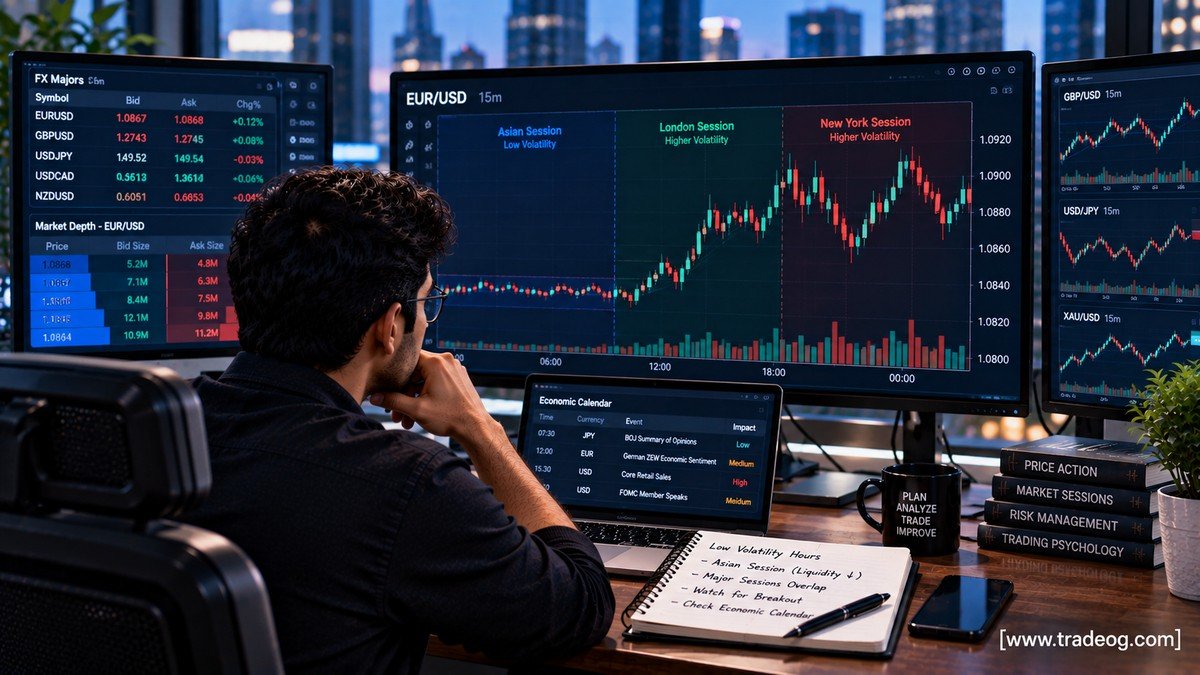
Forex is a 24-hour market, but that does not mean it moves with the same speed throughout the day. There are periods when EUR/USD, GBP/USD or other major currency pairs can look almost frozen for several candles, only to become active again when another major financial centre opens.
This sudden disappearance of volatility can confuse traders, especially those using short timeframes. A trader may see a clean setup, enter a position and then spend the next 30 to 60 minutes watching price barely move. In another part of the day, the same pair may travel several times farther in just a few candles.
The reason is not that the forex market has stopped working. It is that trading activity, liquidity, order flow, market participation and information flow change during the day.
In this guide, TradeOG explains why forex volatility can suddenly disappear during certain hours, which sessions are usually quieter, why low volatility can turn into a breakout, and how Indian traders can adjust their strategy instead of forcing trades into a dead market.
What Does “Forex Volatility Disappears” Actually Mean?
Low volatility means that the price is making relatively small movements over a period of time. It does not necessarily mean there are no buyers or sellers.
For example, suppose EUR/USD spends an hour moving inside a 12-pip range. During a more active session, the same pair might move 40 or 60 pips within an hour. The market is still trading in both cases, but the amount of price discovery and directional pressure is different.
Low volatility can appear through:
- Small candle bodies and narrow ranges
- Repeated movement around the same price
- Lower tick activity or quote activity
- Fewer clean breakouts
- Reduced follow-through after technical signals
- Tighter or relatively stable spreads on major pairs
- Price repeatedly returning to the middle of a range
It is therefore better to think of volatility as a changing market condition rather than a simple on/off switch.
Why Does Forex Volatility Suddenly Disappear During Certain Hours?
1. Major Trading Centres Are Between Active Sessions
Forex trading moves through different financial centres during the global day. Activity starts in the Asia-Pacific region and later moves through Europe and North America.
The amount of participation is not constant. When a major centre is fully active, more banks, funds, corporations, market makers and other participants can be simultaneously managing orders. During transition periods, participation can temporarily fall.
BIS research describes the FX market as decentralised and fragmented across multiple venues rather than operating from one central exchange. This structure helps explain why liquidity and trading activity can vary significantly by time of day. BIS research on the 2025 FX trade execution landscape.
2. London and New York Do Not Stay Equally Active All Day
London and New York are two of the most important centres for global FX activity. BIS research has historically found that liquidity is typically highest around the London open and during the overlap between London and New York.
That does not mean every minute of the overlap will be volatile. But it helps explain why a pair can become more active when major market participants are simultaneously operating and then slow down later.
When a major session approaches its end, some traders reduce exposure, institutional desks manage positions, and the flow of new orders can change. The result can be a noticeably quieter chart.
3. The Market Is Waiting for Information
Sometimes price becomes quiet because traders are waiting for a known catalyst.
Examples include:
- US CPI
- Nonfarm Payrolls
- FOMC decisions
- ECB or BoE decisions
- Central-bank speeches
- Important employment data
- GDP releases
- Major inflation reports
Before a major event, some market participants reduce directional exposure. Others wait for confirmation before committing fresh capital.
This can create a compression phase where price trades in a narrow range. The market may look inactive, but the absence of movement can actually be the preparation for a much larger move after the information arrives.
4. Order Flow Becomes Balanced
Price needs an imbalance between buying and selling pressure to travel decisively. When aggressive buying and selling are relatively balanced, price can remain trapped inside a narrow range.
This is especially visible when there is no strong catalyst and neither side is willing to chase price.
A quiet chart does not necessarily mean that traders have disappeared. It can mean that the available order flow is not strong enough to push price far away from its current area.
This is one reason why a market can spend a long time moving sideways before suddenly breaking out.
5. Liquidity Is Not Uniform Across the Global Day
Liquidity describes how easily transactions can occur without causing a large price impact. It can change with market conditions, participant activity and the availability of counterparties.
BIS research has shown that FX liquidity is closely connected with trading structure, dealer behaviour and market conditions. In the modern FX market, a large amount of customer trading can also be internally matched by dealers, which can reduce the immediate price impact of individual trades.
During quieter periods, however, there may be less aggressive participation available to push price through nearby levels. The chart can therefore appear unusually slow.
6. Different Currency Pairs Have Different Active Hours
This is one of the biggest mistakes beginners make.
They assume that because forex is open around the clock, every pair should be equally active at every hour.
That is not how the market behaves.
For example, a pair involving the Japanese yen can receive more regional attention during Asian hours, while European currencies may become much more active around European trading hours. USD pairs can become especially important when the US market becomes active.
Therefore, a quiet period for EUR/USD does not automatically mean every currency pair will be equally quiet.
7. Weekends and Holiday Periods Can Change the Normal Pattern
Normal session behaviour can also be distorted around public holidays and major market closures.
If fewer institutional participants are active, liquidity and trading activity can change. A session that normally produces reasonable movement may become much quieter than usual.
This is particularly important around major holidays in the United States, United Kingdom, Europe and Asia.
Why Does Low Volatility Sometimes Continue for Hours?
Low volatility can persist because the market has not received enough information to reprice aggressively.
Imagine EUR/USD is trading at 1.0850. Buyers are comfortable above 1.0840, while sellers are defending 1.0870. If there is no major economic surprise, price may repeatedly move between those areas.
Every time price approaches the upper boundary, sellers appear. Every time it approaches the lower boundary, buyers appear. The result is compression.
This can continue until one of three things changes:
- A new fundamental catalyst enters the market.
- A major session brings a fresh wave of order flow.
- A technical level breaks and triggers additional orders.
Once that happens, the market can move from low volatility to high volatility surprisingly quickly.
Can Low Volatility Predict a Breakout?
Not by itself.
A narrow range tells you that price movement has contracted. It does not guarantee that the next move will be bullish or bearish.
However, volatility compression can create conditions where a breakout becomes more noticeable. If a large number of traders have placed stops around a narrow range, a break through one side can trigger additional orders and accelerate the move.
This is why traders often watch the high and low of a quiet session.
The important distinction is:
Low volatility can create the conditions for expansion, but it does not tell you the direction of expansion.
Why the First Move After a Quiet Period Can Be a Fakeout
A common pattern is a narrow range followed by a quick move above the range high, followed by a return back inside the range.
This can happen because breakout traders enter, while existing traders use the liquidity around the level to execute or exit positions.
The first move should therefore not automatically be treated as confirmation.
For short-term traders, it can be useful to wait for:
- A candle close beyond the range
- Follow-through from the next candle
- Increasing participation
- A retest that holds the broken level
- Alignment with the broader session trend
These filters do not eliminate false breakouts, but they can reduce the temptation to enter every small spike.
Forex Volatility During Asian, London and New York Sessions
| Period | Typical Behaviour | What Traders Should Watch |
|---|---|---|
| Asian session | Can be quieter for many European currency pairs, although JPY, AUD and NZD-related flows can be important | Range formation, Asian high/low, regional news |
| London open | Often brings a noticeable increase in activity and price discovery | Breakouts, liquidity sweeps, European data |
| London–New York overlap | Often one of the most active periods for major FX pairs | US data, continuation, reversals, institutional flows |
| Late New York | Activity can decline as major desks wind down and the global day transitions | Range behaviour, spread conditions, position management |
These are broad tendencies, not fixed rules. Day-of-week effects, holidays, economic releases and market stress can completely change the normal pattern.
What Does This Mean for Indian Forex Traders?
For traders operating from India, session timing matters because a “quiet market” is not necessarily a bad market. It may simply be the wrong time for a strategy that needs strong movement.
If your strategy depends on momentum, you may prefer periods when the relevant market centres are active. If your strategy is based on range trading, a quiet session may actually be useful.
The key is to match the strategy with the volatility regime.
For example:
- Scalping: Be careful during extremely quiet periods because small targets can be consumed by spread and execution costs.
- Breakout trading: Monitor compressed ranges before major session opens or scheduled news.
- Range trading: Low-volatility periods can sometimes provide cleaner boundaries.
- Swing trading: Intraday quiet periods are usually less important than the broader trend and macro environment.
How Indian Traders Can Identify a Low-Volatility Period
You do not need a complicated indicator.
Start with a simple checklist:
- Compare the current candle range with the previous 20 to 50 candles.
- Mark the high and low of the current session.
- Check whether price is repeatedly returning to the same area.
- Look at the economic calendar for upcoming high-impact events.
- Check whether London or New York is about to open or close.
- Compare the pair with correlated markets such as DXY, bonds or related currencies.
- Watch the spread before entering a short-term trade.
For a deeper understanding of why price can move without obvious news, see our guide on Why Does a Forex Pair Move Without Major News?. You can also read Why Can Forex Prices Move in Opposite Directions Within Seconds? to understand how liquidity and order flow can create rapid reversals.
ATR Can Help Measure the Change in Volatility
The Average True Range, or ATR, is one of the simplest tools for measuring recent price movement.
Suppose EUR/USD normally has an ATR of 12 pips on your chosen timeframe, but the current candles are repeatedly printing 3 to 5 pip ranges. That tells you that current movement is significantly below its recent average.
ATR does not predict direction. It simply helps answer a different question:
“Is the market moving more or less than it normally does?”
This can be useful when deciding whether a strategy’s normal stop-loss and take-profit settings still make sense.
Why Low Volatility Can Be Dangerous for Scalpers
A slow market can look safe because candles are small. But small candles do not automatically mean low risk.
In a quiet market, a trader may enter repeatedly because nothing seems to be happening. Five small trades can eventually create meaningful losses through spread, commission, slippage and poor entries.
Another problem is overtrading.
A trader sees a small range, assumes a breakout is coming and keeps entering every minor move. When the breakout finally happens, the trader may already have accumulated several unnecessary positions.
Low volatility should therefore encourage selectivity, not constant trading.
Low Volatility vs No Liquidity: They Are Not the Same Thing
This distinction is important.
A market can have relatively low volatility while still functioning normally with reasonable liquidity. Conversely, a stressed market can experience sudden liquidity deterioration and extreme price movement.
BIS research has documented how volatility, bid-ask spreads and quote activity can behave differently during periods of market stress. This means traders should not use price movement alone as a complete measure of liquidity.
For practical trading, watch several signals together:
- Price range
- Spread
- Quote activity
- Execution quality
- Trading volume where reliable data is available
- Upcoming catalysts
Does Low Volatility Mean the Market Is Manipulated?
No.
A quiet forex market is usually a normal consequence of changing participation, order flow and information flow.
Because spot forex is an OTC market spread across multiple venues, there is no single central order book that represents every transaction. The market is decentralised and fragmented, and a significant amount of customer trading can be internally matched by dealers.
That structure means the chart you see is the result of a complex network of liquidity providers and trading venues rather than one central exchange controlling the price.
If a quiet range suddenly breaks, that does not automatically prove manipulation. The move may simply reflect new information, a session transition, stop orders, positioning changes or an imbalance in order flow.
A Simple Example
Assume EUR/USD trades between 1.0860 and 1.0870 for 90 minutes.
A beginner may think, “Nothing is happening.”
But a professional approach asks different questions:
- Is the market waiting for US data?
- Is London becoming less active?
- Is New York about to open?
- Are traders defending 1.0860?
- Are stops building above 1.0870?
- Is DXY also quiet?
If the US session then becomes active and EUR/USD breaks 1.0870 with strong follow-through, the earlier quiet period becomes important context rather than meaningless price action.
How Prop-Firm Traders Should Handle Quiet Markets
Low volatility can be especially frustrating for prop-firm traders because many traders feel pressure to reach a daily target.
That pressure can lead to unnecessary trades during hours when the market simply does not offer enough movement.
A better approach is to define in advance which market conditions qualify for a trade.
For example:
- Minimum expected range
- Maximum acceptable spread
- Specific trading sessions
- Maximum number of attempts
- Maximum daily loss
- Rules for scheduled news
The objective is not to trade every hour. The objective is to trade when your strategy has an identifiable edge.
Common Mistakes Traders Make During Quiet Hours
Trading Every Candle
A candle is not a trade signal. If the market is compressed, many candles can simply represent noise.
Using the Same Stop-Loss at Every Time of Day
Volatility changes. A stop that works during a high-activity session may be unnecessarily wide during a quiet period, while an extremely tight stop can be vulnerable to normal spread and micro-movements.
Assuming a Breakout Must Happen
Compression can continue much longer than expected. Do not trade a breakout simply because the range looks small.
Ignoring Economic Calendar Timing
A quiet market immediately before major data can be very different from a quiet market caused by genuinely low participation.
Confusing Low Volatility With Low Risk
Small candles can encourage overconfidence. Execution costs and sudden volatility expansion can still produce losses.
Final Takeaway
Forex volatility does not disappear because the market has stopped functioning. It often falls because participation, liquidity, order flow and information flow change during the global trading day.
Some hours naturally have less activity, while other periods attract more market participants and produce stronger price discovery. London and New York overlap is historically associated with high FX liquidity, while certain transition and late-session periods can be considerably thinner. BIS: The foreign exchange market.
For Indian traders, the practical lesson is simple: do not judge a trading setup without considering the time of day. A strategy designed for momentum may struggle in a compressed market, while a range strategy may perform better under the same conditions.
Before taking a trade, ask three questions:
- Which major market centres are active right now?
- Is current volatility normal for this pair and timeframe?
- Is there a known event that could suddenly change the range?
Understanding these factors can help traders stop treating every quiet period as a trading opportunity and start treating market timing as part of their risk-management process.
Frequently Asked Questions
Why does forex volatility become low at certain times?
Volatility can fall when major trading centres are less active, order flow is balanced, fewer new orders enter the market, or traders are waiting for scheduled economic information.
Is the Asian forex session always low volatility?
No. The Asian session can be active, particularly for currencies such as JPY, AUD and NZD. Volatility also depends on economic releases, geopolitical events and the specific currency pair.
Why is the London-New York overlap important?
It brings together major financial centres and historically coincides with strong FX liquidity and trading activity. It is not guaranteed to be volatile every day.
Can low volatility lead to a breakout?
It can. A narrow range can precede volatility expansion, but low volatility alone cannot predict whether the breakout will be upward or downward.
Should Indian traders avoid low-volatility hours?
Not necessarily. They should match the session with their strategy. Momentum traders may prefer active periods, while range traders may find quieter conditions useful.
Does low volatility mean there is no liquidity?
No. Low price movement and poor liquidity are different concepts. A market can be relatively quiet while still having functional liquidity.
Sources & Further Reading
- Bank for International Settlements — The FX trade execution landscape through the prism of the 2025 BIS Triennial Survey
- Bank for International Settlements — The foreign exchange market
- Bank for International Settlements — Global FX markets when hedging takes centre stage
- Bank for International Settlements — Offshore markets drive trading of emerging market currencies
Risk Disclaimer: This article is for educational and informational purposes only. Forex and leveraged trading involve substantial risk of loss. Market behaviour, liquidity, spreads and volatility can change without warning. Always consider your own risk tolerance, broker conditions, applicable laws and trading rules before placing a trade.