
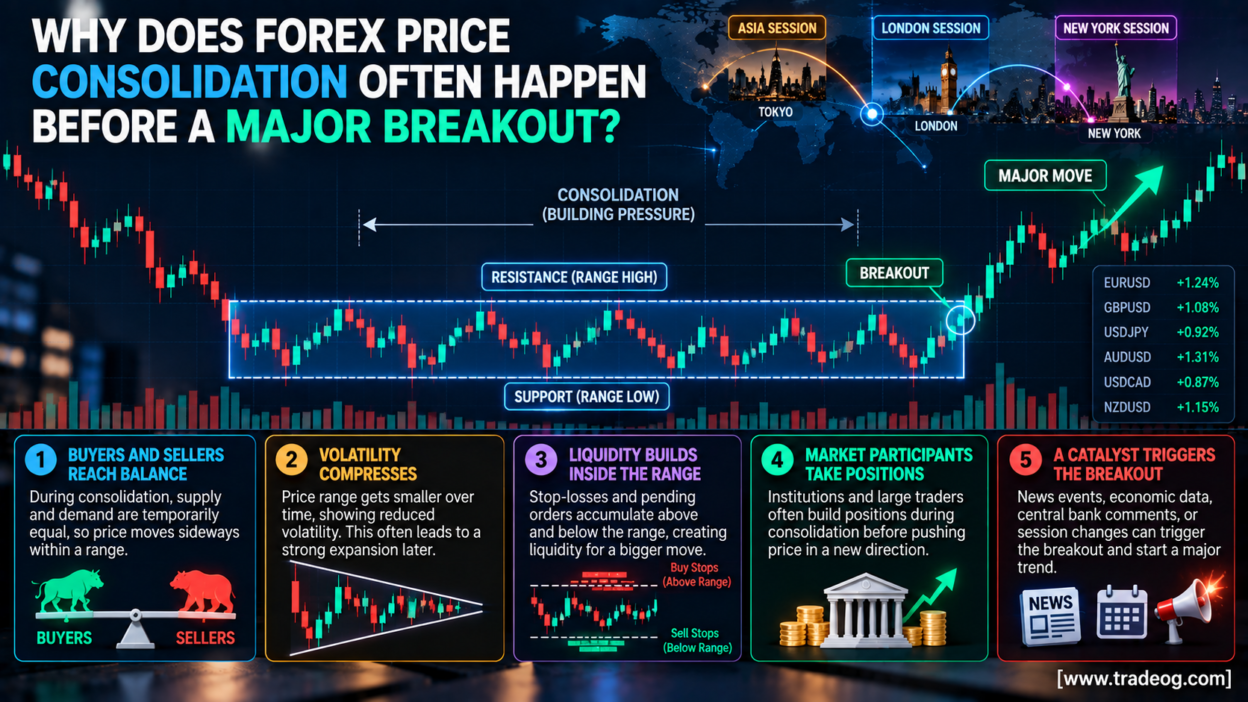
Forex price consolidation often appears before a major breakout, but the relationship is easy to misunderstand. A currency pair can spend hours or even days moving inside a relatively narrow range before suddenly expanding in one direction.
To traders, the chart can look quiet and uninteresting during the consolidation. Then, seemingly out of nowhere, volatility expands and price breaks above resistance or below support.
This behaviour is not a guarantee that every consolidation will produce a major breakout. Consolidation can also continue for a long time, produce a false breakout, or resolve into another range. But the compression of price movement can create conditions in which a later expansion becomes more noticeable.
The key is understanding what consolidation represents: a period in which buying and selling pressure are relatively balanced within a defined area, while market participants continue positioning, adjusting risk and waiting for information or liquidity conditions to change.
What Is Forex Price Consolidation?
Forex consolidation is a period when a currency pair trades within a relatively contained range instead of producing a persistent directional move.
On a chart, consolidation may appear as:
- a horizontal trading range;
- a rectangle pattern;
- a contracting triangle;
- an inside-bar sequence;
- a series of overlapping candles;
- lower short-term volatility after a strong move.
For example, EUR/USD might repeatedly trade between 1.0800 and 1.0850. Buyers become active near the lower boundary while sellers appear near the upper boundary. Neither side produces enough sustained pressure to establish a new directional trend.
That balance can eventually change.
Why Can Consolidation Precede a Breakout?
There is no single mechanism that causes every breakout. Several processes can occur at the same time: volatility can compress, market participants can accumulate or distribute positions, liquidity can build around visible levels, and new information can eventually change the balance between buyers and sellers.
The global FX market is also highly fragmented. Spot FX and most derivatives trade over the counter through dealers and multiple execution venues rather than on one central exchange. The BIS notes that dealers can internalise a large share of customer flow, while FX liquidity and price discovery are distributed across different venues.
This structure means that a chart showing a quiet range does not mean the entire global market is inactive. Significant positioning and risk management can be taking place away from the visible price action.
1. Buyers and Sellers Reach a Temporary Balance
The simplest explanation for consolidation is temporary balance.
Imagine a currency pair has risen sharply. Near a resistance zone, some traders take profits while new buyers are still interested in the pair. Selling prevents an immediate continuation higher, but buying prevents a deep decline.
Price starts moving sideways.
The market is effectively searching for a price where enough buyers and sellers are willing to transact. If neither side gains a decisive advantage, the range can persist.
A later change in order flow can then push price away from that equilibrium.
2. Volatility Can Compress Before Expanding
Markets do not move at the same speed all the time. Periods of high activity can be followed by quieter periods, and quiet conditions can eventually be interrupted by a large move.
This is why consolidation is often described as volatility compression.
During a compression phase:
- candles may become smaller;
- intraday ranges may narrow;
- price may overlap repeatedly;
- short-term volatility can decline;
- breakout levels become easier to identify.
Importantly, low volatility does not guarantee an imminent breakout. It only describes the current state of price movement.
BIS research has found that volatility and liquidity interact in complex ways in FX markets. During major market events, volatility can rise sharply while liquidity conditions and trading activity also change.
3. Orders Can Cluster Around the Range Boundaries
When a currency pair repeatedly respects a range high and range low, those boundaries become visible to market participants.
Different traders may place different types of orders around them:
| Location | Possible Orders |
|---|---|
| Above range high | Buy stops, breakout entries, short stop-losses |
| Below range low | Sell stops, breakout entries, long stop-losses |
| Inside range | Limit orders, profit-taking and short-term trades |
This does not mean all orders are visible or that every trader uses the same levels. In spot FX, there is no single consolidated order book showing the entire market.
Nevertheless, widely watched highs and lows can become important reference points for trading decisions.
When price finally leaves the range, the interaction of these orders can contribute to a rapid move.
4. A Catalyst Can Release the Stored Imbalance
Consolidation can persist because the market lacks a sufficiently strong catalyst to move price away from equilibrium.
Then new information arrives.
Examples include:
- central-bank decisions;
- inflation data;
- employment reports;
- GDP releases;
- unexpected economic announcements;
- political or geopolitical developments;
- changes in interest-rate expectations;
- large portfolio or hedging flows.
The catalyst does not need to be a scheduled news event. A large institutional flow or sudden change in risk sentiment can also alter the balance of demand.
The BIS reported that global FX turnover reached $9.5 trillion per day in April 2025 and that heightened volatility around US tariff announcements was associated with a major increase in trading activity.
This illustrates an important principle: changes in information, hedging needs and risk positioning can quickly transform market activity.
5. The Range Gives Traders a Clear Reference Point
A consolidation range creates visible boundaries.
Suppose GBP/USD trades between 1.2700 and 1.2750 for several sessions. Traders can identify:
- 1.2700 as the approximate range low;
- 1.2750 as the approximate range high;
- the midpoint as an area where price repeatedly rotates.
A decisive move beyond one boundary can attract attention because the market has demonstrated that the level matters.
However, the existence of a clear range does not guarantee that the first breakout will be genuine.
6. Breakouts Can Accelerate Because of Stop-Loss and Momentum Flows
Suppose a range has formed with resistance near 1.2750.
A trader holding a short position may have a stop above the range high. A breakout trader may place a buy-stop above 1.2750. If price rises through the level, both types of orders can create additional buying.
That can produce a sequence such as:
Range → resistance break → breakout buying → short covering → stronger upward movement
The same mechanism can operate in reverse below support.
This is one reason a breakout can look disproportionately large compared with the relatively small candles that preceded it.
7. Consolidation Can Reflect Positioning Rather Than Indecision Alone
It is tempting to describe every sideways market as traders being “indecisive.” That is incomplete.
Different market participants can have very different objectives during the same range.
A corporation may be hedging currency exposure. An asset manager may be adjusting a portfolio. A bank may be managing client flow. A macro fund may be waiting for an economic catalyst. A short-term trader may be trading the range itself.
These flows can offset one another and keep price contained even while substantial activity is occurring.
BIS research shows that customer order flow can contain information about future exchange-rate movements and that different FX customer groups have different trading styles and risk exposures.
8. Session Changes Can End a Quiet Range
Forex trades around the clock during the business week, but activity is not evenly distributed across every hour.
Different financial centres become more active as global trading sessions progress. A range formed during a relatively quiet period can encounter much greater order flow when another major financial centre becomes active.
For example, a currency pair may consolidate during one regional session and then experience a stronger move when European or US participation increases.
This does not mean every session opening causes a breakout. It simply means the market’s participant mix and liquidity conditions can change through the global trading day.
9. Why Consolidation Sometimes Breaks Out Without Major News
A breakout does not require a headline.
FX prices are influenced by order flow, positioning, hedging, liquidity and expectations. A shift in one or more of these factors can produce a directional move even when there is no obvious news event on a retail economic calendar.
The BIS describes FX as a decentralised market with multiple trading venues and substantial dealer internalisation. This means not all information about market activity is visible on a standard retail chart.
Therefore, “no major news” should not be interpreted as “nothing changed.”
Consolidation Does Not Always Lead to a Breakout
This distinction is critical.
Consolidation is a market condition, not a guaranteed setup.
A range can:
- continue sideways;
- break higher and continue;
- break lower and continue;
- break one side and quickly reverse;
- expand into a wider range.
Traders who assume that every tight range must immediately produce a major breakout are likely to overtrade.
Real Breakout vs False Breakout After Consolidation
| Feature | Potentially Stronger Breakout | Potentially False Breakout |
|---|---|---|
| Close | Strong close outside range | Wick or weak close |
| Follow-through | Continues in breakout direction | Returns into range |
| Retest | Broken level holds | Broken level is quickly reclaimed |
| Momentum | Expands with directional movement | Fades immediately |
| Higher timeframe | Supports the move | Conflicts with the move |
| Liquidity | Market accepts new prices | Break may have swept liquidity |
For more on failed moves, see TradeOG’s guide to identifying a false breakout on a forex chart.
How to Read a Forex Consolidation Before Trading a Breakout
Step 1: Define the range
Mark the most important recent high and low rather than drawing dozens of minor levels.
Step 2: Measure the contraction
Compare recent candle ranges with earlier price movement. If the market is visibly becoming quieter, note that volatility has compressed.
Step 3: Identify the higher-timeframe context
Ask whether the range is forming after a strong trend, near a major support or resistance zone, or inside a larger sideways market.
Step 4: Mark potential breakout areas
Identify where price would need to trade to demonstrate that the range has been broken.
Step 5: Wait for acceptance
A brief spike outside the range is weaker evidence than sustained trading beyond the boundary.
Step 6: Consider the retest
If price returns to the broken level, observe whether it holds or immediately falls back into the old range.
Step 7: Manage the risk
Even a technically clean breakout can fail. Position size and invalidation should reflect that uncertainty.
Example: EUR/USD Consolidation Before a Breakout
Imagine EUR/USD rallies from 1.0750 to 1.0850 and then begins moving sideways between 1.0820 and 1.0850.
For several hours:
- buyers defend the lower part of the range;
- sellers repeatedly appear near 1.0850;
- candles become smaller;
- price remains inside the same boundaries.
Eventually, an unexpected shift in interest-rate expectations causes EUR/USD to trade above 1.0850.
Breakout traders enter long, some short positions are closed, and additional buying pushes the pair toward 1.0880.
The consolidation did not “predict” the news. Instead, it created a clearly defined area from which the market could expand once the balance of demand changed.
Why Tight Consolidation Can Be More Interesting Than a Large Candle
Large candles attract attention, but they are often the result of a move that has already started.
A tight consolidation can be more useful for identifying where the market is currently balanced.
When the range is clear, traders can define:
- where the market is currently balanced;
- where the bullish thesis becomes more credible;
- where the bearish thesis becomes more credible;
- where a breakout has failed;
- where risk can potentially be invalidated.
That does not make consolidation inherently bullish or bearish. Its value comes from the structure it creates.
Common Mistakes When Trading Consolidation Breakouts
Entering before the breakout
Trying to predict which side will break can lead to repeated losses when price continues rotating inside the range.
Buying the first tick above resistance
A marginal move above resistance can become a false breakout. Waiting for confirmation can reduce some false signals, although it may also produce a later entry.
Ignoring spread and execution
During fast markets, spreads and execution conditions can change. A chart breakout does not guarantee identical execution for every trader.
Assuming volume is centralized
Spot forex does not have one centralized exchange volume figure representing the entire market. Broker tick volume can be useful for some analyses but should not be treated as complete global FX volume.
Using a tiny range with no broader context
A five-minute consolidation inside a major daily resistance zone has a different meaning from a multi-session range that forms after a major directional move.
Can Consolidation Predict the Direction of the Breakout?
Not reliably by itself.
A range tells you that price is contained. It does not guarantee whether the next expansion will be bullish or bearish.
Direction becomes more informative when consolidation is combined with broader market structure, trend context, fundamental expectations, positioning, liquidity and price acceptance after the break.
Even then, the outcome remains uncertain.
Why Breakouts Can Become Very Fast
Once price leaves a well-defined range, several mechanisms can reinforce the initial move:
- breakout orders activate;
- existing positions are stopped or closed;
- momentum traders enter;
- dealers adjust inventory and quotes;
- new information changes expectations;
- liquidity conditions change as participation increases.
The result can be a transition from low-volatility sideways trading to rapid directional movement.
Because FX is decentralised and liquidity is distributed across venues and dealers, the precise path can vary substantially between events. BIS research highlights both the fragmented nature of FX execution and the role of dealer internalisation in absorbing customer flows.
Consolidation Breakout Checklist
- Is the range clearly defined?
- Has volatility actually compressed?
- Are the range boundaries meaningful on the chosen timeframe?
- What is the higher-timeframe market structure?
- Is there major support or resistance nearby?
- Is a scheduled catalyst approaching?
- Did price close outside the range?
- Is there follow-through?
- Does a retest hold?
- Could the move simply be a liquidity sweep?
- Are spreads and execution conditions normal?
- Where is the setup invalidated?
Final Takeaway
Forex price consolidation often appears before major breakouts because markets can spend time in a temporary balance while volatility compresses, orders accumulate around visible levels and participants wait for new information or a shift in order flow.
When that balance changes, the market can expand quickly as breakout orders, position adjustments, momentum trading and changing liquidity conditions interact.
But consolidation is not a guaranteed prediction of a breakout. A range can continue, break in either direction, or produce a false breakout.
The most useful approach is to treat consolidation as a map of current market balance. Then evaluate the breakout using the close, follow-through, retest, higher-timeframe structure, volatility and liquidity conditions.
For global forex traders, this framework applies across major and emerging-market currency pairs, but execution conditions can vary by currency, session, venue and market environment.
Frequently Asked Questions
Why does forex consolidate before a breakout?
Consolidation can occur when buying and selling pressure temporarily balance, volatility compresses and market participants wait for information or a change in positioning. A later imbalance can cause price to expand outside the range.
Does consolidation always mean a breakout is coming?
No. Consolidation can continue indefinitely for a period, expand into another range, or produce a false breakout.
Is low volatility a bullish or bearish signal?
Neither by itself. Low volatility describes the intensity of price movement, not its future direction.
What causes a forex breakout?
Breakouts can be associated with new information, changes in interest-rate expectations, order-flow imbalances, hedging activity, positioning changes, liquidity conditions or technical order activation.
Should traders buy or sell immediately when consolidation breaks?
Not automatically. Traders should consider whether the market has accepted prices outside the range, whether there is follow-through, and whether the breakout fits their risk-management plan.
Can a breakout happen without news?
Yes. Order flow, positioning, hedging, liquidity and changes in market participation can move exchange rates even without an obvious scheduled news event.
Disclaimer: This article is for educational and informational purposes only and is not financial, investment or trading advice. Forex trading involves substantial risk, particularly when leverage is used. Market patterns can fail, and no consolidation or breakout setup guarantees a profit. Always conduct independent research and use appropriate risk management.