
Choosing a forex broker is one of the first serious decisions a new trader in the United States has to make. The right broker can make learning easier, while the wrong one can create unnecessary costs, confusing platforms, poor execution, or—most importantly—regulatory risk.
For U.S. residents, broker selection is also different from many other countries. Retail forex is subject to a strict regulatory framework, and traders should not assume that an offshore broker that accepts U.S. customers is automatically a legitimate choice. The Commodity Futures Trading Commission (CFTC) specifically advises traders to verify a dealer’s registration and regulatory history before depositing money.
In this guide, we compare some of the leading forex brokers available to U.S. traders in 2026, with a particular focus on beginners: regulation, ease of use, demo accounts, education, trading platforms, pricing, minimum deposits, and the type of trader each broker may suit.
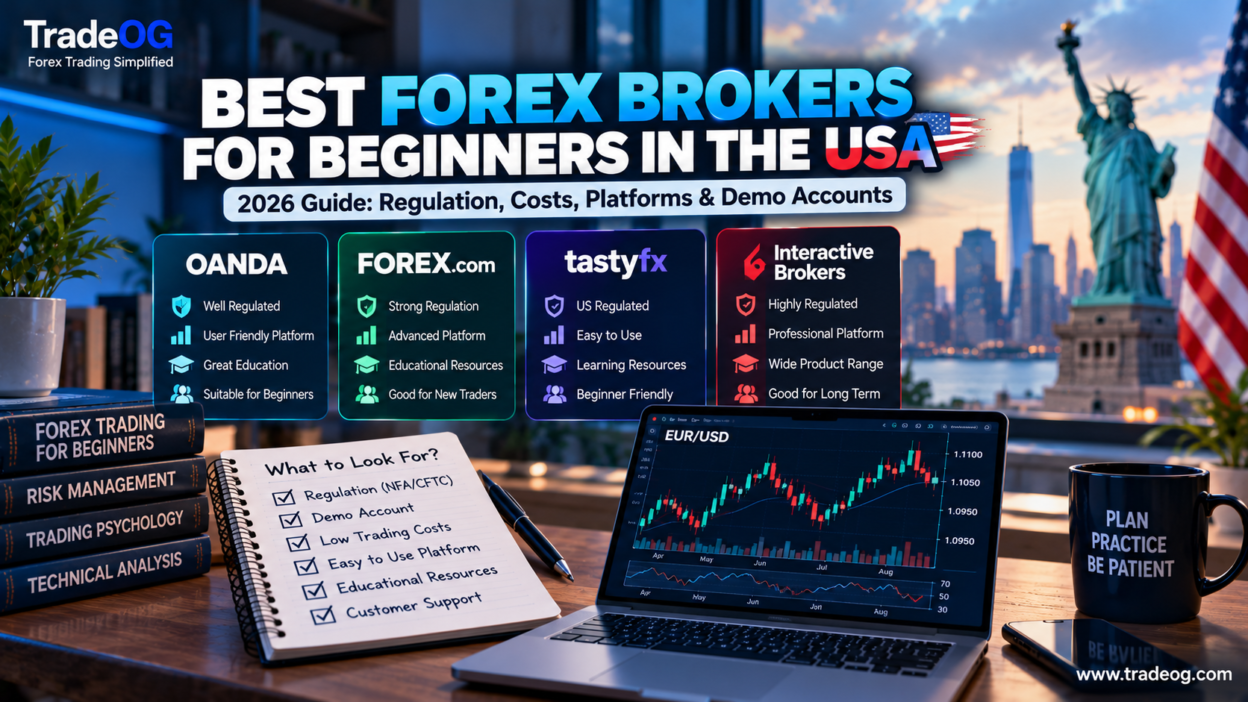
Best Forex Brokers for Beginners in the USA: Quick Picks
| Broker | Best For | Why Beginners May Like It |
|---|---|---|
| OANDA | Best overall beginner choice | User-friendly experience, education, research and demo trading |
| tastyfx | Beginner-friendly experience | Simple interface, U.S. regulation and access to IG’s broader ecosystem |
| FOREX.com | Learning + platform flexibility | Dedicated forex platform, education and multiple trading platforms |
| Interactive Brokers | Advanced traders who want to grow | Professional-grade infrastructure and broad market access |
| Charles Schwab | Traders already using Schwab | Large brokerage ecosystem and thinkorswim tools |
Our beginner-friendly starting point: OANDA is a strong option to investigate first, while tastyfx and FOREX.com are also worth comparing. Interactive Brokers is particularly attractive if you expect to move beyond basic forex and want a broader professional trading environment.
Broker availability, pricing, products and account requirements can change, so always verify the current terms directly with the broker before opening or funding an account.
Why U.S. Forex Regulation Matters
Before comparing spreads or trading platforms, check regulation.
The CFTC states that traders should verify that a forex dealer is properly registered and check its disciplinary history through the National Futures Association’s BASIC database. The CFTC also warns that many retail forex customers lose money and that OTC forex is different from trading on a centralized exchange.
For U.S. retail forex, the regulatory framework is strict. The CFTC identifies regulated dealers including OANDA, FOREX.com, Interactive Brokers, IG’s U.S. operation and other registered firms.
This is why a broker’s flashy website, large leverage advertisement or social-media popularity should never be your first selection criterion.
1. OANDA — Best Overall for Many Beginners
OANDA is one of the first brokers a U.S. beginner should compare. It combines a relatively approachable trading experience with research tools, educational material and access to several popular trading platforms.
OANDA’s U.S. operation states that it is regulated by the NFA, while U.S. retail forex leverage is subject to regulatory limits. OANDA currently states that U.S. retail forex leverage is limited to 50:1 on major currency pairs and 20:1 on other pairs.
Why beginners may like OANDA
- Beginner-friendly trading interface
- Demo trading is available
- Market research and educational resources
- Support for popular third-party platforms
- Strong focus on forex
Potential drawbacks
- Pricing is not necessarily the cheapest for every trading style
- Experienced traders may want more advanced execution features
- New traders still need to understand spread and financing costs
OANDA is a particularly sensible broker to test on a demo account before making a live deposit. The goal is not simply to see whether the charts look good. Test order entry, stop losses, take profits, position sizing and account statements.
2. tastyfx — Best for a Simple Beginner Experience
tastyfx is another U.S. forex broker worth considering if you want a clean and relatively approachable trading experience. Its connection to the broader IG group gives the brand access to a large global trading ecosystem.
Current 2026 broker comparisons list tastyfx among the leading regulated U.S. forex choices, particularly for beginners. It is also one of the U.S. brokers that supports MetaTrader alongside its own trading environment.
Why beginners may like tastyfx
- Simple trading experience
- U.S. regulated structure
- Demo account for practice
- Access to MetaTrader
- Educational resources through the broader IG ecosystem
Potential drawbacks
- Advanced traders may prefer a more institutional-style platform
- Not every global IG product is necessarily available to U.S. retail customers
- Forex-focused traders should still compare total trading costs
tastyfx can make sense for someone who wants to learn forex without immediately moving into a complicated professional platform.
3. FOREX.com — Best for Forex-Focused Traders
FOREX.com is a long-established name in the U.S. retail forex market. Its U.S. entity, GAIN Capital Group LLC, operates as a registered FCM and RFED with the CFTC and is a member of the NFA.
The broker offers different pricing structures. Its U.S. information states that its spread-only accounts are compensated through spreads, while RAW Pricing uses spreads plus a commission of $7 per $100,000 traded.
Why beginners may like FOREX.com
- Strong forex focus
- Multiple platform choices
- Educational material and market analysis
- Established U.S. regulatory structure
- MetaTrader availability
Potential drawbacks
- The number of pricing and platform choices can confuse a first-time trader
- Raw pricing is not automatically cheaper for every account or trading frequency
- Beginners should understand commission plus spread rather than comparing spread alone
If you want a broker where forex is the main focus of the experience, FOREX.com deserves a place on your comparison list.
4. Interactive Brokers — Best for Traders Who Want to Grow
Interactive Brokers is a different type of choice. It is less about making forex feel simple and more about providing a broad, professional trading environment.
Interactive Brokers LLC states that it is a registered Futures Commission Merchant and is subject to CFTC and NFA rules, as well as other U.S. securities regulations.
Why it can be attractive
- Professional-grade infrastructure
- Broad range of financial products
- Strong choice for traders who may diversify beyond forex
- Advanced order and market-analysis capabilities
Potential drawbacks for beginners
- The platform can feel overwhelming at first
- There are many tools that a new forex trader may not need
- Learning the platform can take longer than using a simpler forex-focused broker
Interactive Brokers is therefore not necessarily the easiest first broker, but it can be an excellent long-term option for someone who wants to develop into a more sophisticated multi-asset trader.
5. Charles Schwab — Worth Considering for Existing Schwab Customers
Charles Schwab is another U.S. financial-services provider included among regulated forex dealers. If you already use Schwab for stocks or other investments, having trading activity within the same broader ecosystem may be convenient.
The main question for a beginner is whether Schwab’s forex offering and platform experience fit the way you actually intend to trade. Do not choose a broker only because you already have another account with the company.
OANDA vs FOREX.com vs tastyfx vs Interactive Brokers
| Feature | OANDA | tastyfx | FOREX.com | Interactive Brokers |
|---|---|---|---|---|
| Beginner friendliness | High | High | High | Moderate |
| Forex focus | High | High | Very high | Broad multi-asset |
| Demo/practice | Yes | Yes | Yes | Practice/free-trial options |
| MetaTrader | Yes | Yes | Yes | Not the main platform focus |
| Advanced tools | Good | Good | Good | Excellent |
| Best fit | New traders | New traders | Forex-focused traders | Experienced/multi-asset traders |
What Should a Beginner Look for in a U.S. Forex Broker?
1. CFTC and NFA status
This should come before everything else. Use the NFA BASIC database to verify the firm’s registration and disciplinary history. The CFTC specifically recommends this step.
2. A good demo account
A demo account lets you learn the platform without immediately risking real money. Practice placing market and limit orders, setting stops, calculating position size and closing trades.
3. Transparent trading costs
Do not look only at the advertised spread. Your actual cost can include the spread, commissions, overnight financing, conversion charges and execution-related costs.
4. Platform simplicity
The most powerful platform is not necessarily the best platform for a beginner. If you cannot confidently place a stop loss or calculate your position size, additional indicators will not solve the problem.
5. Risk-management tools
Look for reliable stop-loss orders, position-size information, account reporting and clear margin information.
6. Customer support
For a beginner, support quality matters. You may eventually need help with verification, deposits, withdrawals, platform problems or account documentation.
How Much Money Do You Need to Start Forex Trading in the USA?
There is no single amount that makes someone ready to trade forex.
Some U.S. brokers advertise low or zero account minimums, but that does not mean a very small account is a good idea for active leveraged trading. Current broker comparisons show different stated minimums, including $0 at some brokers and $100 at FOREX.com, while actual funding requirements and product conditions can vary.
The better question is: How much can you afford to lose without affecting your financial life?
Do not borrow money to trade forex. Do not use rent, emergency savings, credit-card money or money needed for essential expenses.
How Much Leverage Can U.S. Forex Traders Use?
U.S. retail forex leverage is restricted compared with many offshore jurisdictions. OANDA currently notes the CFTC limits retail forex leverage to 50:1 for major currency pairs and 20:1 for other pairs.
Lower permitted leverage does not make forex safe. Leverage can magnify losses as quickly as it magnifies gains.
A beginner should think about position size and percentage risk first—not about how much leverage the broker will allow.
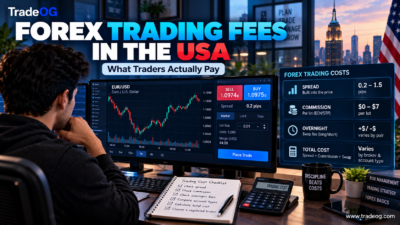
Forex Broker Fees Beginners Often Miss
- Spread: the difference between the bid and ask.
- Commission: charged on certain pricing structures.
- Overnight financing: a cost or credit for positions held beyond the broker’s daily cutoff.
- Currency conversion: possible when account and transaction currencies differ.
- Execution costs: fast markets can produce slippage between expected and executed prices.
For example, a broker advertising a very low raw spread may charge a commission. Another broker may offer a spread-only structure. Compare the total cost of a typical trade rather than selecting the lowest headline number.
Should Beginners Use MetaTrader?
MetaTrader can be useful, especially if you want a familiar charting and order-management environment. But it is not mandatory.
Several U.S. brokers support MetaTrader, including OANDA, FOREX.com and tastyfx.
For a beginner, the better question is not “Does this broker have MT4 or MT5?” It is “Can I use this platform confidently without making order-entry mistakes?”
Demo Account vs Live Account
A demo account should be treated as training, not as proof that you are ready to make money.
Before funding a live account, practice:
- Opening and closing trades
- Setting stop losses
- Setting take-profit orders
- Calculating position size
- Reading margin information
- Managing open positions
- Checking transaction history
- Following a written trading plan
Also remember that demo execution may not perfectly reproduce the emotional and execution conditions of live trading.
Common Forex Broker Scams U.S. Beginners Should Avoid
Be especially cautious when someone promises guaranteed returns, secret signals, fixed daily profits or extremely high leverage.
The CFTC warns about unregistered offshore forex dealers and recommends checking registration and disciplinary history before depositing funds.
Red flags include:
- Guaranteed profits
- Pressure to deposit immediately
- Unclear legal company name
- No verifiable CFTC/NFA registration
- Requests to send money to a personal account or cryptocurrency wallet
- Promises of unusually high leverage for U.S. residents
- Withdrawal problems or unexplained fees
Best Forex Broker for Beginners: Our Verdict
OANDA: A strong first broker to investigate if you want a beginner-friendly forex experience, research and a straightforward path from demo to live trading.
tastyfx: A compelling option if simplicity and a beginner-oriented experience are high on your list.
FOREX.com: A strong choice for traders who want a dedicated forex environment, educational resources and platform flexibility.
Interactive Brokers: Better suited to beginners who are willing to spend more time learning a professional platform and expect to trade multiple asset classes over time.
Charles Schwab: Worth considering for existing Schwab customers who want to evaluate forex within a larger brokerage relationship.
How to Choose Your First Forex Broker in 7 Steps
- Verify regulation. Check the firm’s current CFTC/NFA status.
- Open a demo. Do not deposit immediately.
- Test the platform. Place different order types and set stops.
- Compare total costs. Look at spreads, commissions and financing.
- Check funding and withdrawal rules. Read the actual account agreement.
- Practice risk management. Decide your maximum loss before trading.
- Start small. Increase size only after you have demonstrated consistency.
Frequently Asked Questions
What is the best forex broker for beginners in the USA?
OANDA is a strong starting point for many beginners because of its user-friendly experience, research and demo capabilities. tastyfx and FOREX.com are also strong alternatives. Your final choice should depend on platform preference, costs, education and the products you actually intend to trade.
Are offshore forex brokers legal for U.S. residents?
Do not assume that an offshore broker is authorized to provide retail forex services to U.S. residents simply because its website accepts registrations. Verify the firm’s regulatory status and U.S. authorization before depositing money.
Is forex trading legal in the USA?
Yes, retail forex trading is legal in the United States when conducted through appropriately regulated providers and within applicable U.S. rules. The regulatory environment is stricter than in many other jurisdictions.
Can U.S. traders use MetaTrader?
Yes. Some regulated U.S. forex brokers support MetaTrader, including OANDA, FOREX.com and tastyfx. Availability and specific platform versions can change, so check the broker’s current offering.
How much money should a beginner deposit?
There is no universal ideal amount. Start only with money you can afford to lose. A low minimum deposit is not a recommendation to trade aggressively with a small account.
Can I trade forex with $100?
A broker may allow a small account, but having enough money to open an account is not the same as having enough capital to trade responsibly. Your position size, stop-loss distance and risk per trade matter more than the deposit minimum.
Is high leverage good for beginners?
No. Higher leverage increases the amount of market exposure you can control relative to your account, but it also increases the speed at which losses can accumulate. Beginners should focus on risk management rather than maximizing leverage.
Official Sources and Broker Verification
Before opening an account, verify the broker’s current regulatory status and terms using official sources. The CFTC recommends checking registration and disciplinary history through the NFA BASIC database.
- CFTC: Check Registration & Backgrounds Before You Trade
- NFA BASIC
- OANDA U.S.
- FOREX.com U.S.
- tastyfx
- Interactive Brokers
Final Thoughts
The best forex broker for a beginner in the USA is not necessarily the broker with the lowest spread, the highest leverage or the most indicators. It is the broker that is properly regulated, transparent about costs, reliable enough for your needs and simple enough for you to use correctly.
Start with regulation. Then compare the demo account, platform, spreads, commissions, financing costs, customer support and educational resources. Take your time before depositing real money.
Most importantly, remember that a good broker cannot turn a poor trading strategy into a profitable one. Your broker provides the infrastructure. Your risk management and trading decisions determine what happens to your account.
For a U.S. beginner in 2026, OANDA, tastyfx and FOREX.com are sensible brokers to compare first, while Interactive Brokers is worth considering if you want a more advanced multi-asset platform.
Risk disclosure: Forex trading involves substantial risk of loss and is not suitable for every investor. This article is educational information, not personalized investment advice. Verify current regulatory status, fees, products, leverage limits and account terms directly with the broker and the relevant U.S. regulators before opening an account.