

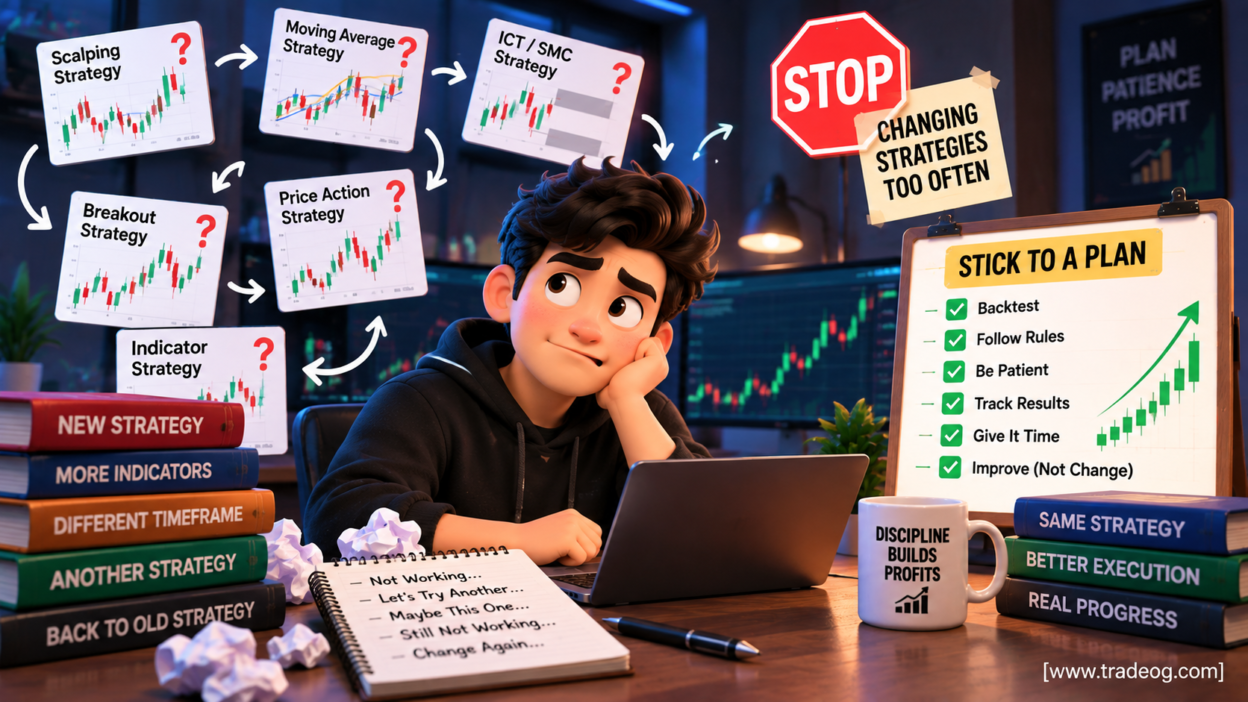
Changing trading strategies too often is one of the most common reasons traders struggle to build consistency. A trader may use a breakout setup for a few days, switch to an indicator-based system after a losing streak, then move to price action, scalping, or another strategy when the market changes.
The problem is not that every strategy is bad. The problem is that a strategy rarely gets enough time, data, and disciplined execution to prove whether it actually works.
If you constantly ask, “Should I change my trading strategy?”, this guide explains how to stop strategy hopping and build a process you can evaluate objectively.
Why Traders Keep Changing Strategies
Strategy switching usually comes from a combination of psychology, unrealistic expectations, and poor measurement.
1. A Losing Streak Creates Doubt
Even a profitable trading system can produce several consecutive losses. Traders often interpret a normal drawdown as proof that the strategy has stopped working. They then abandon it before collecting enough evidence.
2. Another Strategy Looks Better
Social media makes this problem worse. Traders see screenshots of profitable trades, new indicators, smart-money concepts, scalping systems, or highly accurate-looking setups and assume another strategy will solve their current problems.
3. Traders Expect Immediate Results
A strategy is not a money-making button. Execution quality, market conditions, position sizing, spreads, slippage, timing, and discipline all affect results. Expecting a new system to produce immediate profits encourages constant switching.
4. There Is No Written Trading Plan
Without predefined entry rules, exit rules, risk limits, trading hours, and invalidation conditions, almost any losing trade can become a reason to change the system.
The Real Cost of Strategy Hopping
Changing strategies repeatedly creates a measurement problem. You never know whether the strategy failed or whether you failed to execute it consistently.
| Behavior | What Happens |
|---|---|
| Change after a few losses | You abandon normal statistical variance |
| Add indicators after losses | The system becomes more complicated |
| Copy a new strategy from social media | You restart the learning curve |
| Change rules during a trade | Your historical data becomes unreliable |
| Never journal trades | You cannot identify the actual weakness |
The biggest hidden cost is lost information. Every time you change the rules, you make your previous results less useful for evaluating the new system.
How to Stop Changing Trading Strategies Too Often
1. Choose One Core Strategy
Select one strategy that matches your personality, preferred market, timeframe, and available trading hours. You do not need the “perfect” strategy. You need a strategy that you can understand and execute consistently.
For example, your core system could be based on trend continuation, breakouts, pullbacks, price action, or a defined support-and-resistance framework. Keep the rules simple enough that two traders could interpret them similarly.
2. Define the Rules Before Trading
Write down exactly what qualifies as a trade. Your plan should define the market, timeframe, setup, entry trigger, stop-loss placement, take-profit logic, maximum risk per trade, trading session, and conditions that invalidate a setup.
If a rule is not written down, avoid treating it as part of the strategy.
3. Backtest Before You Abandon It
Do not judge a strategy from five or ten trades. Build a meaningful sample using historical data and, when possible, forward testing. Record the win rate, average win, average loss, maximum losing streak, drawdown, and expectancy.
A strategy with a 45% win rate can still be viable if its average winning trade is sufficiently larger than its average losing trade. Win rate alone does not determine whether a system has an edge.
4. Set a Minimum Evaluation Sample
Before live trading, decide how many trades you will use to evaluate the system. The exact number depends on the strategy and market, but the important rule is this: do not change the system simply because of a short losing streak.
Evaluate the strategy after a predefined sample, not after an emotional day.
5. Separate Strategy Failure From Execution Failure
This is one of the most important distinctions in trading.
If your strategy required a valid breakout, but you entered before confirmation, that trade does not necessarily prove the strategy failed. If you moved the stop, ignored the risk limit, or entered outside your trading window, the problem may have been execution.
Journal every trade as either a valid execution, execution mistake, rule violation, or market condition outside your tested framework.
6. Create a “No Strategy Changes” Rule
Give yourself a cooling-off period. For example, you can decide that strategy rules cannot be changed during an evaluation cycle unless there is a documented structural problem.
This prevents emotional decisions immediately after a loss.
7. Improve One Variable at a Time
If the strategy needs improvement, do not replace everything simultaneously. Test one variable at a time: entry confirmation, stop placement, trading session, risk-reward structure, or market filter.
This turns random strategy switching into controlled strategy development.
Use a Trading Journal to Prove What Is Actually Working
A trading journal should contain more than entry and exit prices. Record the setup type, market condition, reason for entry, planned stop, planned target, actual result, rule violations, emotional state, and screenshot.
After a meaningful sample, look for patterns. You may discover that the strategy performs well during one session but poorly during another, or that most losses come from trades that did not meet your full setup criteria.
That information is far more useful than searching for another strategy.
When Should You Actually Change a Trading Strategy?
There are legitimate reasons to modify or replace a strategy. A strategy deserves serious review when robust testing shows that its expected performance no longer matches the conditions in which it was designed to operate.
Examples include a persistent deterioration in expectancy across a sufficiently large sample, a major change in the market or instrument, execution costs that invalidate the original edge, or a strategy that is fundamentally incompatible with your risk tolerance and trading schedule.
Do not confuse a normal losing period with structural failure.
A Simple Strategy Evaluation Framework
Use this process whenever you feel the urge to switch systems:
- Stop trading impulsively for a moment.
- Review the last group of trades.
- Separate rule-following trades from mistakes.
- Check expectancy rather than win rate alone.
- Review drawdown and losing streaks against historical results.
- Identify whether market conditions changed.
- Change only one variable if testing shows a genuine weakness.
- Continue the evaluation instead of jumping to an unrelated strategy.
Strategy Consistency Matters More Than Strategy Variety
Knowing ten trading strategies does not automatically make a trader better. In many cases, knowing one clearly defined system and executing it with discipline is more valuable.
Consistency allows you to collect comparable data. Comparable data allows you to measure expectancy. Measurement allows you to improve. Constant strategy switching breaks that chain.
Final Takeaway
To stop changing trading strategies too often, stop evaluating your system emotionally. Define the rules, test them over a meaningful sample, journal execution, measure expectancy, and establish clear conditions for when a strategy can be changed.
The goal is not to find a strategy that never loses. The goal is to develop a process where losses are expected, mistakes are identifiable, and strategy changes are based on evidence rather than frustration.
Trade the plan long enough to collect evidence before deciding whether the plan deserves to change.
Frequently Asked Questions
How often should I change my trading strategy?
There is no universal schedule. Avoid changing a strategy because of a small number of losses. Use a predefined evaluation sample and objective performance metrics.
Is strategy hopping bad for traders?
Frequent strategy hopping can make it difficult to determine whether a strategy has an edge because the rules and sample keep changing.
What should I do after a losing streak?
Review the trades and determine whether the losses were normal for the strategy, caused by execution errors, or linked to unsuitable market conditions. Do not automatically replace the strategy.
Should beginners use only one trading strategy?
Beginners generally benefit from mastering one clearly defined framework before adding complexity. The objective is to develop repeatable execution and understand the statistics of the system.