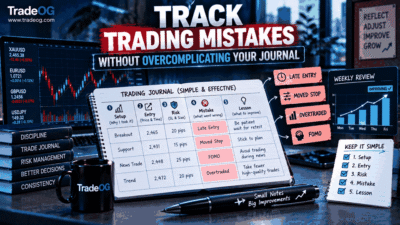


Trading Journal Apps Indian Traders Can Use
Trading is not only about finding entries. A serious trader also needs to know which setups actually work, when losses are coming from the strategy, when they are coming from poor execution, and whether risk is being controlled consistently.
That is where a trading journal becomes useful.
A trading journal records what happened before, during and after a trade. Over time, it can reveal patterns that are difficult to notice from a broker statement alone.
For Indian traders, the need is even more practical because the trading environment can involve NSE and BSE stocks, index futures and options, MCX commodities, XAU/USD through international or prop-firm platforms, forex-related instruments, and multiple trading accounts.
This guide looks at trading journal apps that Indian traders can consider in 2026, what each type of platform is good for, what to check before paying, and how to build a journaling workflow that actually improves decision-making.
Why Indian Traders Should Use a Trading Journal
A broker statement normally tells you how much you made or lost.
A good journal can help answer much better questions.
Which setup has the highest expectancy?
Do you perform better during the Indian morning session or later in the day?
Are your NIFTY losses concentrated around specific market conditions?
Do you make more mistakes when trading Bank Nifty options?
How often do you move a stop-loss?
Are your XAU/USD losses concentrated around CPI, NFP or FOMC?
Do you take too many trades after a losing trade?
Are you risking more when you feel confident?
These questions turn a trade history into a decision-making database.
A journal does not make a strategy profitable by itself. Its value comes from helping you identify repeatable behavior and remove avoidable mistakes.
What Should a Trading Journal Track?
Before choosing an app, understand what information you actually need.
At minimum, your journal should record:
Date and time
Instrument
Buy or sell
Entry price
Exit price
Position size
Stop-loss
Take-profit
Gross P&L
Fees and commissions
Net P&L
Risk per trade
Strategy or setup
Market session
Reason for entry
Reason for exit
Screenshot
Mistake or rule violation
Emotional state
Post-trade notes
For Indian traders, you may also want to track:
NSE or BSE
NIFTY
Bank Nifty
FINNIFTY
Equity stocks
Index options
Stock options
Futures
MCX Gold
MCX Silver
XAU/USD
USD/INR
Prop-firm account
Broker account
Account currency
Brokerage and transaction charges
STT and other applicable costs
Not every journal handles all of these fields in the same way. This is why choosing a platform based only on its marketing feature list can be a mistake.
Best Trading Journal Apps Indian Traders Can Consider
There is no single best journal for every trader.
A beginner who wants simple analytics may prefer a different platform from a prop-firm trader who needs detailed execution analysis.
The following platforms are worth considering.
1. TradeZella
TradeZella is one of the more complete trading journals for traders who want journaling, analytics, strategy review, replay and backtesting in one ecosystem.
Its current platform includes automated trade journaling, strategy tracking, analytics, trade replay, backtesting and AI-powered features. TradeZella also advertises more than 500 broker and prop-firm integrations.
The platform introduced updated pricing in July 2026. Its current plans are Essential at $35 per month, Pro at $59 per month and Ultra at $99 per month, with lower effective monthly pricing when billed annually.
Why Indian traders may consider TradeZella:
Strong analytics
Automated journaling options
Strategy tracking
Trade replay
Backtesting
Prop-firm oriented features
Multiple-account support on higher plans
AI-assisted review
Potential limitation for Indian traders:
Do not assume that a platform supporting hundreds of brokers automatically supports every Indian broker or every Indian instrument perfectly.
Before subscribing, test how your actual trade data imports.
This is especially important for:
Zerodha
Upstox
Angel One
Groww
ICICI Direct
Other Indian brokers
If your broker is not directly supported, check whether the platform accepts your CSV or other export format.
Best for:
Traders who want a premium all-in-one review and analytics platform.
2. TraderSync
TraderSync focuses heavily on trade journaling, analytics, planning and performance review.
Its official feature set includes interactive charts, trade-specific analytics, screenshots, stop-loss and target tracking, custom tags and detailed trade breakdowns. Its higher plans also include trade replay, AI assistance and advanced market tools.
TraderSync currently offers several pricing tiers. Its Pro plan is listed at $29.95 per month before annual-billing discounts, with higher plans adding more accounts and advanced functionality.
Why Indian traders may consider TraderSync:
Detailed trade analytics
Interactive charts
Screenshot support
Custom trade tags
Trade planning
Risk and target tracking
Trade replay on applicable plans
AI features on higher plans
TraderSync can be useful if you trade multiple markets and want one place to review your decisions.
For Indian traders, the key issue is data import.
Check the current broker directory and test your actual export before paying. A broker appearing in a platform directory does not automatically mean that every instrument, contract format, fee structure or execution type will import exactly as expected.
Best for:
Active traders who want detailed analytics and a strong trade-review workflow.
3. TradesViz
TradesViz is particularly interesting for traders who want a large amount of analytics and a usable free option.
Its official platform currently offers a free plan, with the free tier allowing up to 3,000 executions per month and including basic journaling, charts, tags, notes and broker-file imports.
TradesViz also advertises support for more than 250 brokers and platforms, along with advanced plans covering multiple asset classes, AI tools, simulations, backtesting and hundreds of statistics.
Why Indian traders may consider TradesViz:
Free plan available
Large analytics library
Broker-file import
Stocks
Options
Futures
Forex
Crypto
CFDs
AI Coach on paid plans
Large number of statistics and visualizations
The free tier can make TradesViz attractive to a beginner who wants to start journaling without immediately committing to a subscription.
For an Indian trader, the biggest advantage may be the ability to test the workflow before spending money.
Export a small sample of your actual trading history.
Import it.
Check entries.
Check exits.
Check quantities.
Check fees.
Check P&L.
Check partial fills.
Then decide whether the journal is reliable enough for your workflow.
Best for:
Budget-conscious traders and traders who want deep analytics.
4. Edgewonk
Edgewonk takes a different approach.
Instead of focusing only on automated analytics, it places significant emphasis on trading psychology, discipline, mistakes, strategies and structured review.
Its current annual plan is listed at $197 for customers outside the EU and UK, with the platform providing unlimited journals, unlimited trades, multiple markets, strategy tracking, psychology analysis, drawdown analysis, mistake tracking, checklists, performance simulation and other review features.
Why Indian traders may consider Edgewonk:
Trading psychology tracking
Mistake tracking
Strategy analysis
Risk analysis
Drawdown analysis
Trading plans
Checklists
Performance simulation
Unlimited trades
Multi-market support
This can be particularly useful if your main problem is not finding another indicator but following your own trading rules.
For example, suppose your strategy is profitable when you follow the plan but loses money when you enter late.
A journal focused on mistakes and psychology can help identify that pattern.
Best for:
Traders whose biggest challenge is discipline, psychology and process consistency.
5. Tradervue
Tradervue is another established trading journal option.
It focuses on importing trades, organizing trade history, reviewing individual trades and analyzing performance.
It can appeal to traders who want a relatively straightforward journaling workflow rather than an extremely complex trading research environment.
Why Indian traders may consider Tradervue:
Trade organization
Performance reports
Trade notes
Screenshots and review
Strategy tagging
Trade sharing and review workflows
The important point for Indian users is again data compatibility.
Before committing to any international journal, confirm that your broker’s export format works correctly.
A journal that requires hours of manual correction after every import may become too inconvenient to maintain.
Best for:
Traders who want an established trade-review and reporting workflow.
6. A Spreadsheet
Do not underestimate a spreadsheet.
For many Indian beginners, Google Sheets or Excel can be a better starting point than an expensive journal subscription.
A spreadsheet can track:
Date
Instrument
Setup
Entry
Stop-loss
Target
Exit
Quantity
Risk
P&L
Fees
R multiple
Session
Mistake
Emotion
Screenshot link
Notes
You can also build custom formulas for:
Win rate
Average win
Average loss
Profit factor
Expectancy
Maximum drawdown
Average R
Best setup
Worst setup
Best trading day
Worst trading day
Session performance
The biggest advantage is control.
The biggest disadvantage is manual work.
If you stop updating the spreadsheet, the system stops being useful.
The Best Journal Depends on Your Trading Style
Instead of asking which app is number one, ask what you need.
For NIFTY and Bank Nifty traders:
Look for accurate quantity handling, options support, fees, partial exits and clean performance reports.
For equity traders:
Look for broker import, symbol mapping, dividends if relevant, fees and long-term performance analysis.
For options traders:
Look for strike, expiry, option type, premium, quantity, contract multiplier and multi-leg strategy support.
For XAU/USD traders:
Look for forex or CFD support, lot size, entry and exit price, spread, commission, swap where applicable and screenshot review.
For prop-firm traders:
Look for multiple accounts, drawdown tracking, daily loss analysis, risk rules, trade review and support for the platform used by your prop firm.
For scalpers:
Look for precise timestamps, execution analysis, session filters, screenshots and fast trade review.
For swing traders:
Look for longer holding-period analysis, setup tracking, fundamental notes and portfolio-level statistics.
What Indian Traders Should Check Before Paying
This is one of the most important sections.
Do not buy a trading journal simply because a website says it supports hundreds of brokers.
Test the actual workflow.
1. Test Your Broker Import
Export a small number of trades.
Import them.
Compare every field with your broker statement.
2. Check Quantities
This is particularly important for Indian derivatives.
Make sure the platform correctly understands your quantity and contract structure.
3. Check Fees
A gross P&L number can look good while the net result is much weaker after brokerage, exchange charges, taxes and other costs.
4. Check Partial Exits
Suppose you enter one position and exit it in three parts.
Make sure the journal reconstructs the trade correctly.
5. Check Time Zones
Indian traders should verify that timestamps are displayed correctly in IST when required.
This matters when analyzing:
NSE sessions
U.S. sessions
CPI
NFP
FOMC
Fed speeches
Gold trading
Prop-firm execution
6. Check Currency Handling
If your account is in INR but you trade an instrument priced in USD, understand how the journal handles currency conversion.
7. Check Data Export
A good journal should not trap your history.
Find out whether you can export your data.
8. Check Screenshots
Screenshots are extremely useful for discretionary traders.
They preserve the exact market context around an entry.
9. Check Mobile Access
If you review trades away from your desktop, a mobile app or responsive web experience can be important.
10. Check Subscription Limits
Some platforms restrict:
Number of accounts
Number of trades
AI credits
Backtesting
Replay
Reports
Data retention
Imports
Make sure the plan fits your actual volume.
How to Journal NIFTY Trades
A useful NIFTY journal should record more than P&L.
Example:
Instrument: NIFTY
Direction: Buy
Setup: Breakout
Entry: Planned level
Stop-loss: Defined before entry
Target: Defined before entry
Risk: 0.5% of account
Session: Morning
Market condition: Trending
Reason: Breakout with volume confirmation
Execution: On plan
Emotion before entry: Neutral
Emotion after entry: Slightly anxious
Exit: Target
Mistake: None
Screenshot: Attached
After 50 or 100 trades, you can start comparing your actual results.
Maybe breakout trades have a positive expectancy.
Maybe your afternoon trades are consistently weaker.
Maybe your losses increase when you widen the stop.
That is actionable information.
How to Journal Bank Nifty Options
Options require additional fields.
Record:
Underlying
Call or put
Strike
Expiry
Entry premium
Exit premium
Quantity
Number of lots
Stop-loss
Target
Strategy
IV environment when relevant
Time to expiry
Reason for entry
Reason for exit
Fees
Slippage
Screenshot
Mistake
One common mistake is to judge an options strategy using only the percentage return on individual trades.
A journal should also show how much capital was at risk and how consistent the results are.
How to Journal XAU/USD Trades
For Indian traders who trade gold, journaling becomes especially useful around major U.S. events.
Track:
XAU/USD
Direction
Lot size
Entry
Stop-loss
Take-profit
Exit
Risk in dollars
R multiple
Trading session
Setup
DXY condition
Treasury-yield environment
News event
Screenshot
Reason for entry
Reason for exit
Mistake
Emotional state
For example, you may eventually discover that your XAU/USD strategy works well during London-New York overlap but performs poorly immediately before high-impact U.S. news.
That is a much more useful discovery than simply knowing your monthly P&L.
How to Journal Prop-Firm Trades
Prop-firm traders should add account-level risk metrics.
Track:
Starting balance
Current equity
Daily loss
Maximum drawdown
Risk per trade
Open exposure
Number of trades
Winning trades
Losing trades
Rule violations
News-event trades
Daily P&L
Weekly P&L
Consistency
This allows you to answer an important question:
“Am I losing because my strategy is bad, or because I am violating my risk rules?”
Those are completely different problems.
The 30-Second Journal Method
A journal does not have to take 15 minutes after every trade.
You can use a simple three-stage workflow.
Before the trade:
Write the setup and planned risk.
During the trade:
Avoid changing the plan without a documented reason.
After the trade:
Record the result and one sentence explaining whether you followed the plan.
Example:
Setup: London breakout
Risk: 0.5%
Result: +1.4R
Plan followed: Yes
Mistake: Entered 2 minutes late
That takes less than a minute.
At the end of the week, perform the deeper analysis.
The Weekly Trading Journal Review
This is where the real value appears.
Once per week, review:
Total trades
Win rate
Average winner
Average loser
Profit factor
Expectancy
Maximum drawdown
Average R
Best setup
Worst setup
Best session
Worst session
Rule violations
Largest emotional mistake
Largest execution mistake
One change for next week
Do not try to change ten things at once.
Pick one behavior.
For example:
Next week I will not move my stop-loss farther away.
That is measurable.
After 20 or 30 trades, review whether the behavior improved.
What Metrics Matter Most?
Win rate is useful, but it is not enough.
Imagine Strategy A:
Win rate: 70%
Average win: 1R
Average loss: 2R
Strategy B:
Win rate: 45%
Average win: 2.5R
Average loss: 1R
Strategy B may have better expectancy despite the lower win rate.
This is why your journal should track R multiples, not only rupee or dollar P&L.
Useful metrics include:
Win rate
Average win
Average loss
Expectancy
Profit factor
Average R
Maximum drawdown
Largest losing streak
Largest winning streak
Setup expectancy
Session expectancy
Long versus short performance
Day-of-week performance
Trade duration
Mistake frequency
Rule-following percentage
The Psychology Layer
A trade journal becomes much more powerful when it records behavior.
Use simple tags such as:
FOMO
Revenge trade
Overtrading
Early entry
Late entry
Moved stop
Oversized position
Exited too early
Ignored setup
News chase
No confirmation
Followed plan
This allows you to answer questions such as:
How much money did FOMO cost me last month?
How often do I revenge trade after a loss?
Does moving my stop reduce my average R?
Do my best trades happen when I wait for confirmation?
Those are questions a standard broker statement cannot answer.
Free vs Paid Trading Journals
A paid journal is not automatically better.
A free spreadsheet used every day can be more valuable than a $50-per-month platform that you rarely open.
For beginners:
Start with a spreadsheet or a free journal.
For active traders:
Move to an automated journal when manual entry becomes a burden.
For professional or serious traders:
Consider advanced analytics, replay, psychology and strategy-testing features.
For prop-firm traders:
Prioritize drawdown, risk and rule tracking.
For options traders:
Prioritize accurate contract and multi-leg handling.
For Indian traders:
Prioritize reliable broker-file imports and INR/IST handling before flashy AI features.
Which Trading Journal Should Indian Traders Choose?
A simple decision framework can help.
Choose TradeZella if you want an all-in-one premium platform with journaling, strategy review, replay, backtesting and AI features.
Choose TraderSync if you want detailed trade analytics, planning, interactive charts and advanced review features.
Choose TradesViz if you want a strong free starting point and extensive analytics, with paid upgrades for more markets and advanced tools.
Choose Edgewonk if trading psychology, mistakes and discipline are your main priorities.
Choose Tradervue if you prefer a more established trade organization and reporting workflow.
Choose Excel or Google Sheets if you are a beginner and want maximum control with minimum cost.
There is no universal winner.
The best journal is the one that accurately captures your trades and that you consistently review.
A Simple Indian Trader Journal Template
You can start with these columns:
Date
Time
Market
Symbol
Direction
Setup
Entry
Stop-loss
Target
Exit
Quantity
Risk
P&L
R Multiple
Fees
Session
Market Condition
Emotion
Mistake
Screenshot
Plan Followed?
Post-Trade Note
For options, add:
Expiry
Strike
Call/Put
Premium
Lots
For prop-firm accounts, add:
Starting Equity
Ending Equity
Daily Drawdown
Maximum Drawdown
Rule Violation
For XAU/USD, add:
Lot Size
News Event
DXY Direction
Yield Direction
This simple structure can already produce valuable insights.
Final Takeaway
Indian traders do not need the most expensive trading journal.
They need a journal that accurately records their trades and makes review easier.
TradeZella, TraderSync, TradesViz, Edgewonk and Tradervue all offer different approaches. A spreadsheet can also be a perfectly reasonable starting point.
Before paying for any platform, test your real broker export.
Check quantities.
Check partial exits.
Check fees.
Check timestamps.
Check currency conversion.
Check options contracts if you trade derivatives.
Check XAU/USD lot handling if you trade gold.
And most importantly, check whether you will actually use the journal.
The goal of journaling is not to create another dashboard.
The goal is to turn your trading history into evidence.
Your journal should eventually tell you:
What works.
What does not work.
When you perform best.
When you make your biggest mistakes.
Which setups deserve more attention.
Which habits are destroying your edge.
For Indian traders, that information can be far more valuable than another indicator added to the chart.
FAQs
What is the best trading journal for Indian traders?
There is no universal best choice. TradeZella, TraderSync, TradesViz, Edgewonk and Tradervue each focus on different workflows. Indian traders should choose based on broker compatibility, markets traded, analytics, cost and ease of consistent use.
Is TradesViz free?
TradesViz currently offers a free plan. Its official site lists up to 3,000 executions per month on the free tier, along with basic journaling and analytics features. Paid plans add more asset classes and advanced functionality.
Is TradeZella worth it for Indian traders?
It can be useful for active traders who want advanced analytics, replay, backtesting and automated journaling. However, Indian traders should verify their specific broker and instrument import workflow before subscribing.
Can Indian traders use TraderSync?
Yes, Indian traders can consider TraderSync, but the important question is whether your specific broker export or connection works correctly. Always test actual trade data before paying for a long subscription.
Is Edgewonk good for trading psychology?
Edgewonk is particularly focused on psychology, mistakes, discipline, strategies and performance review, making it worth considering if behavioral mistakes are a major problem.
Can I use Excel as a trading journal?
Yes. Excel or Google Sheets can track trades, risk, P&L, setups, emotions and mistakes. It is often a good starting point for beginners.
Should a trading journal track emotions?
Yes. Emotional tags such as FOMO, revenge trading, hesitation and overconfidence can reveal behavioral patterns that are invisible in normal P&L reports.
Should Indian options traders use a trading journal?
Yes. Options traders can benefit significantly from tracking strike, expiry, premium, quantity, strategy, risk, fees and multi-leg execution.
Should XAU/USD traders keep a journal?
Yes. XAU/USD traders should consider recording lot size, risk, session, setup, news events, screenshots, DXY conditions and the reason for entry and exit.
How often should I review my trading journal?
A quick review after each trade and a deeper weekly review is a practical approach. A monthly review can then identify larger patterns.
Sources & Further Reading
TradeZella
https://www.tradezella.com/pricing
TradeZella Help Center — Pricing
https://help.tradezella.com/en/articles/8911582-our-pricing
TraderSync
https://tradersync.com/features/
TraderSync Pricing
https://tradersync.com/pricing/
TradesViz
https://www.tradesviz.com/
TradesViz Pricing
https://www.tradesviz.com/pricing/
Edgewonk
https://edgewonk.com/pricing/
TradeOG provides educational information only and does not provide financial advice. Trading involves substantial risk, and past performance does not guarantee future results.