
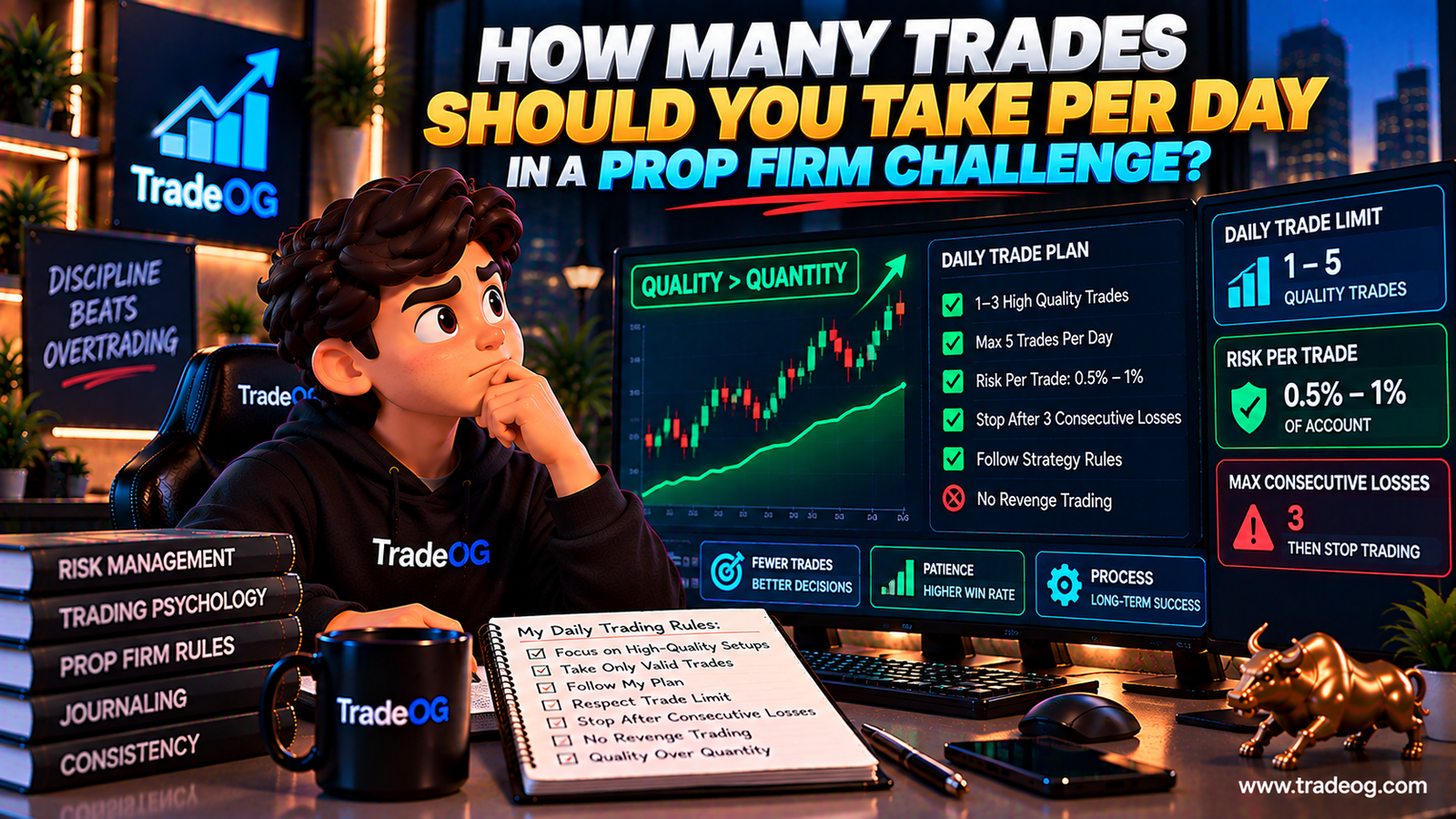
One of the most common questions in prop trading sounds simple: how many trades should you take per day in a prop firm challenge?
The difficult part is that there is no universal number that fits every trader, strategy, market or prop-firm account.
A scalper may legitimately take several qualified setups. A breakout trader may take one trade. A swing-oriented approach may produce no trade at all on a particular day.
The important question is therefore not simply “How many trades can I take?” It is:
“How many trades can I take while keeping my strategy, risk model, drawdown limits and execution quality under control?”
That distinction matters in a prop firm challenge because the objective is normally constrained by account-specific rules such as maximum loss, daily loss, position limits, profit targets, consistency requirements or other trading conditions.
For example, Topstep’s current Trading Combine parameters include a Maximum Loss Limit, a Profit Target, a Consistency Target and maximum position sizes. The rules do not require traders to use the maximum permitted position size. Topstep — Trading Combine Parameters.
Topstep also currently describes responsible trading as avoiding excessive account churn and focusing on sustainable habits, discipline and risk management. Topstep — Responsible Trading.
FTMO’s current guidance similarly emphasizes predefined risk, avoiding revenge sizing and setting a personal stop-trading limit below the account’s outer loss boundaries. FTMO — 5 Rules to Stop Breaching Your Challenge.
Is There a Perfect Number of Trades Per Day?
No.
There is no evidence-based universal rule such as “every prop trader should take exactly three trades per day.” The correct frequency depends on the strategy’s opportunity frequency and the trader’s risk model.
Think about trade frequency as an output of your strategy rather than an input.
| Trading Style | Possible Daily Frequency | Main Consideration |
|---|---|---|
| Selective intraday | 0–3 trades | Wait for high-quality setups |
| Active intraday | Several trades | Costs, execution and risk accumulation |
| Breakout | 0–2 trades | Wait for qualified breakouts |
| News/event strategy | Strategy-dependent | Firm-specific event rules |
| Short-term scalping | Potentially many | Execution quality and tested expectancy |
These ranges are illustrative, not recommendations. A strategy should determine its normal opportunity frequency from historical testing and live execution data.
The Biggest Mistake: Setting a Trade Quota
A quota sounds disciplined:
“I must take five trades today.”
But what happens if only one setup appears?
The trader may start searching for reasons to enter.
That can turn a strategy into a trade-generation exercise rather than a decision framework.
A better rule is:
Take every trade that independently satisfies the tested setup and risk rules, and take no trade when those conditions are absent.
This means a successful day can contain:
- zero trades;
- one trade;
- two trades;
- several trades;
depending on the strategy.
Trade Frequency vs Trade Quality
More trades do not automatically mean more opportunity.
Every additional trade creates another exposure to:
- market risk;
- slippage;
- commissions or transaction costs;
- execution errors;
- emotional decisions;
- drawdown.
Topstep’s current guidance explicitly frames responsible trading around sustainable habits rather than churning through many accounts, and its current prohibited-strategy guidance distinguishes legitimate trading from deliberately exploiting simulator behaviour through hundreds or thousands of rapid trades. Topstep — Responsible Trading and Topstep — Prohibited Trading Strategies.
Start With Risk, Not Trade Count
The most useful way to determine a daily trade limit is to start with your risk budget.
Suppose, purely as an example, that a trader has decided that the maximum acceptable personal loss for the day is $450.
If each planned trade risks $150:
$450 ÷ $150 = 3 full-risk trades
That does not automatically mean the trader should take three trades.
It means three full losses would consume the entire hypothetical daily risk budget.
If the strategy normally generates one or two valid setups, the trader should not manufacture a third.
Why Your Personal Daily Stop Should Be Below the Firm Limit
A prop firm’s maximum loss is an outer boundary, not necessarily a sensible personal trading budget.
If you wait until the account is close to its formal limit before stopping, you have left very little room for execution error, slippage or another loss.
FTMO’s current challenge guidance recommends establishing a personal stop-trading limit instead of relying only on the account’s maximum loss boundary. Its example suggests stopping after a defined number of consecutive losses or after using part of the permitted daily loss. FTMO — 5 Rules to Stop Breaching Your Challenge.
The exact threshold should come from your own risk plan.
How Many Trades Should You Take After a Loss?
This is where many challenge traders get into trouble.
A loss can create an urge to recover the money immediately.
The trader takes another setup that is only “almost valid,” loses again, and then increases size.
The number of trades is no longer being determined by the strategy.
It is being determined by the previous result.
A rule-based response is:
- Record the loss.
- Check whether the trade followed the plan.
- Return to the normal setup criteria.
- Use the normal position-sizing calculation.
- Take the next trade only if it independently qualifies.
- Stop when the personal daily loss or consecutive-loss rule is reached.
FTMO specifically warns against increasing position size to recover a loss and recommends setting a personal stop-trading limit. FTMO — 5 Rules to Stop Breaching Your Challenge.
How Many Trades After a Winning Trade?
The opposite problem can happen after a winner.
A trader makes $500 and suddenly feels that the account has “room” for bigger trades.
That can produce:
- larger position sizes;
- lower-quality entries;
- more frequent trades;
- less respect for stops;
- profit giveback.
A rule-based routine treats the next setup independently from the previous outcome.
Win → reset.
Loss → reset.
The next trade must qualify on its own.
Trade Count and Maximum Drawdown
Trade frequency becomes particularly important when the account has a relatively small drawdown buffer.
Imagine a hypothetical account with $2,000 of remaining drawdown.
If the trader risks $200 per trade, ten full losses would mathematically consume $2,000 before considering commissions, slippage or any other account-specific mechanics.
If the trader risks $400, only five full losses would consume the same amount.
This is why trade count cannot be evaluated independently from position size.
Daily exposure = number of trades × risk per trade
This is a simplified planning equation, because actual exposure can vary with partial exits, overlapping positions, correlated trades, slippage and changing stop distances.
Trade Count and Daily Loss Limits
A daily loss limit can make repeated trading especially dangerous when each trade uses a similar risk amount.
For example:
| Risk Per Trade | Three Full Losses | Five Full Losses |
|---|---|---|
| $50 | $150 | $250 |
| $100 | $300 | $500 |
| $150 | $450 | $750 |
| $200 | $600 | $1,000 |
These are mathematical examples only.
The purpose is to show why a trader should calculate the effect of repeated losses before deciding how many trades to permit.
What If Your Strategy Has a High Win Rate?
A high historical win rate does not mean you should increase your daily trade count without testing it.
Suppose a strategy has a high win rate but produces occasional large losses.
Taking more trades may increase the number of opportunities for the strategy, but it can also increase the number of exposures to those larger losing outcomes.
Trade frequency should therefore be tested together with:
- average win;
- average loss;
- expectancy;
- maximum consecutive losses;
- maximum drawdown;
- daily loss clusters;
- execution costs.
What If Your Strategy Has a Low Win Rate?
A lower win-rate strategy can still be viable if the relationship between wins and losses produces positive expectancy.
But this makes risk control particularly important.
Suppose a strategy has several losing trades in a row as part of its normal distribution.
If the trader takes more trades than the strategy was tested for, the actual drawdown path may become very different from the tested sample.
Trade frequency should match the tested methodology.
Use Expectancy to Evaluate Trade Frequency
A simplified expectancy equation is:
Expectancy = (Win Rate × Average Win) − (Loss Rate × Average Loss)
Imagine a hypothetical strategy with:
- 55% win rate;
- $100 average win;
- $100 average loss.
Expectancy would be:
(0.55 × $100) − (0.45 × $100) = $10 per trade
Before costs and execution differences, the mathematical expectation is $10 per trade.
Increasing the number of trades may increase expected opportunity in a stable environment, but it also increases total exposure and can magnify deviations from the historical sample.
The key is that the strategy must actually support the frequency.
Do More Trades Help You Reach a Profit Target Faster?
Potentially, more qualified trades can create more opportunities.
But “trade more to reach the target faster” is a dangerous rule.
It can create a cycle:
Profit target pressure → more trades → lower-quality setups → losses → more trades → larger risk → drawdown.
Topstep’s current consistency rules are another example of why simply maximizing one day’s trading activity can interact with challenge requirements. Under its current Trading Combine consistency target, the best single day’s profit must remain at or below 55% of the Profit Target; exceeding that can increase the target. Topstep — Consistency at Topstep.
The lesson is not that a particular number of trades is correct. The lesson is that trade frequency should fit the complete account objective and rules.
Trade Count vs Position Size
These are separate risk controls.
| Control | What It Limits |
|---|---|
| Position size | Exposure per individual trade |
| Risk per trade | Planned loss if the stop is reached |
| Daily loss limit | Total loss allowed for the session/account model |
| Maximum trades | Number of entries/exits or trading attempts |
| Consecutive-loss rule | Loss streak before stopping |
| Maximum drawdown | Overall account loss boundary |
Using only one of these controls can leave a large gap in your risk model.
Should You Set a Maximum Number of Trades?
For many traders, a personal maximum can be useful, especially if the main behavioural problem is overtrading.
But it should be a ceiling, not a target.
For example:
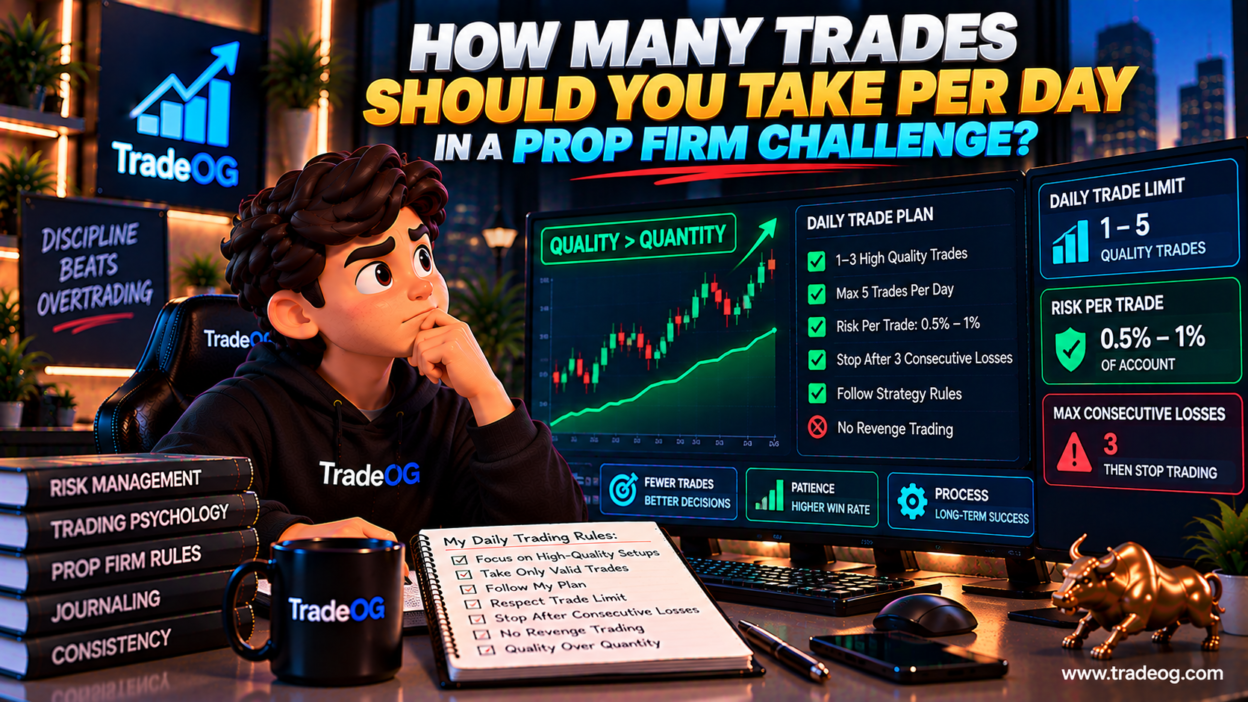
Maximum 5 trades per day; normally expect 0–3 qualified setups.
That is different from:
Take 5 trades every day.
The first statement protects against excessive activity while allowing the strategy to determine whether opportunities exist.
How to Find Your Personal Trade Limit
Use your historical trading data.
Step 1: Calculate normal opportunity frequency
Review at least a meaningful sample of trades and record how many valid setups occurred per session.
Step 2: Identify the upper tail
Find the days when your strategy generated unusually many valid setups.
Step 3: Check whether those extra setups were actually profitable
Do not assume the sixth or seventh trade is useful simply because it exists.
Step 4: Compare performance by trade number
Compare:
- trade #1;
- trade #2;
- trade #3;
- trade #4;
- trade #5;
- and so on.
You may discover that later trades have lower expectancy or higher rule-violation rates.
Step 5: Add risk and drawdown analysis
Determine what happens if several consecutive trades lose.
Track Performance by Trade Number
This is a powerful journal metric.
| Trade Number | Trades | Win Rate | Average R |
|---|---|---|---|
| 1st trade | 40 | Example: 58% | +0.25R |
| 2nd trade | 35 | Example: 54% | +0.12R |
| 3rd trade | 27 | Example: 49% | +0.04R |
| 4th+ trade | 18 | Example: 39% | -0.08R |
These figures are illustrative, but this type of analysis can show whether trading more frequently is actually adding value.
How Consecutive Losses Should Affect Your Trade Limit
Suppose your historical data shows that four consecutive losses occur occasionally.
Your routine should know what happens when that sequence appears.
Possible rules include:
- stop for the day after a predefined loss streak;
- reduce activity only if the strategy has a tested regime filter;
- review whether the losses were valid setups;
- never increase size simply to recover.
FTMO’s current challenge guidance specifically uses consecutive-loss analysis as an example of how to evaluate whether position size is too large for the account’s drawdown constraints. FTMO — 5 Rules to Stop Breaching Your Challenge.
What About Scalpers?
Scalpers may legitimately take more trades than slower intraday traders.
But a high trade count makes execution quality increasingly important.
For a scalping strategy, track:
- average holding time;
- average spread/slippage;
- commission per trade;
- average R per trade;
- maximum consecutive losses;
- time-of-day performance;
- trade count per session.
Topstep’s current prohibited-strategy guidance specifically distinguishes normal trading from intentional simulator exploitation involving extremely rapid, repetitive trading. Topstep — Prohibited Trading Strategies.
What About One-Trade-a-Day Traders?
One trade per day can be completely reasonable if the strategy produces one high-quality opportunity.
The problem occurs when “one trade per day” becomes a requirement.
If no valid setup appears, forcing a trade defeats the purpose of selectivity.
A better rule is:
Maximum one trade if that is what the tested strategy supports, but zero trades when no setup qualifies.
What About Days With No Trades?
A no-trade day is not necessarily a failed day.
If the strategy requires a specific setup and that setup does not appear, staying flat can be correct execution.
In a prop firm challenge, preserving capital while waiting for a valid opportunity can be more consistent with a risk-controlled process than manufacturing activity.
When Should You Stop Trading for the Day?
Create stopping rules before the session.
Possible triggers include:
- personal daily loss limit reached;
- maximum consecutive losses reached;
- maximum trade count reached;
- session window ended;
- major strategy condition invalidated;
- emotional control deteriorated;
- technical or data problem;
- account-specific rule requires stopping.
The exact conditions should be written into your trading plan.
Do Prop Firms Usually Set a Daily Trade Limit?
Do not assume that every prop firm has the same trade-count rule.
Some programs may not impose a simple maximum number of daily trades, while platforms can provide trader-controlled limits.
For example, the current TopstepX platform includes configurable daily and weekly trade limits. Its documentation says every entry and exit counts as a trade for that feature, and once the limit is reached no new trades can be opened while existing positions can still be managed. TopstepX — Trade Limits.
That is a platform feature, not evidence that every Topstep account or every prop firm has a mandatory universal daily trade limit.
Always check the rules for the specific program you are using.
Trade Frequency During Major News
News can create an unusual number of setups, but it can also create unusual execution conditions.
A strategy that normally takes three trades might suddenly generate several rapid signals during a high-volatility event.
Do not automatically increase trade frequency because the chart is moving faster.
First check:
- prop-firm news restrictions;
- position-size restrictions;
- market liquidity;
- expected volatility;
- slippage risk;
- your strategy’s tested behaviour during similar events.
Topstep, for example, currently prohibits purposefully trading maximum position size directly into major scheduled news events. Topstep — Prohibited Trading Strategies.
How Trade Frequency Can Create Overtrading
Overtrading usually does not begin with a trader deciding, “I am going to overtrade today.”
It often starts with a small deviation:
- The planned setup loses.
- The trader sees another small movement.
- The next entry is slightly lower quality.
- Another loss occurs.
- The trader wants to recover.
- Trade frequency increases.
- Position size may increase.
- The original plan disappears.
This is why a trade-count ceiling can be useful as a behavioural guardrail.
Trade Frequency and FOMO
FOMO can create the opposite pattern:
“The market is moving, so I need to be involved.”
But market movement is not itself a setup.
Your routine should require the same entry conditions regardless of whether the market is moving slowly or rapidly.
A Practical Trade-Frequency Framework
Instead of asking for one universal number, use four levels.
Level 1 — Normal frequency
How many qualified setups does your strategy usually produce?
Level 2 — Maximum planned frequency
What is the highest number of trades you are willing to take before review?
Level 3 — Risk ceiling
How much cumulative loss could occur if several trades lose?
Level 4 — Stop condition
What exact event ends the trading session?
For example:
| Rule | Illustrative Example |
|---|---|
| Normal setups | 0–3 |
| Maximum trades | 5 |
| Risk per trade | $100 |
| Personal daily loss | $300 |
| Consecutive losses | 3 |
Again, these numbers are examples rather than recommendations.
A Simple Formula for Planning Daily Trade Count
You can create a rough upper bound using:
Maximum planned trades = Personal daily risk budget ÷ Planned risk per trade
Then compare that result with:
- your strategy’s normal opportunity frequency;
- your historical losing streak;
- the firm’s daily loss rules;
- your account’s drawdown;
- your maximum position size.
The smallest practical constraint should determine your operational ceiling.
This is a planning framework, not a guarantee that the resulting number is optimal.
Example: A $50K Hypothetical Challenge
Consider a hypothetical $50,000 prop challenge.
Assume the trader’s own plan allows:
- $100 planned risk per trade;
- $300 personal daily loss limit;
- maximum three consecutive losses;
- maximum five entries per session.
What happens?
If the first three trades all lose:
3 × $100 = $300
The personal daily stop is reached.
The trader does not take trades four and five simply because the maximum is five.
The maximum is a ceiling; the daily loss rule takes priority.
Example: Why More Trades Can Reduce Discipline
Suppose a trader normally has three high-quality setups per day.
They decide that five trades are necessary because they want faster challenge progress.
On a slow day, only one setup appears.
Instead of accepting one trade, they take four additional marginal entries.
The problem is not the number five itself.
The problem is that the number became the objective.
The correct objective should remain quality execution of the tested strategy.
How to Journal Your Daily Trade Count
Add these fields to your trading journal:
| Metric | What to Record |
|---|---|
| Total trades | Number of executed entries |
| Qualified trades | Trades that met every setup rule |
| Unqualified trades | Trades taken outside the plan |
| First trade result | P&L or R |
| Last trade result | P&L or R |
| Trade count at daily stop | Number when trading ended |
| FOMO trades | Count |
| Revenge trades | Count |
| Rule violations | Count |
After enough data accumulates, look for patterns.
Questions to Ask After 30–50 Trading Sessions
- How many trades do I normally take?
- How many valid setups appear?
- Which trade number has the best expectancy?
- Do later trades produce more mistakes?
- How often do I reach my maximum trade count?
- How often do I reach my daily loss limit?
- How often do I stop because of consecutive losses?
- How many trades were FOMO or revenge trades?
- Does performance deteriorate after a certain trade number?
These answers are much more useful than copying a generic “three trades per day” rule from social media.
Should You Reduce Trades After Two Losses?
That can be a valid rule if it is part of your tested risk framework.
But simply reducing size or frequency after two losses should not be presented as a universal solution.
There are two separate questions:
- Does your strategy statistically support continuing after two losses?
- Does your psychology remain stable after two losses?
If your personal rule says stop after two or three losses, follow that rule consistently rather than changing it during the session.
Should You Stop After a Big Winning Trade?
Some traders choose to stop after reaching a personal profit threshold.
This can be useful if they have a history of giving back profits through overtrading.
However, it should be a predefined rule rather than an emotional reaction.
Topstep’s current consistency framework is also a reminder that account objectives can interact with daily profitability rather than simply rewarding the largest possible single day. Topstep — Consistency at Topstep.
What Is More Important: Trade Count or Risk Per Trade?
Neither should be considered in isolation.
Imagine two traders:
| Trader | Trades | Risk/Trade | Planned Maximum Exposure |
|---|---|---|---|
| A | 3 | $100 | $300 |
| B | 1 | $500 | $500 |
Trader A takes more trades, but Trader B may have greater single-trade exposure.
That is why trade frequency should always be analyzed alongside position size and risk.
The Best Rule for Most Challenge Traders
A useful general principle is:
Do not set a required number of trades. Set a maximum activity limit and let valid setups determine actual trade count.
Then combine it with:
- a predefined risk per trade;
- a personal daily loss limit;
- a maximum consecutive-loss rule;
- a maximum position-size rule;
- a no-FOMO rule;
- a no-revenge rule;
- a clear session cutoff.
This creates a risk framework instead of a simple trade quota.
Final Takeaway
There is no universal number of trades you should take per day in a prop firm challenge.
The right number is the frequency your tested strategy can support while you remain within your risk plan and the specific firm’s current rules.
For one trader, that may mean one or two high-quality trades. For another, it may mean several qualified intraday setups. Some sessions should produce zero trades.
The critical distinction is between maximum trades and required trades.
A maximum can protect you from overtrading. A required number can encourage you to manufacture setups.
Use your historical data to measure normal opportunity frequency, analyze expectancy by trade number, examine losing streaks, calculate cumulative risk and identify where rule violations begin to increase.
Then create a routine where:
- the strategy determines whether a setup exists;
- the risk model determines how much you can risk;
- the account rules determine the outer constraints;
- your personal rules determine when you stop;
- the journal tells you whether the routine is actually working.
For current prop-firm programs, always verify the official rules for your exact account. Trading rules can differ by program and can change over time; Topstep explicitly states that its current trading rules are subject to change and that traders are responsible for staying current. Topstep — Terms of Use.
Quality over quantity is not a trading strategy by itself. It becomes useful when “quality” is defined by objective setup, risk and execution rules.
FAQs
How many trades should I take per day in a prop firm challenge?
There is no universal number. Your daily trade count should come from your tested strategy’s normal opportunity frequency, risk model, personal stop rules and the specific prop firm’s account rules.
Is 3 trades per day a good rule?
Three can be used as a personal maximum if it fits your strategy and risk plan, but it is not a universal rule. The important part is not turning three into a required daily quota.
Can I take 10 or 20 trades in a prop challenge?
It depends on the strategy, account rules and execution model. High trade frequency should be supported by testing and should remain consistent with the firm’s current rules. Some platforms also offer configurable trade limits.
Should I stop trading after 3 losses?
A three-loss stop can be a reasonable personal rule if it fits your risk plan and historical drawdown analysis. It should be defined before trading rather than changed emotionally after losses.
Should I trade more to reach the prop firm profit target faster?
Increasing trade frequency solely to reach a target faster can create lower-quality entries and greater exposure. The target should not replace your normal setup and risk rules.
Can I have a no-trade day?
Yes. If your strategy produces no valid setup, remaining flat can be correct execution.
Does a prop firm usually have a fixed daily trade limit?
Not universally. Rules vary by firm and account. Some platforms may provide trader-controlled trade limits, while other programs may focus on loss, position, consistency or prohibited-strategy rules instead.
What should I track to find my ideal trade count?
Track valid setups, total trades, performance by trade number, average R, expectancy, losing streaks, rule violations, FOMO trades, revenge trades and results by session.
Is taking fewer trades always safer?
No. Fewer trades can reduce exposure, but a single oversized trade can create more risk than several properly sized trades. Trade count must be evaluated together with position size and risk per trade.
What is the most important rule for trade frequency?
Do not trade because you have trades remaining. Trade because a predefined setup exists and the position fits your risk model.
TradeOG risk note: This article provides an educational framework, not a universal trading prescription. Prop-firm rules, drawdown calculations, daily loss limits, position limits, news restrictions and platform features vary by provider and account type and can change. Verify the current official rules for your specific account before trading.