

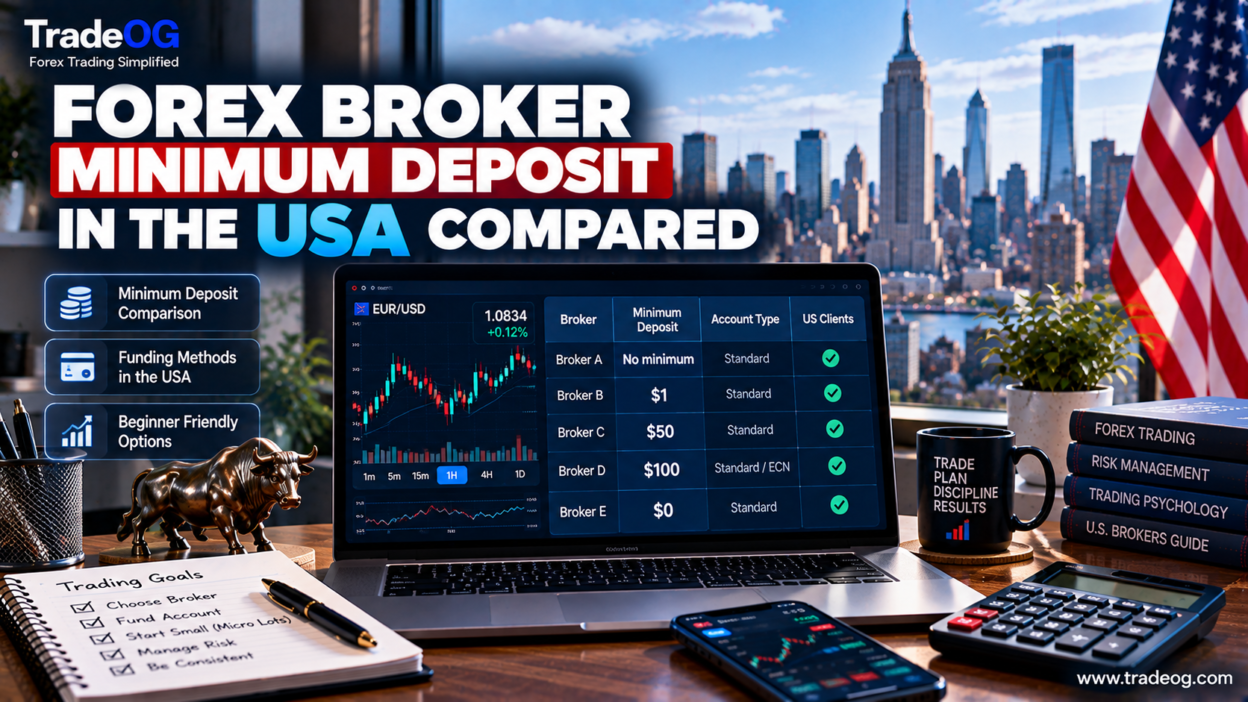

One of the first things new U.S. forex traders ask is, “How much money do I actually need to open an account?”
The answer is more complicated than a simple $0, $1, $50, or $100 number. A broker’s minimum deposit tells you what the company will accept to open or fund an account. It does not tell you how much you should deposit to trade comfortably, manage risk, or survive a normal losing streak.
We compared the current published minimums from several major forex brokers available to U.S. traders, including OANDA, tastyfx, FOREX.com, Interactive Brokers, and Trading.com.
Forex Broker Minimum Deposits in the USA Compared
| Broker | Published minimum | Best known for |
|---|---|---|
| OANDA | $0 | Flexible funding and position sizing |
| tastyfx | $1 | Low entry requirement and multiple platforms |
| Trading.com | $50 | Low-cost entry to its T1 account |
| FOREX.com | $100 | Established U.S. forex platform |
| Interactive Brokers | $0 account minimum | Broad multi-asset platform |
These figures are the brokers’ published account or deposit requirements and can change. More importantly, the amount you can deposit is different from the amount you should trade with.
1. OANDA — $0 Minimum Deposit
OANDA is one of the easiest U.S. forex brokers to understand if your main concern is the minimum deposit.
OANDA currently states that there is no minimum deposit or minimum balance required to open or maintain an account. You still need enough money in the account to actually open a position.
That distinction matters. A $0 minimum does not mean you can trade with zero dollars. It simply means OANDA does not impose a minimum funding requirement before you can maintain the account.
OANDA also offers multiple funding methods, including ACH, debit card and bank wire. Its U.S. funding information currently says ACH deposits have no minimum, while domestic wire transfers also have no minimum deposit limit.
Best for: Beginners who want to start without meeting a formal deposit threshold and traders who value flexible position sizing.
What to watch: Don’t confuse a $0 broker minimum with a recommended trading balance. Your position size and risk per trade still need to make sense for your account.
2. tastyfx — $1 Minimum Deposit
tastyfx has one of the lowest advertised entry points among U.S. forex brokers.
The broker currently says forex trading requires a minimum deposit of $1. It also notes that minimum margin requirements can be around $20 on selected major pairs, while recommending that traders often fund accounts with roughly $1,000 to $5,000 to provide more flexibility.
That last point is important. There is a huge difference between what a broker will accept and what gives a trader enough room to manage positions responsibly.
tastyfx also offers several platforms, including its own platform, TradingView and MetaTrader 5. That makes it more attractive if platform choice matters to you.
Best for: Traders who want a very low formal entry requirement but still want a full-featured forex platform.
What to watch: A $1 deposit is not a realistic bankroll for most active forex strategies. Margin, spreads, losses and position sizing can quickly make such a small balance impractical.
3. Trading.com — $50 Minimum for T1
Trading.com is another option for U.S. traders looking for a relatively low account minimum.
Its current T1 forex account page lists a $50 minimum deposit. Trading.com also identifies its U.S. operation as a registered Retail Foreign Exchange Dealer with the CFTC and a member of the NFA.
A $50 minimum sits between tastyfx’s very low entry requirement and FOREX.com’s $100 minimum. But again, the deposit requirement should not be confused with a recommended account size.
Best for: Traders who want a low formal deposit requirement and are specifically interested in Trading.com’s account structure.
What to watch: Review the account’s trading costs, available instruments, platform and margin requirements before choosing it just because the minimum is low.
4. FOREX.com — $100 Minimum Deposit
FOREX.com currently requires at least $100 as the minimum initial deposit for opening an account.
The broker itself recommends depositing at least $2,500 because that provides more flexibility and better room for risk management.
That recommendation is a good example of why comparing minimum deposits alone can be misleading. A $100 minimum sounds affordable, but the broker is telling customers that a much larger balance may be more practical for trading.
FOREX.com also has different account and pricing options, so your actual trading cost depends on the account you choose, the currency pair, position size and how frequently you trade.
Best for: Traders who want an established U.S. forex broker and don’t mind meeting a $100 entry requirement.
What to watch: FOREX.com currently recommends $2,500 rather than treating $100 as an ideal trading bankroll.
5. Interactive Brokers — $0 Account Minimum
Interactive Brokers is slightly different from the pure-play forex brokers on this list because it provides access to a much wider range of financial markets.
Its current U.S. required-minimums page lists $0 account minimums for individual, joint, trust and organizational accounts under both IBKR Pro and IBKR Lite.
However, account type and trading requirements matter. For example, Interactive Brokers’ educational material notes a $2,000 minimum for a margin account for IBLLC clients, while a cash account does not have the same minimum deposit requirement.
So if you’re comparing Interactive Brokers with a forex-only broker, make sure you’re comparing the same type of account.
Best for: Experienced traders who want forex alongside stocks, options, futures, bonds and other markets.
What to watch: The platform and account structure can be more complicated for a complete beginner than a dedicated forex broker.
What Does “Minimum Deposit” Actually Mean?
A minimum deposit is simply the smallest amount a broker says you need to fund an account under a particular account or funding method.
It does not necessarily mean:
- the minimum amount needed to open every type of position;
- the amount needed to manage risk properly;
- the recommended starting balance;
- the amount required for every deposit method;
- the amount needed to withstand normal market volatility.
For example, FOREX.com lists a $100 minimum initial deposit but recommends $2,500 for greater flexibility. tastyfx advertises a $1 minimum while saying many traders fund with $1,000 to $5,000.
Those differences tell you something important: minimum deposit and recommended trading capital are two completely different numbers.
Minimum Deposit vs. Minimum Trade Size
Don’t mix these two terms up.
Minimum deposit is how much you put into the account.
Minimum trade size is the smallest position the broker allows you to open.
A broker could theoretically let you open an account with $1 but still require a position size that makes that balance impractical to trade.
This is why traders should look at both numbers when comparing brokers.
How Much Should You Actually Deposit?
There isn’t one correct number for every trader, but a useful starting point is to work backward from your risk limit.
Suppose you have a $500 account and decide that you will risk no more than 1% on one trade.
1% of $500 = $5 maximum planned risk.
Now imagine a trade setup where your stop loss is 50 pips away. Your position size needs to be small enough that a 50-pip loss is around $5, after allowing for the actual pip value, spread and execution conditions.
That is much more useful than saying, “My broker lets me deposit $1, so I’ll start with $1.”
Can You Really Trade Forex With $50?
Technically, a broker may allow you to open an account and deposit $50. The harder question is whether $50 gives you enough room to trade responsibly.
At a 1% risk limit, $50 gives you only $0.50 of planned risk per trade.
That can make position sizing extremely restrictive. A few spreads, commissions and losing trades can also have a noticeable effect on the account.
A tiny account can be useful for learning how a live trading platform behaves, but it should not be treated as a shortcut to generating meaningful income.
Can You Start Forex With $100?
Yes, if the broker allows it. FOREX.com, for example, currently lists $100 as its minimum initial deposit.
But a $100 account still has the same basic problem: your dollar risk per trade is very small if you follow conservative risk management.
At 1% risk, you have $1 of planned risk per trade.
That is not necessarily a bad thing. In fact, it can force discipline. The problem comes when traders use leverage to take positions that are much too large for the account.
Why a $1 Minimum Deposit Can Be Misleading
Marketing a $1 minimum deposit sounds attractive, but it can create the wrong expectation.
Forex is leveraged. You don’t want to ask, “What is the smallest amount I can put into this account?” You want to ask, “What account balance gives me enough room to trade my strategy while keeping each loss within my risk limit?”
Those are very different questions.
tastyfx itself illustrates this point by listing a $1 minimum while suggesting that traders often fund with $1,000 to $5,000 for more flexibility.
Does a Higher Minimum Deposit Mean a Better Broker?
No.
A broker requiring $100 is not automatically better than one accepting $1. Likewise, a broker with no minimum deposit is not automatically cheaper or safer.
When comparing brokers, look at the complete package:
- U.S. regulatory status
- spread and commission structure
- minimum trade size
- margin requirements
- available currency pairs
- platforms
- funding and withdrawal methods
- execution quality
- customer support
- account protections and disclosures
How Funding Methods Can Change the Minimum
The advertised account minimum isn’t always the same thing as the minimum transaction for every funding method.
FOREX.com, for example, currently lists $100 as the minimum deposit for certain bank-transfer and debit-card funding transactions, while wire transfers have no minimum transaction amount. OANDA similarly states that its ACH and domestic wire funding options have no minimum deposit limit.
So always check the broker’s funding page before assuming the account minimum applies identically to every payment method.
Which U.S. Forex Broker Has the Lowest Minimum Deposit?
If you are looking only at the published minimum, the answer is straightforward:
| Broker | Published minimum |
|---|---|
| OANDA | $0 |
| Interactive Brokers | $0 account minimum |
| tastyfx | $1 |
| Trading.com | $50 |
| FOREX.com | $100 |
But if you’re choosing a broker to actually trade with, this table should only be the first step.
Best Broker by Type of Trader
Best for no formal deposit minimum: OANDA
OANDA is a strong choice if you don’t want to meet a formal deposit threshold. Its current U.S. policy says there is no minimum deposit or minimum balance requirement.
Best for a very low entry point: tastyfx
tastyfx currently advertises a $1 minimum deposit for forex trading, making the formal barrier to entry extremely low.
Best for a $50 starting threshold: Trading.com
Trading.com’s T1 account currently lists a $50 minimum deposit and is worth considering if that account structure fits your needs.
Best for a traditional $100 minimum: FOREX.com
FOREX.com requires at least $100 to open an account and is a straightforward choice for traders who want an established U.S. forex platform.
Best for multi-asset traders: Interactive Brokers
Interactive Brokers lists $0 account minimums for its standard individual account structures, but its account and margin requirements can be more involved. It is generally better suited to traders who want access to multiple markets rather than forex alone.
Common Mistakes When Comparing Minimum Deposits
- Choosing only by the smallest number: A $1 minimum does not make a broker the cheapest.
- Ignoring trade size: A low deposit is useless if your preferred position size is too large for the account.
- Using maximum leverage: More buying power is not the same as better risk management.
- Forgetting transaction costs: Spreads and commissions can matter a lot on tiny accounts.
- Depositing money you cannot afford to lose: Forex is leveraged and losses can happen quickly.
- Assuming the minimum is recommended: Brokers may accept a very small deposit while recommending a much larger balance.
Frequently Asked Questions
What is the lowest minimum deposit for forex brokers in the USA?
Among the brokers compared here, OANDA and Interactive Brokers currently list $0 account/deposit minimums for relevant account structures. tastyfx lists a $1 minimum deposit for forex trading.
Can I start forex trading with $10?
A broker may allow a very small deposit, but that does not mean $10 is a practical trading balance. Your risk per trade would need to be extremely small, and transaction costs could become significant relative to the account.
Is $100 enough to start forex trading?
It can be enough to open an account with a broker such as FOREX.com, which currently lists a $100 minimum. Whether it is enough to trade responsibly depends on your position size, stop-loss distance and risk limit.
What is a good starting balance for a beginner?
There is no universal number. A better approach is to decide how much you can afford to lose, set a maximum risk per trade, and then choose a position size that fits that risk. A demo account can be a better starting point if even a small live loss would be financially uncomfortable.
Does a $0 minimum deposit mean forex trading is free?
No. It only means the broker does not require a minimum funding amount. Trading can still involve spreads, commissions, financing charges and other costs.
Is OANDA better than FOREX.com because OANDA has no minimum deposit?
Not necessarily. OANDA’s $0 minimum is convenient, but broker selection should also consider pricing, platform, execution, position sizing, available pairs and your trading style.
Bottom Line
The cheapest forex broker to open is not necessarily the cheapest forex broker to trade with.
OANDA currently has no minimum deposit, tastyfx lists a $1 minimum, Trading.com lists $50 for its T1 account, FOREX.com lists $100, and Interactive Brokers lists $0 account minimums for its standard individual account structures.
Those numbers are useful, but don’t let them make the decision for you. Your real question should be: How much capital do I need to trade my strategy without taking more risk than I can afford?
For a beginner, that question is far more important than whether the broker lets you start with $1 or $100.
Official Sources
- OANDA — Minimum Deposit Requirement
- tastyfx — Forex Accounts
- FOREX.com — Opening a Trading Account
- Interactive Brokers — Required Minimums
- Trading.com — T1 Forex Account
Risk disclosure: Forex trading involves substantial risk of loss and is not suitable for every investor. Leverage can magnify both gains and losses. This article is for educational purposes only and is not financial or investment advice. Broker requirements, pricing, account terms and regulations can change, so verify current details directly with the broker before opening or funding an account.