

A prop firm payout rejection can be frustrating, especially when your account is profitable and you expected the withdrawal to be approved. But a positive account balance does not automatically mean every dollar is eligible for payout.
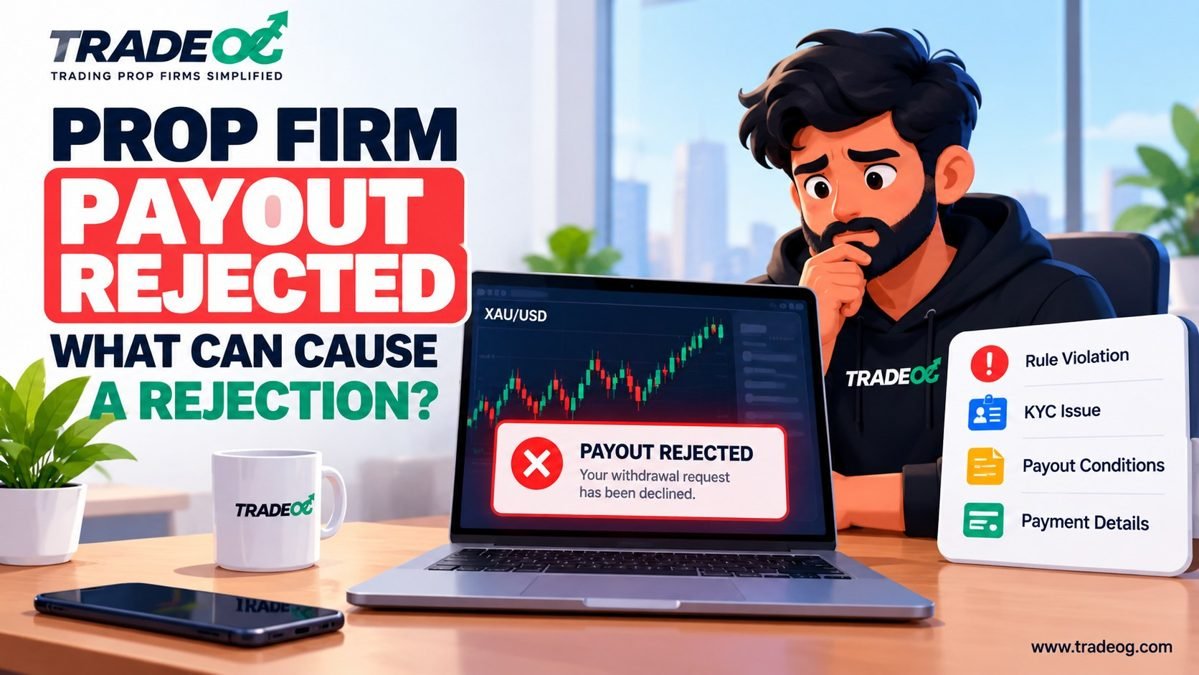
A payout can be delayed, reduced, placed under review, or rejected because of trading-rule issues, payout eligibility conditions, KYC requirements, payment details, prohibited activity, or firm-specific account rules. The exact reason depends on the prop firm and the account model.
In this guide, we break down the most common reasons a prop firm payout can be rejected and what you should check before submitting a withdrawal request.
What Does “Payout Rejected” Mean?
A payout rejection means the firm did not approve the withdrawal or reward request as submitted. It does not necessarily mean the trader has lost all account profit. In some cases, the issue is simply that a condition was not completed or the requested payment information needs correction.
For example, FTMO’s current withdrawal guidance says a reward request is reviewed after the applicable conditions are met, and the account must be in positive profit with no open positions or pending orders when the reward is requested. FTMO’s current withdrawal guidance explains its process.
FundedNext’s current guidance similarly requires traders to complete the applicable trading cycle and profitability conditions before requesting a payout. Its withdrawal process also requires KYC verification for commission withdrawals. FundedNext’s current profit withdrawal guide and withdrawals and payments guide explain the current process.
1. A Trading Rule Was Violated
The first thing to check after a payout rejection is whether the account breached a trading rule.
Depending on the program, this can involve maximum drawdown, daily loss, restricted strategies, prohibited execution practices, account-management rules, or other terms that apply to the account.
Do not assume that reaching the profit target or becoming profitable means the account is automatically eligible. A prop firm can review the trading activity associated with the payout request.
FTMO Futures, for example, publishes a list of forbidden trading practices and states that violations can have consequences that may include trade removal, account termination or forfeiture of rewards depending on the circumstances. FTMO Futures forbidden trading practices.
2. You Have Profit, But You Are Not Yet Eligible
This is one of the most common misunderstandings: account profit is not always the same as eligible payout.
A program may require a completed trading cycle, a certain number of qualifying or profitable days, a minimum profit amount, a payout interval, or a required buffer.
FundedNext currently states that traders can request profit withdrawals after completing the relevant trading cycle and meeting the profitability criteria. Its model-specific rules can differ, so the account dashboard and current program documentation should be checked before submitting a request. FundedNext profit withdrawal requirements.
FTMO Futures currently has product-specific payout conditions as well. Its current information says Growth Sim-Funded traders can request payouts every four days after meeting the qualifying-day conditions, while Pro uses a five-day cycle and qualifying-day requirement. FTMO Futures payout rules.
3. KYC or Identity Verification Is Incomplete
A payout can be blocked if identity verification has not been completed or approved.
FundedNext currently states that KYC must be completed and passed before a commission withdrawal can be requested. Its current KYC documentation also explains that identity documents and, in some cases, proof of address may be required. FundedNext withdrawal and KYC requirement.
Before requesting a payout, make sure the name and other personal information in your account match your verified documents. Never submit altered, misleading or someone else’s documents.
4. Incorrect Bank, Wallet or Payment Details
Sometimes the issue is not trading at all. A payout can encounter problems because the selected payment method or payment information is incorrect.
Examples include:
- Incorrect bank account details
- Incorrect crypto wallet address
- Unsupported payment method
- Wrong beneficiary information
- Details that do not match the account information
- Choosing a method that is unavailable for your country or account
FundedNext currently lists bank transfer, crypto and other payout methods, with availability depending on the service and applicable country restrictions. Its current withdrawal documentation also explains that transfer gateway charges may apply. FundedNext payout methods.
5. Copy Trading or Trade Mirroring
Copy trading is another area where traders can run into account-specific restrictions.
A firm may allow copying between accounts owned by the same trader while prohibiting copying trades from another individual, signal provider or external account. Some programs also have specific restrictions on cloud-based trade copiers or cross-firm copying.
Therefore, do not judge the legality of a copier simply because it technically works on your platform. Check the current policy for the exact prop firm and account model.
For more detail, see TradeOG’s Prop Firm Copy Trading Rules Explained.
6. Prohibited or Abusive Trading Strategies
Some firms restrict strategies or trading behaviour they consider abusive, manipulative or inconsistent with their program rules.
Depending on the firm, examples can include certain forms of arbitrage, latency exploitation, coordinated activity, high-frequency abuse, account manipulation or other prohibited execution practices.
The important point is that the definition is firm-specific. Do not rely on a Telegram post, YouTube video or an old screenshot as proof that a strategy is currently permitted.
7. News Trading, Overnight or Weekend Restrictions
News trading is not automatically prohibited at every prop firm, but individual programs can impose restrictions around major economic releases. Overnight and weekend holding can also differ between firms and account types.
This matters particularly for XAU/USD traders because volatility, spreads and execution conditions can change quickly around NFP, CPI and FOMC events.
If your strategy involves news trading, overnight positions or weekend holding, check the current rules before requesting a payout. A trade that was profitable can still be problematic if it was executed in a way that conflicts with the applicable account rules.
8. You Requested More Than the Eligible Amount
Another possibility is requesting an amount that does not match the program’s payout calculation.
The account may show $2,000 in profit, but the amount available for withdrawal could be lower because of a profit split, payout cap, required buffer, qualifying conditions, fees or other account-specific calculations.
FTMO’s current CFD guidance, for example, explains that reward percentages depend on the product through which a trader qualified. FTMO reward calculation guidance.
9. The Account Is Still Under Review
“Under review” and “rejected” are not the same status.
A firm may review the account before approving a reward. The review can involve trading history, rule compliance, account conditions and identity information.
FundedNext currently describes a review process after traders complete certain challenge requirements, including checks for compliance with trading rules and platform policies. FundedNext’s current review process.
Therefore, if your payout is simply marked as pending or under review, wait for the firm’s official decision rather than assuming that the money has been permanently rejected.
10. Profit May Be Excluded After a Rule Issue
Some programs distinguish between total account profit and eligible profit.
If specific activity is determined to violate the program rules, the amount associated with that activity may be treated differently from ordinary eligible profit, depending on the firm’s terms.
This is why traders should keep a record of their trading history and understand the rules that applied at the time each trade was placed.
11. Payout Documentation Is Incomplete
A payout process can also require administrative information such as an invoice, identity confirmation, payment details or other documentation.
FTMO’s current process, for example, involves a reward request followed by review and withdrawal instructions. FTMO’s reward withdrawal process.
Always read the payout dashboard carefully and complete every required step before assuming the request has been fully submitted.
What to Do If Your Prop Firm Payout Is Rejected
- Read the rejection message. Identify the exact reason given by the firm.
- Check your account rules. Use the rules for your exact account model, not another trader’s account.
- Review your trade history. Pay particular attention to large positions, news trades, unusual execution and activity involving other accounts.
- Check payout eligibility. Confirm the cycle, qualifying days, profit requirement and payout limit.
- Verify KYC. Make sure your status is approved, not merely submitted.
- Check payment details. Reconfirm bank, wallet and beneficiary information.
- Ask official support for the specific reason. If the message is unclear, request the exact rule or condition involved.
- Keep evidence. Save the payout request, rejection notification, account history and support replies.
Prop Firm Payout Rejection Checklist for Indian Traders
- All applicable drawdown rules are intact.
- Required trading or profitable days are complete.
- The current payout cycle has ended.
- The requested amount is within the eligible payout amount.
- KYC is approved.
- Name and payment details are correct.
- Wallet address or bank details have been checked twice.
- News-trading rules have been reviewed.
- Overnight/weekend restrictions have been checked.
- EA and copy-trading rules have been checked if applicable.
- No third-party account management has been used where prohibited.
- The firm’s current rules have been checked immediately before withdrawal.
Example: Why a Profitable Trader Can Still Get a Rejection
Imagine a trader has made $2,000 in an account and requests the full amount. The account looks profitable, but the trader has not completed the required payout cycle or qualifying days. Alternatively, KYC may still be incomplete, or the requested payment details may be incorrect.
In another case, the account may be profitable but contain activity that the firm’s rules restrict. In that situation, the payout review can focus on the trading activity rather than simply the account’s headline profit.
The key lesson is simple: profitability and payout eligibility are related, but they are not identical.
Final Takeaway
A prop firm payout rejection can happen for several different reasons. The most important areas to check are trading-rule compliance, payout-cycle requirements, qualifying days, KYC, payment details, prohibited strategies, copy trading, news or holding restrictions, and the firm’s review process.
Rules can change and can differ significantly between firms and account models. Always verify the current official rules for your exact account before submitting a payout request.
For related TradeOG guides, read Prop Firm Profit Split Explained, Can You Withdraw Profit Before Completing a Scaling Step?, and Why Prop Firms Track Trading Patterns and Account Behavior.
Disclaimer: Prop firm rules can change and may differ by program, platform and account model. This article is for educational purposes only and is not financial, legal or tax advice.


[…] related TradeOG guides, read Prop Firm Payout Rejected: What Can Cause a Rejection?, Prop Firm Profit Split Explained, and Can You Withdraw Profit Before Completing a Scaling […]
[…] more TradeOG guides, read Prop Firm Payout Verification Explained Step by Step, Prop Firm Payout Rejected: What Can Cause a Rejection?, and Prop Firm Profit Split […]
[…] related TradeOG guides, read Prop Firm Payout Verification Explained Step by Step, Prop Firm Payout Rejected: What Can Cause a Rejection?, and Crypto vs Bank Transfer for Prop Firm […]