

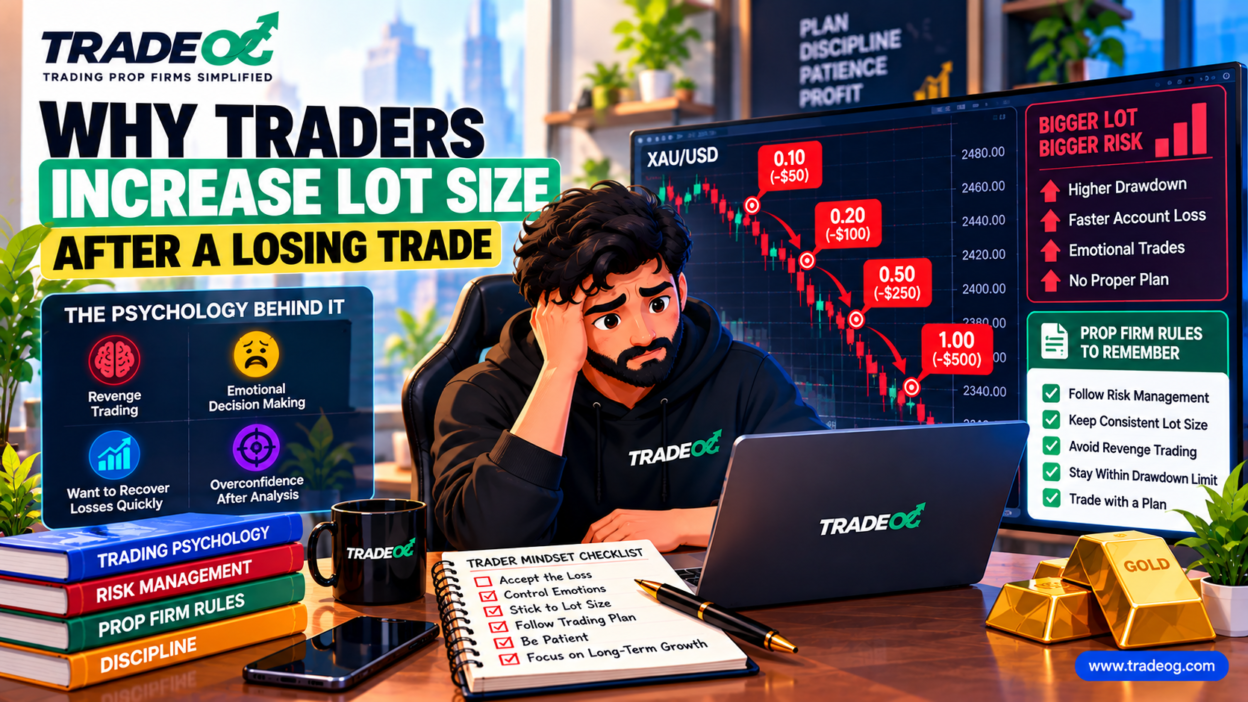
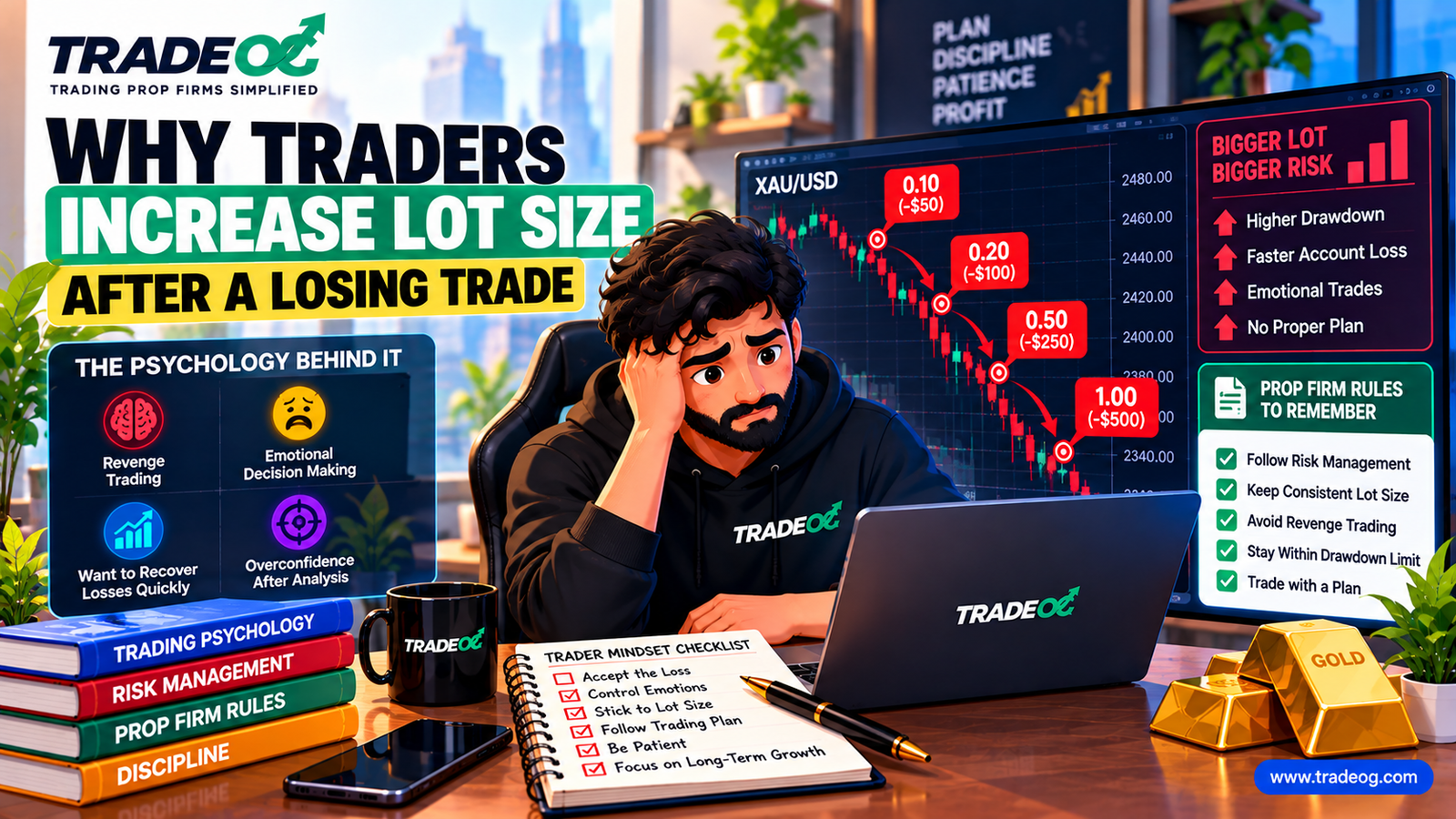
One of the most dangerous habits after a losing trade is increasing the lot size on the next trade. A trader loses 0.10 lot, feels the need to recover quickly, and suddenly enters with 0.20, 0.50 or even 1.00 lot. If the next trade also loses, the account can deteriorate much faster.
This behavior is often connected to revenge trading, loss aversion, overconfidence, and the desire to recover a recent loss immediately. The problem is not simply the bigger lot. The deeper problem is that the position size is being changed because of the previous result rather than because the current trade setup justifies the risk.
CME Group’s trading-psychology material notes that losses can make decision-making harder and emphasizes having rules for dealing with losing trades. Its risk-management guidance also explains that position size should be determined from the stop-loss and the amount of account risk the trader is willing to accept. CME Group: Planning for Trading Losses and CME Group: Proper Position Size.
Why Do Traders Increase Lot Size After a Loss?
1. They Want to Recover the Loss Quickly
The most common thought is simple: “I lost $100, so I need to make $100 back.” That changes the objective from following the next valid setup to recovering the previous trade.
Once recovery becomes the priority, a trader may increase position size because a normal-sized trade feels too slow. This can create a cycle where one loss leads to a larger trade, the larger trade loses, and the trader increases size again.
2. Revenge Trading Takes Over
Revenge trading happens when a trader reacts emotionally to a loss instead of evaluating the next setup independently. The trader may feel that the market “owes” them a winning trade.
But the market does not know that the previous trade lost. The next position has its own entry, stop, target, probability and risk. A previous loss does not improve the probability of the next setup.
3. Loss Aversion Makes the Loss Feel Bigger
After a losing trade, the trader is no longer thinking only about the market. They are thinking about the red number in the account.
CME Group’s educational material discusses how traders can struggle with losses and may hold losing positions or make decisions aimed at avoiding the psychological pain of realizing a loss. CME Group: Misconceptions of Taking Losses.
This can lead to a dangerous idea: “If I take a bigger trade, I can get back to breakeven faster.” Mathematically, the bigger position also makes it possible to move further away from breakeven.
4. The Trader Becomes Overconfident After Analysis
Not every lot-size increase is emotional revenge trading. Sometimes a trader believes the previous loss happened because the market was wrong, the entry was early, or the setup was misunderstood.
The trader may then become unusually confident in the next setup and increase size. The issue is that confidence is not the same thing as a quantified risk advantage. If the stop distance and account-risk limit do not justify the larger position, the lot increase can still be dangerous.
5. The Trader Focuses on Lot Size Instead of Dollar Risk
A fixed lot size does not always represent the same risk. The actual risk depends on position size, stop distance, contract specifications, tick or point value and the instrument being traded.
CME Group explains that proper position sizing starts with the stop-loss and the dollar or percentage amount the trader is willing to risk. CME Group position-sizing guidance.
For example, 0.50 lot with a tight stop can have a different risk from 0.50 lot with a much wider stop. That is why experienced risk management is based on planned loss, not simply on the number shown in the lot-size field.
A Simple Example of How Loss Chasing Escalates
| Trade | Lot Size | Result | Cumulative Result |
|---|---|---|---|
| 1 | 0.10 | -$100 | -$100 |
| 2 | 0.20 | -$200 | -$300 |
| 3 | 0.50 | -$500 | -$800 |
| 4 | 1.00 | -$1,000 | -$1,800 |
This example is only an illustration. Actual P&L depends on the instrument, contract specification, entry, exit and stop distance. The important point is the risk escalation: the trader is increasing exposure after being wrong rather than reducing exposure or returning to the original risk plan.
Why This Is Especially Dangerous for Prop Firm Traders
For a prop firm account, increasing lot size after a loss can create a much bigger problem than a normal losing streak. Many programs have daily loss limits, maximum loss or drawdown limits, and other account-specific restrictions.
If a trader starts with controlled risk and then suddenly doubles or triples exposure after a loss, a single additional losing trade can consume a significant portion of the available drawdown buffer.
This is particularly important for XAU/USD traders because gold can move quickly. A larger position combined with a volatile move can produce a much larger dollar loss than the trader expected.
TradeOG’s guides on prop firm risk management for Indian traders and prop firm drawdown explain why the amount of available drawdown matters more than the headline account size.
The Mathematics of Increasing Size After a Loss
Suppose a trader loses $200 and decides to risk $400 on the next trade simply to recover the previous loss faster.
If the second trade wins $400, the trader returns to the original balance. But if the second trade loses $400, the combined loss becomes $600.
Now the trader may feel even more pressure to increase size. This is how a small loss can become a large drawdown event.
CME Group’s risk-management material demonstrates the opposite approach: using predetermined risk limits means that position size is controlled during losing streaks rather than automatically becoming larger. CME Group: Controlling Risk.
Should Lot Size Increase After a Losing Trade?
There is no universal rule that a trader must always use the exact same lot size. Position size can legitimately change when the planned risk changes.
For example, a trader may use a smaller position when the stop is wider and a larger position when the stop is tighter, while keeping the maximum dollar risk approximately constant.
What is important is the reason for the change.
- Risk-based increase: position size changes because the calculated risk allows it.
- Setup-based adjustment: the strategy has a predefined rule for different market conditions.
- Loss-recovery increase: size increases only because the previous trade lost.
The third situation is the one traders should treat with particular caution.
How to Stop Increasing Lot Size After Losses
Use a Predefined Risk Per Trade
Decide the maximum acceptable loss before entering. Once the amount is defined, calculate the position size from the stop-loss rather than from the previous trade result.
Create a Losing-Streak Rule
For example, your trading plan could specify a pause after two or three consecutive losses. The exact number should come from your strategy and risk plan, not from an arbitrary promise made during an emotional moment.
Do Not Trade to Recover a Specific Rupee Amount
If you are thinking, “I need to make back ₹5,000 today,” your decision-making can become focused on the account balance instead of the setup. A better process is to evaluate whether the next trade meets your normal entry and risk criteria.
Use a Maximum Daily Loss Limit
A daily loss limit can stop a bad session from becoming a major account event. Prop firm traders should also understand the firm’s own daily loss and maximum drawdown rules before trading.
Write Down the Reason for Every Size Change
Before increasing size, write one sentence: “Why am I increasing this position?” If the answer is “because I lost the last trade,” that is a warning sign.
What About Martingale?
Increasing position size after a loss can resemble a martingale-style approach, although not every size increase is technically a martingale system.
A classic martingale approach increases exposure after losses with the objective of recovering previous losses when a winning trade eventually occurs. The major weakness is that a sufficiently long losing sequence can make the required position size grow very quickly.
For leveraged trading, this can become especially dangerous because margin, drawdown and market volatility place practical limits on how much exposure an account can carry.
A Better Process After a Losing Trade
- Accept the result. The trade is finished.
- Record the reason for the loss. Was it a valid setup, execution error or rule violation?
- Check your daily risk. Know how much drawdown remains.
- Wait for the next valid setup. Do not create a trade just to recover money.
- Calculate position size from risk. Use stop distance and predefined risk.
- Keep the same process. Do not let the previous P&L determine the next trade size.
Quick Checklist for Indian Traders
- Do I have a fixed maximum risk per trade?
- Is my lot size based on stop distance?
- Am I increasing size because of the previous loss?
- How much daily drawdown is already used?
- Am I trading XAU/USD during a high-volatility period?
- Does my prop firm have a daily loss or maximum drawdown rule?
- Have I followed my normal setup criteria?
- Would I take this exact trade if the previous trade had been a winner?
Final Takeaway
Traders often increase lot size after a losing trade because they want to recover quickly, react emotionally to the loss, become overconfident about the next setup, or confuse lot size with actual risk.
The key distinction is simple: position size should come from the risk plan and current trade structure, not from the desire to erase the previous loss.
A losing trade is part of the trading process. Turning one controlled loss into a sequence of increasingly larger bets can create unnecessary drawdown and, for prop firm traders, may bring the account closer to its loss limits.
For more TradeOG risk-management guides, read Drawdown Recovery: How Much Profit Is Needed After a Loss? and Daily Loss Limit vs Stop Loss.
Disclaimer: This article is for educational purposes only and is not financial advice. Trading leveraged products involves substantial risk of loss. Prop firm rules vary by firm and account model, so always check the current official rules before trading.



[…] more TradeOG risk-management guides, read Why Traders Increase Lot Size After a Losing Trade and Prop Firm Risk Management Plan for Indian […]
[…] more TradeOG guides, read Why Traders Increase Lot Size After a Losing Trade and Drawdown Recovery: How Much Profit Is Needed After a […]