When comparing forex brokers in the UK, one of the most important questions is simple: is it cheaper to trade with a spread-only broker or with a low spread plus commission?
The answer depends on your trading size, frequency, currency pairs, holding period and the broker’s actual pricing. A 0.0-pip headline spread does not necessarily mean lower costs, because a commission may be charged separately. Likewise, a commission-free account can still be expensive if the spread is wide.
This guide explains forex broker spread vs commission for UK traders, with practical calculations, current UK broker examples and a simple way to compare the true all-in cost.
Spread vs Commission: What Is the Difference?
A spread is the difference between the bid price and ask price. It is normally built into the price you receive when opening or closing a trade.
A commission is a separate trading charge. With a raw-spread account, the broker may give you a much tighter underlying spread and then charge a fixed commission based on your trade size.
In simple terms:
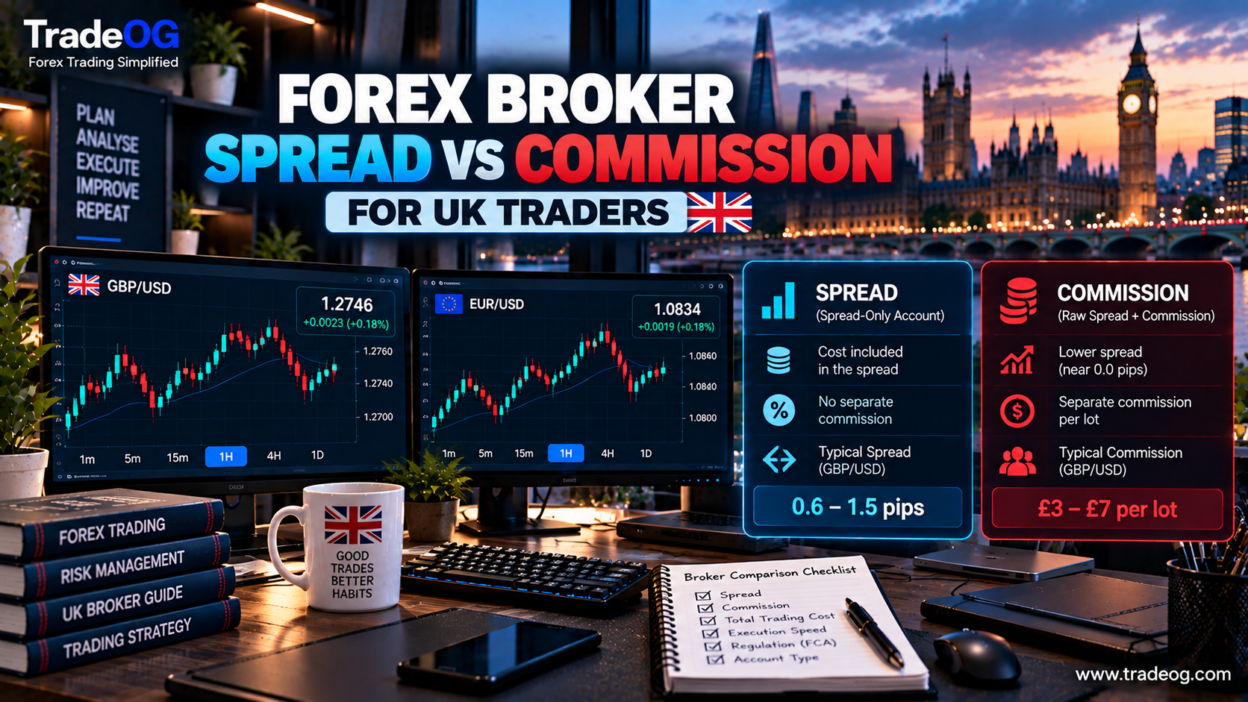
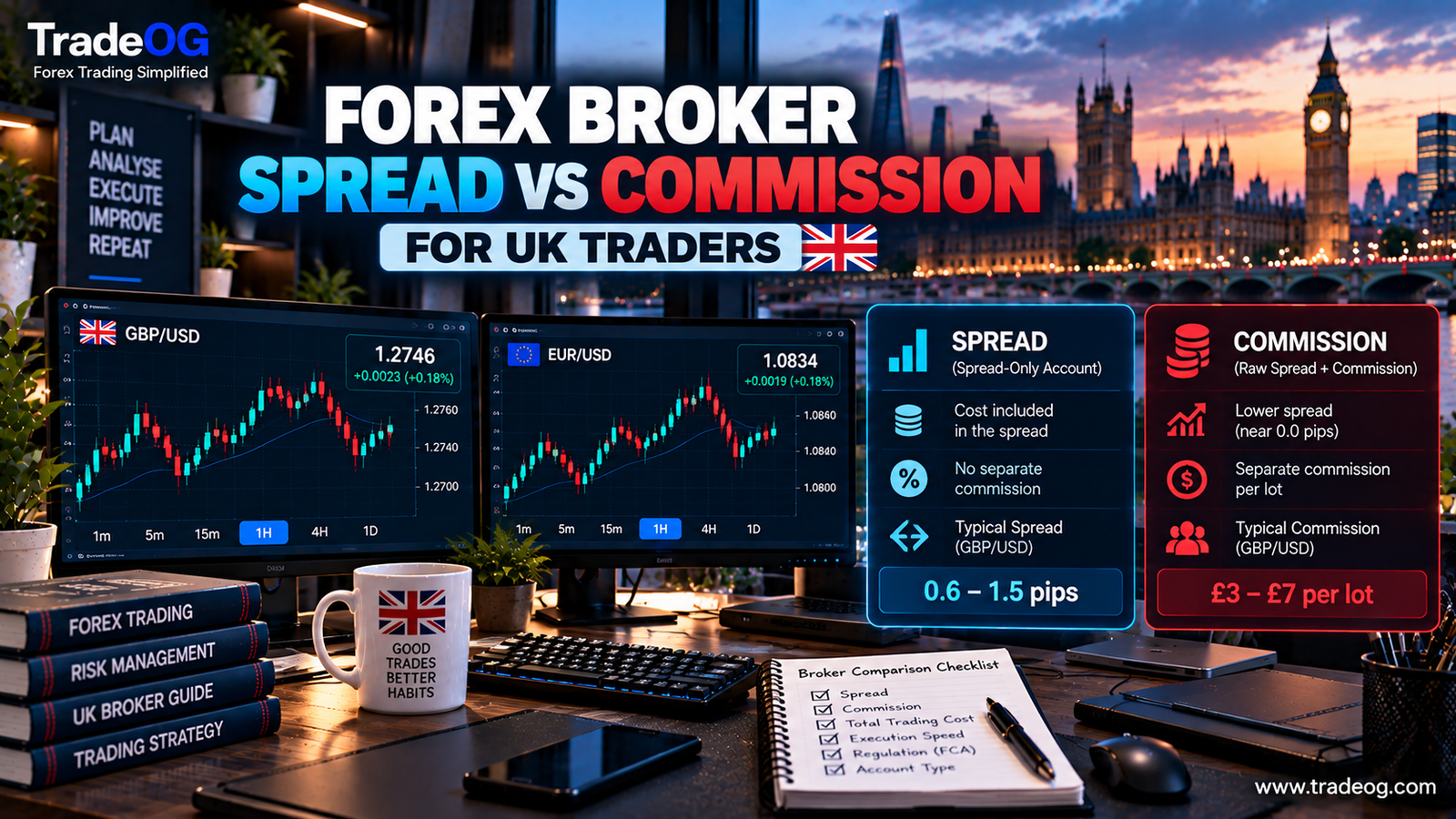
- Spread-only account: wider spread + no separate FX commission.
- Raw spread + commission account: very low spread + separate commission.
The only comparison that really matters is the total cost of the round trip.
How Does a Forex Spread Work?
Suppose GBP/USD is quoted at:
- Bid: 1.27460
- Ask: 1.27470
- Spread: 1.0 pip
If you buy at the ask and the market does not move, you cannot immediately sell at the same price because the bid is lower. That difference is the initial spread cost.
Spreads can change during the day. They may be tighter during liquid market conditions and wider during major economic announcements, rollover periods or thinner trading conditions.
How Does Forex Commission Work?
Commission is normally calculated according to your trade size. The critical detail is whether the broker quotes the amount per side or for the complete round trip.
For example, if a broker charges £2.25 per standard lot per side, opening a 1-lot position costs £2.25 and closing it costs another £2.25. The round-trip commission is therefore £4.50.
For a 0.10-lot trade, the same rate would be approximately £0.225 per side, or £0.45 for the round trip, assuming the broker applies the commission proportionally.
Which Is Cheaper: Spread or Commission?
Neither pricing model is automatically cheaper. You have to convert both into the same unit.
A useful calculation is:
All-in cost = spread cost + round-trip commission + execution costs.
For a commission account, you can convert the commission into an equivalent number of pips. If the commission on your position equals £4 and one pip costs £7.50, the commission is roughly equivalent to 0.53 pips.
You can then compare that effective commission with the extra spread charged by a spread-only account.
Simple Example: 1 Lot GBP/USD
Imagine two hypothetical accounts for a 100,000-unit GBP/USD trade.
| Cost | Spread-only account | Raw spread + commission |
|---|---|---|
| Spread | 1.0 pip | 0.1 pip |
| Spread value | £7.50* | £0.75* |
| Round-trip commission | £0 | £4.50 |
| Illustrative total | £7.50 | £5.25 |
*Illustrative calculation only. Actual pip value depends on the currency pair, exchange rate and account currency.
In this example, the commission account is cheaper. But if the raw spread widens or the commission is higher, the result can change.
Current UK Broker Example: Pepperstone
Pepperstone currently describes its UK Standard account as spread-based, with FX trading costs included in the spread and no separate FX commission. Its Razor account uses raw spreads from 0.0 points plus commission from £2.25 per standard FX lot per side.
Pepperstone’s published August 2026 data shows average Razor spreads of about 0.1 pip for EUR/USD, 0.2 for GBP/USD and 0.2 for USD/JPY, while the Standard account’s published averages are about 1.1, 1.2 and 1.2 respectively.
This illustrates why comparing only “0.0-pip spreads” can be misleading. The commission must be added to the calculation.
Current UK Broker Example: IG
IG’s UK pricing page currently shows minimum forex spreads of 0.6 for EUR/USD, 0.9 for EUR/GBP, 0.9 for GBP/USD and 0.7 for USD/JPY. IG describes its forex pricing as spread-based, with the spread built into the quoted price.
IG also states that overnight funding applies to positions held beyond 10pm UK time and that currency conversion can carry a separate charge when a trade involves a currency different from the account’s base currency.
So even with a spread-only account, the spread is not necessarily the entire cost of holding a leveraged position overnight.
Spread-Only Accounts: Advantages and Disadvantages
Advantages
- Simple pricing structure.
- No separate FX commission to calculate.
- Easy for beginners to understand.
- Convenient for traders who make relatively few trades.
Disadvantages
- The spread can be wider.
- High-frequency traders may pay more over many trades.
- The advertised minimum spread may not represent your normal trading cost.
- Spreads can widen in volatile or thin markets.
Raw Spread + Commission Accounts: Advantages and Disadvantages
Advantages
- Very tight underlying spreads.
- Can be cheaper for high-volume traders.
- Costs can be easier to model precisely once commission is understood.
- Often attractive for scalpers and active day traders.
Disadvantages
- There is an additional commission.
- You need to calculate the round-trip cost.
- Very small trades can make the pricing advantage less meaningful.
- Funding and slippage still apply where relevant.
What Is Better for Scalping?
Scalpers usually care heavily about the combined spread and commission because their target per trade may be small.
Suppose a strategy typically aims for 5 pips. A total transaction cost of 0.5 pip consumes about 10% of the gross target. A 2-pip cost consumes about 40%. The same cost difference can therefore have a much larger impact on a scalper than on a swing trader targeting 100 pips.
For scalping, compare actual average spreads during your trading session, commission per side and execution quality rather than choosing a broker based on the lowest advertised spread.
What Is Better for Day Trading?
For day traders, both models can work. If you make a handful of trades each week, a simple spread-only account may be convenient. If you make many trades every day, a raw-spread account may become more attractive if its combined spread and commission are lower.
Calculate your expected monthly volume. If you trade 20 standard lots per month and save £2 per round trip, the difference is about £40. If your volume is 200 lots, the same £2 difference becomes £400.
What Is Better for Swing Trading?
Swing traders should not focus only on the entry spread. Overnight funding can become more important when positions remain open for several days.
A broker with a slightly wider spread but favourable funding could potentially be more suitable for a long-term trading approach than a broker with an extremely tight spread and expensive financing.
Always compare the funding methodology for the exact pairs and direction you intend to trade.
Does a 0.0-Pip Spread Mean Zero Cost?
No.
A 0.0-pip minimum spread normally means that the underlying spread can reach zero under certain conditions. It does not mean the complete trade is free.
A commission can be charged separately, and the actual spread can fluctuate above the minimum. Slippage, overnight funding and currency conversion can also affect your final cost.
How to Convert Commission Into Pips
To compare commission with spread, convert the commission into an equivalent pip cost.
Equivalent commission in pips = round-trip commission ÷ monetary value of one pip.
For example, if your round-trip commission is £4.50 and one pip on your position is worth £7.50, the commission is equivalent to 0.60 pips.
If the raw spread averages 0.20 pips, the approximate combined trading cost is:
0.20 + 0.60 = 0.80 pips.
You can then compare that 0.80-pip equivalent with the average spread on a spread-only account.
Why Average Spread Matters More Than Minimum Spread
Minimum spreads are useful for understanding the best-case pricing, but they are not a reliable estimate of what you will pay on every trade.
Pepperstone, for example, publishes both minimum and average spreads and notes that its displayed August 2026 spread data covers all trading sessions, including rollover periods.
When comparing brokers, look for:
- Average spread on your preferred pairs.
- Spread during your normal trading hours.
- Spread behaviour around news.
- Commission per side.
- Overnight funding.
- Execution quality and slippage.
Spread vs Commission for a £500 Account
For a small account, the difference between pricing models can matter, but risk management matters more.
Suppose you have £500 and risk 1% per trade. Your planned risk is £5. If your stop-loss risk is already £5, trading costs are an additional drag on the strategy. A low-cost account cannot make an oversized position sensible.
Beginners should therefore select the smallest practical position size, calculate the stop-loss risk and then compare broker costs.
Spread vs Commission for a £5,000 Account
With a £5,000 account, traders may have more flexibility in position sizing, but the same principle applies. If you trade frequently, even a small difference in all-in cost can compound over hundreds of transactions.
For example, saving £1.50 per round trip across 300 trades would represent approximately £450 in gross transaction-cost savings. That does not make a strategy profitable, but it demonstrates why execution costs matter at higher trading frequency.
Do UK Traders Pay Tax on the Spread or Commission?
Trading costs and tax are separate concepts. A spread or commission is a trading expense; the tax treatment of any trading profits depends on the product and your individual circumstances.
UK spread betting has a different tax treatment from CFD trading in many ordinary retail situations, but personal circumstances can differ. Do not choose a product solely on a general tax statement; obtain appropriate tax advice if your situation is complex.
How to Choose Between Spread and Commission
- Estimate your average trade size.
- Estimate your monthly number of trades.
- Record the pairs you actually trade.
- Find the broker’s average spread.
- Add the round-trip commission.
- Check overnight funding.
- Consider slippage and execution.
- Compare the total cost rather than one headline number.
A Simple Broker Cost Comparison Formula
Use this framework before opening an account:
Monthly trading cost ≈ (spread cost + round-trip commission + expected slippage) × number of trades + overnight funding + other applicable charges.
This is an estimate, not a guarantee. Actual costs vary with market conditions and execution.
Common Mistakes UK Forex Traders Make
- Choosing a broker because it advertises 0.0 pips.
- Ignoring commission per side.
- Comparing a minimum spread with an average spread.
- Forgetting overnight funding.
- Ignoring currency conversion costs.
- Assuming spread betting and CFDs have identical costs.
- Trading too frequently to compensate for small transaction costs.
- Using high leverage because the account appears cheap to trade.
Final Verdict: Spread or Commission?
For UK forex traders, neither spread-only nor commission-based pricing is universally better.
Spread-only accounts are usually simpler and can suit beginners and lower-frequency traders. Raw-spread plus commission accounts can be attractive for scalpers and active traders when the combined cost is genuinely lower.
The best broker is the one that offers competitive all-in costs for your actual strategy — not the one with the lowest advertised spread or lowest commission in isolation.
Before choosing an account, compare the average spread, commission, funding and execution costs for the exact pair and trade size you expect to use.
Frequently Asked Questions
Is spread or commission cheaper in forex?
It depends on the broker, pair, trade size and strategy. Convert the commission into an equivalent pip cost and compare it with the spread.
Are 0.0-pip forex brokers really free?
No. A raw spread can be near zero while a separate commission is charged. Other costs such as funding and slippage may also apply.
What is better for a beginner in the UK?
A simple spread-only account can be easier for a beginner to understand, but the best choice depends on the broker’s total cost and your trading frequency.
Is commission charged on every forex trade?
Only when the broker or account type uses commission-based pricing. Some brokers include their FX charge entirely in the spread.
Does Pepperstone charge commission on forex?
Pepperstone’s UK Standard CFD account includes FX costs in the spread, while its Razor account uses raw spreads plus commission. Its current published Razor commission starts at £2.25 per standard FX lot per side.
Does IG charge commission on forex?
IG’s UK pricing is primarily spread-based for forex, with its current page showing selected minimum forex spreads and no separate FX commission listed for those products. Other charges, such as overnight funding and currency conversion, can still apply.
Official UK Broker Sources
- Pepperstone UK: Trading Costs and Fees
- Pepperstone UK: Forex Pairs and Spreads
- IG UK: Costs and Charges
Risk warning: Forex and leveraged CFD trading are high-risk activities. You can lose money rapidly due to leverage. This article is educational and is not personal financial advice. Always check the current broker terms, pricing and regulatory status before trading.