

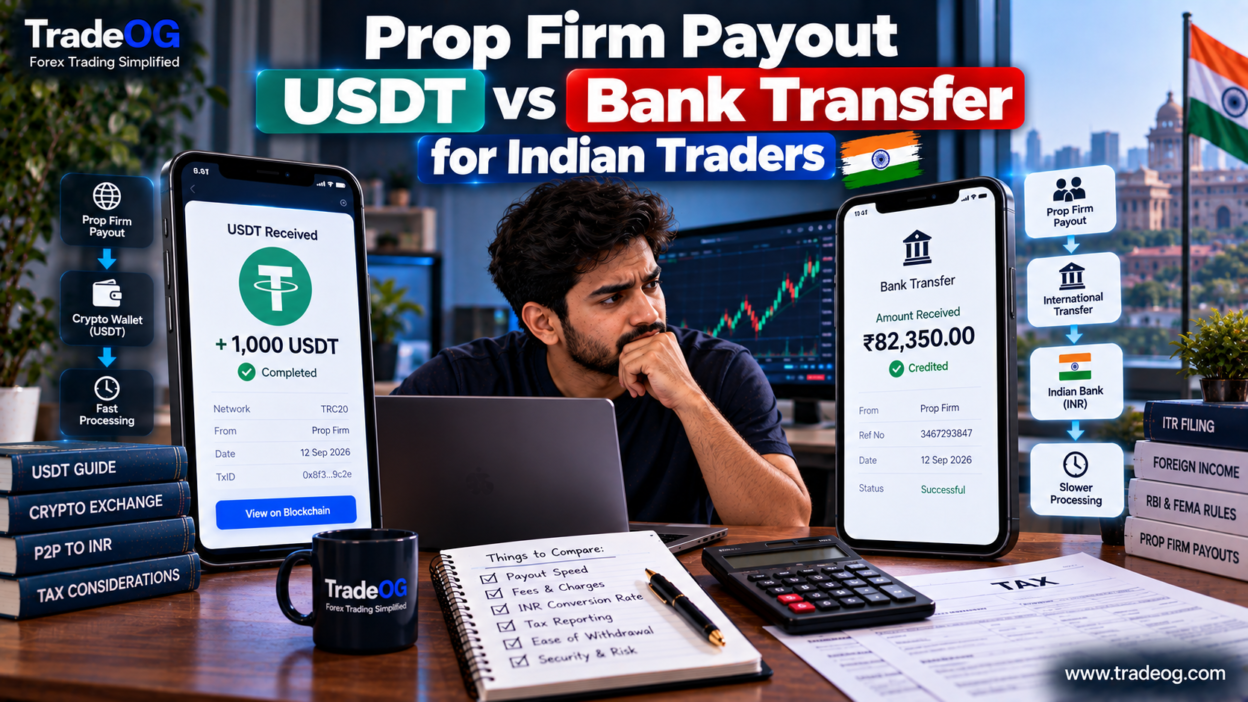
For Indian traders, getting a prop firm payout is only half the story. The other half is how the money reaches you.
A prop firm may offer a payout through a bank transfer, payment processor, or cryptocurrency such as USDT. At first glance, USDT can look faster and more convenient. A bank transfer can look slower, but it may leave a clearer banking trail.
For an Indian trader, however, the choice is not simply about speed. You also need to think about documentation, conversion into INR, tax treatment, banking records, compliance, fees, counterparty risk and what happens when you convert USDT into rupees.
This guide compares USDT and bank-transfer payouts for Indian prop firm traders and explains what you should record before choosing a payout method.
USDT vs Bank Transfer: The Basic Difference
The biggest difference is the form in which you receive the payout.
| Factor | USDT Payout | Bank Transfer |
|---|---|---|
| Settlement | Digital asset transferred to a crypto wallet | Money credited through the banking/payment system |
| Conversion | Usually requires conversion from USDT to INR | May arrive directly in INR or be converted by the payment/banking chain |
| Records | Blockchain transaction + exchange/wallet records | Bank statement + remittance/payment records |
| Speed | Can be fast after the prop firm approves it | Depends on bank and payment route |
| Tax complexity | Potentially higher because a VDA transaction can create a separate tax question | Usually simpler to trace as a bank receipt |
| Price risk | USDT may have a small price deviation and conversion spread | FX/conversion spread may apply |
| Banking trail | Created when USDT is sold/converted and funds reach the bank | Created directly through the bank/payment provider |
What Exactly Happens With a USDT Prop Firm Payout?
Imagine a prop firm approves a US$1,000 payout and sends the equivalent amount in USDT.
The flow may look like this:
Prop firm → your crypto wallet → crypto exchange/platform → USDT sold for INR → Indian bank account
There can be several separate records:
- Prop firm payout approval
- Prop firm payout statement
- Blockchain transaction hash
- Wallet receipt
- Exchange deposit record
- USDT sale/conversion record
- INR settlement record
- Indian bank credit
Do not keep only the final bank credit. If you use USDT, preserve the complete trail from the original prop firm payout to the final INR receipt.
What Happens With a Bank Transfer Payout?
A bank-transfer payout may have a simpler flow:
Prop firm/payment provider → bank/payment network → your Indian bank account
You may receive:
- Payout confirmation from the prop firm
- Payment-provider confirmation
- Bank credit advice
- Bank statement entry
- Currency-conversion details, if applicable
That can make reconciliation easier, particularly when the payout is received in a foreign currency and converted into INR by the payment or banking chain.
Is USDT a Better Payout Method for Indian Traders?
Not automatically.
USDT can be convenient, particularly when a prop firm does not offer a straightforward Indian bank payout. But convenience should not be confused with lower tax or lower compliance requirements.
Once you receive and later transfer or sell a crypto asset, the transaction can create a separate Indian tax-reporting question. The Income Tax Department currently treats income from transfer of Virtual Digital Assets under a special tax framework, with a 30% rate under Section 115BBH and a dedicated Schedule VDA in applicable ITR forms.
That does not mean your entire prop firm payout is automatically taxed at 30% simply because it was paid in USDT. The contractual prop-firm payout and any later transfer of USDT need to be analysed separately based on the actual facts.
Why the USDT Route Can Be More Complicated
Consider this example:
- Prop firm payout: US$1,000
- USDT received: approximately 1,000 USDT
- USDT later sold for INR
- Exchange charges a trading/withdrawal fee
- INR is deposited into your bank account
You now have more than one financial event to document.
The original payout may be income arising under the prop-firm agreement. The later disposal or transfer of USDT can potentially create a separate VDA tax issue. The exact result depends on the transaction structure, valuation, timing and applicable law.
This is why Indian traders should not simply calculate:
“Bank credit = taxable prop firm income.”
Nor should they calculate:
“USDT payout = automatically 30% tax.”
Both shortcuts can produce the wrong result.
How Is USDT Taxed in India?
USDT is generally treated as a virtual digital asset when it falls within the statutory definition. The Income Tax Department’s current ITR guidance states that gains from VDA transfers are subject to 30% tax plus applicable surcharge and 4% cess under Section 115BBH, and that Schedule VDA is used for transaction-wise disclosure in ITR-2 and ITR-3.
There is an important distinction here:
- Prop firm payout: the payment you are contractually entitled to receive from the firm.
- USDT receipt: the form in which the payout is delivered.
- USDT disposal: a later sale, transfer or exchange of the USDT.
- INR bank credit: the eventual banking settlement after conversion, if you convert it.
These events should not automatically be collapsed into one number without examining the underlying transaction.
Does Receiving USDT Automatically Mean You Owe 30%?
No.
This is one of the most important points in this article.
The special 30% VDA regime concerns income from the transfer of a VDA. Receiving a prop-firm payout in USDT and later transferring or selling that USDT are not necessarily the same taxable event.
The correct treatment can depend on whether the payout itself is business/professional income or another form of income, how the USDT is received, its INR value when received, what happens afterward, and the taxpayer’s complete facts.
If the amount is material, have a qualified Indian tax professional review the prop-firm contract and the actual wallet/exchange history rather than applying the 30% rate blindly.
What About 1% TDS on USDT?
Indian VDA transactions can also involve tax-deduction requirements. The Income Tax Department’s current guidance covers TDS on transfers of virtual digital assets, and the 2026 transition framework continues to provide VDA-related TDS procedures.
However, do not assume that every USDT receipt from a foreign prop firm automatically has Indian 1% TDS deducted.
TDS depends on the actual transaction and the parties involved. A foreign prop firm paying you USDT is not automatically the same as an Indian buyer purchasing VDA from you.
Keep the transaction records so your tax professional can determine whether any VDA TDS obligation actually applies to the relevant transfer.
Bank Transfer Is Usually Easier to Reconcile
For many Indian traders, the main advantage of a bank transfer is record clarity.
Suppose a prop firm pays US$1,000 and the payment provider converts it into INR before crediting your bank account. You may have:
- Payout invoice or statement
- Payment-provider receipt
- Exchange-rate information
- Bank credit entry
That is generally easier to reconcile than:
- Payout statement
- Wallet address
- Transaction hash
- USDT receipt
- Exchange deposit
- USDT sale
- Exchange fee
- INR withdrawal
- Bank credit
For a trader who wants clean accounting, fewer moving parts can be valuable.
Is USDT Faster?
It can be, but there is no universal guarantee.
Blockchain settlement can be fast after a prop firm initiates a payout. But your real-world time to usable INR depends on more than blockchain confirmation.
You may still need:
- Prop firm approval
- Wallet confirmation
- Exchange deposit confirmation
- USDT conversion
- Exchange compliance checks
- INR withdrawal processing
- Bank credit
A bank transfer can also be delayed by compliance checks, weekends, holidays, intermediary banks or payment-provider processing.
Therefore, compare the complete payout-to-bank timeline, not just the blockchain transfer time.
USDT vs Bank Transfer Fees
USDT does not necessarily mean “free”.
You may encounter:
- Blockchain/network fees
- Exchange trading fees
- USDT/INR spread
- Withdrawal fees
- Payment-provider fees
- Bank charges after conversion
A bank route can involve:
- FX conversion spread
- Incoming transfer fees
- Correspondent-bank charges
- Payment-provider fees
- Bank service charges
Always compare the net INR received, not the advertised payout fee.
Example: USDT Payout vs Bank Transfer
Assume a prop firm approves a US$1,000 payout.
Option A — USDT
- US$1,000 payout equivalent
- USDT received
- Small network or processing cost
- USDT sold for INR
- Exchange spread/fee applies
- INR withdrawn to bank
Option B — Bank Transfer
- US$1,000 payout
- Payment provider processes transfer
- USD converted to INR
- Applicable bank/payment fees deducted
- INR credited to bank
The better option is not necessarily the one with the lower headline fee. Compare:
Final INR received ÷ original payout amount
Also consider the documentation and tax complexity created by each route.
What Records Should You Keep for a USDT Payout?
If you receive a prop firm payout in USDT, keep a dedicated folder for every payout.
| Document | Keep It? |
|---|---|
| Prop firm payout statement | Yes |
| Prop firm agreement | Yes |
| Wallet address | Yes |
| Transaction hash | Yes |
| USDT amount received | Yes |
| Date/time of receipt | Yes |
| Exchange deposit record | Yes |
| USDT sale/conversion record | Yes |
| Exchange fees | Yes |
| INR withdrawal record | Yes |
| Indian bank statement | Yes |
Do not rely on screenshots alone. Download statements and transaction records wherever the platform provides them.
What Records Should You Keep for a Bank Transfer?
- Prop firm payout approval
- Prop firm invoice or statement
- Payment-provider receipt
- Foreign currency amount
- Exchange-rate calculation
- Fees deducted
- Bank credit advice
- Bank statement
- Relevant correspondence about the payment
If the bank asks for the source or purpose of the payment, having this documentation can make the explanation much easier.
Can USDT Payouts Create a Foreign-Exchange Compliance Question?
Potentially, yes, depending on the underlying activity and transaction structure.
Indian traders should keep two separate questions in mind:
- How is the prop-firm payout taxed?
- Is the underlying trading/payment arrangement compliant with Indian law?
RBI states that resident persons may undertake forex transactions only with authorised persons and for permitted purposes under FEMA. It also cautions residents against unauthorised electronic trading platforms and states that remittances for margins to overseas exchanges or overseas counterparties are not permitted under the LRS framework.
Receiving a payout in USDT does not by itself answer whether the underlying prop-firm arrangement is permitted. Likewise, receiving a bank transfer does not automatically make an underlying trading arrangement compliant.
What About Converting USDT to INR?
Conversion is an important part of the record trail.
For example:
1,000 USDT received → 1,000 USDT sold → INR received → INR sent to bank
Keep the exact:
- USDT quantity
- Transaction date
- INR value
- Exchange rate
- Trading fee
- Withdrawal fee
- Wallet/exchange transaction ID
If the USDT is sold later at a different value, that later transaction can have its own tax implications under the VDA rules. The Income Tax Department’s current guidance requires transaction-wise reporting of VDA transfers in Schedule VDA where applicable.
What If I Keep the USDT Instead of Converting It?
Keeping USDT in a wallet does not make the original prop-firm payout disappear.
You should still preserve the payout statement and the wallet transaction record. If you later transfer, exchange or sell the USDT, that later event should also be recorded.
Avoid the mistake of thinking:
“I didn’t send it to my bank, so there is no income.”
The form in which you receive money does not automatically determine whether the underlying income is taxable.
Which Is Safer for Record-Keeping?
If your priority is simple accounting and straightforward reconciliation, a bank transfer will often be easier.
If your priority is speed and access to a digital settlement method, USDT may be attractive, but you accept additional record-keeping and potential VDA tax considerations.
For a trader receiving large or regular payouts, the administrative difference can become significant.
Which Payout Method Is Better for Indian Traders?
| Your Priority | Usually More Convenient |
|---|---|
| Simple bank records | Bank transfer |
| Direct INR settlement | Bank transfer |
| Fast digital settlement | USDT may be convenient |
| Minimal VDA complexity | Bank transfer |
| Prop firm only offers crypto | USDT may be necessary |
| Easy reconciliation for an accountant | Bank transfer |
| Crypto already used for legitimate purposes | USDT can be practical, with proper records |
There is no universal “best” method. Your prop firm’s payout options, the payment provider, your bank, fees, documentation and the applicable tax/compliance rules all matter.
USDT Payout Does Not Mean “Tax-Free”
This deserves a direct warning.
Some traders hear “crypto payout” and assume it is outside the banking system and therefore outside tax reporting.
That is not a safe assumption.
The Income Tax Department has specific VDA reporting and taxation provisions, including Schedule VDA and a 30% special rate for income from transfer of VDAs under the applicable provisions.
Also, moving USDT through wallets does not eliminate the need to preserve the underlying transaction trail.
What If the Prop Firm Is Based Outside India?
A foreign prop firm creates another layer of documentation.
You should know:
- The firm’s legal entity name
- Its country of incorporation
- The contract governing your payout
- The payment processor used
- The currency of the payout
- The payment method
- Whether any foreign tax was withheld
If a foreign payment is made to an Indian resident, do not assume that the payment is exempt from Indian tax simply because the payer is located abroad.
The same principle applies whether the payment arrives through a bank, payment processor or digital asset.
What If the Bank Transfer Is Rejected?
A rejected bank transfer does not automatically mean the income has vanished.
Keep:
- Original payout approval
- Rejected transfer notice
- Payment-provider reference
- Updated payout instructions
- Final successful payment record
If the prop firm later changes the payout method to USDT, keep both sets of records so the complete history is clear.
What If a USDT Payout Is Sent to the Wrong Wallet?
Crypto transfers can be operationally unforgiving. A blockchain transfer may not be reversible simply because you entered the wrong address or network.
Before accepting a payout:
- Confirm the wallet address
- Confirm the network
- Check the supported USDT chain
- Check whether the prop firm requires a specific network
- Use a small test transaction when appropriate
- Save the transaction hash
Never assume that USDT on one network is automatically interchangeable with USDT on another network.
Indian Traders: A Practical Payout Workflow
If you receive regular prop-firm payouts, use a fixed process.
Step 1: Save the payout approval
Download the prop firm’s payout statement before the money moves.
Step 2: Record the gross payout
Record the original amount and currency before fees.
Step 3: Record the payment method
Mark whether it was bank transfer, USDT or another method.
Step 4: Save every transaction reference
For USDT, save the blockchain hash and wallet details. For bank transfers, save the payment reference and bank credit advice.
Step 5: Record conversion
If you convert USD or USDT into INR, record the actual conversion amount and fees.
Step 6: Reconcile with your bank
Match the final INR credit against the original payout.
Step 7: Give the complete file to your tax professional
Do not provide only the final bank statement. Give the underlying payout and transaction records as well.
USDT vs Bank Transfer: The Bottom Line
For most Indian traders, bank transfer is usually simpler from a record-keeping perspective.
USDT can be useful when it is the payout method offered by a prop firm or when a trader needs digital settlement, but it introduces additional steps: wallet records, blockchain transactions, exchange conversion and potential VDA reporting considerations.
The biggest mistake is choosing USDT because you think it is “outside the tax system.” It is not.
The safest approach is to choose the payout method based on net amount received, reliability, documentation, tax treatment and compliance rather than speed alone.
Frequently Asked Questions
Is USDT payout from a prop firm legal in India?
Do not treat the payout method alone as proof of legality. The underlying prop-firm arrangement, forex activity, payment structure and applicable Indian laws need to be considered separately.
Is a bank transfer better than USDT for Indian prop traders?
For simple records and reconciliation, a bank transfer is generally easier. USDT can be faster or more convenient in some cases but requires additional crypto transaction records.
Is a USDT prop firm payout taxed at 30% in India?
Not automatically. The 30% VDA regime applies to income from transfer of VDAs under the applicable provisions. The tax treatment of the underlying prop-firm payout and a later USDT transfer should be analysed separately.
Do I need to report USDT received from a foreign prop firm?
Do not assume that receiving USDT instead of INR removes reporting obligations. Keep the payout contract, transaction history, wallet records and conversion records and determine the applicable tax treatment based on your facts.
Should I keep the blockchain transaction hash?
Yes. It is useful evidence linking the prop firm’s payout to the wallet transaction and can help reconcile the later exchange and bank records.
Does converting USDT to INR create another tax event?
A later transfer or disposal of USDT can raise a separate VDA tax question. The Income Tax Department provides transaction-wise Schedule VDA reporting for applicable VDA transfers.
Can I avoid tax by keeping USDT in my wallet?
No. Keeping the asset in a wallet does not automatically make the underlying prop-firm income tax-free or remove reporting obligations.
Final Takeaway for Indian Traders
USDT and bank transfers are payment methods, not tax loopholes.
A bank transfer generally gives you a cleaner banking trail. USDT can offer flexibility and potentially faster digital settlement, but it creates additional records and can introduce VDA tax considerations when the asset is later transferred or sold.
For every prop-firm payout, keep the complete chain:
Prop firm approval → payout amount → payment method → transaction record → conversion → INR receipt → bank statement.
If you receive significant or regular payouts, especially from foreign prop firms, have a qualified Indian tax professional review the actual contract and transaction trail. Do not classify the payout solely based on whether it arrived as USDT or through a bank.
Disclaimer: This article is for general educational purposes only and is not tax, legal, investment or financial advice. Indian tax, foreign-exchange and virtual-digital-asset rules can change. The correct treatment depends on the taxpayer’s residential status, contract, transactions and other facts. Verify the current rules with the Income Tax Department, RBI and a qualified professional before acting.