

Yes, spread expansion can contribute to a prop-firm breach in certain situations because a wider bid-ask spread can temporarily increase floating losses and reduce account equity. Whether that results in an actual breach depends on how the firm calculates drawdown, daily loss, floating P&L, stop-loss rules, and whether it makes allowances for spread or slippage.
Consider a familiar and frustrating scenario: You enter a long position on Gold (XAU/USD) with a 2-lot position on your $100,000 funded account. The market moves slightly in your favor, showing a modest floating profit of +$150. Your account balance sits safely at $102,000, and your equity is nowhere near the firm’s 5% daily loss limit.
Suddenly, the clock hits 5:00 PM EST—the daily market rollover window. Bank liquidity dries up, and the interbank Gold spread expands from a normal 25 cents to $3.50. Instantly, your open position’s mark-to-market valuation plunges into a -$1,400 floating loss. Worse, the bid price drops so sharply that it clips your stop loss at a price significantly below your intended exit level. Within seconds, your dashboard flashes an automated notification: \”Account Terminated: Daily Loss Limit Breached.\”
You didn’t over-leverage. You didn’t revenge trade. You had a stop loss in place. The underlying market didn’t even make a major directional trend move. So what happened? Spread expansion compressed your equity buffer and triggered an automated liquidation.
Understanding how bid-ask spread dynamics interact with prop firm risk monitoring engines is essential for every serious trader. Here is an exhaustive, practical breakdown of how spread expansion works, why it widens, how it affects floating equity, and how to protect your funded accounts from unexpected execution-related liquidations.
What Is Spread Expansion?
In financial markets, every tradable asset has two concurrent prices:
- The Bid Price: The highest price at which buyers are currently willing to purchase the asset (the price at which you sell).
- The Ask Price (Offer): The lowest price at which sellers are willing to sell the asset (the price at which you buy).
The difference between these two prices is the bid-ask spread. The spread represents the immediate transaction cost of trading and serves as the primary compensation for liquidity providers and market makers who facilitate order matching.
A Simple Numerical Example of Spread Expansion
Under normal, highly liquid market conditions, the quote for Gold (XAU/USD) might appear as:
- Bid: $2,000.00
- Ask: $2,000.50
- Spread: $0.50 (50 cents)
If you buy 100 ounces (1 standard lot) at the Ask price of $2,000.50, your position opens with an immediate -$50 unrealized loss due to the spread.
Now consider what happens during an unexpected liquidity vacuum or high-impact news event. Liquidity providers pull their resting limit orders, and the spread expands:
- Bid: $1,998.50
- Ask: $2,001.50
- Spread: $3.00 (300 cents / 6x expansion)
Notice that the midpoint of the market ($2,000.00) did not change at all. Yet, because the Bid dropped by $1.50 and the Ask surged by $1.50, the immediate cost to enter or exit that same position increased six-fold. For an open trade, that sudden gap immediately erodes live account equity.
Why Do Spreads Widen?
Spreads do not widen arbitrarily; they expand in direct response to the supply and demand of order book liquidity. The primary catalysts include:
- High-Impact Economic News Releases: During red-folder macroeconomic releases—such as US Non-Farm Payrolls (NFP), Consumer Price Index (CPI), and Federal Reserve interest rate announcements (FOMC)—institutional algorithmic market makers withdraw liquidity to avoid adverse selection. With fewer orders on the book, the gap between buyer bids and seller asks widens dramatically.
- The 5:00 PM EST Bank Rollover Window: Between 4:59 PM and 5:15 PM EST, New York trading closes and Asian markets begin opening. Major global investment banks temporarily close their books to settle daily swaps and financing fees. During this 15-minute interbank liquidity vacuum, foreign exchange and precious metals spreads routinely expand by 5x to 20x normal levels.
- Market Session Openings: Sunday market openings (when forex opens in Sydney/Tokyo) and equity market cash opens (such as the 9:30 AM EST New York opening bell) frequently exhibit unstable spreads during the first several minutes of order discovery.
- Off-Peak Trading Hours: Trading currency pairs during sessions when their primary domestic banking centers are asleep (for example, trading AUD/NZD during the London morning or EUR/USD during late Asian hours) carries wider baseline spreads due to reduced market depth.
- Extreme Market Volatility: Sudden flash crashes, unexpected geopolitical conflicts, or unscheduled central bank statements cause price discovery to fracture, forcing market makers to widen spreads to price in execution risk.
- Instrument-Specific Liquidity Profiles: Exotic currency pairs (e.g., USD/ZAR or EUR/TRY), crude oil contracts, and precious metals inherently experience wider and more volatile spread swings than ultra-liquid majors like EUR/USD or USD/JPY.
How Can Spread Expansion Affect Your Trading Account?
Spread widening impacts your trading account through three interrelated operational mechanisms:
Mechanism 1: Floating Profit and Loss (Mark-to-Market Valuation)
Trading software values your open positions in real time using current market exit prices. Because a long position must exit at the Bid price and a short position must exit at the Ask price, an expanding spread pushes exit quotes further away from your entry price. This instantly inflates your open floating loss—even if the underlying candlestick chart has not moved against your thesis.
Mechanism 2: Account Equity Compression
Account equity is calculated as:
$$\text{Equity} = \text{Closed Balance} + \text{Floating Unrealized P&L}$$
If your closed balance is $100,000 and an expanding spread pushes your floating loss from -$800 to -$3,200, your live equity instantly drops from $99,200 to $96,800. In prop firms where risk algorithms track live tick equity, this sudden drop reduces your available distance to account failure.
Mechanism 3: Premature Stop-Loss Triggers
A stop-loss order is not an ironclad physical barrier; it is a conditional resting order that converts into a market order the moment the market touches your stop price. Crucially:
- For Long Positions: Your stop loss is triggered by the Bid price. If the spread expands and the Bid plunges downward, your stop can be triggered even if the chart’s displayed candle wick never reached your stop line.
- For Short Positions: Your stop loss is triggered by the Ask price. Most retail charting terminals display only Bid price candles by default. If the spread expands and the Ask spikes upward, your short stop loss can be executed while the chart shows price comfortably below your stop!
Can Spread Expansion Trigger a Prop Firm Drawdown Breach?
Yes, spread expansion can trigger a prop firm breach, but whether it actually results in an account termination depends entirely on the firm’s specific drawdown methodology and execution rules.
Prop firms monitor accounts using different technological architectures. The table below outlines how spread expansion interacts with various prop firm risk rules:
| Drawdown / Risk Rule | How Spread Expansion Affects It | Risk Severity |
|---|---|---|
| Equity-Based Daily Loss Limit | Live spread spikes directly reduce floating equity. If equity touches the daily floor for a single millisecond, automated liquidation occurs. | Critical (Most common breach scenario) |
| Balance-Based Daily Loss Limit | Spread widening does not cause a breach while trades remain open. However, if the spread triggers a stop loss, the realized loss can breach the limit. | Moderate |
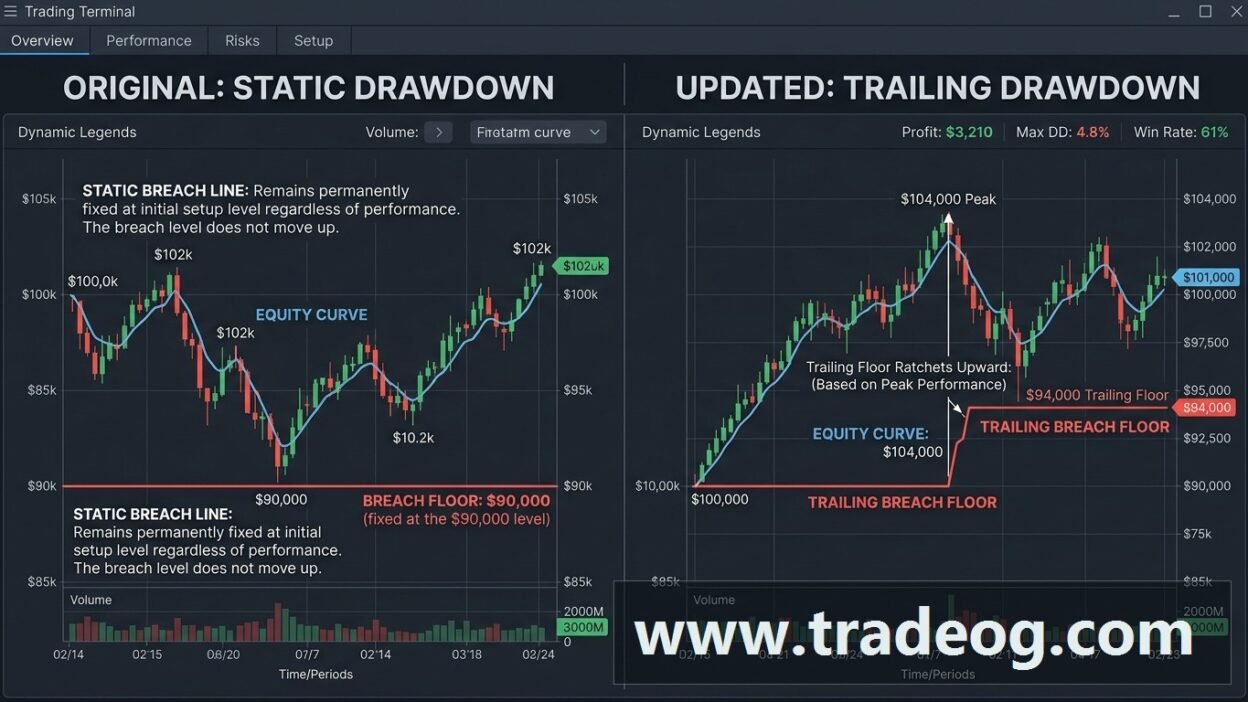
| Trailing Intraday Drawdown | If equity drops due to spread expansion while the trailing floor remains ratcheted at peak equity, the compressed buffer can trigger a breach. | High |
| Static Maximum Drawdown | Spread expansion reduces distance to the fixed floor. It causes a breach only if live equity falls below the permanent dollar threshold. | Moderate (Critical if already in drawdown) |
| Stop-Loss Slippage Policy | If a widened spread triggers your stop and liquidity is thin, your order executes at the next available tick, causing negative slippage past your limit. | High |
| Broker Bridge Price Feeds | Simulated retail demo feeds often mirror raw interbank spreads with an added broker markup, exacerbating spread expansion spikes. | Variable (Depends on broker bridge) |
To understand the fundamental distinction between balance and equity loss monitoring, read our in-depth analysis on daily loss limit vs stop loss: why they are not the same.
A Practical Example: Spread Expansion on a $100,000 Account
Let us examine a concrete mathematical walkthrough showing how spread expansion can compromise an account:
- Nominal Account Size: $100,000
- Maximum Allowable Drawdown: 10% ($10,000)
- Current Account Balance: $96,000 (-$4,000 historical loss)
- Breach Threshold Floor: $90,000
- Current Available Risk Buffer: $6,000 ($96,000 minus $90,000)
The trader enters a swing position of 4 standard lots on EUR/USD at 1.0850. The trade has a 30-pip stop loss set at 1.0820, representing an intended risk of $1,200 (well within their $6,000 buffer).
At 4:59 PM EST, price is trading at 1.0835. The trade is floating at -$600. The trader’s live equity is $95,400, leaving a comfortable $5,400 safety buffer above the $90,000 liquidation floor.
Then rollover begins. The EUR/USD spread instantly blows out from 0.8 pips to 28 pips. Because the Bid drops by 14 pips and the Ask rises by 14 pips:
- The position’s mark-to-market floating loss instantly increases from -$600 to -$1,720.
- Live account equity drops to $94,280.
- More dangerously, the plunging Bid price drops to 1.0821, within a fraction of a pip of the stop loss. An erratic tick spike touches 1.0818, triggering the stop.
- Because interbank liquidity during rollover is hollow, the stop order slips by an additional 12 pips, executing at 1.0806.
- The final realized loss on the trade is -$1,760 instead of the intended $1,200.
In this example, the trader’s account survived because their total buffer was $6,000. But if this had occurred on an account with a tight $2,000 daily loss limit, that single spread-and-slippage event would have resulted in an immediate, automated hard breach. Learn how to protect your funded accounts from non-drawdown closures in our guide on can a prop firm close your account without a drawdown breach.
Can Spread Widening Trigger a Stop-Loss?
Yes. A stop loss is frequently triggered by spread widening even when the chart’s underlying candlestick wick never touches your stop level.
To understand why this happens, remember the execution mechanics of long and short orders:
| Position Type | Entry Executed At | Stop Loss Triggered By | Default Chart Display Price |
|---|---|---|---|
| Long Position (Buy) | Ask Price | Bid Price | Bid Price (Visible) |
| Short Position (Sell) | Bid Price | Ask Price | Bid Price (Ask is Invisible) |
The Short Trade Phantom Stop Trap
This is the most common execution dispute in retail trading. A trader enters a short position on GBP/USD with a stop loss at 1.2750. Price trades around 1.2730. Spreads widen from 1 pip to 25 pips during a news release.
The Bid price stays at 1.2730, meaning the candlestick on the chart shows a high of 1.2730. But the Ask price—which governs the short stop loss—spikes upward to 1.2755. The stop loss is hit, the short is closed, and the trader looks at their chart in disbelief: \”Price never hit my stop loss line! The broker hunted my stop!\”
In reality, the broker did not manipulate the chart. The Ask price legitimately spiked due to spread expansion, triggering the stop order. Enabling the \”Show Ask Line\” setting in your charting platform is critical to visualizing this risk.
Spread Expansion vs. Slippage: What Is the Difference?
While spread expansion and slippage frequently occur simultaneously during volatile markets, they are fundamentally distinct market phenomena:
| Feature | Spread Expansion | Market Slippage |
|---|---|---|
| What Actually Changes? | The gap between the current Bid price and Ask price. | The difference between your requested price and actual executed price. |
| When Does It Happen? | Continuously during open trades as market liquidity shifts. | At the exact millisecond an order is sent or executed. |
| Impact on Floating P&L | Directly alters mark-to-market valuation of open positions. | Zero impact on open trades; affects entry and exit fill levels. |
| Primary Cause | Market makers pulling quotes or widening spreads to hedge risk. | Lack of resting liquidity at your specific order price level. |
| Can It Affect Stops? | Pushes the trigger quote closer to your stop price. | Causes the stop order to fill worse than your stop price. |
When high-impact economic news breaks, you often suffer a double penalty: spread expansion pushes the market price into your stop loss prematurely, and thin order book depth causes the resulting market order to slip 15 pips past your exit price.
Can Spread Expansion Cause a Daily Loss Limit Breach?
Yes. In fact, spread expansion is responsible for a substantial percentage of daily loss limit breaches on prop firm accounts.
Consider an account with a $50,000 balance and a strict 5% ($2,500) daily loss limit:
- Starting Day Balance: $50,000
- Daily Breach Level: $47,500 (calculated against starting day equity)
- Current Closed Realized P&L: -$1,200 across two completed morning trades.
- Current Open Trade: Floating loss of -$900 on 3 lots of EUR/JPY.
- Total Day Loss: -$2,100 ($400 away from the $2,500 daily limit).
The trader is managing risk carefully and plans to close the trade if it drops another $150. However, the session rollover hits at 5:00 PM EST. The EUR/JPY spread widens from 1.5 pips to 12 pips.
The sudden spread expansion adds an immediate -$315 in floating loss to the open ticket. Total daily loss reaches -$2,415. An erratic 2-pip tick fluctuation pushes total loss to -$2,505. The prop firm’s automated risk engine registers a breach of the $2,500 daily limit, liquidates the position, and disables the account—even though the trader was waiting to cut the position manually.
This demonstrates why professional traders never carry open positions into low-liquidity rollover windows when trading near daily loss boundaries. Review how soft and hard breaches differ in our guide on prop firm soft breach vs hard breach explained.
Can Spread Expansion Cause a Maximum Drawdown Breach?
While daily limits are vulnerable to intraday spread spikes, maximum drawdown limits can also be breached by spread expansion—particularly under trailing drawdown architectures.
If you trade under an intraday high-water mark trailing drawdown, your liquidation floor climbs tick-by-tick with your highest open profit. If your account reaches a new peak, your floor ratchets upward. When you subsequently experience a drawdown, your remaining failure buffer is razor-thin.
If your account sits just $500 above your trailing maximum drawdown floor, a sudden spread expansion event that inflates floating losses by $600 will instantly cross your liquidation threshold, causing a permanent contract termination. Learn how to manage your capital against trailing floors in our guide on trailing drawdown vs EOD drawdown.
Why Traders Notice Spread Problems Too Late
The vast majority of retail traders do not monitor spreads; they monitor candlestick charts. This creates a dangerous perceptual blind spot:
- Candlestick Charts Mask Ask Prices: By default, platforms like MetaTrader, cTrader, and TradingView draw candlestick bars using only the Bid price. If you are short, the price that actually determines your risk (the Ask) is completely invisible unless you manually toggle it on in chart properties.
- Midpoint Pricing on Aggregated Charts: Web-based trading dashboards often display smoothed midpoint pricing rather than real-time broker execution quotes. You might see a flat line on your chart while the broker’s underlying liquidity bridge is executing orders with 15-pip spreads.
- Focusing on Price Movement Instead of Spread Expansion: When an account is liquidated, traders check how far the market moved directionally. When they see price moved only 5 pips, they assume a broker glitch occurred—unaware that the spread widened by 25 pips during that same 10-second window.
When Does Spread Expansion Matter Most?
Spread expansion risk varies significantly across different trading environments:
| Trading Environment | Spread Widening Risk | Typical Operational Impact |
|---|---|---|
| Major Economic News Releases (CPI/NFP) | Extremely High | Severe slippage, massive spread blowouts, premature stop triggers. |
| 5:00 PM EST Daily Bank Rollover | Very High | Predictable 5x to 20x spread expansion across forex and metals. |
| Sunday Market Opening Bell | High | Weekend price gaps combined with thin opening liquidity. |
| Late Friday Afternoon Session | Moderate to High | Institutional desks flattening books before weekend closure. |
| Off-Peak Overnight Sessions | Moderate | Wider baseline spreads on non-domestic currency pairs. |
| Liquid London/New York Overlap | Very Low | Tightest spreads, deepest market liquidity, optimal execution. |
Does Every Prop Firm Treat Spread-Related Losses the Same Way?
No. Proprietary trading firms differ substantially in how they handle execution-related losses.
Some firms take an absolute, automated stance: if your account equity touches the drawdown floor for any reason—whether caused by market momentum, spread expansion, or broker slippage—the breach is considered final and irreversible.
However, industry standards are evolving. Several forward-thinking proprietary firms have introduced formal execution dispute frameworks. For example, published rules from Axon Funded explicitly distinguish between market execution anomalies (such as extreme slippage or broker pricing feed disconnects) and intentional trader risk-limit breaches. Under such policies, if a trader provides verified server logs proving that an abnormal spread spike breached an account that was otherwise compliant, the firm’s risk desk may review the incident and reinstate the account.
This demonstrates why traders must research a firm’s execution policy before buying an evaluation. Never assume that every company enforces an inflexible automated liquidation policy. Learn what questions to ask in our guide on questions to ask before choosing a prop firm.
What If the Spread Expansion Was Clearly Abnormal?
If you believe your account was breached due to an artificial pricing anomaly, server bridge freeze, or off-market quote rather than normal market widening, you must compile verifiable forensic evidence.
The Execution Dispute Evidence Archive:
- ☐ High-Resolution Chart Screenshot: Showing the exact candlestick bar, with both Bid and Ask lines visible.
- ☐ Tick Execution History: Exported tick data from your terminal showing the exact spread value at the millisecond of execution.
- ☐ Order Ticket Details: Documenting the exact Order ID, open timestamp, close timestamp, requested stop loss price, and actual fill price.
- ☐ Terminal Journal / Server Logs: The raw text log from your MetaTrader or cTrader \”Journal\” tab showing server connection pings and broker quote transmissions.
- ☐ Independent Benchmark Comparison: Comparing the prop firm broker’s quote against institutional price feeds (such as TradingView interbank feeds or major ECN brokers) to prove that the prop firm’s spread expansion was disproportionate.
What Should You Do If You Believe Spread Expansion Caused a Breach?
If your account flashes a breach notification following an unexpected spread spike, execute this 10-step dispute protocol:
- Step 1 — Stop Trading Immediately: Do not place compensatory trades or attempt to modify other orders on linked accounts.
- Step 2 — Preserve Screen Evidence: Take full-screen timestamped screenshots of your terminal, dashboard, and open charts immediately before closing the window.
- Step 3 — Export Complete Trade Logs: Download your detailed account statement in HTML and CSV format, capturing all closed trade records.
- Step 4 — Copy Platform Journal Logs: Navigate to the \”Journal\” tab of your trading terminal, right-click, and select \”Open Folder\” to archive the raw daily text log.
- Step 5 — Record the Exact Spread Value: Calculate the exact pip/cent difference between the Bid and Ask prices at the millisecond of liquidation.
- Step 6 — Verify the Applicable Rulebook: Review the firm’s published Terms of Service to check whether spread expansion or slippage is explicitly addressed under breach policies.
- Step 7 — Draft a Professional Support Inquiry: Avoid emotional accusations or aggressive language. Present a calm, factual, data-driven summary.
- Step 8 — Request Exact Server Audit Data: Ask support to provide the broker bridge tick log showing the exact quotes received from their liquidity provider.
- Step 9 — Check External Dispute Channels: If the firm refuses to investigate a documented pricing anomaly, verify whether the company is registered with independent dispute bodies (such as the Financial Commission).
- Step 10 — Learn and Adapt: Regardless of the outcome, assess whether your position sizing and trade timing left too small a buffer for normal market execution realities.
How Traders Can Reduce Spread-Related Risk: A Practical Protocol
You cannot control global market spreads, but you can control your exposure to spread expansion through disciplined risk management:
- Never Hold Positions Across the 5:00 PM EST Rollover Window: Unless your strategy specifically requires multi-day swing holds on wide stop margins, flatten intraday positions by 4:55 PM EST and wait until 5:15 PM EST before re-entering. This single rule eliminates 90% of spread expansion liquidations.
- Enable the \”Show Ask Line\” on Every Chart: Never trade blind. In your platform settings, toggle on the Ask price line so you can visually monitor current spread width in real time.
- Size for the Drawdown Buffer, Not Account Balance: If your account has only $1,500 of remaining drawdown buffer, risking $1,000 on a trade leaves zero room for spread widening. Size your positions so that potential spread spikes represent less than 5% of your available buffer. Learn the mathematical formula in our guide on position size based on drawdown buffer.
- Avoid Entering Market Orders Directly Into Red-Folder News: If you trade news momentum, wait 2 to 5 minutes after the initial economic data release for order books to stabilize and spreads to normalize before entering.
- Trade Only Liquid Instruments During Their Native Sessions: Trade European currencies during London hours, US indices during New York cash hours, and Asian currencies during Tokyo hours to ensure maximum order depth.
Spread Expansion Risk: Gold vs. Major Forex vs. Indices
| Asset Class | Primary Spread Catalysts | Normal Spread Range | Peak Expansion Range | Recommended Trader Action |
|---|---|---|---|---|
| Gold (XAU/USD) | US macroeconomic news, 5:00 PM EST rollover, geopolitical headlines. | 15 to 30 cents | $2.00 to $6.00+ | Never hold tight stops through rollover; avoid pre-news orders. |
| Major Forex (EUR/USD, GBP/USD) | Central bank rate decisions, CPI/NFP, rollover liquidity vacuum. | 0.2 to 1.2 pips | 8 to 25+ pips | Flatten intraday orders before 4:59 PM EST; enable Ask line. |
| Equity Indices (US30, NAS100, SPX500) | Cash open (9:30 AM EST), earnings releases, futures settlement. | 1.0 to 2.5 points | 15 to 50+ points | Wait 5 minutes after 9:30 AM EST open for spreads to normalize. |
| Exotic Currencies & Crypto | Off-peak hours, weekend liquidity drops, low trading volume. | Wide baseline | Highly unpredictable | Reduce position sizing by 50% to absorb wide execution variance. |
Frequently Asked Questions (FAQ)
Can spread widening cause a prop firm breach?
Yes. Spread widening increases open floating losses and compresses live account equity. If your account is close to its daily loss limit or maximum drawdown floor, a sudden spread expansion can trigger an automated liquidation and breach.
Can spread expansion trigger a stop-loss without price touching it?
Yes. Short positions exit at the Ask price, while standard charts display only the Bid price. If the spread expands and the Ask spikes upward, your stop loss can execute even if the visible candlestick chart shows price comfortably below your stop.
Does spread count as a realized trading loss?
Spread is an immediate transaction cost that reflects in your open floating P&L upon entry. It becomes a realized loss once the position is closed or if the spread triggers a stop-loss exit.
Can spread expansion cause an equity drawdown breach while in profit?
Yes. On accounts with intraday trailing drawdown, the liquidation floor moves up with peak open profit. If a trade pulls back and spreads suddenly expand, your remaining buffer can be wiped out, causing a breach even while the account is in net profit.
Can a prop firm reverse a breach caused by spread widening?
Most firms treat normal market spread expansion as an unavoidable market risk that traders must manage. However, if the spread expansion was caused by a verified broker bridge error, off-market bad tick, or technical platform freeze, reputable firms will investigate and reinstate the account.
What is the difference between spread expansion and slippage?
Spread expansion is the widening difference between the Bid and Ask prices in the order book. Slippage is the difference between your requested order price and the actual price at which the order executes on the server.
Why do spreads widen so dramatically at 5:00 PM EST?
At 5:00 PM EST, major global banks settle daily currency transactions and calculate swap fees. During this interbank rollover window, institutional liquidity drops sharply, causing spreads to expand until Asian liquidity enters the market.
Does floating loss count toward prop firm daily drawdown?
At the majority of proprietary trading firms, yes. Daily drawdown limits are calculated using tick-by-tick equity. Floating unrealized losses caused by spread widening count directly toward your daily loss limit.
How can I see real-time spreads on my trading platform?
In MetaTrader or cTrader, open your chart properties (press F8) and enable \”Show Ask Line.\” You can also add the \”Spread\” column to your Market Watch window to monitor current spread numbers in points or pips.
Should funded traders avoid trading during economic news?
Traders with tight drawdown limits should generally avoid trading immediately before or during high-impact news releases. Extreme spread expansion and slippage during news events dramatically increase the mathematical probability of account failure.
Conclusion: Managing Spread Is Active Risk Management
Spread expansion is not a broker scam or a technical anomaly; it is the fundamental mechanism through which financial markets price liquidity risk. When buyers and sellers withdraw from the market, spreads expand—and accounts with fragile risk buffers pay the price.
To succeed as a funded prop trader, you must look beyond candlestick bodies and manage the real, two-sided market:
- Understand that your account equity fluctuates with the Bid-Ask spread on every tick.
- Respect the danger zones: avoid holding tight positions through the 5:00 PM EST rollover and major news releases.
- Always size positions relative to your real failure buffer rather than headline account size.
Before assuming that an execution-related breach was an unfair liquidation, check the bid/ask records, audit your server execution logs, and review your firm’s published rules. By mastering spread risk management, you turn market volatility from a destructive hazard into a controllable operational reality.