

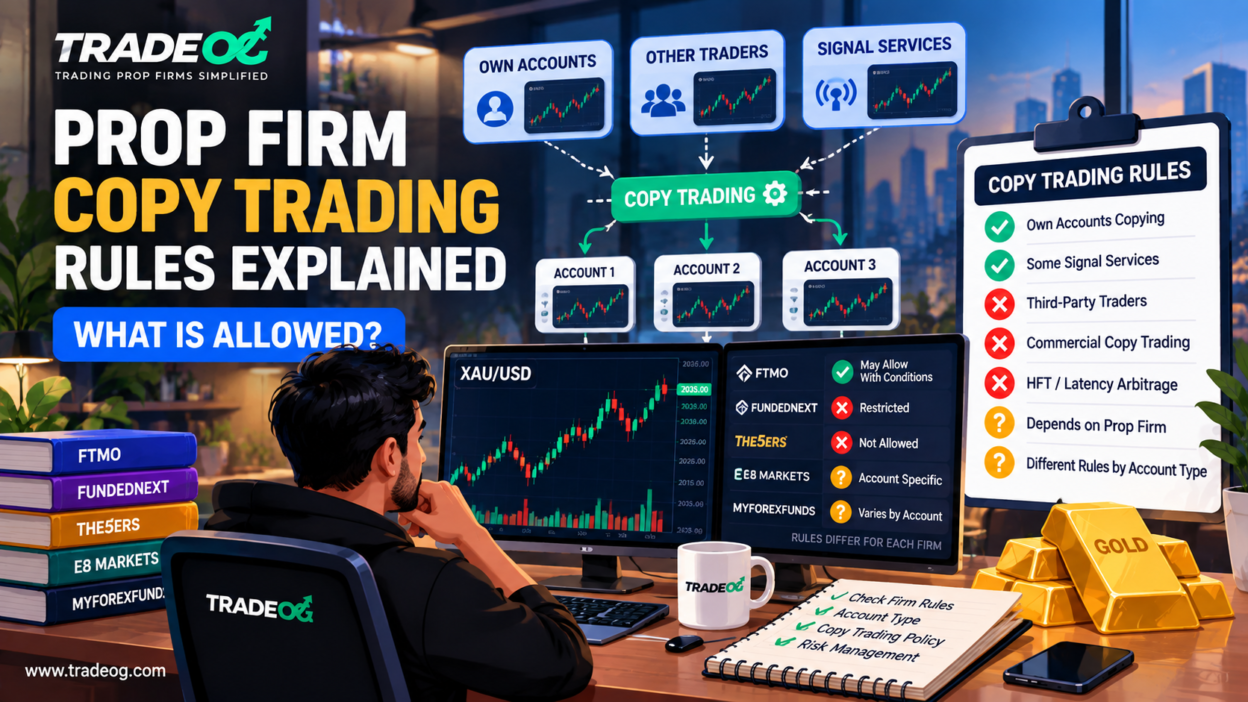
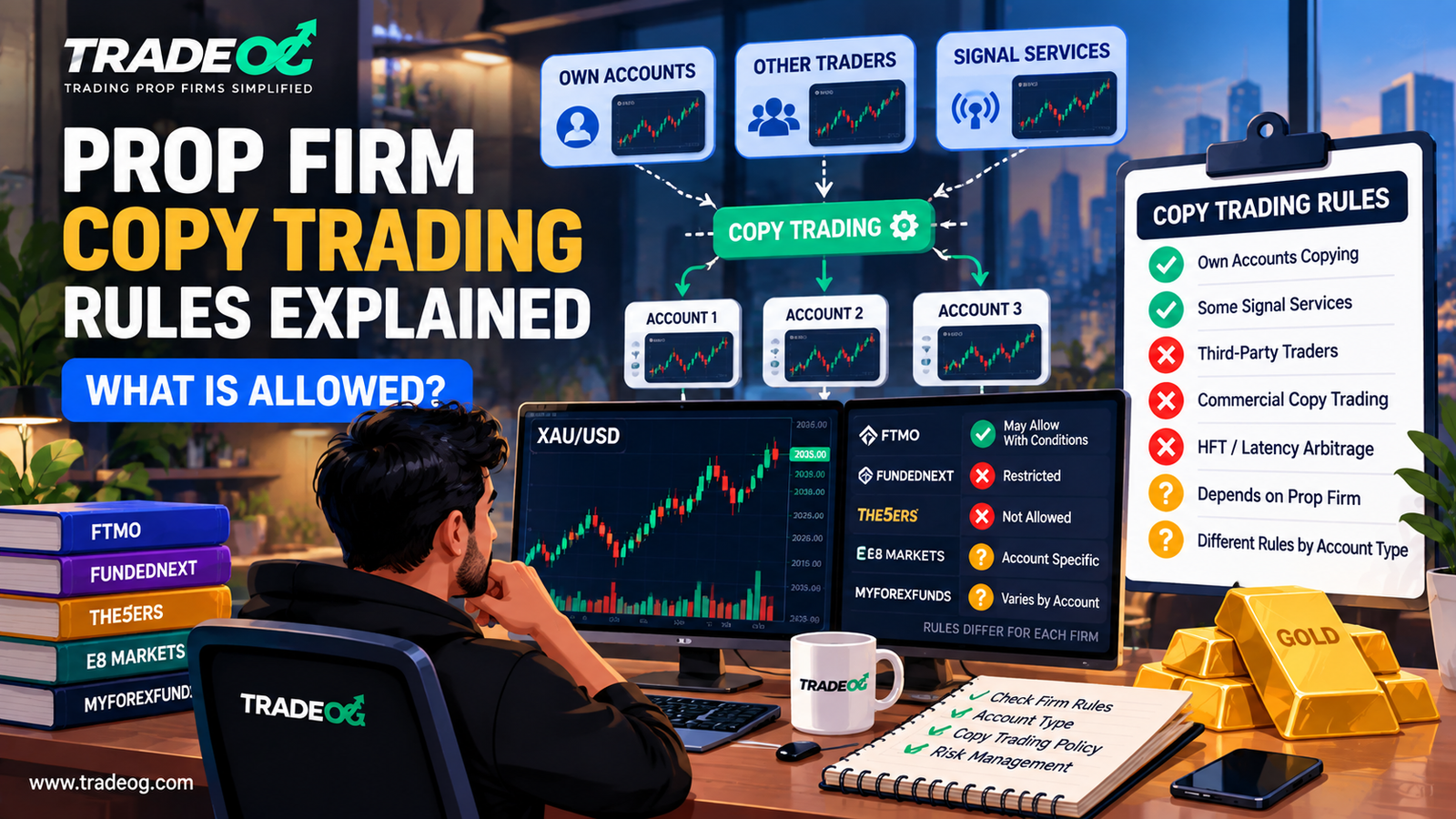
Copy trading sounds simple: one account places a trade and another account automatically or manually follows it. But when you trade through a prop firm, copy trading can become a rules and compliance issue.
The key question is not simply “Does this prop firm allow copy trading?” You need to know whose trades you are copying, which accounts are involved, whether the accounts have the same owner, whether signals are being followed, and whether the copy method is permitted for your exact product.
For Indian traders, this matters because many traders operate multiple evaluation accounts, use trade copiers, follow signal groups, or try to mirror a successful strategy across different firms. A method that is permitted by one prop firm can be prohibited by another.
What Is Copy Trading?
Copy trading means replicating trades from one account into another account. The replication can be manual or automated.
Examples include:
- Copying your own trades from one account to another.
- Using a VPS-based trade copier between your own accounts.
- Following a master account.
- Copying trades from a friend or family member.
- Following a paid signal provider.
- Using cloud-based copy-trading software.
These methods are not treated equally by prop firms. The ownership and source of the trading decisions are often critical.
Why Do Prop Firms Restrict Copy Trading?
Prop firms generally want each trader to demonstrate independent trading decisions and risk management. Copying another person’s trades can make it difficult for a firm to determine whether the account represents the trader’s own strategy.
There is also a difference between copying your own strategy across your own accounts and copying another person’s decisions.
For example, FundedNext’s current copy-trading documentation permits certain copying between a trader’s own eligible Challenge Accounts, while copying trades between different individuals is prohibited. Its Futures rules similarly allow copying a trader’s own accounts under stated conditions but prohibit copying another person’s trades or using external signal services. FundedNext copy-trading rules and FundedNext Futures copy/group trading rules.
Types of Copy Trading
1. Copying Your Own Accounts
This is where you have a master account and replicate your own trades to other accounts that you personally own.
Some firms permit this, but there may be limits on total allocation, account types, or which stages can be copied.
2. Copying Another Person
This is where your account follows trades generated by another trader.
This is commonly restricted or prohibited because the trading decisions originate from someone else.
3. Signal Services
A signal provider sends a buy or sell instruction and you execute it in your account. Even if you click the order manually, a prop firm may treat this as copying or signal following.
4. Automated Trade Copiers
A software tool can automatically replicate orders from a master account to one or more follower accounts. Whether this is permitted depends on the firm’s current rules and the ownership of the accounts involved.
FundedNext Copy Trading Rules
FundedNext’s current CFD copy-trading policy contains an important distinction.
FundedNext states that copy trading is allowed between multiple FundedNext Challenge Accounts owned by the same individual, with total combined capital allocation capped at $300,000 and one account designated as the master account.
However, FundedNext prohibits copy trading between accounts owned by different individuals, including friends, family members and third parties. It also prohibits external cloud-based copy services such as Social Trader Tools, Traders Connect and Duplikum for the prohibited setups. A VPS-based copier is permitted only for copying between the trader’s own eligible FundedNext Challenge Accounts under the stated rules.
FundedNext also says copy trading involving a FundedNext funded account and another FundedNext account or Challenge Account is prohibited, including manual or automated replication. Read the current FundedNext copy-trading policy.
FundedNext Futures Copy Trading Rules
FundedNext Futures uses a separate policy.
Its current Futures documentation says copy trading is generally prohibited when it involves another person, group trading or signal services. However, copying your own trades is allowed between your own FundedNext accounts, and copying between FundedNext and another prop firm is allowed when all accounts are owned by the same individual and can be verified.
FundedNext Futures also states that copy-trading tools can be used for copying the trader’s own accounts, including Tradovate’s built-in copy feature, NinjaTrader modules such as Replikanto and other third-party platforms. FundedNext Futures official copy/group trading policy.
FTMO Copy Trading Rules
FTMO’s current Futures forbidden-practices documentation explicitly prohibits copying the trading decisions of another trader into an Evaluation or Sim-Funded Account. This includes signal services, master accounts, trade copiers and manual or automated arrangements where the decisions originate from a third party.
At the same time, FTMO states that copy trading across your own accounts is permitted, provided every account independently complies with the applicable rules. FTMO Futures forbidden trading practices.
FTMO’s broader account rules also impose capital-allocation limits. Its current CFD FAQ states that total capital allocation across accounts is limited to $400,000 per trader or strategy before scaling. Identically traded strategies across multiple accounts can therefore create additional compliance considerations. FTMO account allocation rules.
Copy Trading vs Account Management
These are related but not identical concepts.
Copy trading usually means trades from one account are replicated into another. Account management can mean another person actually operates your account on your behalf.
Many prop firms have strict personal-use rules. FTMO, for example, says third parties must not access or operate a trader’s Evaluation or FTMO Account, and traders must not perform trades on another person’s account. FTMO personal-use and trading rules.
Therefore, giving your login to a friend, signal provider, account manager or another trader is a separate compliance risk from simply using a permitted copier between your own accounts.
Can You Copy Your Gold Trades?
Yes, potentially, if your prop firm permits the specific copy arrangement.
For example, suppose you trade XAU/USD manually on your own master account. You may want to replicate the same gold trade across several accounts.
Before doing this, check:
- Are all accounts legally and operationally yours?
- Does the prop firm permit copying between those account types?
- Are evaluation and funded accounts treated differently?
- Is there a maximum combined allocation?
- Is a trade copier permitted?
- Are external signal services prohibited?
- Does the firm prohibit identical strategies across registrations?
Copy Trading and XAU/USD Risk
Copying trades does not remove market risk. It can actually multiply the same exposure across several accounts.
Suppose one XAU/USD position risks 0.5% on a master account. If the same position is copied to four accounts, you have created four separate account-level exposures. A gold spike against the trade can therefore affect every account simultaneously.
Each account still has its own drawdown and risk limits. Passing one account does not protect another account from a loss-limit breach.
Copy Trading and Drawdown Rules
A common mistake is assuming that because the trade is copied automatically, the firm’s drawdown rules somehow apply only to the master account.
That is not how account-level risk limits work.
Each account should be checked independently for:
- maximum daily loss
- maximum overall drawdown
- position size
- open exposure
- margin usage
- news restrictions
- account-specific trading conditions
If a copier uses identical lot sizes instead of scaling the position according to each account’s balance and risk limit, a smaller account can become overexposed.
Can You Use a Trade Copier Between Different Prop Firms?
There is no universal answer.
Some programs allow copying your own trades across different firms when all accounts belong to you. Other firms can restrict or prohibit cross-account copying, mirroring or coordinated trading.
FundedNext Futures currently states that copying between FundedNext and other prop firms is permitted when the trader owns all accounts and can verify the ownership. FundedNext Futures policy.
By contrast, FundedNext’s CFD terms currently state that copy trading, mirroring, signal following and trade replication are prohibited unless expressly authorised in writing and permitted under the applicable programme rules. FundedNext CFD Challenge Terms.
This difference shows why you should never assume that a copier allowed by one product is automatically allowed by another.
Copy Trading From a Friend: Is It Allowed?
Do not assume that because you and your friend are both trading the same market, copying each other’s trades is acceptable.
FundedNext’s current CFD policy specifically prohibits copying between accounts owned by different individuals, including friends and family members. FTMO’s rules also prohibit copying another person’s trading decisions into its Evaluation or Sim-Funded Accounts. FundedNext and FTMO.
What About Telegram and WhatsApp Signals?
Signal groups are another area where traders need to be careful.
A signal provider may send instructions such as “BUY XAU/USD” or “SELL EUR/USD,” after which subscribers execute the same trade.
A prop firm can treat this as third-party signal following or copy trading even when the trader manually presses the Buy or Sell button.
FundedNext’s current Futures policy explicitly prohibits subscribing to trading signal services or using external signals to guide trading decisions. FundedNext Futures rules.
How Prop Firms Can Detect Copy Trading
Firms can compare trading patterns across accounts. FundedNext says its monitoring can look at identical trades, including entry price, exit price, lot size, symbol and trade time, as well as synchronized trading patterns and group trading behaviour. FundedNext’s copy-trading policy.
That does not mean that two traders can never make the same trade. Similar market analysis can naturally produce similar entries. The important issue is whether the trading pattern and account relationships fall within the firm’s rules.
Common Copy Trading Mistakes
1. Assuming All Prop Firms Have the Same Rules
They do not. Account types, products and platforms can have different policies.
2. Copying a Friend’s Account
Shared ownership or friendship does not automatically make copying permissible.
3. Using a Signal Service Without Checking the Rules
Manual execution does not necessarily make third-party signals compliant.
4. Copying the Same Lot Size Everywhere
Different account sizes may require different position sizes to maintain equivalent risk.
5. Ignoring Funded vs Challenge Differences
A method allowed during an evaluation may be restricted after the account becomes funded.
6. Ignoring Cross-Firm Rules
One firm’s permission does not override another firm’s terms.
Copy Trading Checklist for Indian Traders
- ☐ Read the current copy-trading policy.
- ☐ Confirm who owns every account.
- ☐ Check whether copying your own accounts is permitted.
- ☐ Check whether copying across different firms is permitted.
- ☐ Check Challenge vs Funded rules separately.
- ☐ Check CFD vs Futures rules separately.
- ☐ Confirm the trade copier is permitted.
- ☐ Avoid third-party signal services if prohibited.
- ☐ Never share your account credentials.
- ☐ Scale position size to each account’s risk limits.
- ☐ Check total capital allocation limits.
- ☐ Keep records showing account ownership when required.
Final Answer: Are Copy Trading Rules the Same at Every Prop Firm?
No. Copy-trading policies can differ substantially between firms, account types and products.
FundedNext currently allows certain forms of copying between a trader’s own Challenge Accounts, while restricting copying involving other individuals and placing additional rules around funded accounts and third-party copy tools. FundedNext Futures has a separate policy that permits copying your own accounts, including certain cross-prop-firm setups, while prohibiting third-party signals and group trading. FundedNext CFD rules and FundedNext Futures rules.
FTMO Futures currently prohibits copying another trader’s decisions but permits copy trading across your own accounts when each account independently follows the applicable rules. FTMO Futures rules.
For Indian traders, the safest workflow is simple: identify the account owner, identify the source of the trading decision, check the exact product and account type, and read the current official copy-trading policy before using a copier or signal service.
Sources
- FundedNext — Copy Trading Rule
- FundedNext Futures — Copy & Group Trading Policy
- FundedNext — CFD Challenge Terms
- FTMO Futures — Forbidden Trading Practices
- FTMO — Account Allocation Rules
Risk note: This article is for educational purposes only and is not financial advice. Prop-firm rules can change and may differ by account, product, platform and jurisdiction. Always verify the current official terms before using copy trading, signal services or trade-copier software.



[…] guide on prop firm copy trading rules covers the distinction between own-account copying, third-party copying, signals and trade […]