

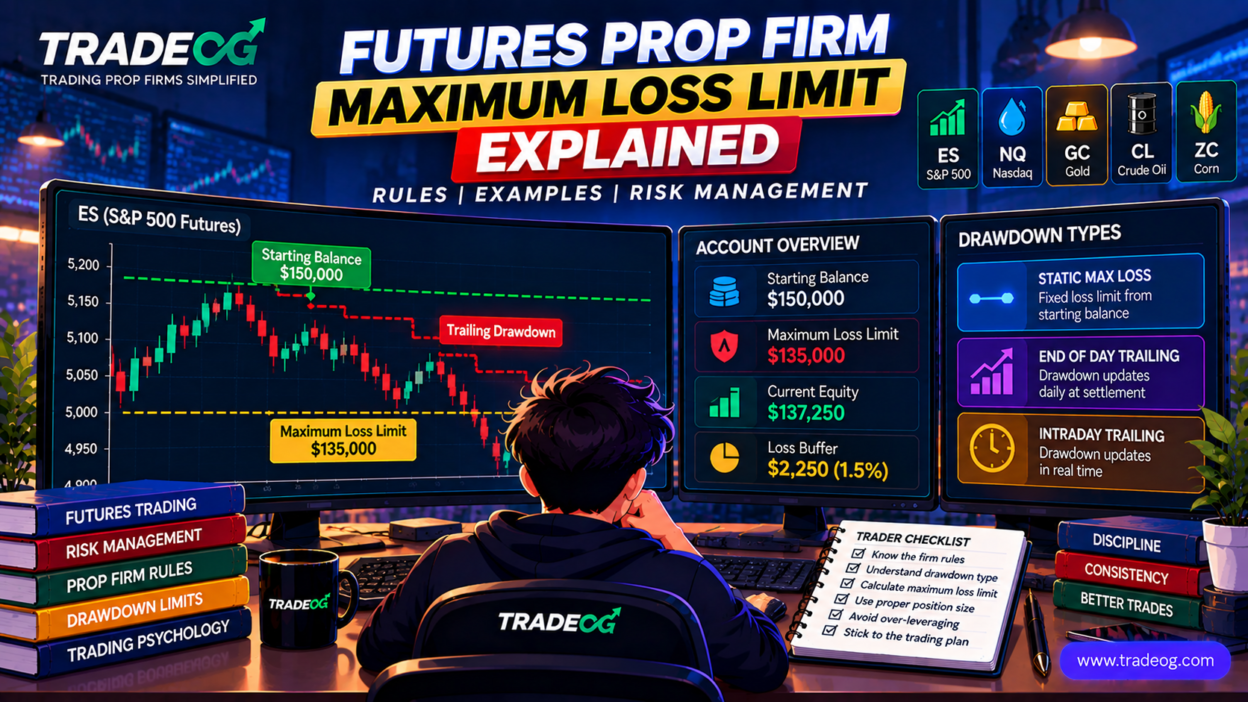
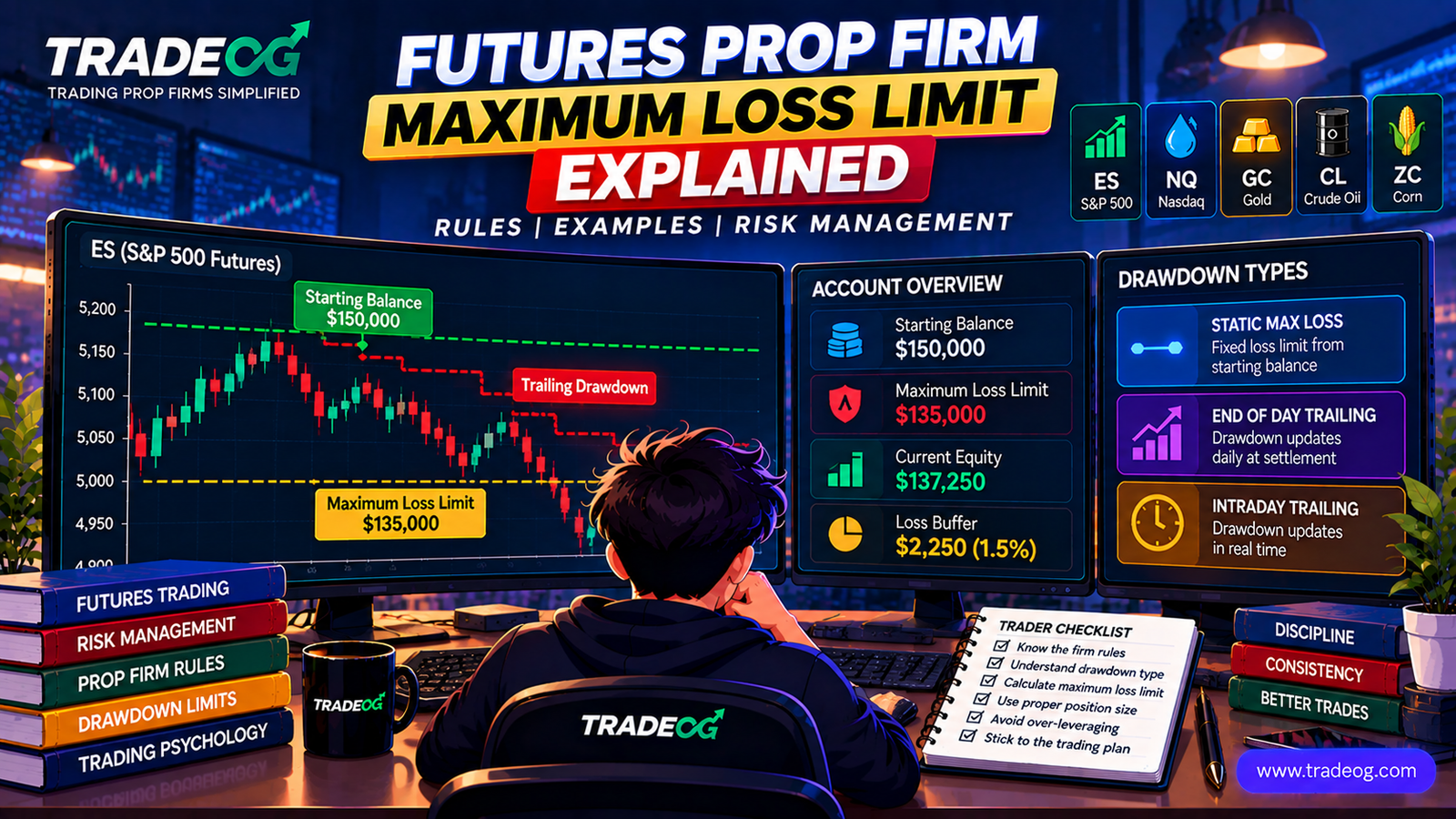
If you are trading futures through a prop firm, one number matters more than the headline account size: the Maximum Loss Limit (MLL). A $50,000 or $100,000 futures prop account does not necessarily mean you can lose thousands of dollars freely. The MLL defines the floor your account cannot reach without triggering a rule violation, liquidation, or account closure.
The important part is that maximum loss is not calculated the same way at every futures prop firm. Some programs use a static drawdown, some use an end-of-day trailing drawdown, and others use an intraday trailing threshold that can react to unrealized profit. Your job is to understand the exact calculation before you trade.
What Is a Futures Prop Firm Maximum Loss Limit?
The Maximum Loss Limit is the maximum drawdown a program allows before the account reaches its failure or liquidation threshold. In simple terms, it creates a minimum acceptable account value.
For example, if a program starts with a $50,000 balance and has a $2,000 maximum loss limit, the account may have a floor of $48,000. But whether that floor remains fixed or moves upward after you make money depends on the firm’s drawdown model.
Topstep currently describes its MLL as the lowest point the account balance is allowed to reach. Its current $50K, $100K and $150K examples use MLL amounts of $2,000, $3,000 and $4,500 respectively. Topstep also states that its MLL is monitored in real time, including unrealized P&L. Topstep Maximum Loss Limit
Why the Account Size Can Be Misleading
Futures prop firms often advertise buying-power labels such as $50K, $100K or $150K. That figure should not automatically be treated as the amount you are free to lose.
Your actual trading risk is better understood through the combination of:
- Maximum Loss Limit or drawdown
- Daily Loss Limit, if applicable
- Maximum position size
- Contract and product rules
- Trailing-drawdown methodology
- News, overnight and trading-hour restrictions
- Payout and balance rules after funding
For a futures trader, the useful question is not simply “How big is my account?” It is “How much room do I have before the account reaches its risk threshold?”
Static Maximum Loss vs Trailing Maximum Loss
There are three common ways traders may encounter a maximum-loss structure.
1. Static Maximum Loss
A static drawdown keeps the loss floor at a fixed level. If the account starts at $25,000 and the static maximum loss is $1,000, the floor remains $24,000 even if the account later grows.
Topstep’s 2026 Labs $25K Static Trading Combine is an example of this model: its published parameters list a $1,000 static Max Loss Limit. Topstep explains that the static floor does not move as the account grows. Topstep Labs parameters
2. End-of-Day Trailing Drawdown
An end-of-day trailing model adjusts the loss threshold based on the account’s end-of-day performance rather than every intraday tick. This can give a trader more breathing room than a real-time trailing model when a temporary intraday high is followed by a pullback.
For example, imagine a $25,000 account with a $1,000 EOD trailing drawdown:
- Starting balance: $25,000
- Initial floor: $24,000
- End-of-day balance rises to $25,500
- Next-day trailing floor can move to $24,500, depending on the firm’s formula
The exact calculation differs by program, so never copy an example from one firm into another firm’s rules.
3. Intraday Trailing Drawdown
An intraday trailing drawdown is more dynamic. The threshold can move as the account reaches new peak equity or balance levels during the session. In some programs, unrealized profit can also increase the peak used in the calculation.
Apex Trader Funding’s current Intraday Evaluation documentation, for example, says its trailing threshold follows Peak Balance in real time, includes realized and unrealized gains, and only moves upward. It also states that breaching the threshold can automatically liquidate positions and fail the evaluation. Apex Intraday Trailing Drawdown
Simple Example of a Trailing Maximum Loss
Suppose a futures evaluation starts with a $50,000 balance and a $2,500 trailing drawdown.
At the beginning:
Starting balance = $50,000
Drawdown allowance = $2,500
Initial threshold = $47,500
Now imagine the account reaches $51,500. If the firm’s rules trail the threshold from that peak, the loss floor may rise with the account. The trader therefore cannot assume that the original $47,500 floor remains available forever.
This is why a trader can be profitable overall and still violate a trailing-drawdown rule. The relevant question is not only where the account started, but how the firm’s threshold has moved.
Does Unrealized P&L Count?
This is one of the most important details to check.
Some futures prop programs monitor the account’s risk threshold using equity or net P&L, meaning an open trade that temporarily moves against you can be enough to breach the limit even if the trade later recovers.
Topstep states that its MLL is monitored using both realized and unrealized P&L. Its documentation gives an example where an open position temporarily pushes the account below the MLL, triggering liquidation even if the final realized balance later ends above the threshold. Topstep MLL explanation
This creates an important futures-trading rule: do not manage your account only from closed-trade profit. Watch your live equity and the remaining distance to the firm’s threshold.
Maximum Loss Limit vs Daily Loss Limit
| Rule | What it controls | Typical effect |
|---|---|---|
| Maximum Loss Limit | Total allowed drawdown or account floor | Can fail or close the account |
| Daily Loss Limit | Loss allowed during one trading session | May stop trading for the session |
| Trailing Drawdown | Moving loss threshold linked to balance/equity | Threshold can rise as performance improves |
| Position Limit | Maximum contracts | Restricts exposure |
These rules can interact. A trader may avoid the MLL but still hit a daily loss limit, or stay within a daily limit while getting close to the overall drawdown floor.
How Futures Traders Accidentally Hit the Maximum Loss
1. Trading too close to the threshold
If your account is only a small amount above the MLL, normal futures volatility can become a major problem. A sudden move in ES, NQ, GC or another contract can consume the remaining buffer quickly.
2. Using too many contracts
Position size determines how quickly P&L changes. A setup that feels manageable with one micro contract can become difficult to control with multiple minis.
3. Ignoring unrealized losses
Waiting for a losing position to recover can be dangerous when the firm’s threshold is evaluated in real time.
4. Treating a winning trade as free risk
After making a large profit, traders sometimes increase size because the account is “in profit.” With a trailing drawdown, however, the risk floor may also have moved upward.
5. Trading during high volatility without a buffer
Economic releases and fast markets can create larger-than-normal price movement and execution uncertainty. A trade that looks comfortably inside the limit can approach or breach it much faster than expected.
What Happens When the Maximum Loss Limit Is Hit?
The exact consequence depends on the prop firm’s program. Possible outcomes include automatic liquidation, temporary trading lockout, evaluation failure, or permanent account closure.
Topstep says that if its MLL is breached, positions can be liquidated immediately. Its current documentation also notes that market execution and slippage can cause the final realized balance to differ from the threshold after a breach. Topstep MLL rules
Apex’s current intraday evaluation documentation similarly states that a threshold breach triggers automatic liquidation and fails the evaluation. Apex evaluation drawdown rules
So do not assume that “the trade closed above the limit” means the rule was not broken. Some systems act on the threshold breach itself.
How to Calculate Your Real Trading Buffer
A simple risk-management calculation is:
Available Buffer = Current Equity − Current Maximum Loss Threshold
For example:
- Current equity: $52,800
- Current MLL threshold: $50,000
- Available buffer: $2,800
That $2,800 is more useful for risk planning than the headline “$50K account” label.
You can then define a personal risk limit below the firm’s hard limit. For example, a trader may choose to stop trading well before the official MLL rather than allowing a normal losing streak to reach the firm’s liquidation threshold.
Futures Prop Firm Maximum Loss: A Practical Risk Framework
For Indian traders using futures prop firms, a simple framework is to treat the firm’s MLL as an emergency boundary, not as your normal stop-loss budget.
- Record the current MLL threshold before the session.
- Calculate the remaining buffer from current equity to the threshold.
- Set a smaller personal daily loss limit.
- Reduce contracts when volatility increases.
- Monitor unrealized P&L if the firm’s rules use equity.
- Recheck the drawdown after a strong winning day because a trailing threshold may have moved.
- Read the current official rule page before relying on any old screenshot or YouTube explanation.
Static vs EOD vs Intraday: Quick Comparison
| Feature | Static | EOD Trailing | Intraday Trailing |
|---|---|---|---|
| Threshold moves? | No | Yes, based on the program’s EOD calculation | Yes, potentially in real time |
| Intraday peaks important? | No | Usually not in the same way as an intraday model | Yes |
| Unrealized P&L may matter? | Depends on program | Depends on program | Often yes |
| Liquidation on breach? | Program-specific | Program-specific | Common in real-time models |
What Indian Futures Traders Should Check Before Joining a Prop Firm
Before paying for an evaluation, read the firm’s current rule page and answer these questions:
- What is the exact Maximum Loss Limit?
- Is it static, EOD trailing, or intraday trailing?
- Does unrealized P&L count?
- When does the threshold update?
- Does the threshold stop trailing at a certain balance?
- Is there a separate Daily Loss Limit?
- What happens immediately after a breach?
- How do payouts change the effective loss floor?
- What contracts and maximum position sizes are permitted?
- Are there restrictions around news, overnight holding or session times?
TradeDay’s current terms, for example, state that its rules include day-trading requirements, approved CME futures products, position limits, and EOD trailing drawdown limits. Its terms also say the rules can be amended with reasonable notice. TradeDay Terms and Conditions
Final Takeaway
The Futures Prop Firm Maximum Loss Limit is the account’s hard risk boundary. The most important mistake is treating the advertised account size as the amount you can afford to lose.
Instead, focus on the current drawdown threshold, the distance between equity and that threshold, and whether the program uses static, end-of-day trailing, or intraday trailing calculations. In fast futures markets, the difference between those models can materially change how much room a trader actually has.
Always verify the firm’s current rules before trading. Prop firm rules can change, and examples from one provider should not be assumed to apply to another.