

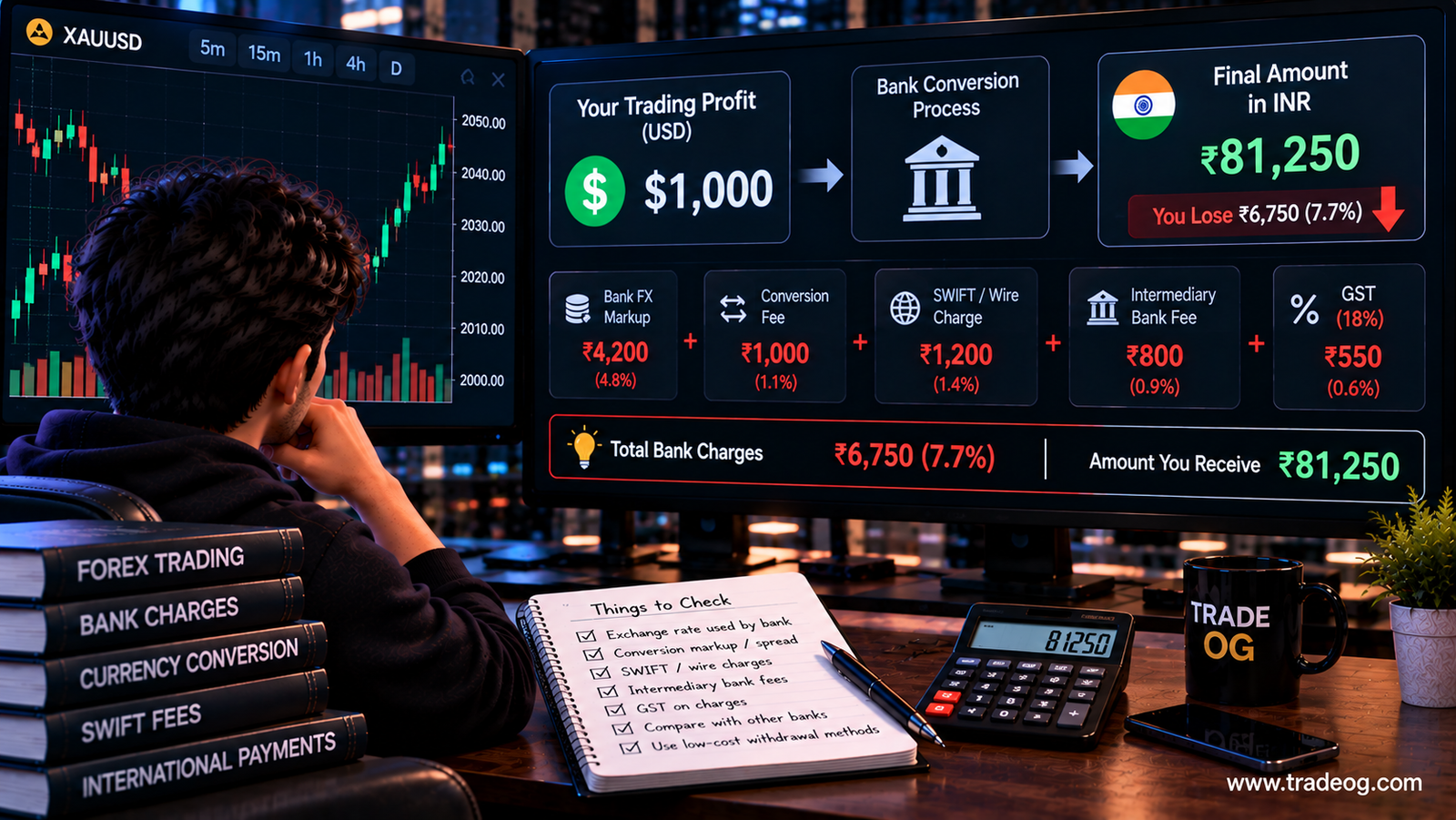
A forex trade can be profitable on your trading platform and still produce a noticeably smaller return when the money reaches your Indian bank account. One reason is the cost of converting foreign-currency proceeds into INR.
For Indian traders, the difference can come from more than a clearly labelled “conversion fee”. A bank or payment route may apply an exchange-rate spread or markup, while separate transfer, correspondent-bank or service charges can also affect the final amount received.
The important number is therefore not just your USD trading profit. It is the net INR you actually receive after all conversion-related costs.
What Are Bank Conversion Charges?
Bank conversion charges are the costs associated with exchanging a foreign currency such as USD into Indian rupees. The exact pricing depends on the bank, transaction route, currency, amount and service involved.
The total economic cost can include:
- Foreign-exchange rate markup or spread
- Explicit currency-conversion fees
- Wire or SWIFT-related charges
- Intermediary or correspondent-bank charges
- Receiving-bank charges
- Applicable taxes or GST on taxable banking services
CBIC’s GST guidance confirms that foreign-currency services and related banking service charges can have GST implications, while charges imposed by overseas correspondent banks can involve separate supplies that need to be considered under the applicable rules. CBIC banking and GST guidance.
Why a Profitable Forex Trade Can Have a Lower INR Return
Suppose your forex account shows a $1,000 profit. At a hypothetical reference rate of ₹96.00 per USD, the reference INR value would be:
$1,000 × ₹96.00 = ₹96,000
Now suppose the bank or payment route effectively converts the money at ₹94.80 per USD.
$1,000 × ₹94.80 = ₹94,800
Before considering any separate transaction fee, the exchange-rate difference has already reduced the INR value by:
₹96,000 − ₹94,800 = ₹1,200
That ₹1,200 is an economic conversion cost even if the transaction screen does not display it as a separate “fee”.
The Difference Between a Fee and an Exchange-Rate Markup
This distinction is important when comparing banks.
An explicit fee is easy to spot. For example, a bank may show a fixed charge for a particular international transfer service.
An exchange-rate markup is less obvious. Instead of charging a large visible fee, the provider may use a customer exchange rate that is less favourable than your chosen reference rate.
That is why comparing only the advertised transfer fee can give you an incomplete picture.
CBIC’s valuation rules for foreign-currency services specifically reference the difference between the buying or selling rate and the applicable RBI reference rate in one method of determining taxable value. The rules also provide alternative valuation methods for foreign-currency services. CBIC valuation rules.
Worked Example: $1,000 Forex Profit Converted Into INR
Consider this hypothetical example:
| Item | Amount |
|---|---|
| Forex profit | $1,000 |
| Reference USD/INR rate | ₹96.00 |
| Reference INR value | ₹96,000 |
| Actual conversion rate | ₹94.80 |
| INR after conversion | ₹94,800 |
| Example transfer/service charges | ₹450 |
| Illustrative net amount | ₹94,350 |
The difference from the reference value is:
₹96,000 − ₹94,350 = ₹1,650
So the trader’s $1,000 profit has an illustrative total conversion-related cost of ₹1,650, or about 1.72% of the reference INR value.
This is an educational example. Your actual bank rate and charges can be materially different.
How Bank Conversion Charges Reduce Your Trading Return
There are two useful ways to look at the impact.
1. Percentage of the withdrawal
If the total conversion-related cost is ₹1,650 on a ₹96,000 reference value, the cost is approximately 1.72%.
2. Percentage of your trading profit
If the same $1,000 represents your entire trading profit, that 1.72% effectively reduces the value of the profit when measured against the reference INR amount.
The impact becomes more noticeable when your trading margin is already small. A trader making a 2% return cannot treat a 1%–2% payment and conversion drag as insignificant.
Why Small Forex Withdrawals Can Be More Expensive
Fixed charges have a larger percentage impact on smaller transactions.
For example, a hypothetical ₹500 fixed cost is:
- 5% of a ₹10,000 transaction
- 1% of a ₹50,000 transaction
- 0.5% of a ₹1,00,000 transaction
- 0.1% of a ₹5,00,000 transaction
The fee itself has not changed. Its percentage impact has.
This is why traders should calculate the complete cost rather than looking at the rupee fee in isolation. TradeOG’s related guide on why forex withdrawal fees matter more for small trading accounts covers this effect in greater detail.
Bank Conversion Charges vs Forex Trading Costs
Do not mix the cost of converting your trading proceeds with the cost of executing the forex trade itself.
Trading costs can include:
- Spread
- Commission
- Slippage
- Swap or financing costs
Conversion costs occur when foreign-currency money is moved or converted into INR.
A trader can therefore have excellent execution costs and still lose part of the economic return through an expensive withdrawal and conversion route.
How to Calculate Your Real Bank Conversion Cost
Use this simple process for every withdrawal.
Step 1: Record the foreign-currency amount
Write down the exact USD amount being converted.
Step 2: Record a reference USD/INR rate
Use a consistent reference source and record the rate around the time of conversion. Do not mix a rate from one day with a transaction completed on another day.
Step 3: Calculate the reference INR value
Reference INR Value = USD Amount × Reference USD/INR Rate
Step 4: Record the bank’s actual conversion rate
Use the rate shown on the transaction advice, statement or applicable bank record whenever possible.
Step 5: Calculate the gross INR conversion
Gross INR = USD Amount × Actual Bank Rate
Step 6: Subtract all relevant charges
Include separately identified transfer charges, receiving charges, intermediary charges and applicable taxes or service charges.
Step 7: Calculate the final cost
Total Conversion Cost = Reference INR Value − Net INR Received
Step 8: Calculate the effective rate
Effective USD/INR Rate = Net INR Received ÷ USD Amount
This final effective rate is particularly useful because it incorporates both the exchange-rate difference and fixed charges.
Why Your Bank Statement Matters
The amount you request from a broker or trading platform may not be identical to the amount credited to your Indian bank account.
There can be multiple stages between the original withdrawal and the final INR credit. Depending on the payment route, a transfer can involve the originating institution, an international payment network, correspondent institutions and the receiving bank.
CBIC’s banking FAQs recognise that overseas correspondent banks can be involved in cross-border transactions and that related charges can have their own GST treatment. CBIC sectoral FAQs.
For this reason, keep the withdrawal confirmation and the final bank credit statement together. The two documents allow you to calculate what actually happened rather than relying on an estimated payout amount.
How to Compare Two Banks or Payment Routes
Imagine Bank A advertises a ₹300 transfer fee while Bank B advertises a ₹700 fee.
It may look obvious that Bank A is cheaper. But suppose:
- Bank A uses a less favourable exchange rate.
- Bank B provides a better conversion rate but charges a higher visible fee.
The cheaper-looking bank may actually deliver fewer rupees.
Compare the net INR received, not just the headline fee.
| Comparison | Bank A | Bank B |
|---|---|---|
| USD converted | $1,000 | $1,000 |
| Reference rate | ₹96.00 | ₹96.00 |
| Actual rate | ₹94.80 | ₹95.40 |
| Other charges | ₹300 | ₹700 |
| Illustrative net INR | ₹94,500 | ₹94,700 |
In this hypothetical comparison, Bank B has the higher visible fee but produces the higher net INR amount.
Can GST Increase the Cost?
Potentially, yes, depending on the service and transaction structure.
GST is generally relevant to taxable banking and foreign-exchange services rather than being something you should automatically apply to the entire trading profit. CBIC states that the purchase or sale of foreign currency is a service supplied by an authorised dealer or authorised moneychanger, and related service charges can be taxable. CBIC GST FAQs.
Do not assume that every bank conversion will have the same GST amount. Check the actual fee schedule and transaction statement for your route.
How to Reduce the Impact of Bank Conversion Charges
- Compare effective exchange rates: Do not compare only visible fees.
- Check the complete bank tariff: Look for FX markup, transfer, SWIFT and receiving charges.
- Understand intermediary fees: Ask whether correspondent-bank charges can be deducted.
- Avoid unnecessary small withdrawals: Where permitted and practical, fixed fees are usually less significant on larger transfers.
- Keep transaction records: Save the withdrawal confirmation and bank credit advice.
- Track your effective rate: Calculate net INR divided by USD for every withdrawal.
- Compare routes periodically: Pricing can change, so do not assume an old route remains cheapest.
Bank Conversion Cost vs Currency Return
There is another important distinction: a lower INR result can come from transaction costs, from a change in USD/INR, or from both.
For example, if the dollar strengthens against the rupee between the time you earn a USD profit and the time you convert it, the INR value can rise even after fees. If the rupee strengthens, the opposite can happen.
That currency movement is different from a bank fee. TradeOG’s article on separating trading returns from currency returns explains why Indian traders should keep these two effects separate.
A Simple Forex Withdrawal Cost Formula
For practical tracking, use:
Reference INR Value = USD × Reference Rate
Net INR Received = USD × Actual Rate − All Applicable Charges
Conversion Cost = Reference INR Value − Net INR Received
Conversion Cost % = Conversion Cost ÷ Reference INR Value × 100
Effective Rate = Net INR Received ÷ USD
Once you record these numbers for every withdrawal, you can calculate your average conversion cost and identify whether your payment route is consistently expensive.
Final Takeaway
Bank conversion charges can reduce forex trading returns without appearing as a single large fee. The exchange-rate spread or markup can be just as important as the visible transfer charge.
For Indian forex traders, the best way to measure the impact is to compare the reference INR value with the net INR actually credited to the bank account. Include the applied exchange rate, bank fees, intermediary charges and applicable taxes.
A trading strategy should be judged on its real-world net result—not only on the profit displayed in USD on the trading platform.
Frequently Asked Questions
What are bank conversion charges in forex trading?
They are costs associated with converting foreign-currency trading proceeds into INR. They can include exchange-rate markups, explicit conversion fees and other applicable banking or payment charges.
Does a bank’s forex conversion fee always appear separately?
No. Part of the economic cost can be embedded in the exchange rate offered to the customer rather than shown as a separate fee.
How do I calculate my real forex withdrawal cost?
Compare the INR value of your USD withdrawal at a chosen reference rate with the net INR that actually reaches your bank account. The difference is your total economic conversion cost.
Why are small forex withdrawals often more expensive?
Fixed charges represent a larger percentage of a small transaction. A ₹500 charge has a much larger percentage impact on ₹10,000 than on ₹5,00,000.
Should I compare banks using their advertised transfer fee?
No. Compare the final net INR received after the exchange rate and all applicable charges. A higher visible fee can sometimes accompany a better exchange rate.
Disclaimer: This article is for educational purposes only. Exchange rates, bank tariffs, payment routes, taxes and regulatory requirements can change. Always verify current charges and applicable rules with your bank, broker, payment provider and qualified professional before making financial decisions.