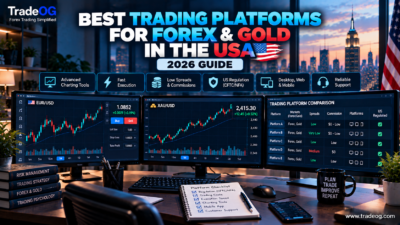
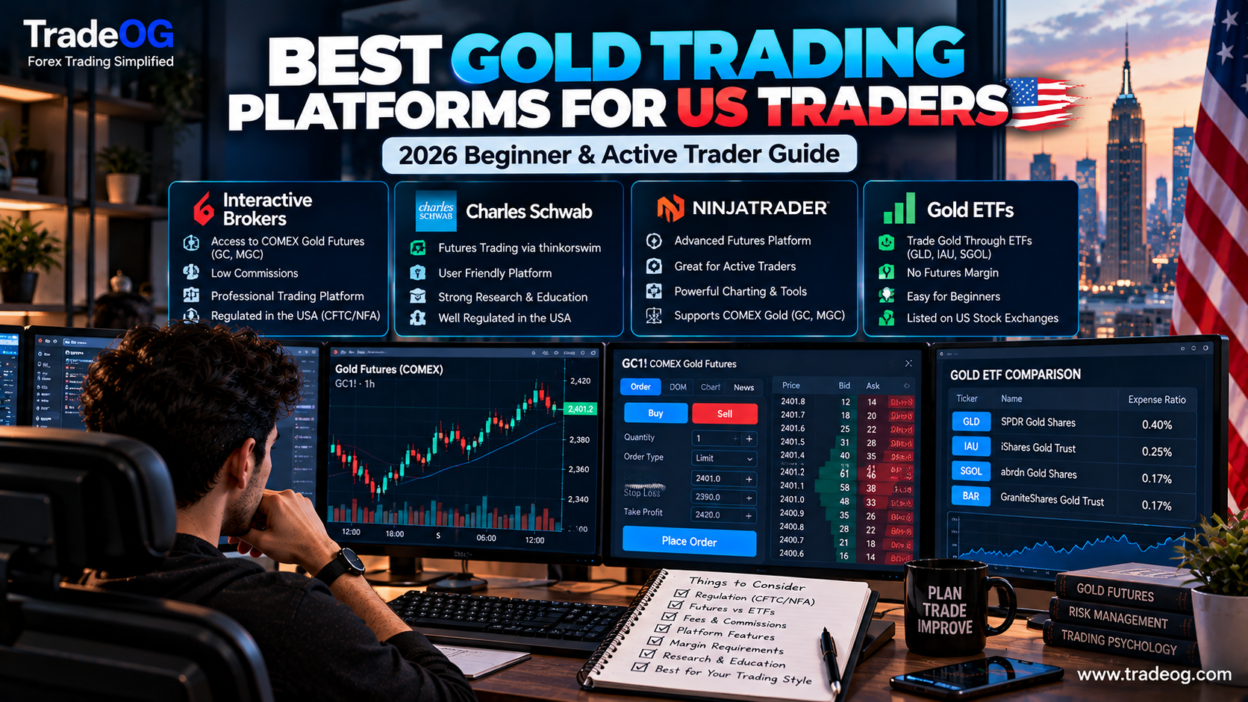
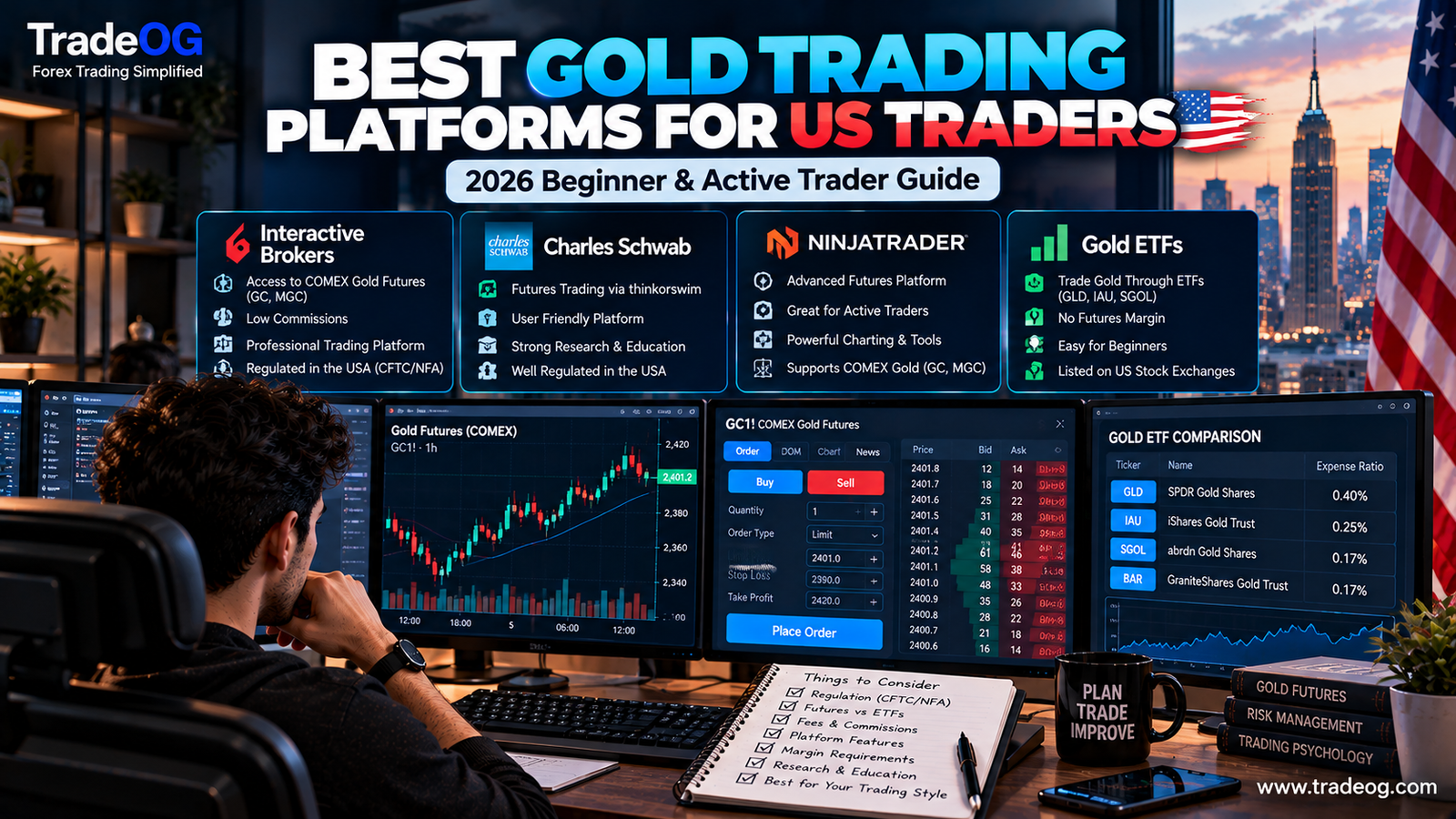
If you are searching for the best gold trading platforms for US traders, the first thing to understand is that “gold trading” can mean several different products.
A US trader can get gold exposure through COMEX gold futures, micro gold futures, 1-ounce gold futures, US spot gold at a qualifying broker, gold ETFs, gold stocks, or physical bullion. These products do not have the same fees, leverage, margin requirements, tax treatment, or risk.
That is why the best platform for an active futures trader may be completely different from the best platform for a beginner who simply wants exposure to the price of gold.
In this guide, TradeOG compares the leading options for US traders and explains which platform makes the most sense for futures trading, smaller accounts, charting, long-term gold exposure, and beginners.
What Is the Best Gold Trading Platform for US Traders?
There is no single platform that is best for everyone. The right choice depends on what you mean by gold trading.
| Platform | Best for | Main gold route | Overall view |
|---|---|---|---|
| Interactive Brokers | Overall gold trading flexibility | US spot gold + COMEX futures | Best overall for experienced traders |
| Charles Schwab | Thinkorswim users | Gold futures + ETFs | Best integrated US brokerage experience |
| NinjaTrader | Active futures traders | GC, MGC and 1OZ futures | Strong for futures-focused traders |
| Fidelity | Long-term gold investors | Gold ETFs and related securities | Best for non-leveraged exposure |
| TradingView + a futures broker | Advanced charting | Charts with broker execution | Excellent analysis workflow |
The important distinction is that a charting platform is not automatically a broker. TradingView can be an excellent analysis interface, but your actual gold futures order is executed through the connected broker or futures provider.
1. Interactive Brokers — Best Overall for Gold Trading
Interactive Brokers (IBKR) is arguably the most complete option for US traders who want several ways to gain direct gold exposure from one account.
IBKR provides access to COMEX gold futures, including the standard GC and Micro Gold (MGC), and it also offers US Spot Gold under the symbol USGOLD. Its US Spot Gold product can be traded in quantities as small as one ounce, and IBKR publishes a tiered commission schedule for the product. Interactive Brokers US Spot Gold
For futures traders, IBKR also lists COMEX GC and MGC contracts. Its current futures margin table shows that margin requirements can vary and should be checked directly before trading. Interactive Brokers futures margin requirements
Why IBKR stands out
- Access to COMEX gold futures.
- Micro Gold futures for smaller contract exposure.
- US Spot Gold availability.
- Stocks, ETFs, options, forex and futures in one account.
- Professional-grade Trader Workstation.
- Transparent commission schedules.
- Potential physical-delivery options for eligible gold products.
IBKR says its US Spot Gold product has a minimum commission of $2 per trade and storage fees of $0.15 per ounce per month, while the commission rate varies by order value. IBKR US Spot Gold pricing
Who should use IBKR?
IBKR is best suited to traders who want flexibility and understand futures, margin, contract specifications and order execution. Its platform has a steeper learning curve than a simple investing app, but that complexity comes with a much wider range of instruments.
2. Charles Schwab — Best for thinkorswim Gold Futures Trading
Charles Schwab is a strong choice for US traders who already like the thinkorswim ecosystem or want an integrated brokerage account with futures and traditional investments.
Schwab offers gold futures through thinkorswim, including standard Gold (/GC), Micro Gold (/MGC), Mini Gold (/QO), and the newer 1-ounce gold futures contract. Schwab’s current contract table lists /GC at a $10 value per $0.10 minimum tick and /MGC at a $1 value per $0.10 tick. Charles Schwab gold futures
That smaller contract structure matters. A standard /GC contract represents 100 troy ounces, while /MGC represents 10 troy ounces. CME Group describes GC as its benchmark gold futures contract and lists Micro Gold as one-tenth the size of the standard contract. CME Group gold futures
Why Schwab is attractive
- thinkorswim desktop and mobile ecosystem.
- Gold futures and futures options.
- Micro Gold futures access.
- Gold ETFs, stocks and other securities.
- Strong research and education tools.
- Useful choice for traders who want investments and trading under one brokerage relationship.
Who should use Schwab?
Schwab is a good fit for traders who want a mainstream US brokerage experience without giving up access to futures. It can also make sense for an investor who wants to keep gold ETFs and futures exposure within a broader portfolio.
3. NinjaTrader — Best for Active Gold Futures Traders
NinjaTrader is built around futures trading, making it particularly relevant if your main objective is active trading of COMEX gold futures rather than long-term gold investing.
NinjaTrader offers Gold futures contracts including GC, MGC and 1OZ through CME Globex. Its own specifications identify GC as 100 troy ounces, MGC as 10 troy ounces and 1OZ as one troy ounce. NinjaTrader gold futures
NinjaTrader’s futures brokerage is registered with the CFTC and is an NFA member. NinjaTrader regulatory disclosures
Why active traders may prefer NinjaTrader
- Futures-focused trading environment.
- Strong charting and order-entry tools.
- Direct access to CME futures markets.
- Micro and 1-ounce gold contracts.
- Useful ecosystem for traders who focus heavily on futures.
- Designed around active execution rather than passive investing.
If you are specifically learning gold futures, NinjaTrader can be easier to understand than a multi-asset brokerage because the platform is centered around the futures workflow.
4. Fidelity — Best for Gold ETFs and Long-Term Investors
If by “gold trading” you actually mean buying an investment that tracks gold rather than trading leveraged gold futures, a traditional brokerage can be more appropriate.
Fidelity is an example of this approach. Investors can use a standard brokerage account to buy and sell exchange-traded products that provide gold exposure.
Gold ETFs can be useful for investors who want exposure to gold without managing futures expiration, futures margin, rollover, or the possibility of physical delivery.
Gold ETF vs Gold Futures
| Feature | Gold ETF | Gold Futures |
|---|---|---|
| Leverage | Usually none unless using margin | Built into futures structure |
| Expiration | No futures expiration | Yes |
| Margin | Not normally required for a cash purchase | Required |
| Contract size | Shares | Specified ounces |
| Best suited to | Investors | Active traders |
| Overnight financing | Different cost structure | Futures have their own financing/margin economics |
Gold ETFs can therefore be much easier for a beginner who wants to participate in the long-term gold price without taking on futures leverage.
5. TradingView + a Futures Broker — Best Charting Workflow
TradingView is not itself the answer to every gold-trading question because it is primarily a charting and analysis platform. But for technical traders, its charting interface can be extremely useful when connected to an appropriate broker.
A common workflow is:
- Analyze gold price structure in TradingView.
- Identify support, resistance, trend and volatility.
- Check the relevant futures contract such as GC, MGC or 1OZ.
- Confirm margin and contract specifications with the broker.
- Place and manage the trade through the supported broker connection.
Do not confuse a TradingView chart with a guarantee that a specific broker offers the same instrument or execution conditions. Always verify the actual tradable symbol and contract with the broker.
Important: US Traders Cannot Simply Use Any XAU/USD Platform
This is one of the biggest differences between US and international gold trading.
Many international brokers advertise XAU/USD as a CFD. US traders should not assume that an offshore broker offering XAU/USD CFDs is a legal equivalent to a regulated US gold product.
The CFTC warns consumers to use registered dealers and to be especially cautious about unregistered offshore platforms. Its fraud guidance lists registered US retail forex dealers and warns that offshore dealers can use familiar trading software while still presenting serious customer risks. CFTC Forex Frauds
There is another important detail: some well-known forex brokers that offer gold internationally do not offer gold to their US clients.
OANDA example
OANDA’s US help documentation states that precious-metal trading is no longer offered to US-based clients because of regulatory requirements, and specifically says that XAU/USD is not available for trading. OANDA US gold availability
FOREX.com example
FOREX.com US also currently states that gold trading is not available on its US platform. Its international metals documentation is therefore not evidence that a US client can trade the same gold product. FOREX.com US available markets
This is a critical distinction for anyone searching Google for “XAU/USD broker USA.” The availability of XAU/USD on an international website does not automatically mean that the same product is available to a US resident.
Gold Futures vs Gold ETFs: Which Is Better?
The answer depends on your objective.
Choose gold futures if:
- You actively trade short-term gold price movements.
- You understand leverage and margin.
- You want centralized exchange-traded pricing.
- You need the ability to go long or short efficiently.
- You understand contract expiration and rollover.
Choose gold ETFs if:
- You want long-term gold exposure.
- You do not need futures leverage.
- You prefer buying shares through a normal brokerage account.
- You want a simpler portfolio-management process.
- You are more interested in investment than active intraday trading.
Understanding GC, MGC and 1OZ Gold Futures
One of the most important things for a beginner is understanding contract size.
GC — Standard Gold Futures
GC represents 100 troy ounces of gold. CME describes it as its largest and most liquid gold futures contract and a global gold pricing benchmark. CME Gold Futures contract information
Because the contract is large, a relatively small gold-price movement can create a significant dollar P&L change.
MGC — Micro Gold Futures
MGC represents 10 troy ounces, or one-tenth of the standard GC contract. CME lists a minimum price fluctuation of $0.10 per troy ounce for Micro Gold, which corresponds to $1 per contract. CME Micro Metals
This smaller contract can make gold futures more accessible for traders who cannot comfortably manage the dollar exposure of a full-size GC contract.
1OZ — One-Ounce Gold Futures
CME introduced the 1-ounce gold futures contract as a much smaller way to obtain exchange-traded gold exposure. CME describes it as one hundredth of the standard GC contract and notes that it trades 24/7 following its 2026 trading-hours expansion. CME 1-Ounce Gold Futures
The existence of smaller contracts is useful, but smaller contract size does not eliminate risk. Traders can still lose money quickly if position size is too large relative to account equity.
How Much Money Do You Need to Trade Gold Futures?
There is no single universal minimum because brokers can set different margin requirements and requirements can change with market conditions.
CME’s current gold page provides estimated margin figures for its contracts, while broker-specific margin tables can differ. For example, CME’s current information shows GC as a 100-ounce contract and also lists smaller gold products. CME Gold Futures
Interactive Brokers also publishes current COMEX margin requirements that can change over time. Its table includes GC, MGC and 1OZ contracts. IBKR current futures margins
Never choose a contract simply because the broker shows a low intraday margin figure. Margin is not the same as the amount you should risk on a trade.
Gold Trading Fees to Compare
The platform with the lowest advertised commission is not necessarily the cheapest platform overall.
Before opening an account, compare:
- Commission per contract or per trade.
- Exchange and regulatory fees.
- Market-data fees.
- Bid-ask spread.
- Margin requirements.
- Overnight financing or related holding costs.
- Platform fees, if applicable.
- Withdrawal and account fees.
For futures, remember that exchange-traded gold has a different cost structure from an OTC spot or CFD product.
Which Gold Platform Is Best for Beginners?
If you are completely new to gold trading, jumping directly into standard GC futures can be a poor starting point. The contract represents 100 ounces, and leverage can turn relatively small price movements into large dollar gains or losses.
A beginner should first learn:
- How gold futures contract size works.
- How much one tick is worth.
- How margin differs from maximum acceptable risk.
- How stop-loss orders work.
- How news affects gold volatility.
- How futures expiration and rollover work.
- How much capital should remain unused as a safety buffer.
For many beginners, a gold ETF can be easier to understand than leveraged futures. If the objective is specifically active trading, learning with a smaller futures contract such as MGC or 1OZ may be more manageable than immediately trading full-size GC, provided the trader understands the risks and broker requirements.
Which Gold Platform Is Best for Scalping?
Scalpers should prioritize execution quality, stable connectivity, competitive commissions, fast order entry, reliable market data and a platform designed for active futures trading.
For this use case, NinjaTrader and Interactive Brokers are worth comparing. Schwab’s thinkorswim can also be attractive for traders who already use the Schwab ecosystem.
Do not select a scalping platform only because a website advertises “zero commission.” Futures trading can include exchange, clearing and regulatory costs, and the bid-ask spread and execution quality can matter just as much as the headline commission.
Which Gold Platform Is Best for Swing Trading?
Swing traders have more choices.
If you want direct futures exposure, compare IBKR, Schwab and NinjaTrader based on contract access, margin, fees and the tools you actually use.
If you want to hold a gold position for weeks or months without managing futures expiration, a gold ETF can be simpler.
The right answer therefore depends on whether you want trading exposure or investment exposure.
What About Physical Gold?
Physical gold is another category entirely. You can buy coins or bars through a bullion dealer, but that is not the same as trading gold futures.
Physical gold introduces costs such as dealer premiums, bid-ask spreads, storage, insurance and potentially shipping.
The CFTC and FINRA have warned investors about precious-metals fraud and recommend checking dealers carefully, especially when someone approaches you through unsolicited calls, emails or social media. CFTC/FINRA precious-metals investor bulletin
How to Choose the Best Gold Trading Platform
Use this five-step process rather than choosing the first platform that appears in a search result.
Step 1: Decide What Gold Product You Want
Do you want GC, MGC, 1OZ, US spot gold, a gold ETF, gold mining stocks, or physical bullion?
Step 2: Check Whether the Product Is Actually Available to US Residents
Do not assume an international broker’s product list applies to US clients.
Step 3: Compare Total Costs
Look beyond commission. Include spread, exchange fees, market data, financing, margin and other account charges.
Step 4: Check Regulation
For futures, verify the futures broker and relevant registration. For securities such as ETFs, verify the brokerage and the product itself.
Step 5: Match the Platform to Your Trading Style
A long-term investor does not need the same tools as a high-frequency futures trader.
Common Mistakes When Choosing a Gold Trading Platform
Mistake 1: Searching Only for XAU/USD
US residents have different product availability from traders in many other countries. XAU/USD CFD availability on an international site does not mean the product is available to US clients.
Mistake 2: Choosing Maximum Leverage
Leverage increases exposure. It does not make a strategy better.
Mistake 3: Ignoring Contract Size
Knowing the gold price is not enough. You need to know how much one tick or one dollar move changes your P&L for your specific contract.
Mistake 4: Treating Margin as Risk Capital
If a broker allows you to open a position with a certain margin amount, that does not mean you should risk that entire amount.
Mistake 5: Using an Offshore Broker Because It Advertises Gold CFDs
Convenience and high leverage should not replace regulatory due diligence. The CFTC specifically warns about unregistered offshore dealers and recommends verifying registration before depositing funds. CFTC fraud guidance
Best Gold Trading Platforms for US Traders: Final Ranking
| Rank | Platform | Best for | Why |
|---|---|---|---|
| 1 | Interactive Brokers | Overall | US Spot Gold plus COMEX futures and broad multi-asset access |
| 2 | Charles Schwab | thinkorswim traders | Gold futures, ETFs and a strong integrated platform |
| 3 | NinjaTrader | Active futures trading | Futures-focused tools and GC/MGC/1OZ access |
| 4 | Fidelity | Gold ETF investing | Simple approach for non-leveraged gold exposure |
| 5 | TradingView + broker | Charting | Excellent technical-analysis workflow when paired with an appropriate execution broker |
FAQs
What is the best gold trading platform in the USA?
Interactive Brokers is one of the strongest overall choices because it offers both US Spot Gold and COMEX gold futures. Schwab and NinjaTrader are also strong choices for futures traders, while Fidelity can be more appropriate for gold ETF investors.
Can US traders trade XAU/USD?
It depends on the product and broker. US residents should not assume that the XAU/USD CFD products offered by international brokers are available or permitted for them. For example, OANDA and FOREX.com currently state that gold is not available to their US clients in their US offerings.
Can US traders trade gold futures?
Yes. Gold futures are exchange-traded contracts available through eligible US futures brokers. CME lists standard GC as well as smaller gold products such as MGC and 1OZ.
What is the smallest gold futures contract?
CME’s 1-ounce gold futures contract is much smaller than standard GC and Micro Gold. CME describes 1OZ as one hundredth the size of standard GC.
Is Micro Gold safer than regular Gold futures?
Micro Gold has smaller dollar exposure per contract, but it is not automatically safe. The risk still depends on the number of contracts, entry price, stop-loss distance and account size.
Are gold ETFs better than gold futures?
Neither is universally better. ETFs are generally simpler for long-term exposure, while futures provide a more direct leveraged trading instrument for active traders.
Does Interactive Brokers offer gold trading in the USA?
Yes. IBKR currently offers US Spot Gold and COMEX gold futures to eligible clients, subject to its product and account requirements.
Does Schwab offer Micro Gold futures?
Yes. Schwab currently lists Micro Gold (/MGC) alongside standard /GC and other gold futures contracts.
Does NinjaTrader offer Micro Gold?
Yes. NinjaTrader lists MGC Micro Gold futures and other CME gold contracts.
Final Takeaway
The best gold trading platform for US traders depends on what you want to do with gold.
Interactive Brokers is a strong overall choice if you want broad access to US Spot Gold and COMEX futures. Charles Schwab is compelling for traders who want gold futures within the thinkorswim ecosystem. NinjaTrader is particularly relevant to active futures traders. If you are investing rather than actively trading leverage, a conventional brokerage such as Fidelity can be a simpler route to gold ETFs.
The most important point is not to copy an international XAU/USD broker list and assume it applies to US residents. Product availability and regulation matter. Always verify the exact gold product, contract size, margin, fees and regulatory status before funding an account.
TradeOG risk reminder: Gold can be highly volatile, and futures use leverage that can produce substantial losses. This article is educational and is not financial, investment, tax or legal advice. Broker products, fees, margins and availability can change. Verify current terms directly with the broker and exchange before trading.