





If you have ever blown a prop firm account while your profit and loss was still green, you probably did not fail because of bad trading. You failed because of the drawdown rule. It is the single most misunderstood mechanic in prop trading, and in 2026, it became even more important as firms overhauled their rulebooks. This guide breaks down the difference between trailing drawdown and end-of-day drawdown in plain English, with real numbers and real examples, so you can pick the right account and stop losing accounts you should have kept.
What Is Drawdown in a Prop Firm Account?
Every prop firm account comes with a maximum loss limit. Fall below that limit once, even for a second, and the account is gone. That limit is your drawdown. The core idea is simple: the firm gives you a buffer, and if you lose too much of it, you are out. What makes it complicated is how that buffer moves as you trade.
There are three main drawdown models in 2026:
-
Static drawdown: The floor is fixed at your starting balance and never moves.
-
End-of-day (EOD) drawdown: The floor updates once per day, based on your closing balance.
-
Trailing drawdown: The floor follows your highest equity point, sometimes in real time, sometimes only at the close.
Most futures prop firms now use some form of trailing drawdown, but the word “trailing” hides two very different products. The question that separates them is simple: when is the floor allowed to move? The answer changes everything about how you trade.
How Trailing Drawdown Works
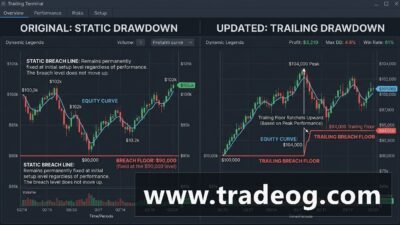
A trailing drawdown locks onto your highest equity point. If you make a winning trade and your account equity spikes, the drawdown floor moves up with it — permanently. You can never recover the old, lower floor, even if you give back all the profit.
Here is a real example. You have a $50,000 account with a $2,500 trailing drawdown. Your starting floor is $47,500. You open a trade and it shows +$1,000 in unrealised profit. Your equity is now $51,000, and your floor moves up to $48,500. Then the trade reverses and gives back all the profit. Your equity returns to $50,000. You are now only $1,500 away from a breach, not $2,500. Nothing was booked, but your buffer shrank by $1,000.
This is why trailing drawdown punishes round-trip trades so harshly. Unrealised profits count toward raising the floor, but they do not protect you when they disappear. You can be up on the day, give back open profit, and hit a floor that did not exist when you opened the trade. The account closes while you are still ahead of where you started.
There is a further split inside trailing drawdown. Some firms use intraday trailing, which updates tick by tick with your live equity. Others use EOD trailing, which only updates at the close. The label on the pricing page often does not tell you which one you are getting, and that is where most traders get burned.
How EOD Drawdown Works
End-of-day drawdown is recalculated once per session, from your closing balance. Intraday swings are invisible to it. Only where you finish the day matters.
Take the same $50,000 account with a $2,000 EOD drawdown. Your floor begins at $48,000. During the day your open position runs to $51,500, you give most of it back, and you close the session at $50,200. Your floor for tomorrow becomes $50,200 minus $2,000, which is $48,200. The $51,500 peak never existed as far as the floor is concerned.
This is massively more forgiving for active intraday traders. Unrealised profits never lock in a higher floor until the day is over. You keep your full drawdown buffer intraday no matter how volatile your session was. EOD drawdown rewards taking profits home, not giving them back.
One important note: EOD drawdown is not the same as a daily loss limit. A daily loss limit caps how much you can lose in a single day, regardless of your drawdown floor. An EOD drawdown can still be breached during the session if your balance touches the floor, even though the floor itself does not move until the close.
The Key Differences, Side by Side
The core difference is timing. An EOD drawdown updates after the session closes. An intraday trailing drawdown can move during the session, the moment your account reaches a new high. An EOD limit may stay fixed while the market is open, but you can still breach it during the day. An intraday limit can rise in real time, which changes how much room you really have.
Another critical difference is whether open profit counts. With intraday trailing, your unrealised gains raise the floor immediately. With EOD, open profit does not move the floor until the session ends. That means giving back open profit can trigger a breach under intraday trailing but not under EOD.
The practical effect is enormous. According to Phidias data cited by PropScorer, EOD drawdown has 83% higher pass rates than intraday trailing. That number alone tells you why so many traders fail accounts they should have passed.
Why This Rule Fails So Many Traders
Almost every story about a prop firm “scamming” a trader is really a trailing drawdown misunderstanding. The trader was up on the day, gave back some open profit, and the account closed. They assumed foul play. In reality, the mechanic was disclosed — they just did not model how the floor trailed.
The nightmare scenario is common. At 10:00 AM, your account hits $52,800 in unrealised profit. Under intraday trailing, your floor moves up to $50,300. At 10:05 AM, the trade reverses to $50,250. Your account fails. At 11:00 AM, the market recovers and the trade would have closed at +$1,200. The account is dead on a temporary $50 dip below peak.
This is why traders say intraday trailing is anti-trader. You are not failing because you cannot trade. You are failing because normal market volatility is being treated as catastrophic loss. EOD drawdown eliminates this problem entirely. The same trade under EOD rules would have stayed alive, closed profitable, and set a new higher floor for tomorrow.
What Changed in 2026
The prop firm landscape changed dramatically in 2026. Firms that survived the MetaTrader licence revocations did not get more generous. They tightened the rules. Drawdown rules became more complex, more real-time, and less consistent between firms.
Apex Trader Funding ran a full overhaul on 1 March 2026. They retired legacy accounts and simplified their offerings to two distinct drawdown types: End-of-Day Trail and Intraday Trail. They introduced a one-time pricing model, removed the old MAE rule, and replaced the 30% consistency rule with a stricter 50% rule. Under the new structure, Apex added a Daily Loss Limit that auto-liquidates positions and pauses trading for the rest of the session. For the popular $50K EOD account, that means a hard stop at $1,000 daily losses. Hit that threshold, and your trading day is over — no recovery attempts, no second chances until tomorrow.
Topstep changed its trailing maximum-loss-limit rules three times between November 2025 and February 2026. MyFundedFutures retired its old plans in mid-2025 and replaced them with Core, Rapid, and Pro. Rapid uses a 4% intraday trailing drawdown, which is the strictest mechanic of the group because it follows real-time equity including unrealised profit.
The practical takeaway is that two funded accounts can now have completely different drawdown behaviour, and one of them can move against you while you are still in profit. Tracking it in your head stopped working. You now need to respect three or four moving constraints at once: the max drawdown, the daily loss limit, the consistency rule, and in some cases a trailing floor that moves tick by tick.
Which Firms Use Which Model in 2026
The drawdown type varies by firm and sometimes by account type within the same firm. Here is a snapshot of the major players.
Apex Trader Funding now offers a choice at purchase: EOD trailing or intraday trailing. EOD accounts update the threshold at 4:59 PM ET based on your closing balance. Intraday accounts use a real-time trailing threshold that follows peak balance and never moves down.
Topstep uses an end-of-day trailing drawdown. The floor follows your highest closed equity until it reaches your starting balance plus a buffer, then it locks and behaves like a static account. Topstep’s trailing drawdown moves up every time your end-of-day balance sets a new high, never moves down, and stops trailing for good once it reaches your starting balance plus $100.
Take Profit Trader also uses an end-of-day trailing drawdown. The max loss limit trails your end-of-day balance, not your intraday peak. On a $50,000 PRO account, the working numbers are roughly a $3,000 profit target, a $2,000 trailing max loss limit, and a daily loss limit near $1,100. Take Profit Trader removed daily loss limits in 2026, shifting emphasis to the EOD trailing drawdown for greater flexibility.
MyFundedFutures uses a mix. The Core and Pro accounts use a 3% EOD trailing drawdown. The Rapid account uses a 4% intraday trailing drawdown, which is the strictest of the group. The EOD trailing drawdown locks in at $100 plus the initial starting balance. Open equity losses are still taken into consideration when calculating whether the account failed on this rule, so if an open position dips your balance below the minimum, the evaluation fails.
Bulenox offers a choice between real-time trailing and EOD trailing at purchase. Alpha Futures uses EOD trailing on all accounts. Lucid Trading uses EOD trailing on all plans. The floor locks once it reaches the initial balance.
The trend is clear. Most firms default to EOD trailing. A growing number of firms are ditching intraday trailing in favour of static or EOD alternatives. In 2026, EOD became the standard for trader-friendly risk control.
The Three Types of Trailing Drawdown
Most guides treat trailing drawdown as a single rule. It is not. There are three distinct types, and the difference matters more than the drawdown amount.
Intraday trailing drawdown is the most aggressive. The floor tracks your peak equity in real time. Every new high watermark during the session immediately raises the floor. Open profit counts. This is the formula used by Hyrotrader’s 6% and MyFundedFutures Rapid. The buffer tightens with every profitable move, and a pullback can breach a level that did not exist when you opened the trade.
EOD trailing drawdown updates the high-water mark once per day, on your closed balance, after the session settles. What happens inside the day does not move the floor. FTMO’s 10% maximum loss works this way on its one-step account, recalculated at midnight against the highest previous closing balance. On its two-step account the same 10% is static. One firm, two formulas, one number.
Locked-in trailing drawdown moves up with your EOD balance until it reaches a certain level, usually your starting balance plus a small buffer, and then it stops trailing. Topstep, Apex, and MyFundedFutures all use some version of this. Once the floor locks, the account behaves like a static drawdown. This is the most trader-friendly trailing model because the buffer stops shrinking once you have proven you can build profit.
How to Calculate Your Real Room
The number that matters is not your account balance. It is your room — the distance between your current equity and the nearest breach level. Under intraday trailing, your room shrinks every time you set a new high. Under EOD trailing, your room only shrinks at the close. Under static drawdown, your room grows as you profit.
Here is a simple way to think about it. Under trailing drawdown, profits tighten the gap between your current equity and the floor. Under static drawdown, profits widen it. EOD trailing sits in the middle: profits tighten the gap, but only once per day, and the gap stops tightening once the floor locks.
Take a $100,000 account with a 6% trailing drawdown. The floor starts at $94,000. You push the account to $110,000. Under a pure trailing model, the floor moves to $103,400. You are up $10,000 and you may only return $6,600 of it. Give back two-thirds of a winning run and the account closes while you are still $3,400 ahead of where you started. That is the mechanism worth naming: the drawdown that follows you up. It rises with every new equity high and never comes back down. The more you earn, the less you are permitted to lose.
Under EOD trailing, the floor still moves up, but only based on your closing balance. If you close at $110,000, the floor moves to $103,400 the next day. But intraday, you had the full $10,000 buffer. You could have taken heat, ridden pullbacks, and still closed strong without the floor chasing you in real time.
Pros and Cons of Trailing Drawdown
Trailing drawdown, especially intraday trailing, is the strictest model. It protects the firm’s capital by tightening the leash as you profit. For disciplined traders who scale out and protect open profit, it can work. But it punishes normal market volatility. A trade that goes 20 ticks in your favour then reverses has already cost you 20 ticks of drawdown room, even if you close flat. Most traders cannot manage that arithmetic in their head mid-trade. It is not discipline; it is a coin flip.
The advantage of trailing drawdown is that it locks in gains. Once you build a buffer, the floor moves up and protects a portion of your profit. Under a pure trailing model, you can never give back everything you made. But the cost is that your buffer shrinks with every new high. You have less room to absorb normal pullbacks, and a single bad trade can close the account even if you are still net profitable for the month.
Pros and Cons of EOD Drawdown
EOD drawdown is the middle ground. It is more forgiving than intraday trailing because unrealised profits do not raise the floor until the session ends. You keep your full buffer intraday, which means you can hold through normal noise without the floor chasing your position. That is why day traders and scalpers prefer it, and why firms like Topstep and Take Profit Trader use it.
The disadvantage is that you can still breach the EOD floor during the session. The floor is fixed while the market is open, but if your balance touches it, the account closes. You do not get the protection of a floor that moves up in real time. But for most traders, that is a small price to pay for the breathing room EOD provides.
Which Model Should You Choose?
If you are a day trader who takes heat intraday but closes flat-to-up, EOD drawdown is almost always the better choice. It gives you the room to absorb normal market volatility without the floor moving against you mid-trade. The 83% higher pass rate for EOD accounts is not a coincidence. It reflects the fact that most traders need intraday breathing room to execute their strategy.
If you are a scalper who closes trades quickly and never holds through pullbacks, intraday trailing might be manageable. But even then, you need to be disciplined about not letting winners round-trip. The moment you give back open profit, the floor has already moved, and you are closer to a breach than you think.
If you are a beginner, static drawdown is the simplest model to reason about. It is the reason firms offering it have become so popular with newer traders. But static drawdown is increasingly rare in futures prop trading. Most firms have moved to trailing systems that “protect” your profits, and that protection often becomes a trap.
The most important thing you can do before buying any challenge is to read the current rules page. Not last year’s rules. Not a review from six months ago. The current rules. Drawdown types change. Apex changed its entire structure in March 2026. Topstep changed its trailing rules three times in four months. The firm you signed up for two years ago is not the one you are trading with today.
A Survival Checklist for 2026
Whatever firm or account you choose, these habits will keep funded accounts alive.
Know your drawdown type. Static, EOD trailing, and intraday trailing all demand different behaviour. Read your firm’s current rules, not last year’s.
Watch room, not balance. What matters is how far you are from each limit: room to your daily loss, room to your max drawdown, room to your target. The raw equity number hides all of it.
Size before you click. Convert the smallest of those distances into a maximum position size before you enter, so a normal stop-loss can never breach the account. If your buffer is $500 and your stop is $200, you cannot trade more than two contracts without risking a breach on a single stop-out.
Respect consistency. Avoid the one oversized day that fails a 50% rule even while you are net profitable. Consistency rules do not close the account, but they block payouts. You can be profitable and still not get paid.
Keep a stop that acts, not just warns. An alert you can ignore is not protection. Something has to flatten the account when a hard line is hit. Automating the arithmetic is not cheating. It is the only way to respect three or four moving constraints at once without making a mistake mid-trade.
The Bottom Line
Trailing drawdown and EOD drawdown answer the same question two different ways: how much can your account give back before the firm closes it? The dollar figure on the pricing page is not the product. The drawdown type is the product. A $2,000 EOD drawdown and a $2,000 intraday trailing drawdown are not the same account. Traders blow accounts every week by treating them as if they were.
In 2026, EOD drawdown is the standard for trader-friendly risk control. Intraday trailing is the strictest model, and it is the one most likely to close an account while you are still in profit. Static drawdown is the simplest, but it is increasingly rare. The firms that survived the shakeout tightened their rules, but they also gave traders more choice. Apex now lets you pick between EOD and intraday. Bulenox does the same. Topstep, Take Profit Trader, and MyFundedFutures default to EOD.
The single most important thing you can do is understand which model you are trading. Read the rules. Model the floor. Calculate your real room before you enter a trade. The drawdown rule decides whether you are still there to collect your profits. The profit target only decides whether you get paid. That order is not intuitive, but it is correct. Get the drawdown right, and you will stop failing accounts you should have kept.


[…] immediately recalibrate your lot sizing to prevent an accidental breach. Read our complete guide on trailing drawdown vs EOD drawdown to understand these […]
[…] recovery is complicated further by intraday trailing drawdown. As detailed in our guide to trailing drawdown vs EOD drawdown, the liquidation floor moves upward in real time with every tick of unrealized high-water mark […]
[…] Understanding whether your maximum drawdown is static, end-of-day trailing, or tick-by-tick intraday trailing dictates your entire survival strategy. Learn more about these calculations in our guide on trailing drawdown vs EOD drawdown. […]
[…] Even though you took zero realized losses, your operational risk runway has been slashed from $5,000 down to $1,000! You are now in a synthetic 80% drawdown relative to your failure cushion. A single $1,000 loss breaches your account. For a comprehensive comparison of these mechanics, consult our detailed analysis on trailing drawdown vs EOD drawdown. […]