

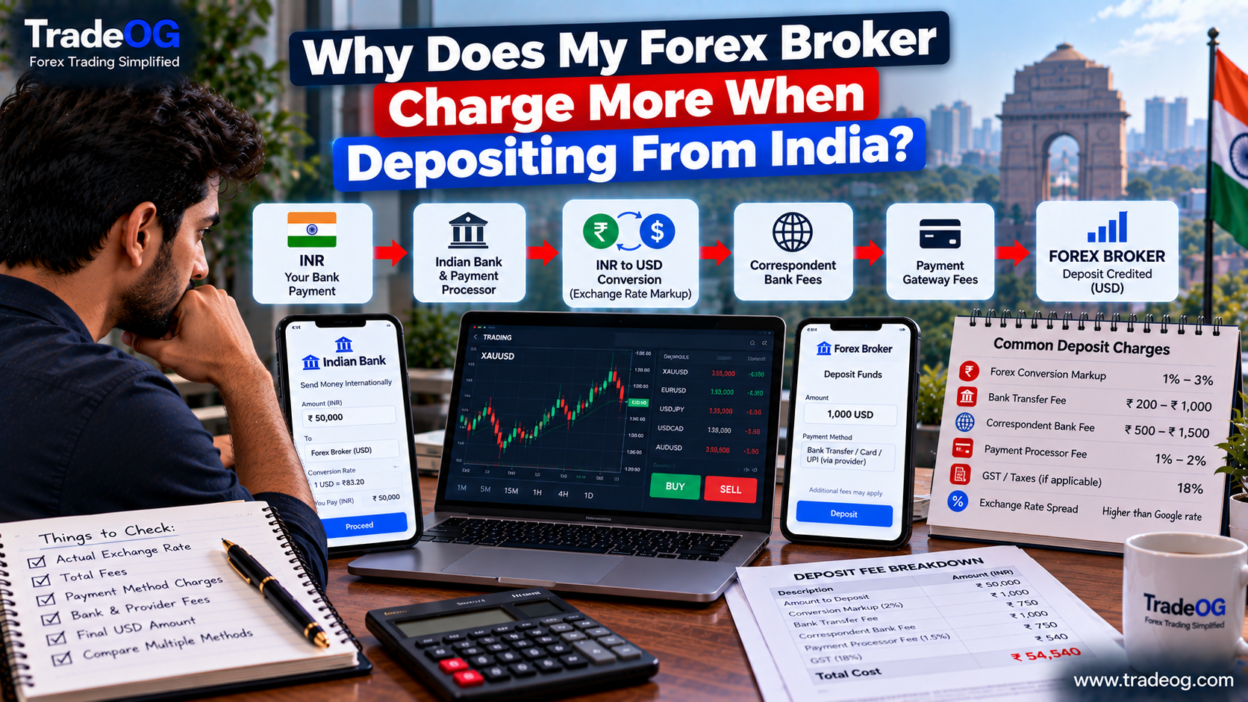
If you deposit money with a forex broker from India, the amount that leaves your Indian bank account can sometimes be noticeably higher than the amount that appears in your broker account.
That does not necessarily mean the broker itself is charging one large hidden fee. A cross-border deposit can pass through several layers, including currency conversion, bank charges, payment processors, card networks, correspondent banks and exchange-rate markups.
For Indian traders, there is another important issue: the payment method itself may be subject to Indian foreign-exchange rules. RBI says resident persons may undertake forex transactions only with authorised persons and for permitted purposes, and it cautions residents against unauthorised electronic trading platforms.
This guide explains why a forex deposit from India can cost more, where the extra money can go, how to compare the true cost, and what you should check before funding an account.
Why Is My Forex Deposit More Expensive From India?
Usually, the difference comes from a combination of costs rather than one single “deposit fee”.
A typical international funding route can look like:
Indian bank → currency conversion → payment network → correspondent/intermediary bank → broker/payment processor → broker account
Each stage can have its own pricing.
| Possible Cost | Where It Can Come From |
|---|---|
| FX conversion markup | Bank or payment provider |
| Transfer fee | Indian bank |
| Correspondent fee | Intermediary bank |
| Payment-processing fee | Payment provider or card network |
| Broker deposit fee | Broker, if applicable |
| Exchange-rate spread | Bank, processor or payment provider |
| Taxes/levies | Depending on the transaction and service |
For example, HDFC currently publishes separate charges for outward remittances and foreign-currency conversion, while HSBC states that correspondent and receiving banks may charge additional fees on international wire transfers.
The Biggest Hidden Cost: The Exchange Rate
Many traders look only for a line called “deposit fee”.
That can be a mistake.
Your bank may quote an exchange rate that is less favourable than the mid-market rate you see on a currency website. The difference is effectively part of the cost of converting INR into USD or another funding currency.
For example, suppose the reference USD/INR rate is ₹83.00 but the effective rate offered for your transaction is ₹84.00.
On a US$1,000 funding transaction:
- At ₹83.00: ₹83,000
- At ₹84.00: ₹84,000
- Difference: ₹1,000
Even if the broker advertises “zero deposit fee”, the transaction can still cost you more through the conversion rate.
Why Banks Add an FX Markup
When an Indian bank converts INR into USD, the bank is providing a foreign-exchange service. The exchange rate offered to the customer can include a spread over a reference or wholesale rate.
This is why you should compare the actual INR amount debited with the foreign-currency amount ultimately credited to the broker.
Do not judge the transaction solely by the broker’s deposit page.
Can the Correspondent Bank Charge Me?
Yes, depending on the payment route.
International wire payments can travel through correspondent banks. Those institutions may deduct charges while processing the transfer.
For example, Central Bank of India states that foreign-exchange transactions can involve SWIFT and out-of-pocket expenses, while HSBC notes that correspondent and receiving banks may impose additional fees on international wire transfers.
This creates a common situation:
You send US$1,000 → the broker receives less than US$1,000.
The difference may not have been charged by the broker at all.
Why the Broker May Show a Different Amount
Suppose you intend to deposit US$1,000.
Your bank converts ₹84,000 and sends the foreign-currency payment. An intermediary bank takes a fee, and the broker receives US$985.
The broker’s statement may show:
Deposit received: US$985
You might think the broker deducted US$15.
But the deduction could have occurred earlier in the payment chain.
That is why you should compare the bank’s remittance advice, payment reference and broker credit rather than assuming the broker caused the difference.
Card Deposits Can Have Different Costs
Depositing with a debit or credit card can create a different fee structure.
Potential costs include:
- Foreign-currency transaction markup
- Card-network conversion
- Bank foreign transaction fee
- Payment gateway fee
- Broker card-processing fee
Some banks also apply a foreign-currency markup to card transactions. The exact percentage depends on the card and bank.
Therefore, a card deposit that looks instant may not be the cheapest way to fund a trading account.
Why UPI Does Not Automatically Mean Zero Forex Costs
A broker may advertise local payment options or a payment gateway that accepts INR.
That does not necessarily mean the entire transaction is economically identical to a domestic INR payment.
If the payment provider ultimately converts INR into another currency or settles the broker’s account overseas, the underlying payment structure still matters.
Before depositing, check:
- Who actually receives the money?
- Which currency is being settled?
- Is there a payment processor?
- What exchange rate is used?
- Are there additional fees?
- Will the broker credit the full requested amount?
Why Small Deposits Can Feel More Expensive
Fixed fees hurt small deposits disproportionately.
Imagine a ₹750 processing cost.
On a ₹10,000 deposit, that is 7.5% before considering any FX spread.
On a ₹1,00,000 deposit, the same ₹750 is only 0.75%.
This is why a trader funding a small account may feel that the broker or bank is charging an unusually high amount.
Example: Depositing US$500 From India
Assume an illustrative transaction:
- Reference USD/INR: ₹83.00
- Bank effective rate: ₹84.00
- Target deposit: US$500
At the reference rate, the currency value would be ₹41,500.
At ₹84.00, the conversion costs ₹42,000.
The difference is ₹500 before any separate transfer or processing charges.
If the bank then charges a fixed fee, the total cost becomes higher again.
This is an example only. Your actual rate and fees depend on the bank, payment method, transaction size and current pricing.
Example: Depositing US$1,000
Consider another illustrative example:
| Component | Illustrative Cost |
|---|---|
| FX-rate difference | ₹1,000 |
| Bank transfer fee | ₹750 |
| Correspondent/intermediary fee | ₹500 |
| Payment processing | ₹250 |
| Total extra cost | ₹2,500 |
In this hypothetical example, the trader might think the broker charged ₹2,500.
In reality, the broker might have charged nothing at all. The costs were generated by the funding chain.
How Much Do Indian Banks Charge for International Transfers?
There is no single Indian-bank price.
Current published schedules illustrate how widely fees can vary. HDFC lists outward remittance charges of ₹500 for amounts up to US$500 equivalent and ₹1,000 above that, plus applicable taxes, while its foreign-currency conversion charges are separately calculated.
HSBC currently publishes a wire-transfer charge based on transaction value, plus a cable charge, and notes that correspondent and receiving banks can add further charges.
Central Bank of India also publishes separate inward and outward foreign-exchange charges and notes that SWIFT and other out-of-pocket expenses can apply.
These are examples of published bank pricing, not a universal fee schedule for all Indian traders.
Does GST Make the Deposit More Expensive?
Depending on the service and fee, applicable taxes can increase the final amount.
For example, banks can state charges separately from applicable taxes. Central Bank of India explicitly notes that GST applies on top of certain international banking service charges.
So when comparing two funding methods, compare the final amount debited from your account, not only the advertised base fee.
What About TCS on International Remittances?
This is an area where traders should be particularly careful.
Tax collection at source can apply to certain remittances under the Liberalised Remittance Scheme, subject to the applicable rules and thresholds. Current bank guidance also reflects changes to LRS-related TCS from 1 April 2026.
However, you should not automatically assume that every deposit to every forex broker is an LRS transaction or that the same TCS treatment applies to every payment method.
The underlying purpose, transaction structure and regulatory status matter.
Important: Forex Funding From India Has a Regulatory Layer
Indian traders should not treat an expensive deposit as merely a banking inconvenience.
RBI states that resident persons can undertake forex transactions only with authorised persons and for permitted purposes under FEMA. It also says permitted electronic forex transactions should be conducted on RBI-authorised ETPs or recognised stock exchanges, subject to applicable conditions.
RBI specifically cautions residents not to deposit or remit money for unauthorised forex trading platforms. It also states that remittances for margins to overseas exchanges or overseas counterparties are not permitted under the LRS framework.
Therefore, do not choose a deposit method solely because it is cheaper. First determine whether the underlying forex activity and platform are permitted for an Indian resident.
Why a Broker’s “Zero Deposit Fee” Can Still Be Expensive
“Zero deposit fee” can mean only that the broker does not add a separate fee to the deposit transaction.
You may still pay through:
- FX spread
- Bank transfer fee
- Card foreign transaction fee
- Payment gateway fee
- Correspondent-bank charge
- Exchange-rate markup
- Applicable taxes
The correct question is not:
“Does my broker charge a deposit fee?”
The better question is:
“How many rupees leave my bank account for every US dollar that reaches my trading account?”
How to Calculate the Real Deposit Cost
Use this simple formula:
Real deposit cost = INR debited − INR equivalent of the amount actually credited to the broker at a reference rate
For example:
- INR debited: ₹85,500
- Broker receives: US$1,000
- Reference USD/INR: ₹83.50
- Reference value: ₹83,500
- Effective extra cost: ₹2,000
The ₹2,000 can then be investigated across FX markup, transfer fees, processor charges and intermediary-bank costs.
What Should You Ask Your Bank?
Before making a large international payment, ask the bank:
- What USD/INR exchange rate will be applied?
- What is the FX markup?
- Is there a fixed remittance fee?
- Is GST charged on that fee?
- Can a correspondent bank deduct charges?
- Will the beneficiary receive the full amount?
- What documents are required?
- What purpose code applies?
- Does TCS apply to this transaction?
- Is the proposed transaction permitted under FEMA/RBI rules?
Getting these answers before sending the money is much better than discovering the final cost after settlement.
What Should You Ask the Broker?
- Do you charge a deposit fee?
- Which currencies do you accept?
- Which payment processor handles Indian deposits?
- Is the deposit converted to USD automatically?
- What exchange rate is used?
- Who bears intermediary-bank fees?
- Will the full amount reach the trading account?
- Are card deposits treated differently?
- Are local INR payment methods available?
- What documents are required for bank transfers?
Bank Transfer vs Card vs Payment Gateway
| Method | Main Cost Risk | Record Trail |
|---|---|---|
| International bank transfer | FX markup + bank/intermediary fees | Strong |
| Debit/credit card | FX markup + card/network fees | Strong |
| Payment gateway | Processor + conversion spread | Depends on provider |
| Crypto/local alternative | Conversion + platform + compliance complexity | Requires additional records |
The cheapest-looking option is not always the cheapest after conversion and settlement.
How to Reduce Forex Deposit Costs From India
1. Compare the effective exchange rate
Do not compare only deposit fees. Compare the actual INR/USD conversion rate.
2. Ask for the complete fee schedule
Ask about bank, payment processor and intermediary charges.
3. Check the minimum and maximum transaction fees
A ₹500 fixed fee is far more significant on a ₹10,000 deposit than on a ₹2,00,000 transaction.
4. Compare funding methods
Bank transfer, card and payment-provider routes can have very different total costs.
5. Keep the transaction documents
Save remittance advice, exchange rates, payment references and broker credit records.
6. Confirm regulatory eligibility first
Do not send money to an offshore or unauthorised forex platform merely because its deposit method appears cheap.
Why Your First Deposit Can Cost More
New customers can encounter additional checks before an international payment is accepted.
A bank or payment provider may request:
- Identity verification
- Purpose of payment
- Beneficiary information
- Source-of-funds information
- Supporting documents
A transaction can also be delayed or rejected if beneficiary information does not match the payment instructions.
This is another reason to verify the broker’s exact funding instructions before sending money.
What If the Broker Receives Less Than I Sent?
Do not immediately assume the broker stole or deducted the difference.
Follow the payment chain:
Indian bank → payment network → correspondent bank → payment processor → broker
Request:
- Bank remittance advice
- SWIFT/payment reference, where applicable
- Correspondent-bank details
- Broker deposit statement
- Payment-provider transaction record
These documents can identify where the shortfall occurred.
Should Indian Traders Deposit Large Amounts at Once?
There is no universal “best” deposit size.
From a fee perspective, fixed charges can make larger transactions more efficient as a percentage of the amount. But that does not mean a trader should send a large amount simply to reduce the percentage cost.
Account funding should be based on:
- Trading risk
- Broker/platform eligibility
- Regulatory compliance
- Liquidity needs
- Withdrawal reliability
- Personal financial capacity
Deposit Cost Checklist for Indian Traders
- Check whether the broker is permitted for Indian residents.
- Check the exact deposit currency.
- Get the current USD/INR rate offered by your bank.
- Ask for the FX markup.
- Check the bank’s fixed remittance fee.
- Check applicable GST/taxes.
- Ask whether intermediary fees can be deducted.
- Check payment-provider fees.
- Compare the final INR cost, not the headline fee.
- Save the remittance/payment reference.
- Save the broker’s deposit confirmation.
- Keep all records for tax and compliance purposes.
Frequently Asked Questions
Why does my forex broker charge more when I deposit from India?
The extra cost can come from currency conversion, bank fees, payment processors, correspondent banks, card fees, exchange-rate markups or applicable taxes. The broker may not be responsible for every charge.
Is the broker’s deposit fee the only cost?
No. The exchange rate can be one of the largest costs even when the broker advertises zero deposit fees.
Why did my broker receive less than I sent?
An intermediary or correspondent bank may have deducted a charge during the international payment route. Check the remittance advice and payment references before assuming the broker deducted it.
Is depositing with a card cheaper than a bank transfer?
Not necessarily. Cards can involve foreign transaction markups and payment-processing costs. Compare the final INR amount required for the same broker credit.
Can Indian traders fund any offshore forex broker?
No. RBI states that resident persons may undertake forex transactions only with authorised persons and for permitted purposes, and it cautions against unauthorised electronic trading platforms.
Can I use UPI to deposit with a forex broker?
A local payment interface does not by itself establish that the underlying forex transaction is permitted. Check who receives the funds, how settlement occurs and whether the platform is authorised for the relevant activity.
How can I calculate the real cost of a forex deposit?
Compare the total INR debited from your bank with the INR value of the amount actually credited to your broker using an appropriate reference exchange rate, then identify bank, processor and intermediary charges.
Final Takeaway
A forex deposit from India can cost more than expected because the transaction may contain several layers of cost.
The biggest one is often not a visible “broker deposit fee”. It can be the exchange-rate markup between the reference USD/INR rate and the rate actually used for your transaction.
On top of that, international transfers can involve bank fees, correspondent-bank charges, payment processors and applicable taxes. Indian banks publish different pricing structures, and intermediary banks can also deduct their own charges.
For Indian traders, there is also a critical compliance point: do not use a cheap deposit method as a reason to fund an unauthorised forex platform. RBI says residents should undertake permitted forex transactions only with authorised persons and through permitted channels.
The best comparison is therefore simple:
How many rupees leave your bank account, how many dollars reach the broker, what fees were deducted, and is the underlying transaction permitted?
Disclaimer: This article is for general educational purposes only and is not tax, legal, investment or financial advice. Banking charges, exchange rates, taxes and RBI/FEMA rules can change. Verify current charges with your bank and broker and confirm the regulatory status of the underlying forex activity before sending funds.