
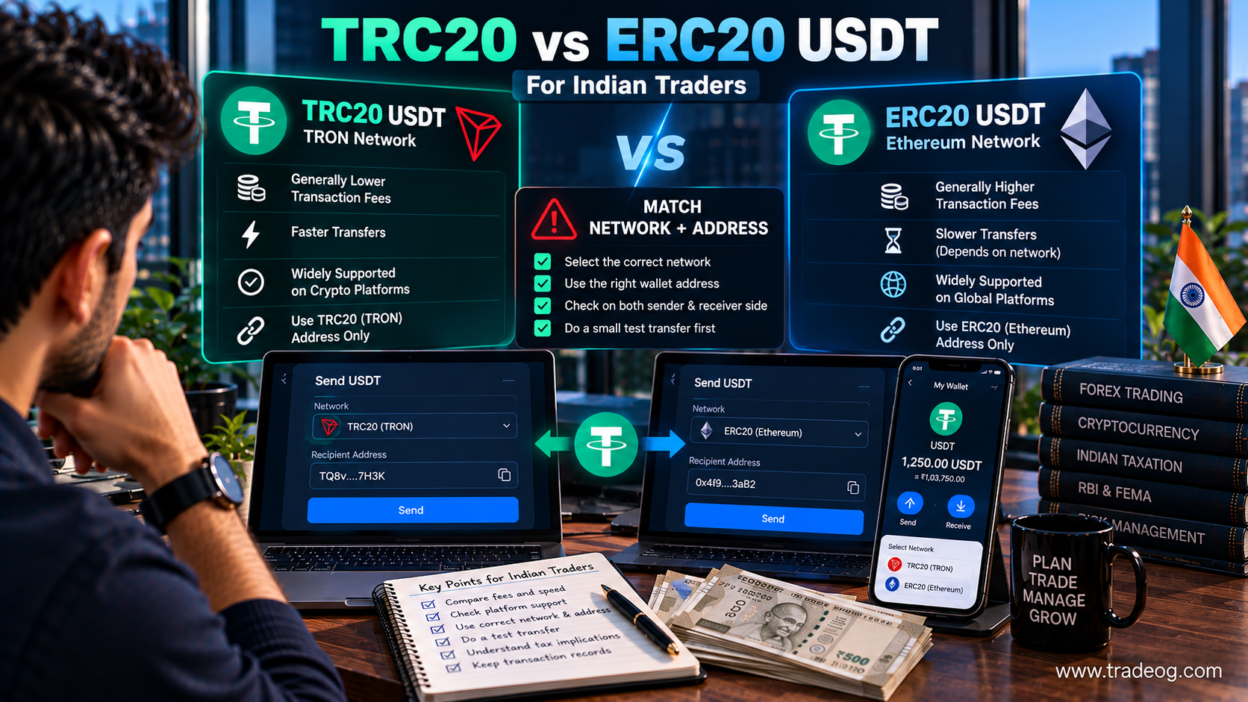
When an Indian trader receives or sends USDT, one of the most important choices is the blockchain network. TRC20 USDT runs on TRON, while ERC20 USDT runs on Ethereum. They are both USDT, but they are not the same network for transfer purposes.
For many routine transfers, TRC20 can be attractive because its transaction-cost structure is often lower than Ethereum’s, while ERC20 remains widely integrated across wallets, exchanges and Ethereum-based applications. But the correct answer is not simply “always use TRC20.” The right network is the one supported by both the sender and receiver for the exact USDT transfer.
For Indian traders moving USDT between a prop firm, Trust Wallet, an exchange or an INR conversion platform, a network mismatch can create a much bigger problem than a fee difference. This guide compares TRC20 and ERC20, explains the address difference, fees, speed, wallet requirements, practical examples and what Indian traders should check before sending USDT.
TRC20 vs ERC20 USDT: Quick Answer
| Factor | TRC20 USDT | ERC20 USDT |
|---|---|---|
| Blockchain | TRON | Ethereum |
| Token standard | TRC20 | ERC20 |
| Native asset used for network resources | TRX | ETH |
| Typical transfer-cost profile | Often lower, but varies | Can be higher when Ethereum gas is expensive |
| Address format | TRON-format address | Ethereum/EVM-format address |
| Compatibility | Depends on the receiving platform | Depends on the receiving platform |
| Best choice | When both sides explicitly support TRC20 | When both sides explicitly support ERC20 |
TRON’s developer documentation defines TRC20 as its fungible-token standard and says it is interface-compatible with Ethereum’s ERC20. Ethereum’s documentation defines ERC20 as the standard interface for fungible tokens on Ethereum. citeturn1search1turn1search0
Bottom line: if your prop firm and receiving platform both support TRC20 and the total cost is lower, TRC20 can be a practical choice. If the receiving platform only supports ERC20, use ERC20. Never change the network simply because one option looks cheaper.
What Is TRC20 USDT?
TRC20 is the fungible-token standard used on the TRON network.
USDT issued on TRON is commonly referred to as USDT-TRC20 or simply TRC20 USDT.
TRON’s official documentation describes TRC20 as a fungible-token standard running inside the TRON Virtual Machine. It is designed for token transfers and smart-contract interactions on TRON. citeturn1search1turn1search2
For an ordinary trader, the important practical point is that a TRC20 USDT transfer is a transaction on TRON, not Ethereum.
That affects:
- the receiving address;
- the network selected at the sending side;
- the network supported by the receiving platform;
- the transaction fee mechanism;
- the blockchain explorer used to verify the transaction.
What Is ERC20 USDT?
ERC20 is Ethereum’s standard interface for fungible tokens. USDT issued on Ethereum is commonly called USDT-ERC20.
Ethereum’s official documentation explains that ERC20 provides a standard interface for fungible tokens, including functions for transferring tokens, checking balances and approving token spending. citeturn1search0
For traders, ERC20 USDT means the transfer is taking place on the Ethereum network.
That means the transaction interacts with Ethereum’s infrastructure and its fee mechanism. The exact cost depends on network conditions and the transaction being performed.
Is TRC20 USDT the Same as ERC20 USDT?
They represent the same stablecoin brand and are both USDT, but they are different network representations of the asset.
Think of it like sending the same currency through two different payment rails.
The amount may be:
1,000 USDT
on either network, but the underlying blockchain transaction is different.
This distinction is why a platform may show:
- USDT-TRC20;
- USDT-ERC20;
- USDT on another supported network.
Do not treat these options as interchangeable during a withdrawal.
TRC20 vs ERC20 Address: Why the Address Matters
One of the easiest ways to understand the difference is to look at the address format.
TRON addresses and Ethereum addresses normally use different formats.
A typical TRON address begins with T, while an Ethereum/EVM address normally begins with 0x.
For example, a simplified illustration might look like:
- TRC20: TQ…example
- ERC20: 0x…example
These are only examples, not real deposit addresses.
The key lesson is that you should not decide the network from the token name alone. Check the network displayed by the receiving wallet or exchange.
Can You Send TRC20 USDT to an ERC20 Address?
Do not do this unless the receiving service explicitly states that it supports that exact deposit route.
The fact that both assets are called USDT does not make every address and network compatible.
A receiving platform may support multiple networks, but that does not mean you can select any network when sending.
The correct procedure is:
- Open the receiving platform’s USDT deposit page.
- Select the exact supported network.
- Copy the displayed deposit address.
- Return to the sending wallet or prop-firm withdrawal page.
- Select the same network.
- Paste the address.
- Compare the address and network again.
TRON’s official documentation confirms that TRC20 is its own token standard, while Ethereum defines ERC20 for Ethereum. The standards being technically compatible at the interface level does not mean a user should send a token across networks without a supported bridge or deposit route. citeturn1search1turn1search0
Why TRC20 Is Often Cheaper Than ERC20
One reason traders frequently prefer TRC20 for routine USDT transfers is transaction cost.
TRON uses its own resource model, including Energy and Bandwidth, while Ethereum transactions consume gas. Ethereum transaction costs can rise when network demand increases.
Therefore, a USDT transfer on Ethereum can sometimes cost significantly more than a comparable TRON transfer.
However, “TRC20 is always cheap” is too simplistic.
Fees can change, and the actual amount you pay may depend on:
- network conditions;
- the wallet’s fee calculation;
- the platform’s withdrawal fee;
- whether the sender or platform subsidises part of the cost;
- the transaction type;
- the amount being transferred.
Compare the actual withdrawal fee shown on the sending platform rather than relying on an old fee screenshot from social media.
How Ethereum Gas Affects ERC20 USDT Transfers
ERC20 USDT transfers use Ethereum’s transaction infrastructure.
Ethereum’s fee market can vary according to network demand and transaction conditions. The amount shown by a wallet can therefore change over time.
For a large transfer, the fee may be relatively small compared with the value being moved. For a small transfer, however, the same absolute fee can represent a meaningful percentage of the transaction.
Example:
- USDT transfer: 100 USDT
- Network-related cost: 5 USDT equivalent
- Effective cost: 5% of the amount
The numbers above are only an illustration. Always check the live fee before confirming.
What Network Fee Is Used for TRC20 USDT?
TRON transactions use TRON’s resource model, and TRX is the native asset of the network.
TRON’s official documentation identifies TRX as the native token and explains that TRC20 transactions operate through the TRON Virtual Machine. citeturn1search1
Depending on the wallet and transaction conditions, network resources such as Energy and Bandwidth can affect the cost of a TRC20 transaction.
This is different from Ethereum’s gas model.
TRC20 vs ERC20 Speed
Both networks can process transactions quickly under normal conditions, but users should not choose solely on a generic “faster blockchain” claim.
The time you experience can include more than blockchain confirmation:
- prop-firm processing;
- payment-provider processing;
- exchange withdrawal processing;
- blockchain confirmation;
- receiving-platform confirmation requirements;
- internal compliance checks.
Therefore, a transaction can be confirmed on-chain while your exchange balance remains pending.
When comparing networks, separate blockchain confirmation time from the total settlement time experienced by the trader.
Which Is Better for Prop Firm USDT Payouts?
If a prop firm gives you a choice between TRC20 and ERC20, compare the withdrawal options against the destination wallet or exchange.
For example:
| Situation | Better Choice |
|---|---|
| Prop firm supports TRC20 and your receiving platform supports TRC20 | TRC20 can be practical, especially if its displayed fee is lower |
| Prop firm supports ERC20 and your receiving platform only supports ERC20 | ERC20 |
| Trust Wallet setup is configured for TRC20 and the sender supports it | TRC20 |
| Your destination explicitly requires ERC20 | ERC20 |
| You are unsure which network the destination accepts | Do not send yet |
The “best” network is therefore determined by compatibility first, cost second.
TRC20 vs ERC20 for Trust Wallet
Trust Wallet supports assets across multiple networks. Tether’s wallet documentation also lists USDT availability across Ethereum, Tron and other networks and emphasizes that the sender and receiver should use the same network. citeturn0search2
If you are receiving USDT in Trust Wallet:
- Search for USDT.
- Choose the relevant network version.
- Tap Receive.
- Check the network name.
- Copy the displayed address.
- Give that address to the sender.
Do not copy an ERC20 address and then tell a prop firm to send TRC20 USDT to it simply because both are labelled USDT.
TRC20 vs ERC20 for Converting USDT to INR
For Indian traders who ultimately want INR, the network choice should be made at the beginning of the transfer chain.
A typical flow may be:
Prop Firm → USDT → Trust Wallet → INR-supported crypto platform → USDT/INR → Indian bank account
If the INR conversion platform supports only ERC20 deposits, sending TRC20 USDT to its deposit address is not an appropriate shortcut.
Likewise, if it supports TRC20 but not ERC20, use TRC20.
For the complete conversion process, see Trust Wallet to INR: How Indian Traders Can Convert USDT to Rupees.
Which Network Is Better for Indian Traders?
There is no universal answer, but for a trader who regularly moves USDT between a prop firm and a compatible wallet or exchange, TRC20 is often the practical choice when it is supported on both ends and the displayed withdrawal cost is lower.
ERC20 remains important when Ethereum compatibility is required.
Use ERC20 when:
- the receiving platform specifically requires ERC20;
- you are interacting with an Ethereum-based application;
- your destination does not support TRC20;
- the provider’s infrastructure is designed around Ethereum.
Use TRC20 when:
- both sides explicitly support TRC20;
- the receiving address is for TRON/USDT-TRC20;
- the withdrawal fee is competitive;
- you do not need an Ethereum-only application.
Important: Lower Fee Does Not Mean Better Network
This is one of the biggest mistakes new crypto users make.
Suppose a prop firm displays:
- TRC20 fee: 2 USDT
- ERC20 fee: 12 USDT
It may be tempting to select TRC20 immediately.
But if your destination exchange only accepts ERC20 for that deposit address, the 2 USDT fee is irrelevant.
The correct decision is:
Destination compatibility → network compatibility → address verification → fee comparison.
Do TRC20 and ERC20 Use the Same USDT Contract?
No.
USDT exists as network-specific token deployments. ERC20 USDT is an Ethereum token implementation, while TRC20 USDT is implemented according to TRON’s TRC20 standard.
This is why a blockchain explorer will show different transaction environments and why the addresses are handled differently.
Ethereum’s ERC20 standard defines how fungible tokens operate through smart contracts. TRON’s TRC20 standard provides the corresponding token interface on TRON. citeturn1search0turn1search1
Can You Convert TRC20 USDT Into ERC20 USDT?
Yes, but this is generally a cross-chain conversion or swap, not a normal wallet transfer.
A supported exchange, bridge or conversion service may allow a user to move value from one network representation to another.
But this introduces another layer of:
- fees;
- smart-contract risk;
- platform risk;
- network selection;
- transaction complexity.
For a beginner, it is usually safer to select the correct network at the original withdrawal stage rather than deliberately sending USDT on the wrong network and attempting to repair the transaction later.
TRC20 vs ERC20: Example With a 1,000 USDT Payout
Imagine a prop firm approves a 1,000 USDT payout.
The withdrawal page offers:
- TRC20 — displayed fee 2 USDT
- ERC20 — displayed fee 12 USDT
Your receiving platform accepts both networks.
If everything else is equal, TRC20 would leave approximately:
1,000 − 2 = 998 USDT
while ERC20 would leave approximately:
1,000 − 12 = 988 USDT
Again, these are illustrative numbers, not current guaranteed fees.
If your receiving platform accepts only ERC20, however, ERC20 is the correct choice regardless of the fee difference.
What Happens If You Send the Wrong Network?
The outcome depends on the exact situation.
Possible scenarios include:
- the platform rejects the deposit;
- the transaction reaches an address controlled by the user but is not displayed correctly;
- the platform requires manual recovery;
- the asset becomes difficult or impossible to recover;
- the platform’s support team can recover it under specific conditions and possibly for a fee.
Never assume that customer support can recover a wrong-network transfer.
Blockchain transactions can be difficult to reverse. That is why the network should be verified before the transaction is submitted.
How to Check a USDT Network Before Sending
Use this five-point check:
- Asset: Is it USDT?
- Network: Is it TRC20 or ERC20?
- Address: Does the address come from the correct deposit/receive screen?
- Destination: Does the receiving platform explicitly support that network?
- Fee: Is the displayed fee acceptable?
Only after all five are confirmed should you send the funds.
Should You Do a Test Transfer?
For a new wallet, exchange or large payout, a small test transfer can be a sensible risk-control step.
For example, if you need to move 2,000 USDT for the first time, you might first transfer a small amount if the destination’s minimum deposit allows it.
Confirm:
- the transaction appears on-chain;
- the receiving platform credits the USDT;
- the network is correct;
- the address is correct.
Then move the remaining amount.
What Should Indian Traders Keep for Their Records?
If the USDT originates from a prop-firm payout, maintain the complete transaction trail.
Keep:
- prop-firm payout approval;
- payout amount;
- selected network;
- sending address, where available;
- receiving address;
- transaction hash;
- exchange deposit record;
- USDT-to-INR conversion statement;
- INR bank withdrawal confirmation;
- bank statement.
This is particularly useful if a bank, exchange, tax adviser or compliance team asks you to explain the source and movement of funds.
TRC20 vs ERC20 and Indian Crypto Tax
The choice between TRC20 and ERC20 does not itself determine Indian tax treatment. Both are network representations of a crypto asset, and the tax question depends on the underlying transaction.
The Income Tax Department’s current Schedule VDA guidance requires transaction-wise reporting for transfers of VDAs and states that income from transfer of a VDA is taxed at 30% plus applicable surcharge and cess, subject to the rules of Section 115BBH. citeturn0search0turn0search3
Section 194S separately provides for 1% TDS on consideration for transfer of a VDA, subject to the applicable conditions and thresholds. The Income Tax Department currently lists the thresholds as ₹10,000 generally and ₹50,000 for a specified person. citeturn0search1turn0search4
Do not interpret this as saying every prop-firm USDT payout automatically receives 30% VDA taxation or 1% TDS. The underlying prop-firm payment, the subsequent transfer or sale of USDT and the taxpayer’s circumstances can require separate analysis.
Does TRC20 vs ERC20 Affect RBI/FEMA Compliance?
The blockchain network does not by itself determine whether the underlying forex activity is authorised in India.
A trader should therefore not think:
“I used TRC20, so the forex transaction is compliant.”
or:
“I used ERC20, so it is treated differently under forex rules.”
The network is a technical payment rail. RBI/FEMA considerations concern the underlying forex activity, authorised entities/platforms, permitted purposes and applicable rules.
For Indian traders dealing with prop-firm payouts, keep the technical crypto-transfer question separate from the legal and tax analysis.
TRC20 vs ERC20 for Large USDT Payouts
For a large payout, the network fee is only one variable.
Also consider:
- maximum withdrawal limits;
- deposit limits;
- daily INR withdrawal limits;
- KYC status;
- source-of-funds requirements;
- platform liquidity;
- network maintenance status;
- bank withdrawal availability;
- tax documentation.
A network that saves 5 USDT is not necessarily the best option if the destination platform imposes a lower deposit limit or temporarily suspends that network.
TRC20 vs ERC20 for Small USDT Transfers
For small transfers, transaction cost matters more as a percentage of the amount.
For example, a 5 USDT cost on a 50 USDT transfer is 10%.
The same 5 USDT cost on a 5,000 USDT transfer is only 0.1%.
This is why traders moving small amounts should pay particular attention to the displayed network and withdrawal fee.
What About Trust Wallet?
Trust Wallet supports multiple networks, but the correct receiving asset/network still needs to be selected.
Tether’s wallet documentation lists USDT availability on Ethereum and Tron among other networks and specifically says users should make sure the other party is using the same network when sending or receiving. citeturn0search2
For a prop-firm payout to Trust Wallet, the practical sequence is:
- Check the prop firm’s supported USDT networks.
- Open Trust Wallet.
- Select the matching USDT network.
- Tap Receive.
- Copy the displayed address.
- Return to the prop firm.
- Select the same network.
- Paste the address.
- Review the fee and destination.
- Submit the payout.
For the full step-by-step transfer process, read How to Move USDT From a Prop Firm to Trust Wallet.
TRC20 vs ERC20: Common Mistakes
Choosing the cheapest network automatically
Cost comes after compatibility. A cheap network is useless if the destination does not support it.
Assuming all USDT addresses are interchangeable
They are not. Always follow the network-specific deposit instructions.
Copying an old exchange address
Deposit instructions can change. Generate or verify the address immediately before sending.
Ignoring maintenance notices
An exchange can temporarily suspend deposits on a particular network. Check its current deposit status.
Sending the full payout without testing
A small test transaction can reduce operational risk for a new destination.
Sharing your recovery phrase
No normal USDT transfer requires your seed phrase or private key.
TRC20 or ERC20: Which Should You Choose?
Use this decision rule:
Does the receiving platform support TRC20?
If yes, check the fee and transfer requirements.
Does it support ERC20 but not TRC20?
Use ERC20.
Does it support both?
Compare the current withdrawal fee, deposit requirements and operational reliability. If TRC20 is supported on both ends and has the lower displayed cost, it is often the practical choice for a routine USDT transfer.
Are you unsure?
Do not send the funds until the network is confirmed.
Frequently Asked Questions
Is TRC20 better than ERC20 for USDT?
Not universally. TRC20 can be cheaper for many routine transfers, while ERC20 can be preferable when Ethereum compatibility is required. The receiving platform’s supported network should come first.
Which USDT network is cheaper?
TRC20 often has a lower transfer-cost profile than ERC20, but actual fees vary by network conditions, wallet and platform. Check the live withdrawal fee before sending.
Is TRC20 the same as TRON?
TRON is the blockchain network. TRC20 is the token standard used on that network.
Is ERC20 the same as Ethereum?
ERC20 is Ethereum’s fungible-token standard. USDT using ERC20 is issued and transferred through Ethereum’s token infrastructure.
Can I send TRC20 USDT to MetaMask?
Do not assume that a wallet interface supporting Ethereum/EVM assets automatically means the specific TRON USDT route is supported. Verify that the wallet and destination explicitly support TRC20 USDT.
Can I send ERC20 USDT to a TRC20 address?
Do not do so unless the receiving service explicitly supports the exact transfer route. ERC20 and TRC20 are different network standards.
Which network should Indian traders use for prop-firm payouts?
If the prop firm and your destination both support TRC20, it can be a practical choice because the displayed withdrawal cost may be lower. If the destination requires ERC20, use ERC20.
Does the network affect Indian tax?
The network choice itself does not determine the tax treatment. Indian VDA rules apply based on the underlying transaction and transfer, not simply because the USDT used TRC20 or ERC20.
Final Takeaway
TRC20 vs ERC20 is not really a question of which network is universally better. It is a question of which network is correctly supported by both sides of your transfer.
For many Indian traders receiving USDT from a prop firm and moving it to Trust Wallet or a compatible crypto platform, TRC20 can be attractive because its current fee structure is often more economical for routine transfers. ERC20 remains important when Ethereum compatibility is required.
Before every transfer, follow this order:
Check destination → confirm USDT network → verify address → check fee → consider a test transfer → send → save transaction hash.
Saving a few USDT in fees is never worth risking the entire transfer through a network mismatch.
Disclaimer: TradeOG provides educational and informational content only. Nothing in this article should be treated as financial, investment, legal, tax, banking, regulatory or professional advice. Blockchain fees, network availability, supported USDT networks, exchange policies, prop-firm payout methods and Indian tax or regulatory requirements can change. Always verify the current network, address, fees and provider terms before transferring funds, and consult a qualified professional for significant transactions.

[…] the receiving platform’s instructions for that specific deposit. TradeOG’s guide on TRC20 vs ERC20 USDT explains why this […]
[…] detailed guide on TRC20 vs ERC20 USDT explains the network-selection issue in more […]
[…] For more detail, see TRC20 vs ERC20 USDT: Which Network Should Indian Traders Use?. […]