


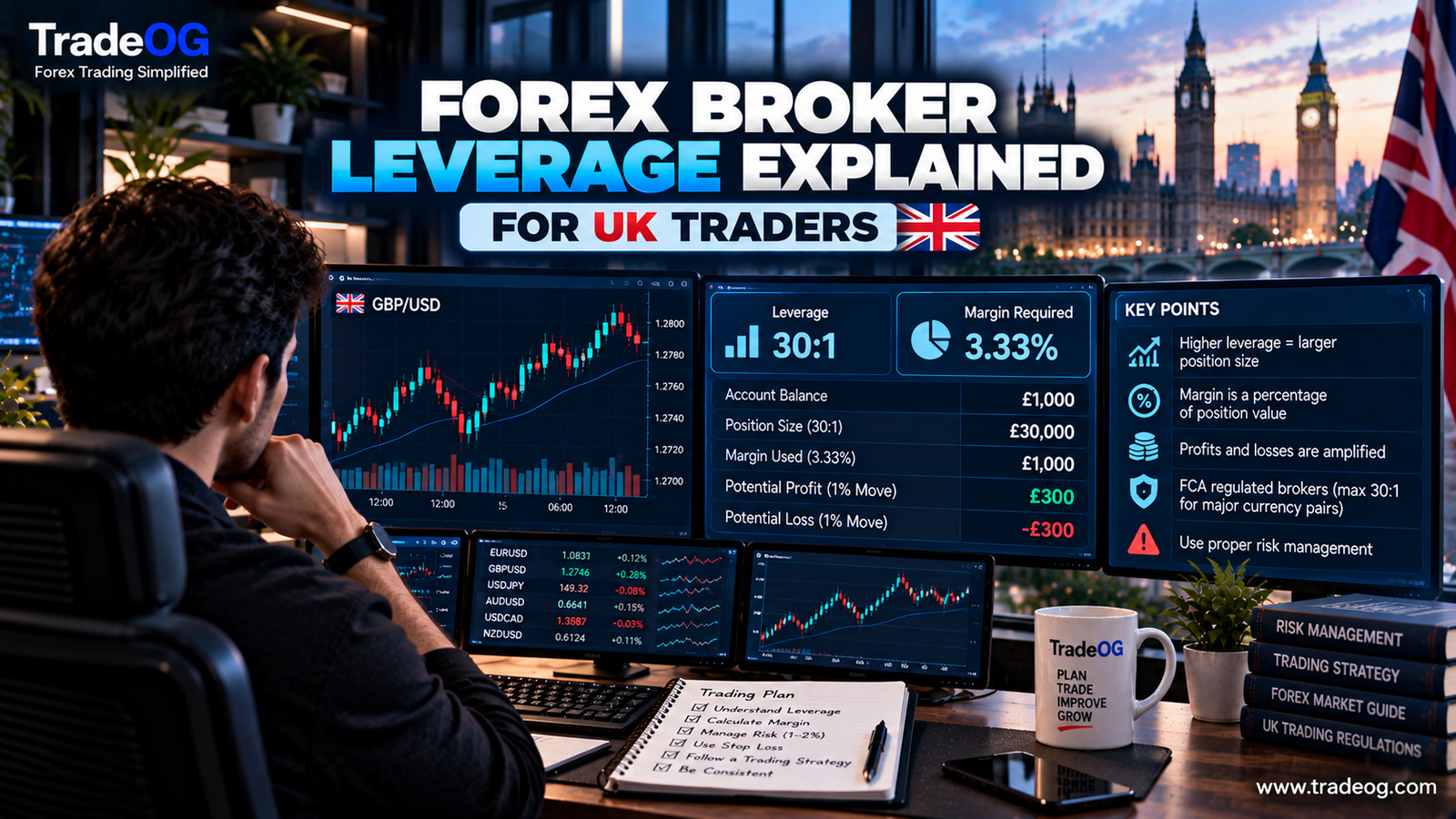
Forex broker leverage can make a relatively small trading account control a much larger position. That sounds attractive, but leverage also magnifies losses. For UK retail traders, leverage is not unlimited: FCA rules restrict the leverage available on rolling spot forex and other CFD-style products, with the maximum generally reaching 30:1 for major currency pairs.
This guide explains forex broker leverage for UK traders in simple terms, including the difference between leverage and margin, how 30:1 works, what happens when a trade moves against you, why the FCA limits leverage, and how beginners can use position sizing and stop losses instead of relying on high leverage.
What Is Forex Leverage?
Leverage is a facility that allows a trader to gain exposure to a position larger than the cash deposited in the trading account.
For example, with 30:1 leverage, £1 of available margin can support up to £30 of exposure, subject to the broker’s terms and the applicable product rules.
So, in a simplified example:
| Account Funds | Leverage | Maximum Example Exposure |
|---|---|---|
| £500 | 30:1 | £15,000 |
| £1,000 | 30:1 | £30,000 |
| £2,000 | 30:1 | £60,000 |
| £5,000 | 30:1 | £150,000 |
These are exposure illustrations, not recommendations to use the maximum available leverage. Your broker may apply product-specific limits, margin requirements and risk controls.
What Is the Maximum Forex Leverage in the UK?
For UK retail clients trading restricted speculative investments such as rolling spot FX, the FCA’s rules set minimum margin requirements according to the underlying asset. For a major foreign exchange pair, the minimum initial margin is 3.33% of the exposure, which corresponds to roughly 30:1 maximum leverage.
The FCA’s leverage framework is tiered. The margin requirement is higher, and therefore the maximum leverage lower, for more volatile or higher-risk underlying assets. The FCA rules specify 5% margin for minor FX pairs and gold, 10% for certain other commodities and indices, and 20% for shares and assets not otherwise listed in the relevant categories.
That means you should not assume that every instrument on a UK broker’s platform automatically has 30:1 leverage.
UK Forex Leverage: 30:1 Explained
Suppose you have a £1,000 trading account and your broker allows 30:1 leverage on a major FX pair.
The simplified maximum exposure would be:
£1,000 × 30 = £30,000
The margin percentage is approximately:
1 ÷ 30 × 100 = 3.33%
If the position has a notional exposure of £30,000, approximately £1,000 of margin would be required at a 3.33% margin rate.
However, margin is not the same thing as the amount you should risk. A trader could have £1,000 in an account and use only £100 or £200 of effective exposure. Good risk management often means using considerably less than the maximum leverage available.
Leverage vs Margin: What Is the Difference?
Leverage and margin describe the same trading relationship from different directions.
- Leverage describes how much exposure can be controlled relative to the margin.
- Margin is the amount of money required to open and maintain a leveraged position.
For example:
30:1 leverage ≈ 3.33% margin.
If a broker requires 3.33% margin on a £30,000 exposure, the initial margin would be roughly £999. That calculation is a simplified illustration; actual trading platforms also account for the instrument, currency conversion, spread, account equity and broker-specific requirements.
Why Does the FCA Limit Forex Leverage?
Leverage can magnify both gains and losses. The FCA introduced permanent restrictions on retail CFD products after identifying significant risks associated with highly leveraged speculative trading. Its rules include leverage limits, a 50% margin close-out requirement and protection designed to prevent retail clients from losing more than the funds in their CFD account.
The FCA describes CFDs as high-risk products and warns that they are not suitable for every retail consumer. Rolling spot foreign exchange is included within the FCA’s CFD-related regulatory framework.
The important point is simple: UK leverage limits are designed to reduce the damage that excessive leverage can cause to retail accounts.
What Happens If a Leveraged Forex Trade Moves Against You?
Consider a simplified £1,000 account controlling £30,000 of exposure.
If the position loses 1% of its exposure:
£30,000 × 1% = £300 loss
That £300 loss represents 30% of the original £1,000 account balance.
A 2% adverse move would represent:
£30,000 × 2% = £600 loss
That is 60% of the original £1,000 account balance.
This is why the statement “30:1 leverage means I can make 30 times more money” is misleading. Leverage increases exposure. It does not create a guaranteed 30-times return.
Does 30:1 Leverage Mean You Should Use 30:1?
No.
The maximum permitted leverage is not a target.
A beginner might have access to 30:1 leverage but deliberately trade a much smaller position. Your actual risk should be determined by your account size, stop-loss distance, position size and trading strategy.
For example, if you decide that a single trade should risk no more than 1% of a £1,000 account:
£1,000 × 1% = £10 maximum planned loss.
The position should then be sized so that a stop-loss hit is approximately £10, after considering spread and other trading costs.
This approach is much more useful than simply asking, “How much leverage does my broker give me?”
Forex Leverage Example for a £1,000 UK Trading Account
Imagine a trader has £1,000 and opens a major currency pair position with £30,000 of exposure.
| Market Move Against Position | Approx. Exposure Loss | % of £1,000 Account |
|---|---|---|
| 0.10% | £30 | 3% |
| 0.25% | £75 | 7.5% |
| 0.50% | £150 | 15% |
| 1.00% | £300 | 30% |
| 2.00% | £600 | 60% |
The figures are simplified and ignore spread, commissions, financing and execution effects. But they demonstrate the key principle: a small percentage move in the underlying market can become a large percentage change in account equity when exposure is large.
What Is the FCA 50% Margin Close-Out Rule?
UK retail CFD rules require firms to close out positions when a retail client’s net equity falls below 50% of the margin required to maintain the open positions, subject to the detailed FCA rules and market conditions.
This is commonly called the margin close-out rule.
It is important not to interpret the 50% threshold as a level where you should intentionally allow your account to reach. A trader who waits for a broker’s forced close-out is already operating with substantial risk.
A personal stop-loss should normally be part of the trading plan well before broker-level liquidation controls become relevant.
What Is Negative Balance Protection?
UK retail CFD protections include measures intended to prevent a retail client from losing more than the funds in the CFD account. The FCA’s permanent restrictions require firms to provide protection that limits retail client losses to the total funds in the CFD account.
That protection does not mean leveraged trading is safe. A trader can still lose the entire account balance. It simply addresses a different risk: owing more than the money held in the account under the applicable retail CFD protections.
What About Professional Forex Accounts?
The retail leverage limits should not be confused with the treatment of elective professional clients.
Professional classification can involve eligibility requirements and a different regulatory protection package. A professional client may lose some of the protections available to retail clients, including certain leverage and loss protections. The FCA has specifically warned investors about firms encouraging customers to “opt up” to professional status in order to access higher leverage.
Higher leverage should therefore not be treated as a free upgrade. It can come with materially different risk and regulatory protections.
Can UK Brokers Offer 500:1 Forex Leverage?
If a website aggressively markets 500:1 leverage to UK retail traders, do not assume that the offer is equivalent to a standard FCA-regulated retail account.
Check:
- Which legal entity holds your account.
- Whether that entity is authorised by the FCA.
- Which jurisdiction actually governs the account.
- Whether you are being asked to become a professional client.
- Whether the product is a CFD, rolling spot FX, futures contract or another instrument.
- What client-money, close-out and loss protections apply.
The FCA has warned about firms using high-pressure techniques to persuade consumers to give up retail protections in order to access higher leverage.
Forex Leverage for Beginners: How Much Should You Use?
There is no single leverage level that is appropriate for every trader. The better question is:
“How much exposure can I take while keeping my planned loss within my risk limit?”
A simple beginner framework is:
- Decide your maximum account risk per trade.
- Set the technical stop-loss level before entering.
- Calculate the monetary distance between entry and stop.
- Calculate the position size that keeps the loss within your risk budget.
- Check the required margin and available free margin.
- Only then place the trade.
For many beginners, risking around 0.5% to 1% of the account on a single trade is easier to manage psychologically than using large exposure. This is a risk-management example, not an FCA requirement.
Leverage and Stop Loss: Why They Work Together
Leverage determines the size of the exposure. The stop loss determines where you intend to exit if the trade thesis fails.
For example, suppose:
- Account size = £2,000
- Planned risk = 1% = £20
- Stop-loss distance = 25 pips
The position should be sized so that approximately 25 pips equals £20 of loss, before allowing for spread, slippage and other costs.
You should not choose a large position first and then move the stop further away simply because the trade is losing.
Leverage and Risk-Reward Ratio
Leverage does not improve the underlying quality of a trading setup.
Suppose a strategy targets a 1:2 risk-to-reward ratio. If the planned loss is £20, the planned profit target would be £40 before costs.
Using more leverage does not magically turn that into a better setup. It simply changes how much market exposure is required to produce a particular monetary gain or loss.
That is why experienced traders normally think about position size and risk per trade before thinking about the maximum leverage available.
Does Higher Leverage Mean Higher Profit?
Not automatically.
Consider two traders who each have £1,000.
Trader A takes £10,000 of exposure. Trader B takes £30,000. If the market moves 1% in their favour, the simplified gross gains are approximately £100 and £300 respectively.
But if the market moves 1% against them, the losses are also approximately £100 and £300.
Leverage changes the scale of the exposure. It does not change the direction of the market or improve the probability that a trade will succeed.
UK Forex Leverage vs Gold Leverage
Do not assume that gold has the same leverage limit as a major forex pair.
Under the FCA margin framework, gold falls into the 5% minimum-margin category for retail clients, equivalent to a maximum leverage of approximately 20:1 under that framework. Major FX pairs have a 3.33% minimum margin requirement, equivalent to approximately 30:1.
| Underlying Asset | FCA Minimum Margin | Approx. Maximum Leverage |
|---|---|---|
| Major FX pair | 3.33% | 30:1 |
| Minor FX pair | 5% | 20:1 |
| Gold | 5% | 20:1 |
| Certain other commodities | 10% | 10:1 |
| Shares / other specified assets | 20% | 5:1 |
These are regulatory minimum-margin categories under the FCA’s restricted speculative investment rules. A broker can require more margin than the regulatory minimum.
Common UK Forex Leverage Mistakes
1. Using the maximum leverage because it is available
Maximum leverage is a ceiling, not a trading recommendation.
2. Confusing margin with risk
£1,000 of margin does not mean you should be willing to lose £1,000.
3. Ignoring position size
Two traders can have the same account balance but radically different risk because their position sizes are different.
4. Moving a stop loss to avoid taking a loss
This can turn a controlled trading loss into a much larger loss.
5. Chasing offshore leverage
Very high leverage can look attractive in advertising, but the legal entity, jurisdiction and protections matter more than the headline number.
6. Becoming a professional client just for leverage
Higher leverage may involve giving up important retail protections. The FCA has specifically highlighted this risk.
How to Choose a Forex Broker in the UK
Leverage should be only one part of your broker comparison.
- FCA authorisation: verify the legal entity and permissions.
- Trading costs: compare spreads, commissions and overnight financing.
- Execution: understand how orders are executed during volatile markets.
- Platform: check whether the broker supports the platform and tools you actually need.
- Risk controls: understand margin requirements and close-out procedures.
- Client protections: understand what protections apply to your account type.
- Withdrawal process: read the broker’s withdrawal terms before depositing significant funds.
You can check FCA information and regulatory details directly through the Financial Conduct Authority and its official register before opening an account.
UK Forex Leverage Checklist for Beginners
- Confirm that you understand whether you are trading rolling spot FX, CFDs or another product.
- Verify the broker’s UK legal entity and FCA status.
- Understand the leverage and margin requirement for the specific currency pair.
- Calculate your position size before entering the trade.
- Set a stop loss based on the trading setup, not the amount you want to make.
- Keep your risk per trade small enough that several losing trades will not destroy the account.
- Monitor free margin and avoid excessive simultaneous exposure.
- Understand overnight financing if you hold positions beyond the broker’s daily funding time.
- Do not choose a broker solely because it advertises high leverage.
- Never assume a higher leverage ratio means a higher-quality trading opportunity.
Frequently Asked Questions
What is the maximum forex leverage for UK retail traders?
For major currency pairs under the FCA’s retail CFD-style restrictions, the minimum margin is 3.33%, corresponding to approximately 30:1 maximum leverage. Other instruments can have lower limits.
Is 30:1 leverage safe?
30:1 is a regulatory maximum for relevant major FX products, not a measure of safety. A trader can still lose a substantial portion or all of an account through excessive position sizing or poor risk management.
Can I get 100:1 leverage in the UK?
A headline offer of 100:1 should be investigated carefully. Check the broker’s legal entity, FCA status, product type and whether the account is being treated as professional rather than retail. Retail protections may differ outside the standard FCA retail framework.
Is gold leverage the same as forex leverage?
No. Under the FCA’s margin framework, gold has a 5% minimum margin requirement, equivalent to approximately 20:1 leverage, while major FX pairs have a 3.33% minimum margin requirement, equivalent to approximately 30:1.
Does leverage increase my trading costs?
Leverage itself is not necessarily a separate fee. However, larger positions can create larger spread costs, commissions and financing charges because those costs are generally related to position size or exposure.
Should beginners use maximum leverage?
No. Beginners should normally focus on position sizing, stop-loss discipline and a defined risk limit rather than trying to maximise leverage.
Final Thoughts
Forex broker leverage for UK traders is heavily regulated for retail clients for a reason. Major FX pairs can have up to approximately 30:1 leverage under the FCA’s retail framework, while other instruments can have lower limits. The same leverage that allows a trader to control a larger position can also magnify losses quickly.
The smarter approach is to treat leverage as a tool rather than a target. Decide how much you are willing to lose, calculate the correct position size, place the stop loss, and then check how much margin the position requires.
Good trading is not about using the most leverage available. It is about controlling exposure when the market does not do what you expected.
Risk warning: Forex and CFD trading are leveraged and high-risk activities. You can lose money rapidly. This article is for educational purposes only and is not personal financial advice. Rules, broker terms and product availability can change, so verify current information with the FCA and your broker before trading.