

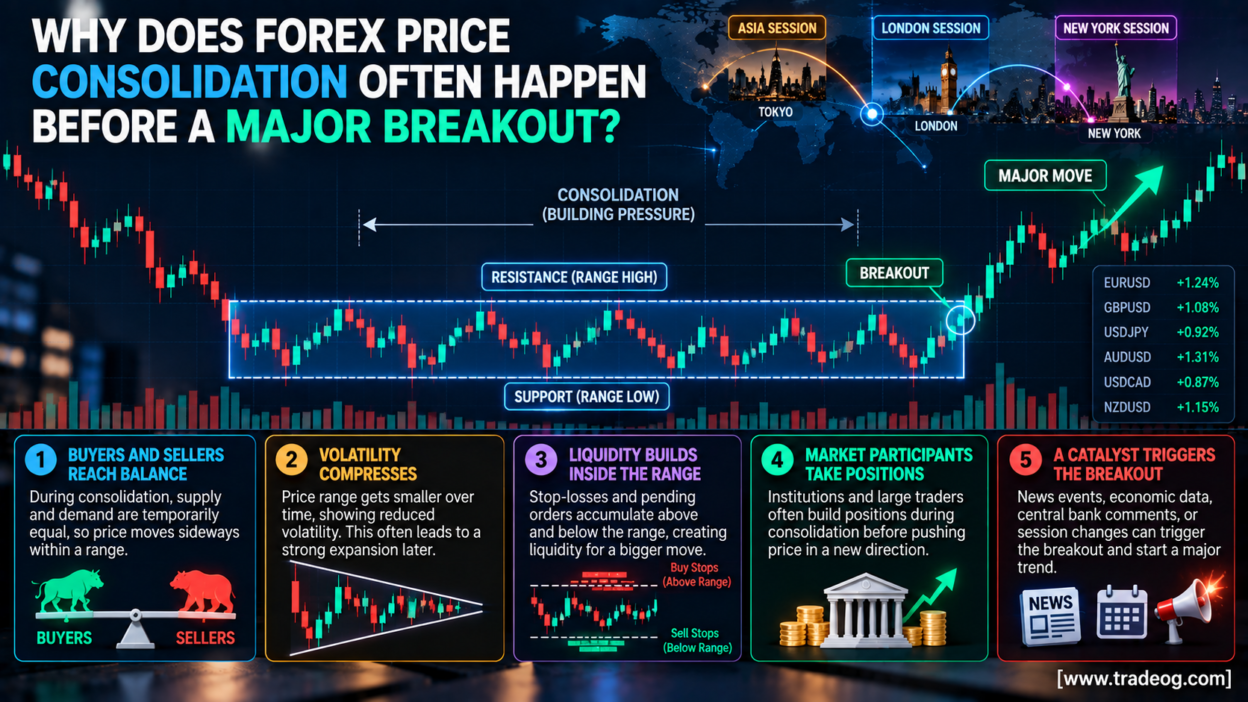
Forex markets do not move in a straight line. After a strong move, price will often slow down and spend time trading inside a relatively narrow range. This phase is called price consolidation.
Consolidation can look boring, but it can be an important part of market structure. Buyers and sellers are temporarily closer to balance, volatility can contract, and price begins to establish clear boundaries. When that balance eventually breaks, the resulting move can be much faster than the quiet period that came before it.
However, consolidation does not guarantee a breakout in a particular direction. A range can break higher, break lower, or produce a false breakout before returning inside the range. The useful question is therefore not simply “Will it break?” but why does consolidation often appear before a major expansion in price?
What Is Forex Price Consolidation?
Forex price consolidation is a period in which a currency pair moves sideways within a relatively defined area rather than producing a sustained sequence of higher highs and higher lows or lower highs and lower lows.
On a chart, consolidation may appear as a rectangle, tight range, triangle, flag, pennant or another compression structure. The exact pattern can vary, but the underlying idea is similar: directional momentum has temporarily weakened and the market is searching for a new balance.
For example, EUR/USD may rise strongly and then spend several hours moving between a nearby support zone and resistance zone. Instead of continuing immediately higher, the market pauses while participants reassess price.
Why Does Consolidation Happen Before a Breakout?
There is no single mechanism that causes every consolidation-to-breakout sequence. Several factors can overlap:
- buyers and sellers temporarily reach a balance;
- profit-taking reduces the strength of the existing move;
- new orders accumulate around important price levels;
- volatility contracts;
- market participants wait for new information;
- liquidity conditions change between sessions; and
- a later catalyst causes the temporary balance to break.
The result is a market that appears quiet on the chart even though positioning and order placement can continue underneath the surface.
Consolidation Is a Temporary Balance, Not a Guaranteed Pause
It is tempting to describe consolidation as the market “resting before the next move.” That description is useful, but incomplete.
Consolidation can also represent uncertainty. Neither buyers nor sellers currently have enough conviction to sustain a directional move. The market may remain in that state until a catalyst, order-flow imbalance or technical level changes the balance.
This is why traders should avoid assuming that every tight range will produce a large breakout.
Volatility Compression Can Precede Expansion
One of the most visible characteristics of consolidation is a reduction in the size of price swings. Candles may become smaller, intraday ranges may narrow and the market can spend more time near the same prices.
This is commonly described as volatility compression.
When conditions later change, volatility can expand again. A breakout therefore often looks dramatic partly because it follows a period in which price was moving relatively little.
Recent market analysis has also highlighted how unusually narrow volatility ranges can coincide with periods of sideways trading before a larger directional move, although compression itself does not predict whether the next move will be higher or lower. citeturn0news12turn0news13
How Support and Resistance Develop During Consolidation
A consolidation range becomes more meaningful when price repeatedly reacts around similar areas.
The upper boundary can act as resistance, while the lower boundary can act as support. These should generally be treated as zones rather than perfectly precise lines because different market participants can use slightly different prices.
Repeated reactions make the boundaries more visible to traders. Once a large number of participants are watching the same area, a break beyond it can attract additional orders.
Why Breakouts Can Become Fast
When price finally leaves a well-defined range, several types of orders can interact at the same time.
- Breakout traders may enter in the direction of the move.
- Traders holding the opposite position may close their trades.
- Stop orders around the range boundary may be triggered.
- New information may cause participants to reprice the currency pair.
That combination can produce a rapid transition from low-volatility consolidation to high-volatility movement.
This is one reason a breakout candle can look disproportionately large compared with the candles inside the preceding range.
Does a Longer Consolidation Mean a Bigger Breakout?
Not necessarily.
A long consolidation can create a well-defined range, but duration alone cannot tell you the direction or size of the next move. A prolonged range can break strongly, break weakly, or produce several false attempts.
The quality of the setup depends on the surrounding market context, the range structure, volatility, liquidity, catalysts and confirmation after the break.
Think of consolidation duration as context, not a guaranteed breakout forecast.
How News Can End Forex Consolidation
Forex markets can remain relatively quiet while participants wait for economic information.
Major events such as central-bank decisions, inflation releases, employment data or unexpected policy announcements can change expectations quickly.
If the new information materially changes the market’s view of interest rates, economic growth or currency demand, price can move outside the established consolidation range.
This explains why some currency pairs appear to consolidate before a major scheduled announcement and then experience a sharp expansion immediately afterward.
Consolidation Around Major Forex Sessions
Liquidity and participation change throughout the trading day. A currency pair may experience quieter conditions during one part of the session and much greater activity when another major financial centre becomes active.
A narrow range formed during a quieter period can therefore be challenged when liquidity and participation increase.
However, traders should not assume that a session opening automatically produces a breakout. The important point is that market conditions can change as participants enter and exit.
Liquidity Matters During Consolidation
Liquidity affects how easily orders can be executed and how price responds to new buying or selling pressure.
A market can remain inside a range while available liquidity absorbs incoming orders. If that balance changes, relatively strong order flow may push price beyond the established boundary.
For a deeper explanation, see How Does Liquidity Affect the Price of a Forex Pair?.
Order Flow Can Change Inside a Quiet Range
A quiet chart does not mean that nothing is happening.
Participants can continue entering, reducing or adjusting positions while price remains inside a relatively narrow area. What matters is whether the combined buying and selling pressure is sufficient to move price beyond the range.
When one side eventually becomes more aggressive, the range can break.
This is why consolidation should be viewed as a period of temporary balance, not simply as a period of inactivity.
Common Types of Forex Consolidation
1. Horizontal range
Price repeatedly moves between relatively clear support and resistance levels. This is one of the easiest consolidation structures to identify.
2. Triangle
Price swings progressively narrow as boundaries converge. A breakout can eventually occur in either direction, so confirmation matters.
3. Flag
A shorter consolidation that develops after a strong directional move. Traders often watch for continuation, but the pattern can fail.
4. Pennant
A compact converging structure following a strong price movement. As with other patterns, the breakout direction must be confirmed rather than assumed.
5. Tight compression
Price trades in an unusually narrow band with reduced movement. This can create a clear breakout level, but compression alone does not tell traders which side will win.
How to Identify a Potential Breakout From Consolidation
Rather than predicting the breakout from the middle of a range, traders can focus on objective conditions.
- Is the consolidation clearly defined?
- Has price respected the boundaries multiple times?
- Is volatility contracting or stable?
- Is there a meaningful higher-timeframe level nearby?
- Is a major economic event approaching?
- Does price actually close beyond the range?
- Does the breakout show follow-through?
- Does the move immediately return inside the range?
The goal is not to predict every breakout. It is to avoid treating every small move outside a range as a genuine breakout.
Why False Breakouts Happen
A false breakout occurs when price moves beyond a consolidation boundary but fails to sustain the move and returns inside the previous range.
This can happen because:
- there was not enough follow-through;
- the initial move triggered orders but attracted insufficient new participation;
- the breakout occurred into a stronger higher-timeframe level;
- the market reacted to a short-lived catalyst;
- liquidity conditions changed; or
- traders entered too early based only on a temporary price spike.
False breakouts are one of the main risks of consolidation-based trading. A breakout should therefore be treated as a hypothesis that needs confirmation, not as proof that a new trend has started.
Breakout vs Breakout Retest
There are two common ways traders approach a consolidation breakout.
| Approach | Advantage | Main Risk |
|---|---|---|
| Immediate breakout | Earlier entry if momentum continues | Greater exposure to false breakouts |
| Breakout retest | Additional confirmation around the broken level | Price may never retest |
| Wait for candle close | Reduces reaction to intrabar spikes | Later entry and potentially smaller reward-to-risk |
There is no universally superior method. The correct approach depends on the strategy and should be tested using consistent rules.
Why Trading Inside the Consolidation Can Be Difficult
Some traders attempt to trade every bounce between support and resistance. This can work in a stable range, but the risk increases when the market transitions into a breakout.
A trader who sells resistance just before an upside breakout can quickly move from a range-trading setup into a trend against the position.
That is why traders should know whether their strategy is designed for range conditions or breakout conditions.
Consolidation and the Higher Timeframe
A consolidation on a 5-minute chart may be almost irrelevant on a daily chart. Conversely, a multi-day consolidation visible on a daily chart can represent a major structural area.
Always consider the timeframe hierarchy.
For example:
- Daily: identify major structure and key levels.
- 4-hour: assess the broader consolidation.
- 1-hour: identify the developing range.
- 15-minute: refine the breakout or retest.
The exact combination is strategy-dependent. The important point is that a breakout should be interpreted in the context of the larger market structure.
How Indian Forex and Gold Traders Can Use This Concept
Indian traders often focus on EUR/USD, GBP/USD, USD/JPY and XAU/USD during the European and US sessions. A pair may consolidate during a quieter period and then become significantly more active when liquidity and scheduled economic events increase.
For XAU/USD in particular, traders should be careful about assuming that a tight range automatically means a bullish breakout is coming. Gold can break in either direction when expectations around US rates, inflation or risk sentiment change.
A disciplined approach is to define the range, identify the invalidation point and wait for the specific confirmation required by the strategy.
How Volatility Indicators Can Help
Indicators such as Average True Range (ATR) and Bollinger Bandwidth can help traders quantify changes in volatility.
A declining ATR can indicate that recent price ranges have become smaller, while narrowing Bollinger Bands can visually highlight compression.
These indicators should not be treated as automatic breakout predictors. They are better used as context alongside price structure and risk management.
Why Consolidation Does Not Always Lead to a Major Move
Markets can remain range-bound for much longer than expected. A trader may assume that a breakout is “due” simply because price has been quiet for a long time.
Markets do not owe traders a breakout.
A range can continue, expand gradually, or break and immediately fail. This is why patience and predefined conditions are more useful than trying to force a trade from every period of compression.
A Practical EUR/USD Example
Imagine EUR/USD has been trending higher and reaches a resistance zone. Instead of breaking immediately, it spends several hours moving between a narrow support area and the resistance.
The candles become smaller and the range becomes clearly visible. Later, a major US economic release changes expectations around interest rates. EUR/USD moves through resistance and closes above the range.
A trader using a breakout strategy might wait for the close, while another may wait for a retest of the old resistance. If price falls back into the range and remains there, the breakout thesis becomes weaker.
The important lesson is that the consolidation provided structure; the catalyst and subsequent price behaviour determined whether the breakout had follow-through.
How to Avoid Chasing a Consolidation Breakout
A large breakout candle can create FOMO. Traders see price accelerating and enter after much of the initial move has already happened.
Before entering, ask:
- Where is the actual invalidation level?
- Has the move already travelled too far?
- Is the spread behaving normally?
- Is there a nearby higher-timeframe resistance or support level?
- Does the potential reward justify the risk?
- Is the breakout confirmed according to the trading plan?
Waiting for a better-defined setup can be more useful than chasing the first large candle.
Consolidation and Risk Management
Breakout trading can produce attractive moves, but the risk of false breaks must be included in the strategy.
Before entering, define:
- maximum risk per trade;
- invalidation level;
- position size;
- entry condition;
- profit-taking plan; and
- conditions that would cancel the setup.
Do not increase position size simply because the consolidation appears unusually tight. A narrow range can produce a sharp breakout in either direction.
What a High-Quality Consolidation Setup Looks Like
There is no perfect setup, but traders can look for a combination of structure and context.
- A clearly identifiable range or compression zone.
- Multiple reactions around important boundaries.
- A logical higher-timeframe location.
- Controlled volatility before the potential expansion.
- A clear breakout level.
- Defined invalidation.
- Confirmation after the break.
- Enough potential movement to justify the risk.
The more objective the criteria are, the easier it becomes to test whether the setup actually has an edge.
Final Takeaway
Forex price consolidation often appears before major breakouts because the market temporarily reaches a balance between buying and selling pressure while volatility and price movement become compressed.
That balance can eventually be disrupted by new information, changing liquidity, order-flow imbalance, positioning or a technical break of an important range.
But consolidation is not a guarantee of direction. A strong breakout can occur, a false breakout can happen, or the market can simply continue moving sideways.
The best approach is to treat consolidation as a market structure that defines important levels and then wait for the breakout conditions your strategy has actually tested.
Frequently Asked Questions
Why does forex consolidate before a breakout?
Forex prices can consolidate when buying and selling pressure are temporarily balanced. Volatility may contract while participants wait for new information or for one side to gain enough strength to move price beyond the range.
Does consolidation always lead to a breakout?
No. Consolidation can continue, break in either direction or produce a false breakout. It should not be treated as a guaranteed directional signal.
Does a longer consolidation mean a stronger breakout?
Not necessarily. Duration provides context but does not guarantee the size or direction of the eventual move.
How can traders confirm a forex breakout?
Common confirmation methods include a candle close beyond the range, follow-through, a successful retest, higher-timeframe agreement and other strategy-specific conditions.
Is forex consolidation good for breakout trading?
It can provide clearly defined boundaries and risk levels, but false breakouts remain common. Traders should test their confirmation and risk rules rather than assuming every range will produce a sustained move.


[…] For more on consolidation and breakout conditions, see Why Does Forex Price Consolidation Often Happen Before a Major Breakout?. […]