


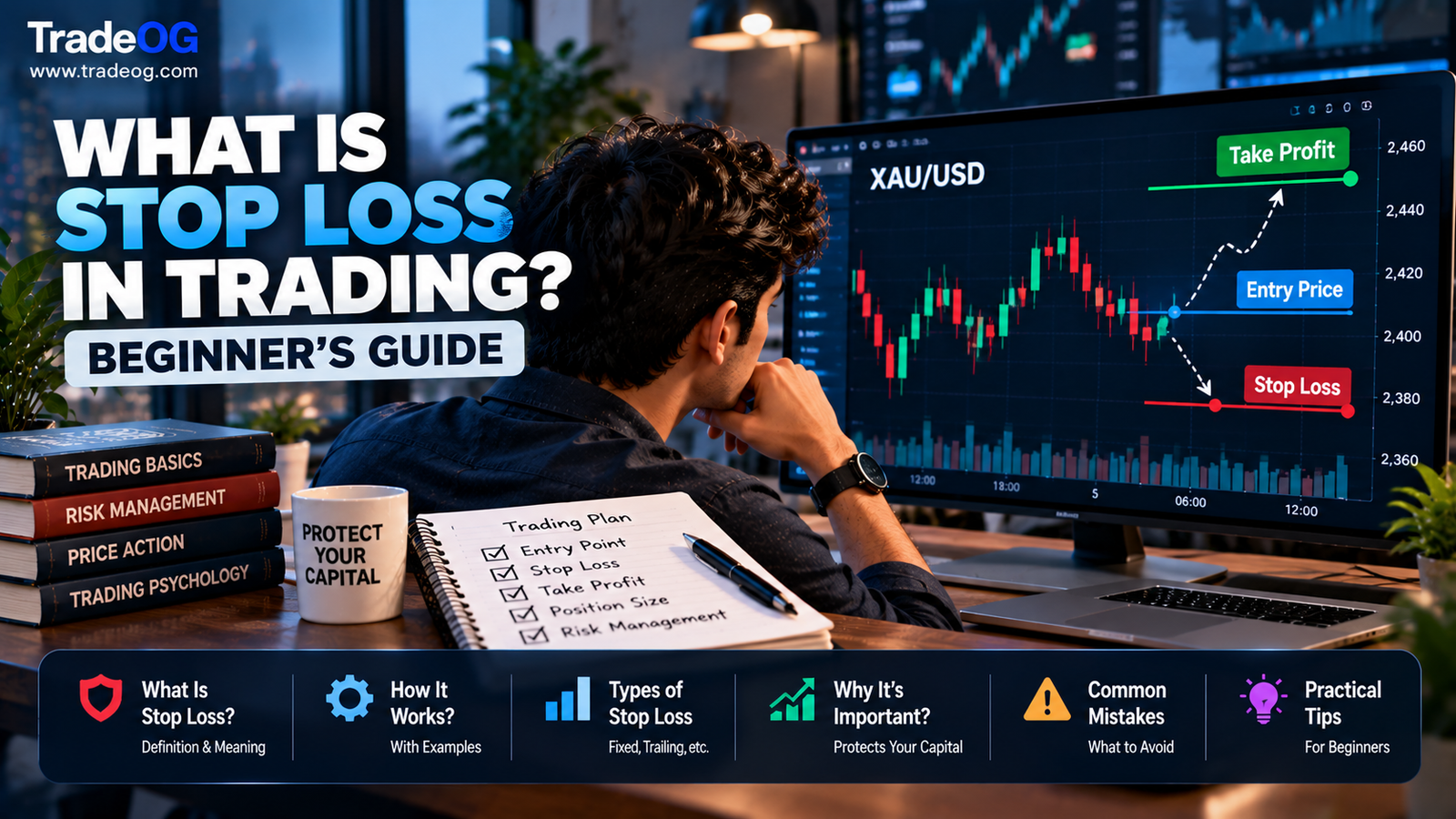
If you are new to trading, you will hear one piece of advice again and again: always use a stop loss.
But what exactly is a stop loss? Where should you place it? How much should you risk? Should the stop be a fixed number of pips, a percentage, or a level based on the chart?
A stop loss is one of the most important risk-management tools in trading. It can help limit the loss on a position when the market moves against you. However, it is not a magic shield and it cannot guarantee an exact exit price in every market condition.
This beginner-friendly guide explains what a stop loss is in trading, how it works, where to place it, how it connects with position sizing and risk-reward, and how beginners can avoid common stop-loss mistakes.
What Is a Stop Loss in Trading?
A stop loss is an order or instruction designed to close a trading position when the market reaches a specified price level that is unfavorable to the trade.
Its main purpose is to help control downside risk.
For example, imagine you buy EUR/USD at 1.1000 because you expect the price to rise. You decide that your trade idea is no longer valid if price falls to 1.0950.
You could place a stop loss around 1.0950.
If the market reaches the stop level, the position is intended to be closed, subject to the order type, execution conditions, liquidity and possible slippage.
The basic idea is:
Entry → Stop Loss = the price level where you accept that the trade idea has failed.
Why Is a Stop Loss Important?
The most important benefit of a stop loss is that it can prevent a trader from leaving a losing position open indefinitely without a defined exit plan.
Without a stop-loss plan, a trader may keep thinking:
- “The market will come back.”
- “I will close it later.”
- “I cannot take this loss.”
- “I will add more money and wait.”
These reactions can turn a manageable trading loss into a much larger account problem.
A stop loss forces you to define the point where your original trade idea is no longer working.
Simple Stop-Loss Example
Suppose you buy a currency pair at 1.1000.
Your analysis says that the setup becomes invalid below 1.0950.
- Entry: 1.1000
- Stop loss: 1.0950
- Stop distance: 50 pips
If the market reaches the stop, your position is intended to close. The monetary loss depends on your position size and the value of each pip.
This last point is important: a 50-pip stop does not tell you how many dollars you will lose until you know your position size and pip value.
Stop Loss vs Position Size
Beginners often choose their lot size first and then place a stop loss wherever it fits their preferred risk.
A better process is the opposite:
- Identify the trade setup.
- Determine where the trade idea becomes invalid.
- Place the stop around that logical invalidation level.
- Calculate the stop distance.
- Choose a position size that fits your maximum acceptable risk.
This is called risk-based position sizing.
How Much Should You Risk Per Trade?
There is no universal percentage that is correct for every trader. Your appropriate risk depends on your account size, strategy, experience and financial circumstances.
For illustration, suppose a trader has a $1,000 account and chooses a 1% maximum planned risk.
$1,000 × 1% = $10
If the stop loss is hit, the trader aims for a planned loss of approximately $10 before considering spread, commission, slippage and other costs.
The important idea is that the stop distance and position size work together.
Example: Same Account, Different Stop Distances
Suppose you have a $1,000 account and want to risk approximately $10.
If your setup requires a 20-pip stop, you need a position size that makes 20 pips worth approximately $10.
If another setup requires a 50-pip stop, you need a smaller position so that 50 pips still represents approximately $10 of planned risk.
Therefore:
Wider stop = smaller position.
Narrower stop = potentially larger position.
This does not mean you should use an artificially narrow stop just to increase lot size. The stop should make sense for the market structure first.
Where Should You Place a Stop Loss?
There is no single correct location. The stop should normally be placed at a level where your trading idea becomes invalid.
Common approaches include:
- below a meaningful support level for a long trade;
- above a meaningful resistance level for a short trade;
- beyond a recent swing low or swing high;
- beyond a breakout invalidation level;
- using volatility-based measurements such as ATR; or
- using a predefined percentage or price-distance rule in a systematic strategy.
The correct method depends on your trading system.
Stop Loss Below Support
Suppose a currency pair has repeatedly found buyers around 1.1000 and you enter a long trade at 1.1030.
If your analysis says the setup is invalid if price decisively breaks below support, the stop may be placed below that area rather than exactly on the support line.
Placing the stop exactly where many traders expect a normal fluctuation can increase the chance of being stopped out before the market resumes the original direction.
However, moving the stop farther away also increases the monetary risk unless you reduce the position size.
Stop Loss Above Resistance
For a short trade, the logic is reversed.
If you sell near a resistance zone, the stop can be placed beyond the level where your bearish idea would become invalid.
Again, the position size should be adjusted so the wider stop does not create excessive account risk.
Fixed Stop Loss
A fixed stop uses a predetermined distance from the entry.
For example:
- 20 pips on every trade;
- 30 pips on every trade; or
- a fixed percentage from entry.
This approach can be simple, but it may not fit changing market volatility. A 20-pip stop may be reasonable in a quiet market and extremely tight during a highly volatile session.
Trailing Stop Loss
A trailing stop is designed to move in the direction of a profitable trade according to predefined rules.
For example, if a long position moves higher, a trailing stop may move upward behind price. If the market then reverses enough to trigger the stop, the position can close.
The potential advantage is that a trailing stop can help protect part of an unrealised profit without requiring the trader to manually move the stop every time.
The disadvantage is that a trailing stop can also close a trade during a normal pullback if the trailing distance is too tight.
Break-Even Stop
A break-even stop means moving the stop toward the entry price after the trade has moved in your favor.
For example, you buy at 2,400 and price rises to 2,410. You might move the stop toward 2,400 under your strategy rules.
This can reduce the chance of turning a profitable trade into a full planned loss, but it does not guarantee a risk-free result. Spread, slippage and execution conditions can still matter.
Stop Loss vs Take Profit
| Stop Loss | Take Profit |
|---|---|
| Designed to limit a losing trade | Designed to close a winning trade |
| Placed on the adverse side of the entry | Placed on the favorable side |
| Controls downside | Defines a profit-taking level |
| Part of risk management | Part of trade-exit planning |
Many traders define both before entering a position.
What Is Risk-Reward Ratio?
The risk-reward ratio compares the distance to your stop with the distance to your target.
Suppose:
- Entry = 1.1000
- Stop = 1.0950
- Target = 1.1100
The trade risks 50 pips to potentially make 100 pips.
That is a 1:2 risk-reward relationship.
A favorable risk-reward ratio does not guarantee a profitable strategy. Your win rate, costs, execution and consistency also matter.
Can a Stop Loss Guarantee Your Exact Loss?
No.
A stop order is designed to trigger an exit when the market reaches the specified level, but the final execution price may differ from the stop price.
This can happen because of:
- fast market conditions;
- low liquidity;
- price gaps;
- major economic news;
- market opening or closing conditions; or
- slippage.
Therefore, a stop loss should be viewed as a risk-control mechanism—not an absolute guarantee of a specific loss amount.
What Is Slippage?
Slippage is the difference between the expected execution price and the actual execution price.
For example, you may have a stop at 2,380, but during a very fast market the position might be executed at a somewhat different price.
Slippage can work in either direction, but when discussing stop losses, traders are particularly concerned about execution worse than the intended stop price.
Stop Loss During Major News
Economic announcements can produce extremely fast price movements.
Events such as US inflation data, employment reports and central-bank decisions can cause markets to move through multiple price levels quickly.
If you keep a position open during major news, understand that your stop may not execute exactly at the requested level.
Do not assume that a stop eliminates all event risk.
Stop Loss for XAU/USD Gold Trading
Gold can move quickly, especially around major US economic releases and changes in interest-rate expectations.
Suppose you buy XAU/USD at $2,400 and your analysis says the setup becomes invalid below $2,385.
- Entry: $2,400
- Stop: $2,385
- Price risk: $15 per ounce equivalent
The actual dollar loss depends on the gold contract size and position volume. A 0.01-lot gold position on one platform may have a different value from 0.01 lot on another.
Always check the exact XAU/USD contract specification before calculating your risk.
Stop Loss With a $100 Account
Small accounts require careful position sizing.
Suppose you have $100 and choose, purely as an example, to risk 1%:
$100 × 1% = $1 planned risk.
If your setup requires a wide stop, your position must be small enough that the stop loss represents approximately $1 of planned loss.
If your broker’s minimum position size would make that impossible, the product may simply be unsuitable for that account size.
Do not solve the problem by moving the stop closer just to make the trade fit.
Stop Loss With a $500 Account
With a $500 account, a 1% example risk would be:
$500 × 1% = $5.
Again, the stop distance should come from the trade setup, and the position size should then be calculated to fit the risk.
Should You Always Use a Stop Loss?
Risk-management methods differ between strategies and instruments, but beginners should have a clearly defined loss-exit plan before entering a leveraged trade.
For many discretionary traders, a stop loss is a practical way to enforce that plan.
Even if you do not use a conventional stop order, you should know exactly what price or condition would make you exit a losing position and how you will execute that exit.
Common Stop-Loss Mistakes
- Placing the stop randomly: The stop should have a reason.
- Making the stop too tight: Normal market noise can trigger it.
- Making the stop too wide: The loss may become too large for your account.
- Moving the stop farther away: This increases risk after the trade has gone against you.
- Moving the stop based on emotion: “I don’t want to lose” is not a trading rule.
- Choosing lot size before stop placement: Position size should fit the stop, not force the stop.
- Ignoring spread and slippage: Execution can differ from the planned level.
- Removing the stop after a loss: This can turn a planned loss into an uncontrolled one.
- Using the same stop on every market: Different instruments have different volatility.
- Trailing too aggressively: A tight trailing stop can exit during normal pullbacks.
How to Place a Stop Loss Step by Step
- Find your entry setup. Know why you are entering.
- Define invalidation. Identify the price level where your idea is no longer valid.
- Place the stop logically. Consider structure, volatility and the instrument.
- Measure the stop distance. Calculate pips, points or price distance.
- Choose your maximum risk. Decide the amount you can afford to lose on the trade.
- Calculate position size. Adjust the lot or quantity to fit the risk.
- Check costs. Consider spread, commission and possible slippage.
- Place the order. Confirm the stop level and position size before execution.
Should You Move Your Stop Loss to Break-Even?
Moving a stop to break-even can be useful in some strategies, but it should be based on tested rules rather than fear.
If you move the stop too early, normal market fluctuations may close the trade before the setup has had enough room to work.
A good question is not “How quickly can I make this trade risk-free?” but “Does my trading plan have evidence that moving to break-even improves results?”
Stop Loss and Trading Psychology
A stop loss is not only a technical tool. It is also a psychological tool.
When traders do not accept small planned losses, they may:
- hold losing positions too long;
- move stops;
- average down without a plan;
- increase leverage;
- revenge trade; or
- stop following their strategy.
Accepting a controlled loss is part of trading. No strategy wins every trade.
Frequently Asked Questions
What is a stop loss in simple words?
A stop loss is an order or exit instruction designed to close a trade when the market reaches a specified unfavorable price, helping control downside risk.
Is a stop loss guaranteed?
No. Fast markets, gaps and slippage can cause the actual execution price to differ from the stop price.
How do I calculate stop-loss risk?
First measure the distance between your entry and stop. Then multiply that distance by the monetary value of the price movement for your position size. Include relevant trading costs and possible execution differences.
Where should a beginner place a stop loss?
Place it at a level where the trade idea becomes invalid, while considering market structure and normal volatility. Do not choose the level only because it produces a desired lot size.
What is a trailing stop loss?
A trailing stop is designed to move with the market in a favorable direction according to predefined rules, potentially protecting some unrealised profit while allowing the trade room to continue.
Should I use a stop loss on gold?
Gold can be volatile, so having a defined risk-exit plan is especially important for leveraged XAU/USD trading. Check the product’s contract specifications and understand possible slippage.
Can a stop loss prevent a negative account?
A stop can help control planned trade risk, but it cannot guarantee execution at the stop price in all conditions. Account protections and negative-balance rules vary by product and provider.
Does a stop loss reduce profit?
A stop loss does not directly reduce a trade’s profit target. It defines the point at which you accept the trade idea has failed. A stop that is too tight, however, can cause premature exits.
Final Thoughts
A stop loss is one of the simplest and most important concepts in trading: decide in advance how you will control a losing trade.
The best stop is not necessarily the smallest stop. It is the stop that makes sense for your trading setup and market conditions, combined with a position size that keeps the planned loss within your risk limit.
Remember the sequence:
Setup → Invalidation → Stop Loss → Position Size → Risk Check → Trade.
Do not start with the lot size and force the rest of the trade around it. Start with the market idea, define where it is wrong, and then size the position accordingly.
Disclaimer: This article is for educational and informational purposes only and is not financial, investment, legal or tax advice. Trading involves risk of loss. Stop orders may experience slippage and may not execute at the exact requested price during fast or illiquid markets. Verify the specific order rules and protections offered by your broker or trading venue.