
If you have ever opened a forex trading platform and seen terms such as 1:10, 1:50, 1:100 or 1:500 leverage, you may have wondered what they actually mean.
Leverage is one of the most important concepts in forex trading because it can allow a trader to control a larger position with a smaller amount of capital. But leverage is also one of the easiest concepts for beginners to misunderstand.
The key idea is simple: leverage increases your market exposure; it does not make the market less risky.
This guide explains forex leverage in simple English, with practical examples using $100, $500 and $1,000 accounts. We will also explain margin, lot size, profit and loss, margin calls, stop-losses, gold/XAU/USD leverage and what beginners should understand before using leveraged products.
What Is Leverage in Forex Trading?
Leverage is a mechanism that allows a trader to control a larger market position with a smaller amount of capital or margin.
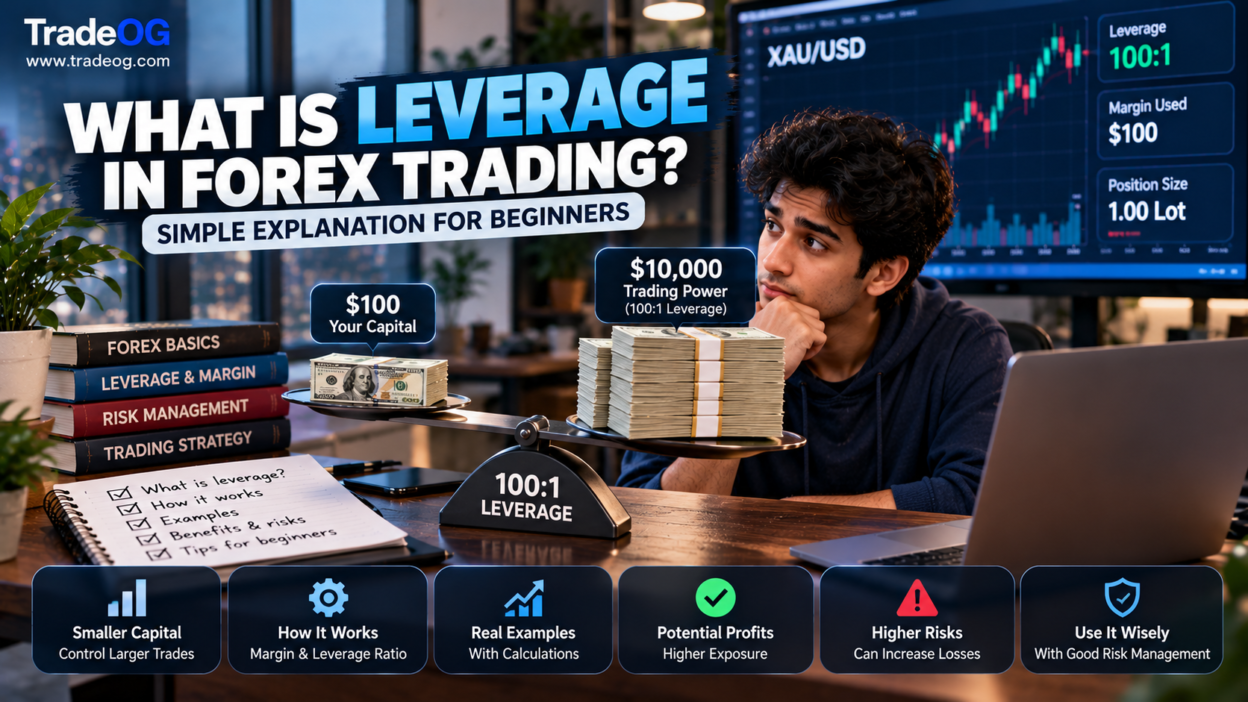
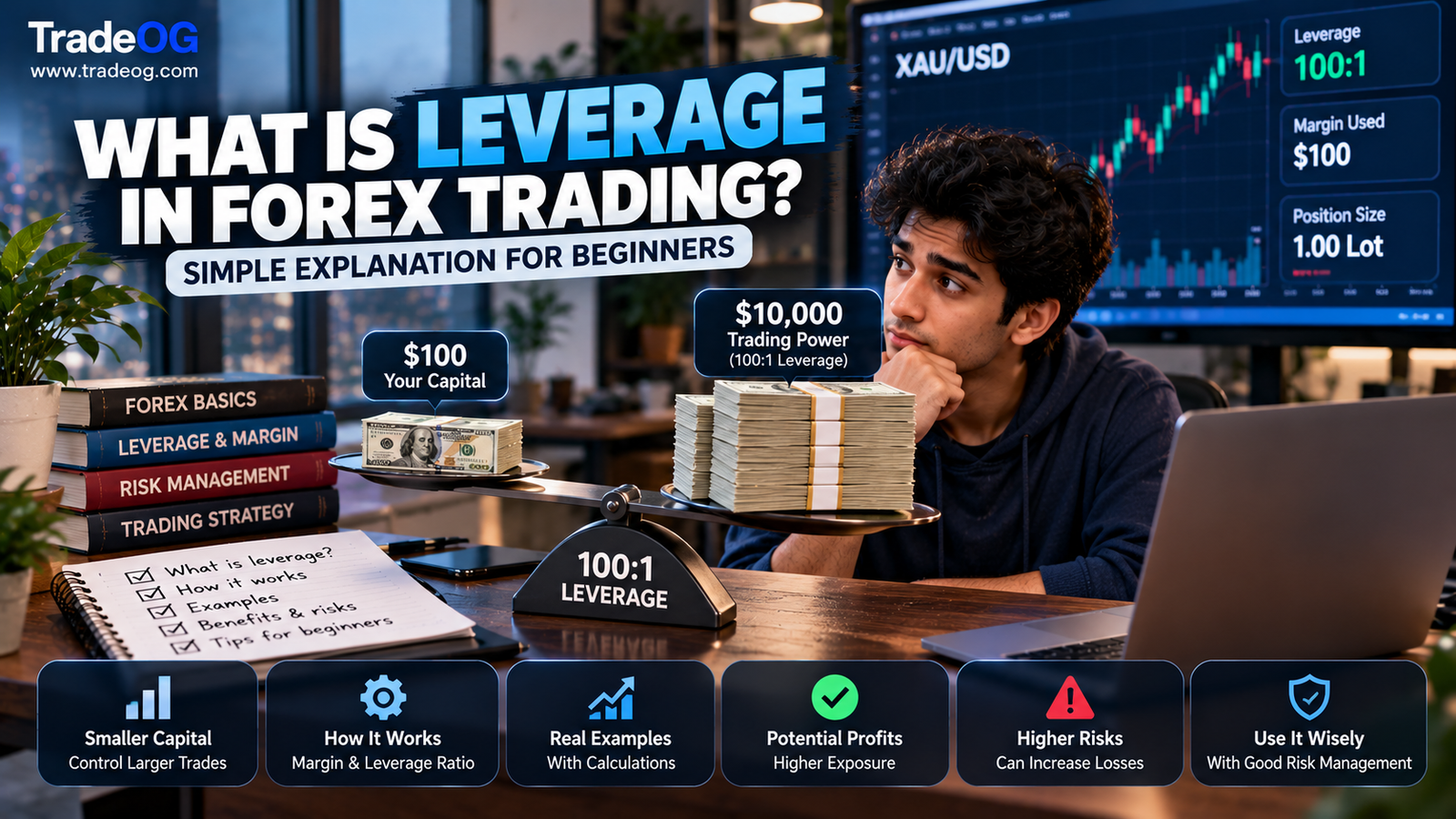
For example, with 1:100 leverage, a trader may be able to control a position with a notional value of $10,000 using approximately $100 of margin, subject to the product’s rules and margin requirements.
The important point is that the trader is exposed to the movement of the larger position. The $100 margin does not mean the market can only cause a $100 loss.
In simple terms:
Leverage increases buying power and market exposure, while also increasing the potential impact of price movements on your account.
What Does 1:100 Leverage Mean?
1:100 leverage means that, under a simplified margin relationship, $1 of margin can support approximately $100 of market exposure.
| Leverage | Example Capital | Approximate Exposure |
|---|---|---|
| 1:10 | $100 | $1,000 |
| 1:50 | $100 | $5,000 |
| 1:100 | $100 | $10,000 |
| 1:200 | $100 | $20,000 |
| 1:500 | $100 | $50,000 |
These are simplified illustrations, not promises of the exact exposure available on a particular platform. Actual margin can depend on the instrument, account type, position size, regulatory limits, broker rules and changing market conditions.
Leverage vs Margin: What Is the Difference?
Leverage and margin are closely connected, but they are not the same thing.
Leverage describes the relationship between your capital/margin and the market exposure you can control.
Margin is the amount of funds required to open and maintain a position under the trading product’s rules.
A simple way to remember it:
- Leverage = how much exposure your capital can control.
- Margin = funds required to support that position.
Margin should never be confused with your maximum possible loss.
Simple Example of Leverage
Imagine you have $100 in a trading account and a product provides 1:100 leverage.
A simplified calculation would be:
$100 × 100 = $10,000 of potential notional exposure.
Now imagine that the position gains 1%:
$10,000 × 1% = $100
A 1% move against the position would similarly represent approximately a $100 loss before costs.
This example shows both sides of leverage. It can make a relatively small price movement produce a large percentage change in the trader’s account.
Does Leverage Increase Profit?
Leverage does not magically improve a trading strategy.
It allows you to take a larger position relative to your cash. If the position is larger, the monetary effect of the same market movement is larger.
So leverage can increase potential profit because it can increase exposure. But it can also increase losses for exactly the same reason.
For example, if a trader uses twice the position exposure, a given percentage move will have roughly twice the monetary effect, all else being equal.
Does Leverage Increase Risk?
Leverage can increase risk because it makes larger positions possible with less upfront margin.
However, there is an important distinction:
High available leverage does not automatically mean high actual risk.
A disciplined trader may have access to 1:500 leverage but choose to use a very small position. Another trader may have only 1:30 leverage and still take excessive risk by using the largest position their account allows.
Therefore, position size and stop-loss risk matter more than the headline leverage number.
Leverage and Lot Size
Lot size tells you how large your trading position is. Leverage affects how much margin may be required to support that position.
For standard forex conventions:
- 1.00 lot commonly represents 100,000 units of the base currency.
- 0.10 lot commonly represents 10,000 units.
- 0.01 lot commonly represents 1,000 units.
The exact contract specification should always be checked with your broker or trading venue.
Do not think, “I have 1:500 leverage, so I should trade 1 lot.” The leverage ratio does not determine your correct lot size.
How Leverage Affects Margin
A simplified relationship is:
Required Margin ≈ Position Notional Value ÷ Leverage
For example, if a position has a notional value of $10,000:
- At 1:10 leverage, simplified margin = $1,000
- At 1:50 leverage, simplified margin = $200
- At 1:100 leverage, simplified margin = $100
The actual calculation can vary because brokers and exchanges can impose instrument-specific margin requirements, tiered leverage and other rules.
Why Margin Is Not Your Risk
Suppose you open a $10,000 position and the platform requires $100 of margin.
You might think:
“I am only using $100, so I can only lose $100.”
That is incorrect.
Your market exposure is $10,000. If the position moves against you, the loss is based on that exposure and the size of the price movement.
The stop loss, position size and contract value determine your planned trade risk—not simply the margin displayed by the platform.
What Is a 1:10 Leverage Account?
With 1:10 leverage, every $1 of margin can theoretically support about $10 of exposure under a simplified model.
This is relatively lower leverage than 1:100 or 1:500. Lower leverage can limit the maximum position size a trader can open, although it does not automatically make every trade safe.
What Is a 1:50 Leverage Account?
1:50 leverage means that $1 of margin can support approximately $50 of exposure under the simplified relationship.
For example, $200 of margin could support approximately $10,000 of notional exposure if the product uses exactly that leverage and no additional margin rules apply.
What Is 1:100 Leverage?
1:100 leverage means $1 of margin can support approximately $100 of exposure under the simplified model.
This can make a large position accessible with a smaller deposit, which is why inexperienced traders can be tempted to overtrade.
The correct response to higher leverage is not to use more of it. It is to maintain sensible position sizing.
What Is 1:500 Leverage?
1:500 leverage means the theoretical exposure-to-margin relationship is very large: $1 of margin can support approximately $500 of exposure under a simplified calculation.
That does not mean 1:500 leverage is appropriate for a beginner.
With very high leverage, a trader can open an oversized position with relatively little margin. A small adverse price movement can then consume a large percentage of account equity.
Leverage Example With a $100 Account
Suppose a $100 account has access to 1:100 leverage.
The simplified maximum notional exposure would be:
$100 × 100 = $10,000
But a sensible trader does not automatically use the entire $10,000 exposure.
If the trader instead opens a much smaller position and risks only $1 or $2 on the planned stop, the available leverage is simply a facility—not an instruction.
This is an important mindset shift:
Available leverage is not the same as recommended leverage usage.
Leverage Example With a $1,000 Account
With $1,000 and 1:100 leverage, the simplified theoretical exposure could be $100,000.
That number may sound attractive, but it should also show why leverage can be dangerous.
A trader who controls $100,000 of exposure with only $1,000 of capital is taking a position where relatively small market movements can create large account-level changes.
The trader does not need to use the full theoretical exposure.
Can You Lose More Than Your Margin?
Potential losses depend on the product, account terms, stop-out rules and applicable regulations.
A stop loss can help limit planned risk, but it is not guaranteed to execute at the exact requested price in all market conditions. Gaps, slippage and fast markets can produce a different execution price.
Some retail products may have negative balance protection or other loss protections, while others may have different rules. Never assume protection exists without checking the account terms.
What Is a Margin Call?
A margin call generally refers to a situation where the equity available in an account is no longer sufficient to support open positions under the provider’s margin requirements.
The provider may require additional funds or the trader may need to reduce exposure.
Modern platforms can also have automated stop-out systems that close positions when equity falls below specified thresholds.
The exact threshold and process vary by provider and jurisdiction.
What Is a Stop-Out?
A stop-out is an automatic position-closing process that can occur when account equity falls below the required margin level.
For example, if a trader uses too much leverage and the market moves sharply against the position, the broker or provider may start closing open trades to reduce exposure.
Never treat stop-out as a substitute for a stop loss. A stop-out can happen far beyond the risk level you intended for an individual trade.
Leverage and Stop Loss
A stop loss is an instruction intended to close a position when price reaches a specified level. It is one of the most useful tools for controlling planned trade risk.
But the stop should be selected from the trading setup first. You should not place a random stop simply because you want to use a particular lot size.
A better sequence is:
- Identify the trade setup.
- Determine where the setup becomes invalid.
- Place the logical stop-loss level.
- Calculate the distance to the stop.
- Calculate the position size that fits your risk limit.
Leverage and Risk Management
Good leverage management starts with position sizing.
Suppose you have a $500 account and decide, purely as an example, to risk 1% on one trade.
$500 × 1% = $5 maximum planned risk.
Your leverage could be 1:30, 1:100 or 1:500. The key question remains: what position size produces approximately $5 of planned loss at your stop?
This is much more useful than asking which leverage ratio is “best.”
Is Higher Leverage Better?
No.
Higher leverage gives you more potential exposure, but more potential exposure is not automatically better.
A beginner often thinks:
“1:500 is better than 1:30 because I can make more money.”
A better way to think is:
“Higher leverage gives me more flexibility, but I still need to control my actual position size.”
In fact, lower leverage can prevent a trader from opening some oversized positions, which can be useful for inexperienced traders.
Leverage vs Risk-Reward Ratio
Leverage does not change the price-based risk-reward ratio of a trade.
For example, if your stop is 20 pips away and your target is 40 pips away, the setup has a 1:2 price-based risk-reward relationship regardless of whether your account has 1:30 or 1:300 leverage.
Leverage changes the amount of exposure you can control. Lot size determines how much that price movement is worth in money.
Leverage in Gold Trading
Gold, commonly quoted as XAU/USD, is often offered with leverage on certain trading platforms. But gold is not a standard forex currency pair, and its contract specifications can be very different.
Do not assume that 0.01 lot of gold has the same monetary risk as 0.01 lot of EUR/USD.
Before trading XAU/USD, check:
- contract size;
- tick size and tick value;
- minimum volume;
- margin requirement;
- leverage limits;
- spread;
- commission;
- financing charges; and
- trading hours.
Gold can move rapidly during major US economic releases, so high leverage can be particularly dangerous when combined with a large position.
Leverage for Indian Forex Traders
Indian traders should not choose a leverage ratio based only on what an overseas platform advertises.
The legality and availability of a forex or leveraged product can depend on the exact instrument, intermediary, trading venue and applicable RBI, SEBI, FEMA and exchange rules.
Before funding an account, verify the intermediary and product through appropriate official sources. A platform offering 1:500 leverage to Indian customers does not, by itself, establish that the arrangement is permitted for an Indian resident.
Common Leverage Mistakes Beginners Make
- Using maximum leverage: Available leverage is not a recommended position size.
- Confusing margin with risk: The margin required to open a position is not necessarily the maximum loss.
- Opening the biggest position possible: More exposure means larger monetary changes.
- Moving the stop loss: Increasing the loss limit after entry can destroy the original risk plan.
- Ignoring volatility: Fast markets can create large adverse movements and slippage.
- Copying another trader’s leverage: Their account balance and risk plan may be completely different.
- Increasing size after a loss: This can turn a normal losing streak into severe account damage.
- Thinking high leverage creates a high win rate: Leverage does not improve your trading strategy.
- Ignoring product specifications: Forex, gold, indices and CFDs can have different margin and contract rules.
How Much Leverage Should a Beginner Use?
There is no universal leverage ratio that is correct for every beginner.
A better approach is to choose the position size based on your maximum acceptable loss and then use only the amount of leverage necessary to support that position.
If a broker offers more leverage than you need, you do not have to use the additional capacity.
For many beginners, the most important skill is learning to control actual exposure, not finding the highest leverage available.
Leverage Example: Good vs Bad Approach
| Approach | What the Trader Does | Risk |
|---|---|---|
| Disciplined | Calculates stop, risk and position size first | Controlled |
| Aggressive | Uses the maximum position allowed | Very high |
| Revenge trading | Increases leverage after a loss | Extremely high |
| Copy trading | Copies another trader’s lot size | Unknown |
Frequently Asked Questions
What is leverage in forex in simple words?
Leverage lets you control a larger market position with less upfront margin. It increases your exposure, which can increase both potential gains and potential losses.
What does 1:100 leverage mean?
Under a simplified model, 1:100 means $1 of margin can support about $100 of market exposure. Actual margin requirements depend on the product and provider.
Is 1:500 leverage safe?
High leverage is not automatically safe. It can make very large positions possible with little margin, which can make losses grow rapidly if position size is not controlled.
Can leverage make me lose money faster?
Yes. Leverage can allow larger exposure, so the same market movement can create a larger monetary gain or loss relative to your account.
Is leverage the same as margin?
No. Leverage describes the exposure-to-capital relationship, while margin is the amount required to support a position.
Does leverage affect lot size?
Leverage affects how much margin may be needed for a given position. It does not determine the correct lot size for your trading strategy.
Can I trade forex without leverage?
Some products and account structures allow trading with little or no leverage, while others are inherently margin-based. Check the exact product terms.
Does higher leverage increase my win rate?
No. Leverage does not improve your entry strategy, market analysis or win rate. It only changes how much exposure you can control.
Can I use high leverage with a $100 account?
A provider may offer high leverage to a small account depending on the jurisdiction and product, but using that capacity to open an oversized position can be extremely risky.
Final Thoughts
Leverage is a tool, not a trading strategy.
It can allow a trader to control a larger position with less margin, but that same larger exposure can magnify losses. The most important thing for a beginner is therefore not finding the highest leverage available.
Learn to calculate your position size, understand the value of each price movement, set a logical stop loss and decide your maximum risk before entering the trade.
Remember the simple relationship:
Leverage controls potential exposure. Lot size controls position size. Stop loss helps define planned risk. Margin supports the position.
Once you understand those four concepts, leverage becomes much easier to understand—and much harder to misuse.
Disclaimer: This article is for educational and informational purposes only and is not financial, investment, legal or tax advice. Forex and leveraged products involve substantial risk of loss. Leverage limits, margin requirements, contract specifications and regulatory rules vary by provider, instrument and jurisdiction. Verify current product terms before trading.