
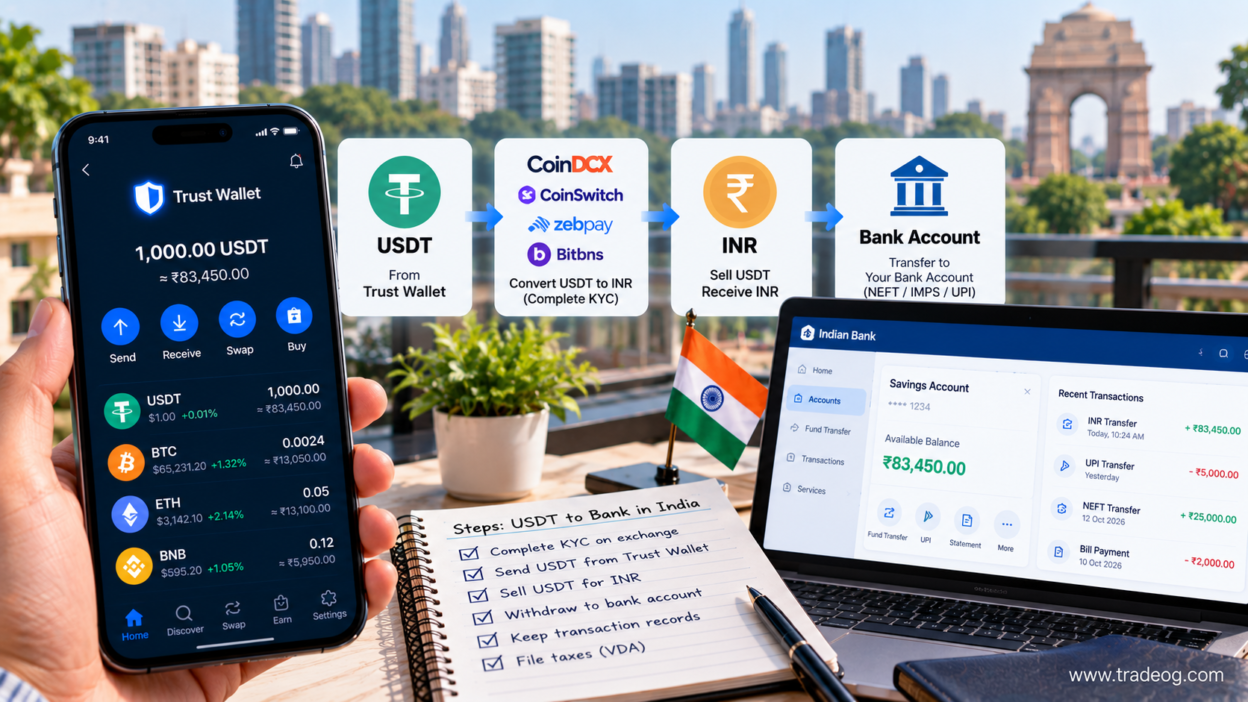
If you hold USDT in Trust Wallet and want the money to reach your Indian bank account, the process is not a direct “Trust Wallet → bank account” transfer. Trust Wallet is a self-custody crypto wallet, while your bank account receives Indian rupees through a banking or payment rail. In most cases, you need an intermediate crypto service or supported fiat off-ramp that can accept your USDT, convert it into INR, and then send the INR to your bank account.
This guide explains the complete process for Indian traders in 2026, including the wallet transfer, network selection, KYC, USDT-to-INR conversion, bank withdrawal, fees, tax records, common mistakes and what to do if the bank credit is delayed.
Can You Transfer USDT From Trust Wallet Directly to an Indian Bank Account?
Normally, no. USDT is a digital asset on a blockchain, while an Indian bank account holds fiat currency such as INR.
Trust Wallet describes itself as a self-custody wallet where users control their private keys. It supports sending, receiving, buying and selling crypto through integrated services, but the actual fiat conversion can involve third-party providers. Trust Wallet’s own documentation explains that selling crypto for fiat can be provided through integrated third-party services.
Therefore, if your objective is to receive INR in an Indian savings account, you need a route that supports both:
- receiving your specific USDT network from an external wallet; and
- selling or converting the USDT into INR and withdrawing the INR to your bank.
The exact availability of an INR off-ramp can change by provider, location, KYC status, asset and payment method. Always check the current options inside the relevant service before sending your USDT.
The Complete Trust Wallet USDT to Bank Process
The overall flow looks like this:
USDT in Trust Wallet → Check network → Choose supported INR platform → Complete KYC → Copy USDT deposit address → Send USDT → Wait for blockchain confirmation → Sell USDT for INR → Withdraw INR → Bank credit → Save records
Do not skip the network verification stage. It is one of the most common causes of failed or difficult-to-recover crypto deposits.
Step 1: Check How Your USDT Is Held in Trust Wallet
Open Trust Wallet and select your USDT holding.
Before doing anything else, identify the blockchain network. USDT can exist on multiple networks, including networks such as TRON, Ethereum, BNB Smart Chain and Polygon. The fact that the asset is called “USDT” does not mean every USDT deposit address is interchangeable.
For example, if your Trust Wallet contains USDT on TRON, you need a receiving platform that explicitly supports USDT deposits on the same compatible network.
Check:
- USDT balance;
- network name;
- available sending balance;
- required network fee;
- receiving platform’s supported deposit network.
For more detail, see TRC20 vs ERC20 USDT: Which Network Should Indian Traders Use?.
Step 2: Choose an INR-Supported Crypto Platform or Off-Ramp
You now need a service that can receive USDT from an external wallet and provide an INR withdrawal option.
Do not choose a platform solely because it appears in a search result or because another trader recommends it. Check its current:
- India availability;
- KYC requirements;
- USDT deposit support;
- supported blockchain networks;
- INR trading or conversion options;
- bank withdrawal options;
- deposit and withdrawal limits;
- fees and spreads;
- compliance and terms.
The availability of specific providers and payment routes can change. Treat the platform’s current deposit and withdrawal screen as the source of truth.
Step 3: Complete KYC Before Sending a Large Amount
Most services that convert crypto into INR will have identity and compliance requirements.
You may be asked for:
- PAN;
- mobile number and email;
- identity documents;
- address information;
- bank account details;
- additional source-of-funds information for certain transactions.
Complete KYC first rather than sending USDT and discovering afterward that the account cannot withdraw INR.
This is particularly important for trading or prop-firm payouts, where the platform may ask you to explain the source of the crypto.
Step 4: Open the USDT Deposit Screen
Inside your selected platform, look for something similar to:
Deposit → Crypto → USDT
You may then be asked to select a network.
This is where you must stop and compare the network shown by the platform with the network used by your Trust Wallet USDT.
For example:
| Trust Wallet USDT | Receiving platform | Action |
|---|---|---|
| TRON / TRC20 | USDT-TRC20 supported | Potentially compatible |
| Ethereum / ERC20 | USDT-ERC20 supported | Potentially compatible |
| BNB Smart Chain | USDT-BEP20 supported | Potentially compatible |
| One network | Different network only | Do not send |
Never assume that two platforms support the same network merely because both display “USDT”.
Step 5: Copy the Deposit Address
Once you select the correct USDT network, the platform will display a deposit address. Some networks can also require a memo, tag or additional identifier.
Copy the address using the platform’s copy button. Avoid manually typing a long blockchain address.
Before sending, compare:
- asset: USDT;
- network: exact match;
- deposit address;
- memo/tag, if applicable;
- minimum deposit amount;
- estimated network fee.
Step 6: Send a Small Test Amount First
If you are sending a significant amount for the first time, a small test transfer can reduce the risk of a large mistake.
For example, if you need to transfer 1,000 USDT, you could first send a small amount that is sufficient for the platform’s minimum deposit and economically reasonable for your situation.
Wait for the test transaction to appear and confirm that:
- the correct amount arrived;
- the correct network was used;
- the platform credited the deposit;
- there was no unexpected memo/tag requirement.
Only then consider transferring the remaining amount.
Step 7: Send USDT From Trust Wallet
In Trust Wallet:
- Open USDT.
- Select Send.
- Paste the receiving platform’s deposit address.
- Select the exact network supported by the deposit.
- Enter the amount.
- Review the network fee.
- Check the first and last characters of the address again.
- Confirm the transaction.
Trust Wallet’s terms make clear that blockchain transactions cannot simply be cancelled or modified by Trust Wallet after submission. The transaction is processed by the applicable blockchain network.
That is why the address and network must be checked before you confirm.
For more on transaction fees, read What Network Fee Is Required to Send USDT From Trust Wallet?.
Step 8: Wait for Blockchain Confirmation
After you send USDT, Trust Wallet will show the transaction status and usually provide a transaction hash.
Keep the transaction hash. It is one of the most useful records if the receiving platform has not credited your deposit.
At this stage, there are three different statuses you should distinguish:
- Pending: the blockchain transaction is still being processed or waiting for confirmation.
- Confirmed: the blockchain has confirmed the transaction, but the receiving platform may still be processing its internal credit.
- Failed: the transaction did not complete successfully.
A confirmed blockchain transaction does not always mean the INR withdrawal can happen immediately. The receiving platform has its own deposit-credit and compliance process.
Step 9: Sell USDT for INR
Once your USDT is credited, the next step is usually to sell or convert it into INR.
The platform may provide a market order, limit order or simple convert function.
Suppose you have:
1,000 USDT
Assume the quoted effective rate is ₹83.45 per USDT before applicable costs. The gross INR value would be approximately:
1,000 × ₹83.45 = ₹83,450
Your actual amount can be lower because of:
- trading fees;
- conversion fees;
- spread;
- network charges;
- withdrawal charges;
- other provider-specific costs.
Do not calculate your expected bank credit using only the displayed USDT/INR rate. Calculate the effective INR received after all applicable costs.
Step 10: Withdraw INR to Your Indian Bank Account
After selling the USDT, your platform should show an INR balance if it supports INR settlement.
You may then select an option such as:
Withdraw → INR → Bank Account
Depending on the provider, the transfer may use an available Indian payment or banking rail. The exact method, processing time and limits vary by provider.
Check the following before confirming:
- bank account holder name;
- account number;
- IFSC;
- withdrawal amount;
- withdrawal fee;
- processing time;
- any daily or monthly limit.
Ideally, the name on your bank account should match the verified account information required by the platform. Do not use someone else’s bank account simply to make a withdrawal easier.
How Long Does Trust Wallet USDT Take to Reach an Indian Bank?
There is no single guaranteed time.
The process contains several independent stages:
| Stage | What Can Cause Delay? |
|---|---|
| Trust Wallet → blockchain | Network congestion, gas/resources, transaction processing |
| Blockchain → platform | Required confirmations and internal crediting |
| USDT → INR | Market execution, provider checks, liquidity |
| INR → bank | Banking rail, provider processing, compliance review |
If the USDT is visible in Trust Wallet but the bank has not received INR, the issue is no longer necessarily a blockchain problem. You should identify which stage is actually pending.
See also Why a USDT Trading Payout Can Arrive in Trust Wallet but Not Reach Your Bank.
What If the USDT Deposit Does Not Appear?
Do not immediately send the same amount again.
First check:
- Was the transaction confirmed on the blockchain?
- Does the transaction hash show the correct receiving address?
- Was the correct network used?
- Did you send an asset the platform supports?
- Was a memo or tag required?
- Was the amount above the platform’s minimum deposit?
- Is the platform experiencing a deposit delay?
If the blockchain shows a confirmed transaction to the correct address and network, contact the receiving platform with the transaction hash and relevant deposit details.
If you used the wrong network, recovery may be more complicated. Read What Happens If You Send USDT to the Wrong Network From Trust Wallet?.
What If the Bank Withdrawal Is Pending?
Once USDT has already been sold for INR, the blockchain is no longer the main part of the process.
Check:
- whether the INR balance was actually debited;
- withdrawal status;
- bank account details;
- provider maintenance notices;
- transaction reference number;
- any compliance or source-of-funds request.
Do not create a second withdrawal merely because the first one has not arrived yet. First confirm whether the original withdrawal is pending, failed, reversed or completed.
What Taxes Apply When You Convert USDT to INR?
This is one of the most important parts of the process for Indian traders.
The Income Tax Department’s current Schedule VDA guidance states that income arising from transfer of VDAs is subject to the Section 115BBH regime: the income is taxed at a flat 30% plus applicable surcharge and cess, with the statutory computation rules applying. The guidance also requires transaction-wise reporting in Schedule VDA for relevant transfers.
Section 194S provides a 1% TDS framework for consideration relating to the transfer of a VDA, subject to the applicable conditions and thresholds.
However, do not assume that simply receiving USDT into Trust Wallet means that 30% tax or 1% TDS automatically applies to the entire amount at the moment of receipt. The tax treatment depends on the underlying transaction and whether there has been a transfer of a VDA for consideration.
This distinction matters for prop-firm payouts and trading-related receipts. A USDT payout can involve an underlying income event and then a later VDA transfer or sale. Those events should not automatically be treated as identical for tax purposes.
For a detailed discussion of the Indian compliance side, see Is Trust Wallet Legal in India? What Traders Should Know in 2026.
Keep These Records for Every USDT-to-Bank Transfer
If you regularly move trading-related USDT into INR, create a simple transaction folder.
- Trust Wallet transaction screenshot or export;
- blockchain transaction hash;
- USDT amount received;
- network used;
- source of the USDT;
- prop-firm payout statement, where applicable;
- exchange deposit record;
- USDT-to-INR conversion record;
- fee and spread information;
- INR withdrawal confirmation;
- bank statement showing the credit;
- tax working papers and ITR records.
A bank statement showing ₹83,000 or ₹2,00,000 does not by itself explain the complete source of the money. Your blockchain and platform records provide the missing transaction trail.
How to Reduce USDT-to-INR Conversion Costs
The cheapest-looking exchange rate is not always the cheapest route.
Compare the complete cost:
USDT value → spread → trading/conversion fee → network fee → withdrawal fee → final INR credited
For example, Platform A may display ₹83.50 per USDT but charge a higher conversion fee, while Platform B may display ₹83.20 but have lower total costs. The correct comparison is the final INR received after all applicable charges.
For larger amounts, also consider the platform’s withdrawal limits and whether an unusually large transaction may trigger additional verification.
Common Mistakes to Avoid
1. Sending USDT Before Checking the Network
Never send first and verify later. Network compatibility must be confirmed before the transaction.
2. Assuming Every USDT Address Is the Same
USDT exists across multiple blockchains. The asset name alone is not enough.
3. Using a Random INR Conversion Website
Do not connect your wallet or send funds to an unknown platform because it promises a better rate.
4. Ignoring Minimum Deposits
A platform may have a minimum deposit requirement. Sending less than the required amount can create unnecessary complications.
5. Forgetting Network Fees
You may have 1,000 USDT displayed in Trust Wallet but still need the relevant network fee asset or supported fee mechanism to send it.
6. Using Someone Else’s Bank Account
Name mismatches can create compliance and withdrawal problems. Use a bank account that satisfies the platform’s current withdrawal requirements.
7. Treating a Bank Credit as the End of the Tax Trail
Keep the blockchain, platform and bank records together. The final INR credit is only the last step in the transaction chain.
Trust Wallet USDT to Bank Account Example
Consider an Indian trader who receives a 1,000 USDT payout into Trust Wallet.
| Stage | Illustrative Amount |
|---|---|
| USDT received | 1,000 USDT |
| Illustrative rate | ₹83.45 per USDT |
| Gross INR value | ₹83,450 |
| Less conversion/trading costs | Depends on provider |
| Less withdrawal costs | Depends on provider |
| Final bank credit | Depends on actual execution |
The example is deliberately illustrative. USDT/INR prices, fees and bank settlement amounts change over time, so traders should use the actual rate and charges displayed at the time of conversion.
Is Trust Wallet Safe for Sending USDT to a Bank?
Trust Wallet itself does not send INR to your bank as a normal banking transaction. Its role is the self-custody wallet stage.
The security risk is therefore spread across the complete chain:
Wallet security + blockchain address + network selection + receiving platform + KYC account + INR withdrawal + bank account
Never share your recovery phrase. Trust Wallet’s own documentation emphasizes that users control their private keys and secret phrase. If someone claims they need your recovery phrase to “release” a bank withdrawal, treat it as a scam.
Final Checklist: Trust Wallet USDT to Indian Bank Account
- Confirm your USDT network in Trust Wallet.
- Select a currently supported INR conversion route.
- Complete KYC before sending a large amount.
- Confirm USDT and exact network on the deposit page.
- Check minimum deposit and withdrawal limits.
- Copy the correct deposit address.
- Use a small test transfer when practical.
- Keep the transaction hash.
- Wait for the deposit to be credited.
- Sell USDT for INR using the actual quoted rate.
- Calculate the final INR amount after fees and spread.
- Withdraw INR only to an eligible bank account.
- Save the conversion and bank withdrawal records.
- Maintain the source-of-funds documentation.
- Review VDA tax and TDS rules for the actual transaction.
Final Answer
The practical Trust Wallet USDT-to-bank process in India is not a direct wallet-to-bank transfer. You normally move the USDT from your self-custody wallet to a supported crypto platform or fiat off-ramp, sell the USDT for INR, and then withdraw the INR to your Indian bank account.
The most important step is not the final bank withdrawal. It is making sure the asset, network, deposit address and receiving platform all match before you send the USDT.
For traders receiving USDT from a prop firm or another trading-related source, maintain a complete audit trail from the original payout through Trust Wallet, the INR conversion and the final bank credit. This makes it much easier to explain the source and nature of the funds if a compliance or tax question arises.
Frequently Asked Questions
Can I send USDT directly from Trust Wallet to my Indian bank?
Not as a normal bank transfer. USDT is a blockchain asset. You generally need a supported crypto-to-INR service or off-ramp between Trust Wallet and the bank account.
Do I need KYC to convert Trust Wallet USDT to INR?
The relevant INR conversion provider will generally have its own KYC and compliance requirements. Complete them before making a large transfer.
Can I convert USDT to INR directly inside Trust Wallet?
Trust Wallet offers buy and sell functionality through integrated third-party providers, but availability varies by asset, region and provider. For an Indian bank withdrawal, check the exact fiat and bank-support options shown in the current app.
Which USDT network should I use?
Use only a network that is explicitly supported by both Trust Wallet and the receiving platform for that specific USDT deposit. Never choose a network solely because its fee appears cheaper.
How long does it take for USDT to reach an Indian bank account?
There is no universal time. Blockchain confirmation, platform crediting, USDT-to-INR conversion and bank settlement are separate stages and each can introduce delays.
Is USDT-to-INR conversion taxable in India?
VDA tax rules can apply to transfers of VDAs, and Section 194S provides a 1% TDS framework for consideration relating to a VDA transfer, subject to the applicable conditions. The exact treatment depends on the transaction structure and should not be reduced to “every USDT receipt is taxed at 30%.”
Can a bank ask for proof of a USDT payment?
Yes. A bank or financial service provider can have source-of-funds and compliance procedures. Keep your payout statement, transaction hash, exchange records and bank statement.
What should I do if I sent USDT to the wrong network?
Do not send another transaction immediately. Save the transaction hash, identify the network and receiving address, and contact the receiving platform if the transaction was confirmed. Recovery depends on the exact network, address ownership and platform support.
Disclaimer: TradeOG provides educational and informational content only. Nothing in this article should be treated as financial, investment, legal, tax, banking, regulatory or professional advice. Indian forex rules, crypto/VDA taxation, exchange availability, payment-provider policies and blockchain support can change. Receiving USDT does not by itself establish that an underlying forex or prop-firm activity is authorised in India. Always verify the applicable RBI/FEMA rules, tax treatment, provider terms and network details, and consult a qualified professional for your specific circumstances.
[…] Trust Wallet USDT to Bank Account in India: Complete Process […]