

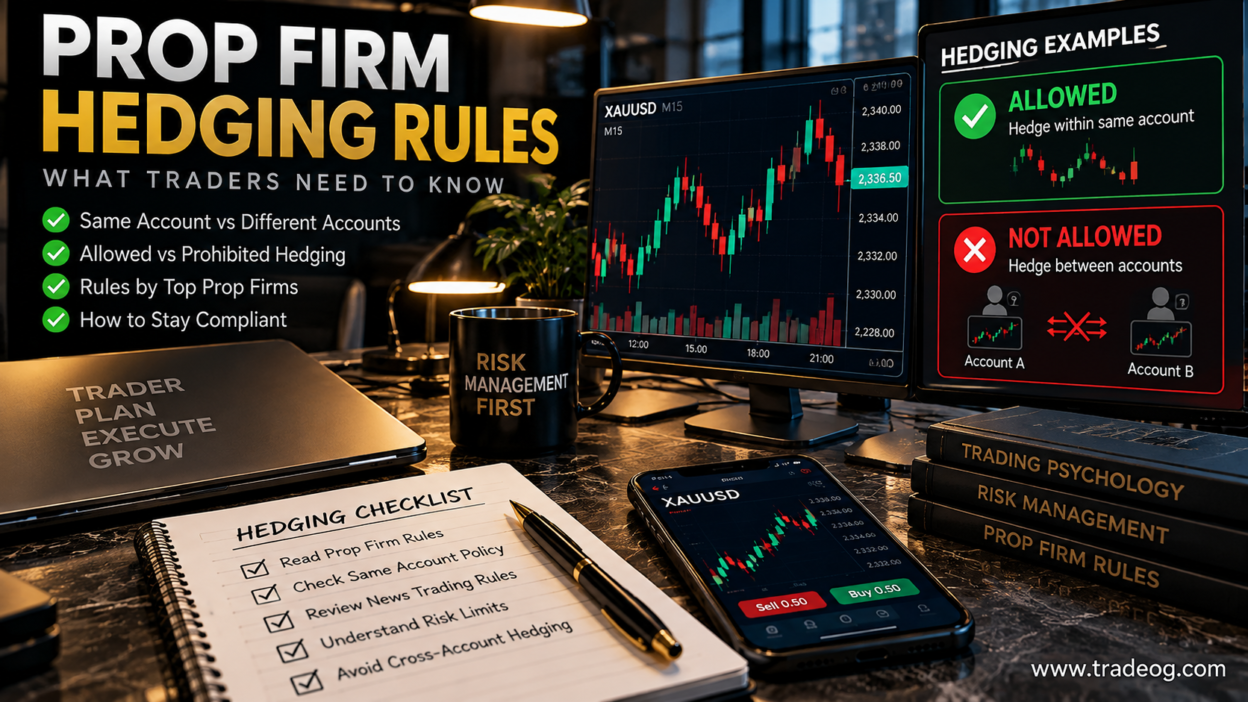
Direct Answer: Are You Allowed to Hedge at Prop Firms?
No universal rule governs hedging across all proprietary trading desks. Opening opposite long and short positions within a single trading account is frequently permitted (subject to platform settings). However, opening opposite positions across multiple accounts—whether owned by the same trader, held across different prop firms, or shared among group members—is widely prohibited as a risk-elimination or rule-manipulation practice. Firm policies focus on the purpose, structure, and account relationship of your trades rather than the simple mechanics of hedging.

The Reality of Prop Firm Hedging Rules
Imagine a trader managing two separate $100,000 funded accounts with a proprietary trading desk. Ahead of a high-volatility announcement, they decide to buy spot gold (XAUUSD) on Account A while placing an equal short position on Account B. The trader reasons logically: “I am eliminating directional market risk. No matter which way gold moves, one account profits while the other suffers an offsetting loss. Why would any firm object to risk reduction?”
When asking can you hedge with a prop firm, traders often assume that because hedging reduces net directional exposure, it is inherently safe. In practice, understanding prop firm hedging rules requires recognizing that risk desks evaluate trades based on legal compliance, account ownership, and evaluation integrity. When examining hedging in prop firms, executing opposite trades prop firm setups across accounts is frequently classified as a severe violation.
Whether you are considering a single-account prop firm hedging strategy, multi-account prop firm hedge trading, or wonder if prop firm hedging allowed guidelines apply to your account, you must examine your desk’s specific terms. Before placing offsetting orders, review the overarching XAUUSD prop-firm rules and risk controls governing your platform, especially under updated prop firm hedge rules 2026 standards.
What Is Hedging in Trading?
At its fundamental level, hedging involves taking an offsetting position in a financial instrument to reduce or eliminate adverse price movements in an existing holding. For example:
- Long XAUUSD: You profit when gold prices rise and suffer a loss when gold prices fall.
- Short XAUUSD: You profit when gold prices fall and suffer a loss when gold prices rise.
- Hedged Position: Holding equal long and short positions simultaneously neutralizes price exposure, locking in current unrealized P&L (minus spread, commission, and swap costs).
While the economic concept of hedging remains constant, its contractual legality changes dramatically depending on where positions are executed. A strategy that is acceptable on one account can result in a permanent prop firm hedging ban when split across multiple accounts.
Is Hedging Allowed at Prop Firms?
Proprietary trading desks evaluate hedging across eight distinct operational scenarios. The table below details why each scenario requires careful verification against your specific funded account hedging rules.
| Hedging Category | Operational Structure | Why You Must Check Rules |
|---|---|---|
| Single-Account Hedging | Long & short on one account | Generally allowed on hedging-enabled platforms; check netting account restrictions. |
| Cross-Account (Own Accounts) | Opposite trades across your accounts | Widely prohibited; treated as risk-elimination or evaluation rule manipulation. |
| Cross-Firm Hedging | Prop Firm A vs Prop Firm B | Strictly banned by major desks under rules extending to third-party providers. |
| Prop vs Personal Broker | Prop account vs personal account | Varies by desk; violates terms if aimed at risk manipulation. |
| Group / Coordinated Hedging | Hedging between different traders | Banned under coordinated trading and group pass prohibitions. |
| Correlated Instrument Hedging | Offsetting risk using related assets | Prohibitions cover highly correlated assets (e.g. XAUUSD vs Gold Futures). |
| News-Event Hedging | Hedging immediately before NFP/CPI | Subject to news trading windows and straddling/bracketing bans. |
| Drawdown Protection Hedging | Hedging to lock floating loss near limit | Relying on platform limits as sole exit mechanism is banned on strict desks. |
The Core Distinction: Single-Account vs. Cross-Account Hedging
To avoid compliance failures, traders must understand the fundamental divide between single-account order management and multi-account risk offsetting.
1. Single-Account Hedging (Internal Hedging)
Single-account hedging occurs when a trader holds both a long and short position on the same instrument within one account. For instance, opening 1.0 lot Buy EURUSD and later 1.0 lot Sell EURUSD on the same account without closing the initial order.
Most prop firms operating on MT4/MT5 hedging accounts permit internal single-account hedging. However, you must verify:
- Platform Execution Mode: Netting accounts automatically collapse opposing positions rather than holding a hedged lock.
- Cost Accumulation: Holding opposing positions incurs double spreads, double commissions, and negative swaps on both sides, eroding your prop firm equity vs. balance cushion.
- Prohibited Behaviors: Placing opposing buy and sell stop orders seconds before news is banned as news straddling.
2. Cross-Account Hedging (External / Multi-Account Hedging)
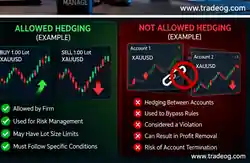
Cross-account hedging involves opening long positions on Account A while opening short positions on Account B. This execution is where the majority of prop firm hedging violation flags occur.
Executing a cross account hedging prop firm or prop firm account hedging strategy across multiple accounts neutralizes market risk while exploiting evaluation rules. When a trader opens 5.0 lots Long XAUUSD on Account A and 5.0 lots Short XAUUSD on Account B, one account passes the challenge target while the other fails. The trader discards the failed account and requests a payout on the passed account. Because this manipulates evaluation integrity, desks enforce strict bans on hedging between prop firm accounts and prop firm cross account hedging setups.
Why Prop Firms Restrict Cross-Account Hedging
Proprietary trading desks fund traders to identify genuine market talent capable of managing risk in live liquidity. Cross-account hedging undermines this model in several key ways:
- Artificial Elimination of Market Risk: Combining prop firm opposite positions across accounts creates a net-zero exposure portfolio. The trader is no longer forecasting market direction; they are simply redistributing simulated funds.
- Asymmetric Risk Exploitation: In challenges, max loss is capped (e.g. 5% daily / 10% total), while profit targets are required. By hedging across accounts, a trader guarantees that one account captures explosive upside while capping the loss on the other at the drawdown limit.
- Toxic Flow for Risk Desks: When prop firms hedge profitable traders in live A-Book broker feeds, receiving simultaneous long and short orders from the same trader creates un-hedgeable order flow, generating severe slippage costs for the firm’s liquidity bridge.
- Coordinated Group Abuse: Group pass schemes involve multiple individuals coordinating opposite trades across separate accounts to pass challenges artificially.
Can You Hedge Between Two Different Prop Firms?
A common question is whether a trader can buy gold on FTMO and sell gold on The5ers to hedge exposure. Traders assume separate corporate entities cannot monitor cross-firm activity. This is a dangerous misconception.
Major prop firm contracts explicitly include prohibitions against prop firm risk hedging across external providers under their prop firm forbidden trading practices. Official compliance guidelines explicitly bar risk-offsetting strategies involving:
- Accounts provided by the primary prop firm.
- Accounts held with other prop trading operators or external brokers.
- Accounts belonging to other members or third parties.
Prop desks utilize shared liquidity bridges, common broker feeds, and institutional compliance databases (such as RiskWard and trade-matching engines). When identical lot sizes hit the market at the exact same millisecond on opposing sides across different prop accounts, automated algorithms flag the correlation instantly.
Hedging a Prop Account Against Your Personal Broker
Another common inquiry is: “Can I hedge a prop account against my personal retail broker account?” (e.g., Long 2 lots XAUUSD on a funded prop account and Short 2 lots XAUUSD on a personal Interactive Brokers or IC Markets account).
While your personal brokerage account is private, prop firm agreements state that if a desk discovers a trader is systematically offsetting prop account risk against a personal account to guarantee risk-free payouts, the firm reserves the right to terminate the contract and forfeit rewards. Rather than seeking workarounds, professional traders focus on proper position sizing and strict stop-loss discipline.
Cross-Account Hedging vs. Copy Trading: Key Differences
Traders frequently confuse cross-account hedging with trade copying. While both involve managing multiple accounts, their operational mechanics and compliance rules are distinct:
| Feature | Copy Trading (Trade Replication) | Cross-Account Hedging (Risk Offsetting) |
|---|---|---|
| Trade Direction | Identical direction (Buy A → Buy B) | Opposite direction (Buy A → Sell B) |
| Net Risk Exposure | Multiplied directional market risk | Neutralized / eliminated directional risk |
| Own-Account Rule | Widely permitted across your own accounts | Widely banned across multiple accounts |
| Primary Purpose | Scaling capital execution across accounts | Eliminating risk or manipulating challenge rules |
Most leading prop firms allow you to copy trades between your own accounts using trade copiers, provided all accounts belong to you. However, configuring a copier to invert trades (copying a Buy on Account A as a Sell on Account B) converts copy trading into illegal cross-account hedging. For full details on trade replication rules, read our dedicated guide on copy trading rules at prop firms explained.
Hedging vs. Correlated Positions
A major trap for prop traders is assuming hedging restrictions only apply to identical asset symbols (e.g., Buy XAUUSD vs. Sell XAUUSD). In practice, risk engines monitor prop firm correlated positions across related financial instruments.
Opening opposing positions on highly correlated assets can trigger automated hedging flags. Examples include:
- Gold Derivatives: Buying spot gold (XAUUSD) on Account A while selling CME Gold Futures (GC) or Micro Gold Futures (MGC) on Account B.
- Forex Pairs: Buying EURUSD on Account A while buying USDCHF on Account B under prop firm forex hedging setups (since EURUSD and USDCHF maintain a strong negative correlation).
- Equity Indices: Buying US30 on Account A while shorting NAS100 on Account B during news releases.
If two positions functionally cancel out net market exposure across accounts, compliance engines classify the structure as a prohibited hedge.
Can Hedging Cause a Prop Firm Drawdown Breach?
Many traders believe that locking a position in a 1-to-1 hedge makes their account immune to drawdown breaches under prop firm drawdown hedging assumptions. This is false. Hedging an open position does not freeze your drawdown margin.
1. Spread Expansion and Rollover Blowouts
When holding long and short positions simultaneously, both trades remain exposed to bid/ask spread fluctuations. During daily rollover (5:00 PM EST) or news events, spreads on gold can expand from $0.20 to $3.00+. As explained in our guide on whether an open trade can breach your prop firm account, spread blowout inflates floating losses on both sides, potentially triggering an automatic equity drawdown breach.
2. Negative Swaps and Financing Costs
Holding hedged positions overnight incurs financing fees. Because brokers charge negative swap rates on both long and short legs for most instruments, your equity steadily bleeds over time. Learn more in our report on prop firm overnight trading rules.
3. Execution Slippage
Closing both sides of a hedge during fast market conditions exposes you to latency and negative slippage. Review our analysis of whether stop loss slippage causes prop firm violations.
Why Hedging Does Not Protect Individual Accounts
A critical practical lesson for funded traders is that portfolio-level risk reduction does not protect individual accounts from independent risk limits.
Hypothetical Scenario: The Two-Account Trap
- Account A ($100k): Long 5.0 Lots XAUUSD at $2,350.00 | Daily Loss Limit: $5,000
- Account B ($100k): Short 5.0 Lots XAUUSD at $2,350.00 | Daily Loss Limit: $5,000
Gold surges $15.00 rapidly. Account A gains +$7,500. Account B loses -$7,500. On a combined portfolio level, your net P&L is -$400 (after commissions and spreads). However, on an individual account level, Account B has crossed its $5,000 daily loss limit and is immediately liquidated by the risk server. Meanwhile, Account A may be flagged for cross-account hedging and stripped of its $7,500 profit. The trader ends up losing both accounts!
XAUUSD Hedging at Prop Firms: Dedicated Risk Analysis
If you ask can I hedge XAUUSD with a prop firm, the answer requires separate evaluations for single-account and cross-account execution under XAUUSD hedging prop firm and gold hedging prop firm guidelines.
Key gold hedging considerations include:
- Intraday Volatility: Gold frequently moves $20 to $40 during U.S. trading sessions. Managing unhedged legs during rapid market turns often leads to severe execution slippage.
- Spread Widening: Gold spreads expand significantly during rollover. Review our guide on prop firm spread rules for gold traders before holding hedged gold positions across session closes.
- Low Liquidity Conditions: Hedging gold during thin market hours increases the risk of partial fills. Read our breakdown on low-liquidity trading with prop firms for safe execution practices.
Hedging During NFP, CPI, FOMC, and Major Economic News
Holding a hedged trade through Tier-1 macroeconomic events does not circumvent news trading restrictions. News rules override general hedging permissions under broader prop firm trading restrictions.
Prop firm news policies enforce specific constraints during high-impact releases:
- Blackout Windows: Desks like FTMO Standard enforce a strict blackout window (±2 minutes) around Tier-1 USD news, prohibiting market orders and automated SL/TP executions on XAUUSD. For complete details, see our guide on can you trade gold during NFP with a prop firm.
- CPI Volatility Rules: Inflation data prints present severe spread blowout risks. Review our study on can you trade gold during CPI with a prop firm.
- Straddling Bans: Placing opposing Buy Stop and Sell Stop orders right before 8:30 AM EST is classified as prohibited news straddling across major prop desks.
Hedging and Prop Firm Drawdown Rules
Prop firm risk engines calculate maximum loss using specific drawdown models that directly impact hedged positions:
- Daily Drawdown: Calculated from the daily reset timestamp (typically midnight server time). For details on clock synchronization, read our guide on prop firm server time and daily drawdown.
- Trailing Equity Drawdown: Tracks real-time peak floating equity. If a hedged position experiences an instantaneous spread expansion that causes floating equity to touch the trailing threshold, the account breaches instantly.
Is Hedging the Same as a Stop Loss?
No. A Stop Loss is an automated exit order that closes a losing position to cap downside risk. A hedge creates an opposing position, keeping both orders open simultaneously.
Relying on a hedge instead of a Stop Loss introduces significant operational risks:
- Margin Consumption: Open hedged orders consume margin (or platform buffer allocation).
- Exit Complexity: Closing a hedged trade requires two execution events, doubling your exposure to market slippage.
- Contractual Restrictions: Official terms explicitly forbid structuring positions so that an account relies on platform drawdown limits as its sole exit mechanism.
Hedging vs. Diversification
It is vital to distinguish between hedging and portfolio diversification:
- Diversification: Allocating capital across uncorrelated assets (e.g., holding EURUSD long, US30 short, and Crude Oil long) to distribute market exposure. Diversification is encouraged by prop firms.
- Hedging: Taking opposing positions on the same or negatively correlated assets to neutralize directional market exposure. Cross-account hedging is restricted or banned.
14 Common Prop Firm Hedging Mistakes
Empirical compliance audits reveal fourteen recurring hedging errors that lead to account liquidations and payout forfeitures:
- Assuming Hedging Is Universally Allowed: Assuming all firms permit hedging without checking specific account terms.
- Confusing Single-Account and Cross-Account Rules: Believing single-account permission allows cross-account opposite trading.
- Assuming Different Firms Prevent Detection: Believing prop firms cannot cross-reference trades across separate providers.
- Ignoring Correlated Asset Restrictions: Hedging XAUUSD against Gold Futures or negatively correlated forex pairs.
- Hedging Major News Without Checking News Rules: Attempting to hedge into NFP or CPI prints on restricted accounts.
- Overlooking Spread Expansion Costs: Failing to factor in $3.00+ gold spread blowouts during rollover.
- Ignoring Overnight Negative Swaps: Bleeding account equity from negative financing fees on both legs.
- Assuming One Account Offsets Another’s Breach: Expecting a profitable account to save a liquidated account.
- Using Opposite Trades to Manipulate Challenges: Attempting group pass schemes to guarantee evaluation passes.
- Inverting Trade Copier Settings: Reversing copied signals between accounts, turning copy trading into illegal hedging.
- Allowing Third Parties to Manage Accounts: Engaging account management services that use cross-account hedging algorithms.
- Relying on Outdated Rule Screenshots: Trusting old forum posts instead of current official rulebooks.
- Confusing Platform Support with Firm Rules: Assuming MT5 hedging mode permission equals prop firm contractual permission.
- Failing to Get Rules in Writing: Executing complex hedge strategies without explicit confirmation from support.

10-Step Checklist to Verify Prop Firm Hedging Rules
Before executing any hedging strategy, follow this systematic ten-step verification protocol:
- Step 1: Identify Your Exact Firm: Locate official terms of service for your specific proprietary trading company.
- Step 2: Verify Your Program Tier: Confirm whether your account is Evaluation (Phase 1/2), Express, Funded, or Master.
- Step 3: Search Official Terms for “Hedging”: Locate specific clauses covering hedging, opposite positions, and risk offsetting.
- Step 4: Check Cross-Account Clauses: Confirm whether prohibitions cover multiple accounts owned by the same trader.
- Step 5: Check Cross-Provider Language: Verify if rules extend to accounts held with external brokers or other prop firms.
- Step 6: Review Correlated Asset Policies: Inspect rules regarding synthetic correlation and related contract hedging.
- Step 7: Check News Blackout Policies: Confirm whether news trading windows restrict order modifications or SL/TP fills.
- Step 8: Review Drawdown Mechanics: Verify whether daily drawdown is calculated on closed balance or real-time equity.
- Step 9: Contact Official Support: Send a written inquiry to official support detailing your exact proposed execution.
- Step 10: Archive Written Confirmation: Save screenshot proof of support responses and current rulebook pages.
13 Questions to Ask Your Prop Firm Before Hedging
When contacting customer support, ask these thirteen precise questions to get absolute compliance clarity:
- 1. Is single-account internal hedging permitted on my account type?
- 2. Am I allowed to open opposite long and short positions across my own accounts at your firm?
- 3. Does your firm prohibit hedging between your account and an account at another prop firm?
- 4. Are there restrictions against hedging a prop account against a personal retail broker account?
- 5. Do hedging restrictions apply to correlated instruments (e.g. XAUUSD vs. Gold Futures or EURUSD vs. USDCHF)?
- 6. Is news-event hedging (or news straddling) permitted before Tier-1 releases?
- 7. Do evaluation accounts and live-funded accounts share identical hedging rules?
- 8. Am I allowed to use a trade copier if it reverses positions between my accounts?
- 9. How are spread expansions during rollover handled on hedged positions?
- 10. Does holding a hedged position freeze my daily drawdown calculation?
- 11. Are automated EAs that utilize grid hedging or recovery hedging permitted?
- 12. What specific penalties apply if a trade is flagged as an unauthorized hedge?
- 13. Can you confirm this policy in writing for my account ID?
Prop Firm Hedging Rules Comparison (Current Desk Policies)
The comparison matrix below outlines how leading proprietary trading firms handle hedging policies based on current official documentation. Always verify active rules in your dashboard prior to trading.
| Prop Firm | Single-Account Hedging | Cross-Account Hedging | Cross-Firm Hedging | Key Contractual Notes |
|---|---|---|---|---|
| FTMO | Permitted (Subject to platform settings) | Prohibited (Forbidden Trading Practice) | Prohibited (Extends to other providers) | Futures rules explicitly ban risk-offsetting across accounts, providers, or group members. |
| The5ers | Permitted (Program-specific) | Prohibited (Cross-account opposite trading) | Prohibited (Coordinated risk elimination) | Own-account trading allowed; group hedging and straddling strictly banned across all tiers. |
| FundedNext | Permitted (On hedging account types) | Prohibited (Opposite account trading) | Prohibited (Risk manipulation ban) | Copy trading allowed between own accounts, but opposite direction trade copying is banned. |
| FundingPips | Permitted (Where platform supports) | Prohibited (Trading Conduct Violation) | Prohibited (Third-party / group risk offset) | Reverse trading across accounts and group hedging lead to immediate account breach. |
What Happens If a Prop Firm Considers Your Hedging a Violation?
If automated compliance engines detect unauthorized cross-account hedging, reverse trading, or group risk-offsetting, prop firms enforce formal contractual penalties based on published terms of service:
- Removal of Invalid Trades: Profits generated from hedged executions are retroactively stripped from your account balance.
- Account Disqualification: Active evaluation challenges are immediately failed without refund.
- Funded Account Termination: Live funded accounts are closed, performance fee payouts are forfeited, and dashboard access is revoked.
- Permanent Platform Restriction: Severe or repeated violations (such as group pass schemes or cross-firm latency hedging) result in permanent blacklisting across the prop group.
Frequently Asked Questions (FAQ)
1. Is hedging allowed at prop firms?
Single-account hedging is generally permitted on hedging-enabled trading platforms. However, cross-account hedging (opening opposite trades across multiple accounts) is widely prohibited across major prop desks.
2. Can I hedge two prop-firm accounts?
No. Opening opposite long and short positions across two separate prop firm accounts—even if both belong to you—is classified as a prohibited risk-offsetting trading practice.
3. Can I hedge between different prop firms?
No. Major prop firm contracts explicitly prohibit hedging across external providers or third-party platforms to eliminate market risk or manipulate evaluation metrics.
4. Can I hedge a prop account against my personal broker?
While your personal broker is private, prop firm agreements prohibit structuring trades to offset prop account risk externally. If detected, it constitutes a contract breach.
5. Is hedging on one account allowed?
Yes, most prop firms allow holding simultaneous long and short positions inside a single account, provided it is supported by the platform (MT4/MT5 hedging mode) and does not involve news straddling.
6. Can I hedge XAUUSD at a prop firm?
You can hedge XAUUSD within a single account if platform settings permit. However, cross-account gold hedging or hedging XAUUSD against Gold Futures across accounts is banned.
7. Is cross-account hedging prohibited?
Yes. Cross-account hedging is strictly banned because it neutralizes market risk while exploiting asymmetric challenge rules to guarantee evaluation passes.
8. Can hedging cause a drawdown breach?
Yes. Hedging does not freeze margin or prevent drawdown breaches. Spread widening, negative swaps, and independent account risk limits can liquidate a hedged account.
9. Is hedging the same as copy trading?
No. Copy trading replicates identical positions across accounts, which is widely permitted for your own accounts. Hedging opens opposite positions, which is prohibited across accounts.
10. Can I hedge during NFP?
Holding hedged positions into news does not override news trading restrictions. Placing opposing pending orders right before NFP is banned as news straddling.
11. Can I hedge during CPI?
CPI releases cause extreme spread expansion. Even hedged positions can suffer equity drawdown breaches if spreads widen past daily loss thresholds during the release.
12. Do prop firms allow correlated hedging?
No. Opposing trades on highly correlated assets (like EURUSD vs USDCHF or XAUUSD vs Gold Futures) across accounts are monitored and treated as prohibited cross-account hedging.
13. Can I use a trade copier for hedging?
You can use a trade copier to replicate identical trades across your own accounts. However, configuring a copier to invert signals and execute opposite trades is prohibited.
14. What happens if a prop firm detects prohibited hedging?
Consequences include profit confiscation, trade removal, evaluation failure, funded account termination, payout forfeiture, and potential permanent platform blacklisting.
Editorial Verification & Expert Review
Author: TradeOG Senior Risk Management Desk
Fact-Checked & Audited: Verified against official rulebooks, terms of service, and risk manuals of FTMO, The5ers, FundedNext, and FundingPips. Updated for current operating conditions.
Disclaimer: Proprietary trading firm terms and conditions are subject to continuous revision by respective operating entities. Always consult your active trading contract and client dashboard before executing positions during major economic releases. This analysis is provided for educational and risk-evaluation purposes only and does not constitute financial or investment advice.