

Can Indian Traders Receive Prop Firm Payouts in USDT?
SEO Title: Can Indian Traders Receive Prop Firm Payouts in USDT?
Suggested URL Slug: `/prop-firm-payout-usdt-indian-traders/`
Meta Description: Can Indian traders receive prop firm payouts in USDT? Learn how Tether withdrawals work, TRC20 vs ERC20 networks, conversion to INR, and tax compliance.
Primary Keyword: `can Indian traders receive prop firm payouts in USDT`
Featured Image Details
- SEO Image Title: Can Indian Traders Receive Prop Firm Payouts in USDT?
- SEO Filename: `prop-firm-payout-usdt-indian-traders.webp`
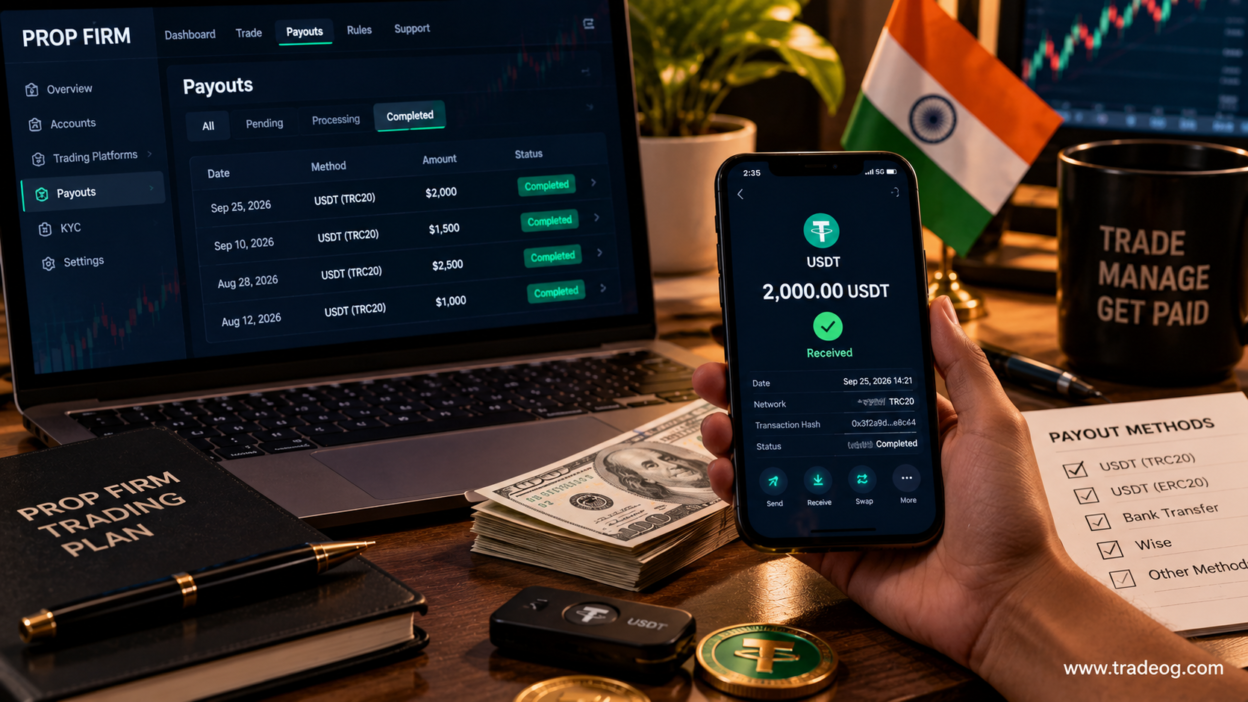
- Alt Text: Indian trader receiving a prop firm payout in USDT through a crypto wallet
- Caption: Understanding USDT prop firm payouts and the conversion process for Indian traders.
- Description: Realistic trading workspace showing a prop firm payout being received in USDT with a potential INR conversion route for an Indian trader.
!Can Indian Traders Receive Prop Firm Payouts in USDT?
If you trade funded accounts in India, one common question is: can Indian traders receive prop firm payouts in USDT?
The direct answer is yes, in many cases—provided the specific proprietary trading firm officially offers Tether (USDT) as a withdrawal channel, accepts residents of India, and the trader completes mandatory identity verification.
However, there is no universal industry rule requiring every company to offer cryptocurrency disbursements. While many modern evaluation firms publish USDT as a standard payment option, others process payouts exclusively through international bank wires or contractor platforms like Rise. If you wonder can Indians receive prop firm payouts in USDT, the availability depends entirely on the firm’s active payout policy.
Before selecting a cryptocurrency withdrawal, Indian traders should verify:
- Whether Indian residents are eligible for crypto disbursements
- Which specific blockchain network is supported (e.g., TRC-20 vs ERC-20)
- Mandatory KYC and wallet address verification requirements
- Minimum payout thresholds and processing fees
- How to convert USDT to INR safely and compliantly
- Applicable Indian income tax and Virtual Digital Asset (VDA) reporting rules
In this guide, we break down how a prop firm payout in USDT works, examine network compatibility, analyze fee structures, and explain the critical legal distinction between prop firm service income and digital asset taxation in India.
1. What Is a Prop Firm Payout in USDT?
Compare crypto payouts with bank vs crypto payouts and review TDS considerations.
For related guidance, see Prop Firm Payout Through Wise and Prop Firm Profit Split for Indian Traders.
Official reference: Income Tax Department of India.
A prop firm USDT payout is a performance reward disbursed in Tether (USDT)—a cryptocurrency designed as a stablecoin to maintain a 1:1 value parity with the United States Dollar.
Instead of wiring fiat USD or EUR through international correspondent banks, a prop firm supporting cryptocurrency transmits an equivalent amount of USDT directly to the trader’s designated digital wallet or payment processor account.
A USDT payout is not liquid Indian Rupees sitting in a domestic bank. It is a digital asset that requires subsequent conversion if you need fiat funds in India.
2. Can Indian Traders Receive USDT Payouts?
Many leading international prop firms support a prop firm crypto payout India traders can access. When researching options for a prop firm payout USDT India traders look for, availability depends on the company’s payment rails.
Based on official documentation verified in September 2026:
- FundedNext: Lists USDT (ERC-20), USDT (TRC-20), and USDC (ERC-20) among its active withdrawal options alongside bank transfer solutions.
- SFX Funded: Specifies that payouts can be processed via bank transfer or cryptocurrency, explicitly utilizing USDT on the TRC-20 network for crypto disbursements.
- Funding Pips & The5ers: Utilize contractor platforms such as Rise Works (which allows traders to receive funds in cryptocurrency or local bank transfers) as well as direct crypto withdrawal rails.
Prop firms update their payment processors frequently due to banking relationships. Always verify the firm’s live payout page before requesting a withdrawal.
3. How Does a USDT Prop Firm Payout Work?
Managing a crypto payout Indian traders receive and executing a funded account payout USDT disbursement involves nine distinct steps:
- Achieve Payout Eligibility: Complete all trading objectives without breaching daily loss or maximum drawdown rules.
- Complete KYC Verification: Submit required identity documents (Aadhaar, Passport, or PAN card). Review Prop Firm KYC Verification: What Traders Should Prepare.
- Open Payout Dashboard: Navigate to the firm’s withdrawal portal during an eligible payout window.
- Select USDT: Choose Tether as your preferred disbursement asset.
- Select Supported Network: Choose the exact blockchain network supported by the firm (e.g., TRC-20 or ERC-20).
- Enter Wallet Address: Carefully paste your corresponding deposit address.
- Firm Processing: The prop firm reviews trading logs and executes the blockchain transaction.
- Wallet Credit: USDT arrives in your private wallet or exchange account within minutes to hours.
- Conversion to INR: You can retain the stablecoin or execute a compliant conversion to Indian Rupees.
4. USDT TRC20 vs USDT ERC20
When selecting a USDT payout for Indian traders, choosing the correct network protocol is vital. A USDT TRC20 prop firm payout operates on the TRON blockchain, whereas a USDT ERC20 prop firm payout operates on the Ethereum blockchain.
| Feature | USDT TRC-20 | USDT ERC-20 |
|---|---|---|
| Underlying Network | TRON Blockchain | Ethereum Blockchain |
| Token Standard | TRC-20 | ERC-20 |
| Asset Value | 1 USDT \approx 1 USD |
1 USDT \approx 1 USD |
| Network Compatibility | Must match receiving TRC-20 address | Must match receiving ERC-20 address |
| Relative Network Fees | Typically low (1 to 2.50) |
Variable gas fees; higher during congestion |
| Primary Operational Risk | Sending tokens to an ERC-20 address | Sending tokens to a TRC-20 address |
Neither network is universally superior. Traders must follow the exact network specified by the prop firm and match it on their receiving platform.
5. What Happens After You Receive USDT?
Receiving USDT in your digital wallet is not necessarily the final transaction step. Indian traders typically pursue one of three operational pathways:
- Option A (Hold USDT): Keep the stablecoins in a secure, self-custody hardware or software wallet.
- Option B (Transfer to Another Wallet): Move the assets to a specialized institutional platform.
- Option C (Sell/Convert to INR): Transfer the stablecoins to an Indian exchange to convert them into rupees and withdraw to a linked domestic bank account.
Document every transfer hash and conversion confirmation to maintain a clean financial audit trail.
6. How Can an Indian Trader Convert USDT to INR?
If you decide to convert USDT to INR, the process should follow compliant domestic financial channels:
- Transfer to an FIU-Registered Exchange: Send USDT from your private wallet to an Indian cryptocurrency exchange registered with the Financial Intelligence Unit (FIU-IND).
- Execute Trade on Order Book: Sell your USDT against the INR trading pair on the platform’s spot market.
- Withdraw Rupee Balance: Transfer the resulting INR directly to your verified domestic bank account via IMPS or NEFT.
- Archive Documentation: Download transaction ledgers, trade execution receipts, and 1% TDS certificates.
Avoid unverified offshore platforms or informal peer-to-peer (P2P) cash channels, which carry severe risks of bank account freezes due to tainted third-party funds.
7. Example: $1,000 Prop Firm Payout in USDT
Consider an approved prop firm withdrawal USDT of $1,000 USD:
- Approved Payout Amount: $1,000 USD
- Firm Processing Fee: Most firms disburse the exact equivalent (1,000 USDT), while some deduct a
1 to5 network processing charge. - Net Received in Private Wallet: ~998 to 1,000 USDT
- Conversion on Indian Exchange: Selling 1,000 USDT at a net market rate of ₹94.80 yields ₹94,800 INR.
- Exchange Trading Fee (0.15%): -₹142.20
- Domestic IMPS Withdrawal Fee: -₹15
- Net Rupee Credit: ₹94,642.80 INR
These figures are educational simulations. Actual receipts depend on live market rates, network gas costs, and platform fees.
8. USDT Payout Fees
Costs associated with a USDT prop firm payout India occur across several stages:
- Prop Firm Processing Fee: Many firms absorb withdrawal costs, while others charge a nominal gateway fee.
- Blockchain Network Gas Fee: Paid to network validators (typically
1 to2 on TRON; higher on Ethereum). - Exchange Trading Fee: Domestic platforms charge 0.1% to 0.2% on the USDT/INR spot trade.
- Domestic Withdrawal Fee: Flat ₹10 to ₹50 charged by Indian exchanges for bank transfers.
- Conversion Spread: The difference between the wholesale interbank USD/INR rate and the live exchange buying rate.
9. Is a USDT Payout Tax-Free in India?
There is a widespread misconception among novice traders that receiving cryptocurrency makes earnings invisible or tax-free.
> Under the Indian Income-tax Act, 1961, tax liability is determined by the commercial nature of the income, not by the technological medium used to receive payment.
Understanding your USDT payout tax India liability requires analyzing the transaction in two separate parts:
- Event 1 (The Prop Firm Service Income): You perform simulated trading services for an overseas entity and receive a contractor reward. This income is subject to standard Indian income tax based on your personal or business tax slab.
- Event 2 (The Virtual Digital Asset Transaction): If you hold, trade, or transfer that USDT, any subsequent gain is governed by Section 115BBH (flat 30% tax on net VDA profits) and Section 194S (1% TDS on crypto transfers).
Do not assume that the entire prop firm payout automatically falls under the 30% VDA rate simply because it was paid in USDT. The initial reward represents foreign service income, while Section 115BBH applies to capital gains arising from the subsequent transfer of the asset.
10. What If I Receive USDT and Immediately Sell It?
Evaluating your overall prop firm payout tax India obligations requires distinguishing between contractor service revenue and subsequent asset gains. If you receive a payout in USDT and immediately convert it to INR on an Indian exchange:
- Underlying Receipt: The fair market value of the USDT on the date of receipt constitutes your gross professional/business revenue.
- VDA Transfer: If you sell the USDT immediately at the same market value, the capital gain on the crypto asset itself is virtually zero, minimizing secondary VDA capital gains tax.
- TDS Compliance: The domestic exchange will deduct 1% TDS under Section 194S upon executing the sale, which reflects in your Form 26AS / AIS.
Always consult a qualified Chartered Accountant to structure your ITR-3 or ITR-4 filing accurately. Read TDS on Prop Firm Payouts: What Indian Traders Should Know.
11. Is USDT Different From Receiving a Bank Payout?
The table below contrasts receiving a USDT withdrawal with a traditional fiat bank transfer:
| Factor | Bank / Fiat Transfer | USDT Payout |
|---|---|---|
| Settlement Medium | Commercial fiat banking rails | Blockchain digital asset |
| INR Conversion | Executed automatically by bank/processor | Executed manually by trader on exchange |
| Blockchain Transaction | No | Yes (TxID generated) |
| Wallet Address Required | No (Requires bank IFSC & account) | Yes (Requires exact network address) |
| Network Selection | Not applicable | Critical (TRC-20 vs ERC-20) |
| Transaction Record | Bank statement & FIRC certificate | Blockchain hash & exchange ledger |
| Tax Considerations | General business/professional income | Professional income + possible VDA rules |
| Average Settlement Speed | 1 to 5 business days | 15 minutes to 2 hours |
For an in-depth analysis of banking channels, explore Prop Firm Payout to Indian Bank Account vs Crypto.
12. Can Indian Banks Receive the INR After a USDT Sale?
Yes. When you convert USDT to INR through an FIU-registered Indian exchange, the platform transfers funds directly to your verified domestic bank account via IMPS, NEFT, or RTGS.
However, keep these compliance factors in mind:
- Banks monitor large, frequent inflows from cryptocurrency platforms under Prevention of Money Laundering Act (PMLA) guidelines.
- Ensure your KYC details on the crypto exchange match your bank account and PAN card exactly.
- Avoid peer-to-peer (P2P) transfers with unverified counterparties, which can trigger account lien freezes.
13. What Records Should Indian Traders Keep?
Maintaining an unassailable documentation trail is critical when handling multi-stage digital asset transactions:
- Prop Firm Contractor Agreement: Copy of signed terms.
- Payout Approval Notice: Email or dashboard screenshot confirming withdrawal approval.
- Payout Statement: PDF statement detailing gross profit and approved payout.
- Blockchain Transaction Hash (TxID): Unique identifier of the USDT transfer.
- Wallet Addresses: Documentation of sending and receiving wallet addresses.
- Exchange Deposit & Trade Slips: Confirmation of USDT deposit and spot market execution.
- Bank Statements: Domestic bank statement showing exact INR credit.
- Section 194S TDS Certificates: Form 16A issued by the exchange for 1% TDS deductions.
14. What If the Prop Firm Uses USDT TRC20?
If your prop firm specifies a USDT TRC20 prop firm payout, you must supply a receiving wallet address created on the TRON blockchain (addresses typically begin with a capital “T”).
- Do not provide an Ethereum address (which starts with “0x”).
- Do not provide a Solana or BNB Chain address.
- Verify whether the exchange requires a memo or destination tag.
Always match the cryptocurrency and the network before submitting your withdrawal request.
15. Is Receiving USDT Legal for Indian Traders?
Holding and receiving cryptocurrency is not illegal in India. However, crypto assets operate within a strictly regulated legal, tax, and anti-money laundering framework:
- FIU-IND Registration: Platforms facilitating crypto-to-INR conversions must register with the Financial Intelligence Unit.
- Tax Compliance: The Indian government mandates reporting under Section 115BBH and Schedule VDA in annual ITR filings.
- FEMA Considerations: Prop firm payouts represent contractual earnings from overseas entities. Ensure documentation proves funds are legitimate service compensation rather than unauthorized retail margin remittances under the Liberalised Remittance Scheme (LRS). Review Can Indians Join Prop Firms in 2026?.
16. Common Mistakes Indian Traders Make With USDT Payouts
Avoid these ten frequent pitfalls:
- Selecting the Wrong Blockchain Network: Sending TRC-20 tokens to an ERC-20 address, causing total loss of funds.
- Reusing Stale Wallet Addresses: Using outdated exchange deposit addresses that have been deprecated.
- Assuming All Platforms Support Every Network: Failing to verify that your domestic exchange supports TRC-20 deposits.
- Ignoring Gas and Withdrawal Fees: Failing to factor in Ethereum network gas fees during periods of market congestion.
- Overlooking Exchange Conversion Spreads: Budgeting based on Google exchange rates rather than actual platform order books.
- Failing to Save Transaction Hashes: Neglecting to save TxIDs, making tax reconciliation difficult.
- Believing USDT Is Tax-Free: Believing digital assets are invisible to Indian tax authorities.
- Assuming the Entire Payout Faces 30% Tax: Erroneously treating initial service income as purely speculative VDA gains.
- Using Crypto to Evade Financial Reporting: Deliberately avoiding banking rails, risking severe penalties under the Black Money Act.
- Relying on Outdated YouTube Advice: Following old tutorials without checking current 2026 prop firm rules.
17. Practical Example for an Indian Trader
Consider an Indian funded trader who achieves an approved $2,000 prop firm payout:
Transaction Flow:
- Prop Firm Disbursement: The firm transmits 2,000 USDT on the TRON network (Tx fee: ~$1.50).
- Wallet Arrival: 1,998.50 USDT arrives in the trader’s private wallet.
- Exchange Deposit: Trader deposits 1,998.50 USDT into an FIU-registered Indian exchange.
- Spot Execution: Selling 1,998.50 USDT at an illustrative net rate of ₹94.85 yields ₹189,557.72.
- TDS Deduction (1% under Sec 194S): -₹1,895.58 (credited to trader’s PAN in Form 26AS).
- Platform Trading Fee (0.15%): -₹284.34.
- Bank Transfer: The remaining balance of ₹187,377.80 INR is deposited via IMPS into the trader’s bank account.
This example illustrates how network fees, conversion spreads, and statutory TDS shape net cash in hand.
18. Questions to Ask the Prop Firm Before Choosing USDT Payout
Before requesting a cryptocurrency disbursement, review this operational checklist:
- Is USDT available for traders residing in India?
- Which specific networks are active (TRC-20, ERC-20, Polygon)?
- Does the firm absorb blockchain gas fees or deduct them from the payout?
- What is the minimum withdrawal threshold for USDT?
- Does the firm charge an internal crypto processing commission?
- Is wallet address whitelisting or signature verification required?
- Does the firm support payouts directly to private non-custodial wallets?
- What is the average timeframe for blockchain confirmation?
- Does the firm provide a verifiable blockchain transaction hash (TxID)?
- What is the resolution protocol if a blockchain transfer fails?
- Can I switch between bank wire and USDT between payout cycles?
- Does the dashboard provide formal PDF invoices for tax filing?
19. USDT Payout vs Bank Payout for Indian Traders
When deciding between prop firm payout crypto and bank transfers, consider your specific operational priorities:
Choose a USDT Payout If:
- You prioritize rapid settlement (minutes instead of business days).
- You manage smaller payouts (
500 to1,500) where fixed SWIFT bank fees (25–35) are disproportionately high. - You already maintain an active, verified account on an FIU-registered Indian crypto platform.
Choose an Indian Bank Payout If:
- You prefer direct fiat settlement without managing crypto wallets or exchange trades.
- You manage large disbursements ($5,000+) where banking channels provide standardized FIRC certificates.
- You want to avoid the administrative complexity of tracking Section 115BBH VDA events.
20. Frequently Asked Questions About Prop Firm Payout USDT (FAQ)
Can Indian traders receive prop firm payouts in USDT?
Yes. Many international prop firms offer USDT payouts to Indian traders, provided the trader passes KYC verification and selects a supported network.
Can a prop firm pay Indian traders in USDT TRC20?
Yes. USDT on the TRON network (TRC-20) is widely supported by prop firms due to low transaction fees and fast block confirmations.
Can Indian traders receive USDT ERC20 payouts?
Yes, but traders should note that Ethereum (ERC-20) gas fees can be considerably higher during times of network congestion.
Is a USDT prop firm payout taxable in India?
Yes. Earnings from prop firms constitute taxable income under Indian tax laws regardless of whether payment is received in fiat currency or USDT.
Does receiving USDT automatically mean 30% tax?
No. The underlying payout represents professional or business income taxed at your normal slab rate. The flat 30% VDA rate under Section 115BBH applies to any subsequent profit realized when transferring or selling the crypto asset.
What happens if I immediately convert USDT to INR?
If you sell USDT immediately upon receipt at prevailing market rates, your crypto capital gain is minimal, but the transaction remains subject to 1% TDS under Section 194S.
Can I transfer prop firm USDT to an Indian crypto platform?
Yes, provided the Indian platform supports the specific token and blockchain network (e.g., USDT on TRC-20) and is registered with the FIU-IND.
What records should I keep for a USDT payout?
Keep signed prop firm contracts, payout approval emails, dashboard statements, blockchain transaction hashes (TxID), exchange trade receipts, and bank deposit statements.
What is the difference between USDT TRC20 and ERC20?
USDT TRC-20 runs on the TRON network with lower transaction fees, while USDT ERC-20 runs on the Ethereum network. The two networks are incompatible and require matching wallet addresses.
Can a prop firm change its available payout methods?
Yes. Prop firms periodically update their payment processors and supported currencies based on international banking and regulatory requirements. Always check the firm’s active payout dashboard.
Conclusion
Answering can Indian traders receive prop firm payouts in USDT requires evaluating the complete financial and regulatory lifecycle:
Receiving payouts in USDT offers unmatched speed and flexibility, making it an excellent vehicle for international prop trading rewards. However, using digital assets does not eliminate your legal, banking, or tax obligations. By matching blockchain networks carefully, utilizing FIU-registered conversion platforms, archiving meticulous transaction hashes, and consulting a certified Chartered Accountant, you can manage your prop firm payouts safely and compliantly.
For further reading on prop firm rules and payouts in India, explore:



[…] For a deeper comparison, see our guide on prop firm payouts in USDT for Indian traders. […]