

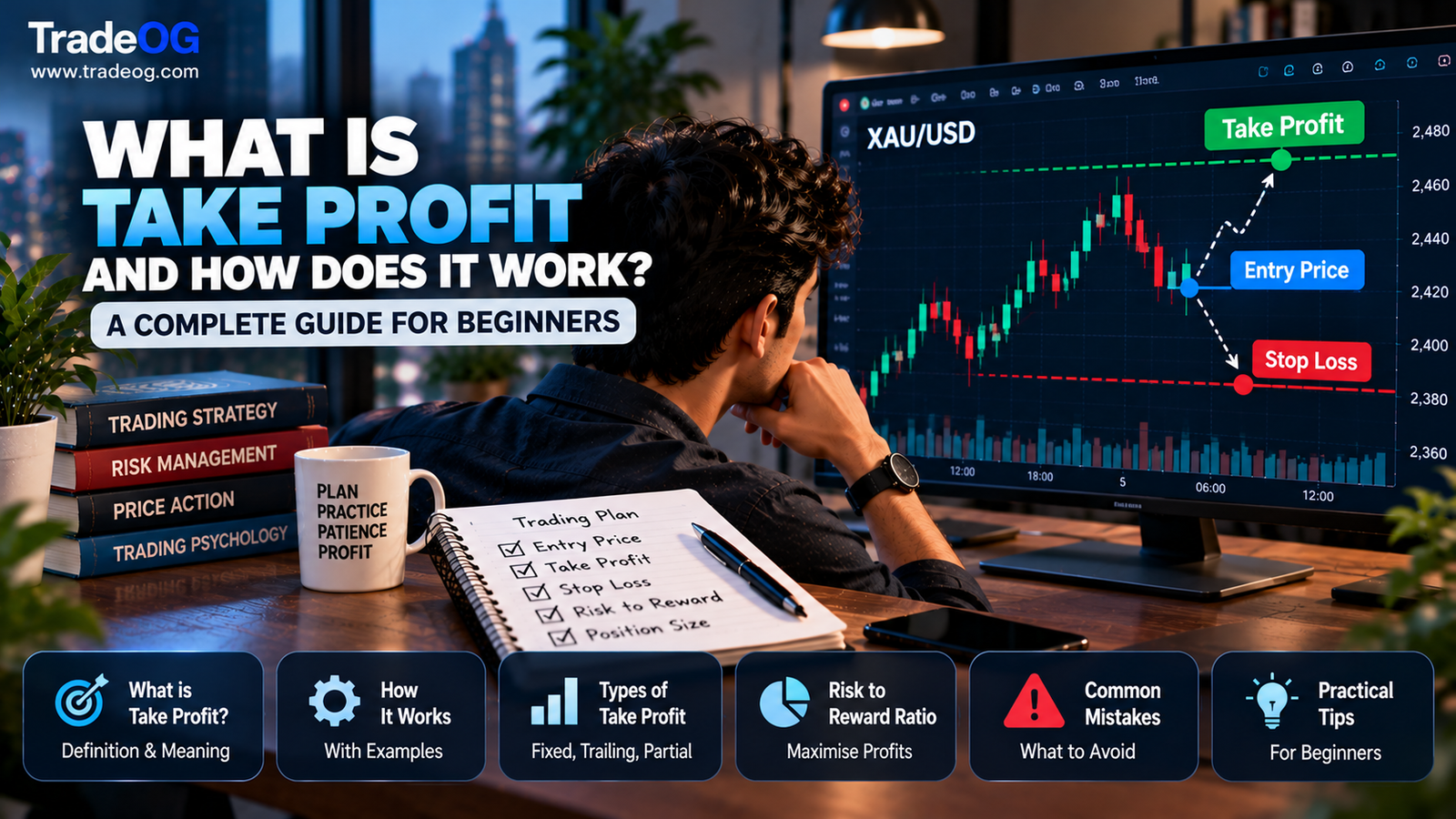
If you are new to trading, you will often see two important exit levels on a chart: Stop Loss and Take Profit. A stop loss is designed to control a losing trade, while a take profit is designed to close a trade when it reaches your planned profit target.
But how does a take-profit order actually work? Where should you place it? Should you always use one? And how does it affect your risk-reward ratio?
This guide explains what take profit means in trading in simple English, with forex and XAU/USD examples, position-sizing calculations, risk-reward examples, partial profit-taking, trailing stops and the most common beginner mistakes.
What Is Take Profit in Trading?
A take-profit (TP) order is an instruction designed to automatically close all or part of a trading position when the market reaches a predefined favorable price.
For a long trade, the take-profit level is normally above the entry price.
For a short trade, the take-profit level is normally below the entry price.
The basic idea is:
Entry → Take Profit = the price where you plan to lock in a gain.
For example, suppose you buy EUR/USD at 1.1000 and expect it to rise. You may set a take profit at 1.1100. If the market reaches that level and the order executes, the position is closed and the planned price-based gain is realised, before considering trading costs and execution differences.
How Does a Take-Profit Order Work?
A take-profit order remains associated with your open position until the market reaches its specified target or you modify/cancel it.
For a long position:
- Entry: 1.1000
- Take profit: 1.1100
- Target distance: 100 pips
If price rises to the relevant trigger level, the take-profit order is designed to close the position.
For a short position:
- Entry: 1.1000
- Take profit: 1.0900
- Target distance: 100 pips
If price falls to the target, the position is designed to close.
The exact mechanics depend on the order type and trading venue, so traders should always understand their platform’s execution rules.
Take Profit vs Stop Loss
| Take Profit | Stop Loss |
|---|---|
| Designed to close a profitable trade | Designed to close a losing trade |
| Normally placed beyond the entry in the expected direction | Normally placed beyond the entry in the adverse direction |
| Defines a planned profit target | Defines a planned loss-exit level |
| Supports profit-taking discipline | Supports downside-risk control |
Using both can create a clearly defined trade plan before the position is opened.
Simple Take-Profit Example
Imagine you buy GBP/USD at 1.3000.
Your analysis suggests the price could move toward 1.3100, while the setup becomes invalid around 1.2950.
- Entry: 1.3000
- Stop loss: 1.2950
- Take profit: 1.3100
You are risking 50 pips to target 100 pips.
That creates a 1:2 price-based risk-reward ratio.
The take profit tells the platform where you intend to exit for the planned gain. The stop loss tells it where you intend to exit if the trade moves against you.
Why Do Traders Use Take Profit?
A take-profit order can be useful for several reasons.
1. It Creates an Exit Plan
Before entering, you already know where you intend to take the profit.
2. It Reduces Emotional Decisions
Without a predefined target, traders may become greedy when price rises or panic when a small pullback occurs.
3. It Can Automate Profit-Taking
You do not necessarily need to watch the chart continuously while waiting for your target.
4. It Helps Define Risk-Reward
Knowing the target allows you to compare the potential reward with the planned risk before entering.
5. It Can Improve Trading Discipline
A predefined exit reduces the temptation to make decisions randomly in the middle of a trade.
How Do You Set a Take-Profit Level?
There is no universal best take-profit distance. The target should come from your trading strategy and the market conditions.
Common methods include:
- previous resistance or support;
- recent swing highs or lows;
- chart patterns;
- measured moves;
- fixed risk-reward ratios;
- volatility-based targets;
- trend continuation levels; and
- predefined percentage or point targets in systematic strategies.
The important principle is: do not choose a target simply because you want a certain amount of money.
Take Profit Based on Support and Resistance
Suppose you buy a currency pair because it has broken above a resistance area.
The next significant resistance level above your entry may provide a logical place to consider taking profit.
For a short trade, a previous support zone below the entry may be a potential target.
This approach connects the take profit to market structure instead of an arbitrary number.
Take Profit Based on Risk-Reward Ratio
Some traders define their target using a predetermined risk-reward ratio.
For example, if the stop-loss distance is 30 pips:
- 1:1 target = 30 pips
- 1:2 target = 60 pips
- 1:3 target = 90 pips
So, if you enter at 1.2000 and use a 30-pip stop, a 1:2 target would be 1.2060 for a long trade or 1.1940 for a short trade.
A higher risk-reward ratio is not automatically better. A very distant target may be reached less frequently. The appropriate target depends on your strategy’s historical performance and market conditions.
Take Profit and Position Size
Take profit and position size work together.
Suppose a trade has a 50-pip target. The money you make if that target is reached depends on your position size and pip value.
A 50-pip move on 0.01 lot does not produce the same monetary result as a 50-pip move on 1.00 lot.
That is why traders should think in this order:
- Identify the setup.
- Determine the logical stop.
- Determine the logical target.
- Calculate the risk-reward relationship.
- Calculate position size from the planned risk.
Do not increase your lot size just because you want a larger profit.
Example With a $100 Account
Suppose you have a $100 account and, purely as an example, plan to risk 1% on a trade.
Maximum planned risk = $100 × 1% = $1.
Imagine your setup has a stop distance of 20 pips and a take-profit distance of 40 pips. That is a 1:2 price-based risk-reward relationship.
If your position size is calculated so that the 20-pip stop represents approximately $1, then the 40-pip target would represent approximately $2 before costs if the target is reached and execution is as expected.
The exact result depends on the currency pair, account currency, pip value, spread and other costs.
Example With a $500 Account
Suppose the account is $500 and the trader chooses a 1% example risk:
$500 × 1% = $5.
If the trade has a 25-pip stop and a 50-pip target, the price-based risk-reward ratio is 1:2.
The position size should then be calculated so that 25 pips represents approximately $5 of planned risk.
If the target is reached, the 50-pip movement would represent approximately $10 before costs under the same simplified assumptions.
Take Profit in XAU/USD Gold Trading
Gold traders also use take-profit levels, but the calculation needs special attention because XAU/USD contract specifications can vary between providers.
Suppose you buy XAU/USD at $2,400 and your analysis suggests a target at $2,425.
- Entry: $2,400
- Take profit: $2,425
- Price target: $25
Your actual monetary profit depends on the contract size and position volume.
Do not assume that a $25 gold move produces the same profit on every platform. Always check the exact contract specification.
Can You Move Your Take Profit?
Yes, a trader can generally modify or cancel a take-profit level while the position remains open, subject to the platform’s rules.
But changing the target emotionally is different from managing a trade according to a defined strategy.
For example, changing a target because your analysis has objectively changed can be part of a trading plan. Moving it farther away simply because price is approaching and you want “more profit” can damage consistency.
What Is Partial Take Profit?
Partial take profit means closing only part of a position at a target instead of closing the entire trade.
For example, suppose you open 0.10 lot.
- Close 0.05 lot at Target 1.
- Keep 0.05 lot open for Target 2.
This allows a trader to lock in part of the gain while keeping some exposure to a larger move.
However, partial exits also make the strategy more complex and can affect the overall average exit price and risk-reward profile.
What Is a Trailing Stop vs Take Profit?
| Take Profit | Trailing Stop |
|---|---|
| Targets a predefined price | Moves with favorable price movement |
| Usually closes at the planned target | Can remain open while the trend continues |
| Simple and predictable | Can capture larger moves |
| May exit before a larger move continues | May exit during a normal pullback |
Neither is universally better. The choice depends on your strategy.
Take Profit vs Manual Profit Taking
You do not always have to use an automatic take-profit order. Some traders manage exits manually based on price action or changing market conditions.
However, manual management requires discipline and constant attention.
A predefined take profit can reduce the chance of holding a winning trade indefinitely while waiting for an even larger move.
Does Take Profit Guarantee a Profit?
No.
A take-profit order is designed to execute when the relevant market price reaches its trigger level, but execution conditions can vary.
Fast markets, gaps, liquidity conditions and the exact order type can affect execution.
Also, a trade can move close to your target and reverse before the target is reached. In that case, the take profit does not activate.
Why Did My Take Profit Not Trigger?
There can be several reasons.
- The market did not actually reach the relevant trigger price.
- The platform uses bid/ask prices differently for long and short positions.
- The order was modified or cancelled.
- The market moved too quickly and execution conditions changed.
- The order was rejected or affected by a platform/provider rule.
Remember that charts may display a price that is different from the bid or ask price used to trigger a particular order.
Take Profit and Spread
Spread is the difference between the bid and ask price.
Because buy and sell positions are closed using different sides of the market, the displayed chart price and the actual executable price can differ.
This can matter when a target is very close to the current market price.
Beginners should understand which price—bid or ask—triggers their particular exit order.
Take Profit During Major News
Major economic releases can cause rapid price movements and wider spreads.
A market may reach your target very quickly, but execution can still differ from what you expected.
Before holding a leveraged trade through major news, understand the potential for volatility, slippage and changing spreads.
Should Beginners Always Use Take Profit?
Not every trading strategy needs the exact same exit method. Some systems use fixed targets, some use trailing exits, and some use discretionary exits.
But beginners should have a clear profit-taking plan before entering a trade.
If you do not know where or why you intend to exit a winning position, you can easily allow greed and emotion to control the trade.
Common Take-Profit Mistakes
- Setting a target only because it gives a big profit: The market does not owe you a specific return.
- Using an unrealistic target: A target far beyond normal market movement may rarely be reached.
- Moving the target farther away out of greed: This can destroy the original trading plan.
- Taking profit too early every time: Constantly cutting winners can change the strategy’s expected results.
- Ignoring market structure: Targets should have a logical basis.
- Ignoring spread and execution: The displayed chart price is not always the exact execution price.
- Using the same target on every market: Different instruments have different volatility.
- Changing targets after every small price movement: This creates inconsistent decision-making.
- Confusing take profit with guaranteed profit: TP is an exit instruction, not a guarantee.
- Increasing lot size to make the target worthwhile: This increases risk instead of improving the setup.
How to Set a Take Profit Step by Step
- Identify the trade setup. Know why you are entering.
- Define the invalidation level. Determine where the trade idea is wrong.
- Set the stop-loss level. This establishes planned downside risk.
- Find a logical target. Use structure, volatility or your tested strategy.
- Check the risk-reward ratio. Decide whether the potential reward justifies the planned risk.
- Calculate position size. Base it on the stop and maximum risk.
- Check trading costs. Include spread, commission and possible slippage.
- Place the trade and exit orders. Confirm the levels before execution.
What Is a Good Take-Profit Ratio?
There is no universal “best” take-profit ratio.
A 1:2 risk-reward ratio is often discussed by traders, but it is not automatically profitable. A strategy with a 1:2 target still needs a sufficient win rate and favorable costs.
Likewise, a strategy with a 1:1 target can potentially work if its win rate, execution and costs support positive expectancy.
What matters is the relationship between win rate, average win, average loss and trading costs.
Take Profit and Trading Psychology
Take profit can help with one of the most common psychological problems in trading: greed.
After a trade moves into profit, traders may start thinking:
- “Maybe it will go much higher.”
- “I should not close yet.”
- “I can make twice as much.”
Sometimes the market does continue. Other times it reverses and gives back the unrealised profit.
A predefined target can help the trader follow a consistent plan instead of making a new decision every time the market moves.
Frequently Asked Questions
What is take profit in simple words?
Take profit is an order or exit instruction designed to close a trade when the market reaches a predefined favorable price, allowing the trader to realise a planned gain.
Is take profit the same as stop loss?
No. Take profit is designed to close a winning position at a target, while stop loss is designed to control a losing position.
Can I use take profit without a stop loss?
A trader can technically place different combinations of exit orders depending on the platform and strategy, but entering a leveraged trade without a defined loss-exit plan can expose the account to uncontrolled downside.
Where should I put my take profit?
Use a level supported by your strategy, such as resistance, support, a measured move, volatility or a tested risk-reward framework. Do not choose it only because it produces a desired dollar profit.
What is a 1:2 take-profit ratio?
It usually means the planned reward is twice the planned risk. For example, a 30-pip stop with a 60-pip target represents a 1:2 price-based risk-reward relationship.
Can I move my take profit after opening a trade?
Usually yes, subject to the platform’s rules. But changes should follow a trading plan rather than emotional decisions.
What is partial take profit?
Partial take profit means closing only part of a position at a target while leaving the remainder open for another target or exit condition.
Does take profit guarantee profit?
No. It is an exit instruction, not a guarantee. Execution can be affected by market conditions, order rules and slippage.
Does take profit work on XAU/USD?
Yes, many trading platforms support take-profit orders for gold products. The exact mechanics and contract specifications depend on the provider.
Final Thoughts
Take profit is simply a predefined plan for where you want to exit a winning trade.
It can help traders stay disciplined, automate exits and evaluate risk-reward before entering a position. But the target should come from the market and the trading strategy—not from an arbitrary amount of money you want to make.
The basic process is:
Setup → Stop Loss → Take Profit → Position Size → Risk Check → Trade.
Once you understand how take profit works alongside stop loss and position sizing, you can build much more structured trading plans.
Disclaimer: This article is for educational and informational purposes only and is not financial, investment, legal or tax advice. Trading involves risk of loss. Take-profit orders may be affected by execution conditions, spread, liquidity and slippage. Verify the exact order mechanics and protections offered by your broker or trading venue.