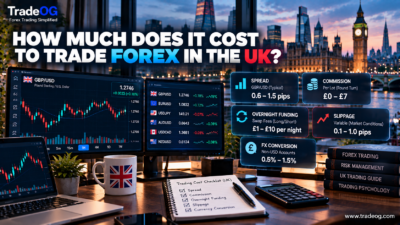
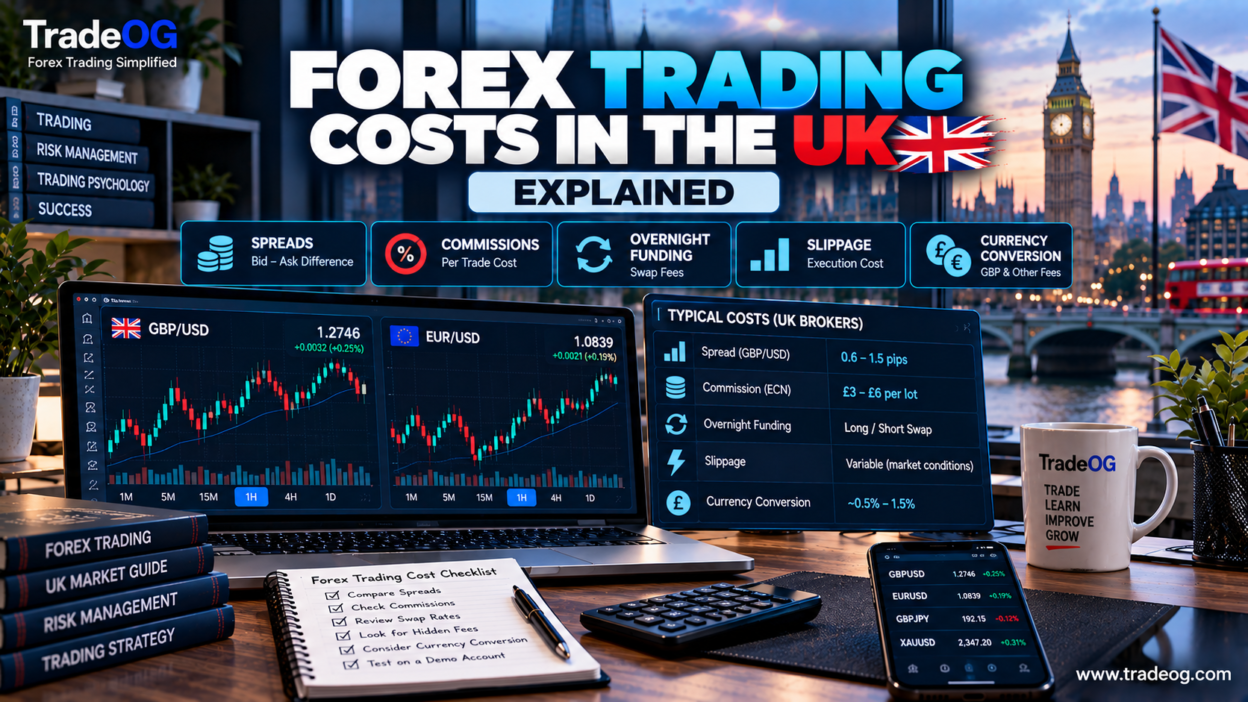
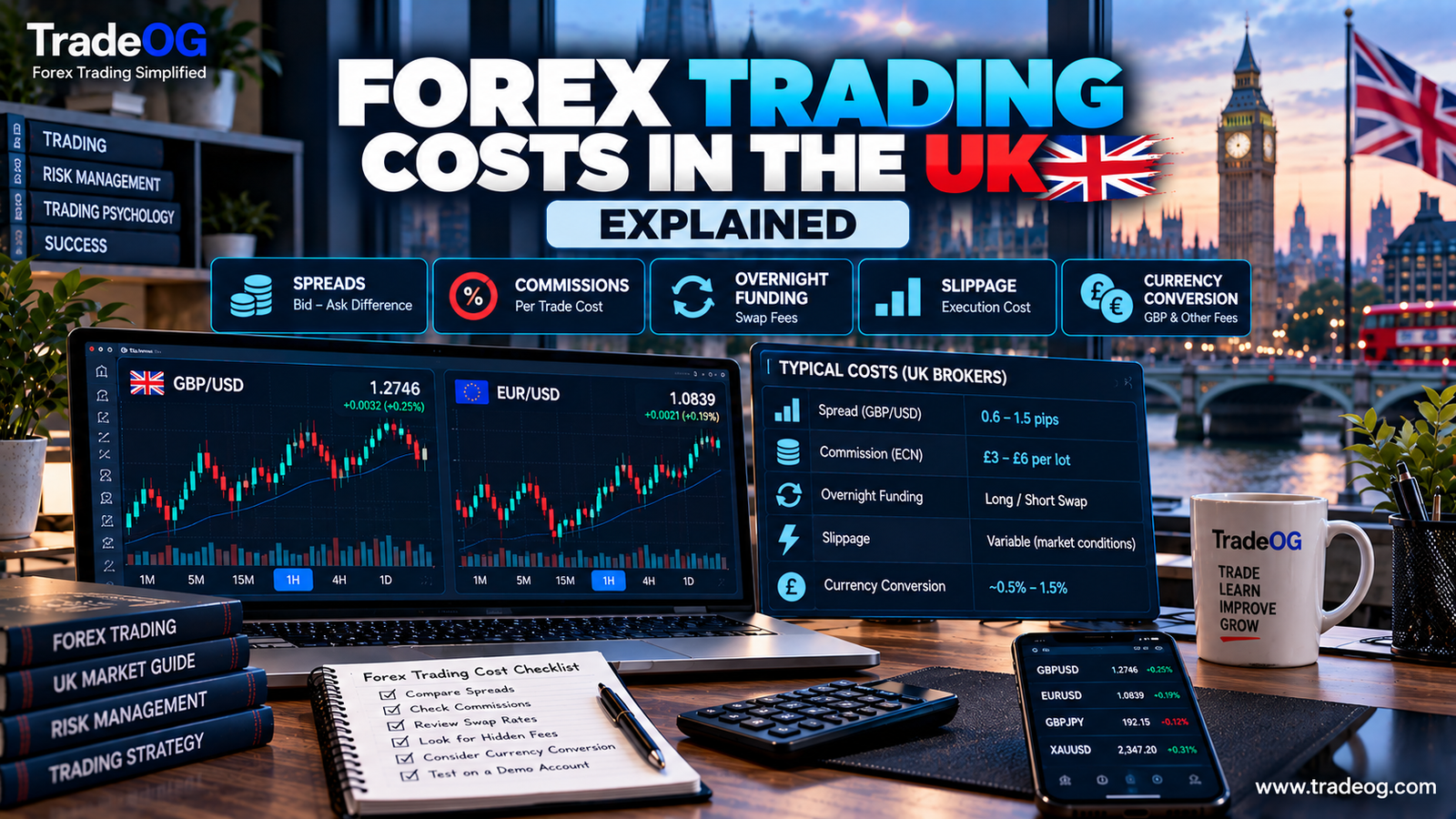
Forex trading in the UK is often advertised as a low-cost way to access global currency markets. That can be true for some trading styles, but the spread you see on a broker’s website is only one part of the real cost.
Your actual cost can include the spread, commission, overnight funding, slippage, currency conversion and other account charges. For a trader who opens and closes positions frequently, small differences can add up quickly. For a swing trader who holds positions overnight, financing can become more important than the entry spread.
This guide explains forex trading costs in the UK in plain British English, with practical examples and current UK broker pricing references. It also explains what beginners should compare before choosing a broker.
Quick Answer: What Does Forex Trading Cost in the UK?
There is no single fixed cost for a forex trade. The main costs are:
| Cost | What It Means | When It Matters Most |
|---|---|---|
| Spread | Difference between the bid and ask price | Every trade |
| Commission | Explicit charge on certain account types | Raw-spread/commission accounts |
| Overnight funding | Financing adjustment for holding leveraged positions | Swing and overnight traders |
| Slippage | Difference between requested and executed price | Fast or volatile markets |
| Currency conversion | Cost of converting between account and trading currencies | Multi-currency accounts |
| Other account charges | Possible fees for particular services | Depends on broker and account |
The FCA’s rules on costs and charges specifically recognise items such as commissions, bid-ask spreads, daily and overnight financing costs, account management fees and taxes as costs that can arise in CFD trading. The FCA has also highlighted overnight funding, spreads and commissions when reviewing CFD providers’ price and value practices.
1. Forex Spreads: The Main Trading Cost
A spread is the difference between the price at which you can buy a currency pair and the price at which you can sell it.
For example, imagine GBP/USD is quoted as:
Buy: 1.2750
Sell: 1.2749
The difference is 0.0001, or 1 pip.
If you buy and immediately close the position at the same market price, the spread means you start with a small loss. This is why a trader’s position can show a negative unrealised profit immediately after opening.
IG explains that its spreads are generally built into the quoted dealing price rather than appearing as a separate fee. Its current UK pricing page lists minimum spreads of 0.6 on EUR/USD, 0.9 on GBP/USD, 0.9 on EUR/GBP and 0.7 on USD/JPY. These are minimum figures, not guaranteed spreads at every moment.
2. What Is a Commission in Forex Trading?
Some brokers offer a spread-only account. Others offer a tighter or raw spread and charge a separate commission.
Suppose a broker offers:
- Raw spread: 0.1 pip
- Commission: £2.25 per standard lot per side
If you open one standard lot and later close it, you could pay £4.50 in round-trip commission, before considering the spread and other costs.
Pepperstone currently publishes a Razor account commission of £2.25 per standard FX lot per side for its UK pricing, with raw spreads from 0.0 on selected FX pairs. Its Standard account instead includes the CFD trading charge in the spread and does not charge a separate forex commission.
Neither model is automatically cheaper. You need to calculate the all-in cost.
3. Spread-Only vs Commission Accounts
Consider two hypothetical accounts.
| Spread-Only Account | Raw-Spread Account | |
|---|---|---|
| EUR/USD spread | 1.0 pip | 0.1 pip |
| Commission | £0 | £2.25 per lot per side |
| Best for | Simplicity | High-volume active trading |
If the tighter spread saves more than the commission costs, the raw-spread account can be cheaper. If you trade very small positions or infrequently, the simplicity of a spread-only account may be more important.
Do not compare “0.0 pip spread” with “1 pip spread” without checking commission. That is one of the most common mistakes when comparing forex brokers.
4. Overnight Funding: The Cost Beginners Often Miss
If you hold a leveraged forex position beyond the broker’s daily funding time, an overnight financing or swap adjustment can apply.
This is particularly important for swing traders. A day trader who opens and closes a position during the same session may avoid the regular overnight charge, while someone holding a position for several days can accumulate financing costs.
IG currently states that forex and spot-metal positions held overnight are subject to its applicable tom-next rate plus an administration fee. IG also notes that FX positions held through Wednesday’s 10pm UK time can incur three days of funding because of the normal FX settlement cycle.
The exact amount depends on the currency pair, direction, broker, prevailing rates and account terms. Some days the long and short rates can be very different.
Simple overnight example
Imagine a broker charges £3 per night on your position.
Holding it for five nights would produce:
£3 × 5 = £15
If your original trade was targeting only £30 of profit, £15 of financing would represent a significant part of the expected return.
This is why swing traders should check swap or financing rates before opening a position.
5. Slippage: The Cost You Cannot Always See in Advance
Slippage occurs when your order is executed at a different price from the price you expected.
For example, you might attempt to buy GBP/USD at 1.2750, but the order is filled at 1.2752. The two-pip difference is execution slippage.
Slippage can become more noticeable during:
- Major economic announcements
- Central-bank decisions
- Very volatile market conditions
- Periods of thin liquidity
- Market opening or closing periods
A broker with a low advertised spread is not necessarily the cheapest broker if execution quality is poor during the conditions in which you trade.
6. Currency Conversion Costs
Currency conversion can matter when your account currency and the currency in which a charge or transaction is settled are different.
For example, an account may be denominated in GBP while a particular transaction or charge is calculated in USD. The broker may convert the amount using an exchange rate that includes a conversion charge or spread.
IG currently states that its standard forex conversion fee is 0.7%, added to the underlying exchange rate when converting currencies. It also states that deposits and withdrawals are not charged by IG where no currency conversion is required. Always check the current fee schedule for your specific account before relying on an example.
7. Are There Deposit and Withdrawal Fees?
Many established UK brokers do not charge ordinary fees for every deposit or withdrawal, but the exact policy varies by provider, payment method and currency.
You should check:
- Bank transfer fees
- Card deposit restrictions
- Withdrawal charges
- Currency conversion charges
- Third-party payment-provider fees
- Any account-specific conditions
Do not assume that a broker advertising “commission-free trading” has no costs. Commission-free usually refers to one particular trading charge, not every possible cost associated with the account.
8. Do UK Forex Traders Pay Tax?
Tax is different from a broker trading fee, and the answer depends heavily on the product and your personal circumstances.
Eligible UK spread betting can receive different tax treatment from CFD trading. CFDs, shares, ETFs and other investments can have different tax consequences. Your tax position can also depend on whether your activity is treated as investing, trading or another form of taxable activity.
Do not choose a broker solely because you have heard that “forex is tax-free”. That statement is too broad to be reliable.
If tax could materially affect your trading decisions, obtain advice from a qualified UK tax professional and check current HMRC guidance.
9. How Much Does a Typical Forex Trade Cost?
Let’s use a simple educational example rather than claiming that every UK broker charges the same amount.
Assume you trade EUR/USD with:
- Position size: 1 standard lot
- Spread: 0.8 pips
- Commission: £0
- Overnight funding: £0 because the trade is closed the same day
For EUR/USD, one standard lot is commonly 100,000 units. With a USD-quoted pip value of approximately $10 per pip for one standard lot, an 0.8-pip spread represents approximately $8 of spread cost before considering the account currency and actual execution.
If you enter and exit at the same market level, you therefore need the trade to move enough in your favour to overcome that initial spread.
Important: pip value changes with position size and exchange rate, so use your broker’s current contract specifications when calculating a real trade.
10. How Much Does a 0.01 Lot Trade Cost?
A 0.01 lot position is one hundredth of a standard lot.
Using the same educational EUR/USD example:
- 1.00 lot → approximately $10 per pip
- 0.10 lot → approximately $1 per pip
- 0.01 lot → approximately $0.10 per pip
If the spread is 0.8 pips, the approximate spread cost on a 0.01-lot position would therefore be $0.08 before conversion and execution effects.
Small position sizes can make learning more manageable, but traders should still calculate risk rather than choosing a lot size simply because it looks small.
11. How Forex Costs Affect Scalpers
Scalpers are especially sensitive to transaction costs because they may take many trades during a single session.
Imagine a trader makes 20 round trips in a day and pays an average all-in spread equivalent of £2 per trade.
20 × £2 = £40
That £40 is a cost before considering whether the trades were profitable, and it can become significant over hundreds of trading sessions.
For scalpers, compare:
- Average rather than headline minimum spreads
- Commission
- Execution quality
- Slippage
- Platform stability
- Financing if positions occasionally remain open
A broker that is slightly more expensive per trade can still be preferable if its execution is more reliable for your strategy.
12. How Forex Costs Affect Day Traders
Day traders usually care most about spread, commission and execution because they generally close positions before the overnight funding period.
For a day trader, an account with a competitive spread and transparent commission can make more sense than an account designed around longer-term holding.
However, do not assume that “no overnight funding” means zero cost. You still pay the spread, and slippage can affect entries and exits.
13. How Forex Costs Affect Swing Traders
Swing traders should pay much more attention to financing.
Suppose your strategy has an expected gross profit of £100 on a position. If spread, commission and several days of overnight funding consume £30, your effective return before slippage and tax considerations is substantially lower.
For this reason, swing traders should compare the broker’s actual long and short financing rates for the currency pair they intend to hold.
14. What Is the Cheapest Forex Broker in the UK?
There is no broker that is permanently the cheapest for every trader.
A broker may have:
- The lowest EUR/USD spread
- A higher GBP/USD spread
- A competitive commission account
- More expensive overnight funding
- Different spread-betting pricing
Your trading style determines which combination matters.
For example, a scalper may care heavily about the entry/exit cost, while a swing trader may care more about financing. A UK spread bettor may compare the spread and overnight charge differently from a CFD trader.
15. Example: Comparing Two UK Forex Accounts
| Cost | Broker A | Broker B |
|---|---|---|
| EUR/USD spread | 0.8 pips | 0.1 pip |
| Commission | £0 | £2.25 per lot per side |
| Overnight funding | £2/day | £3/day |
| Best suited to | Simple day trading | Active high-volume trading |
Broker B may look better because the spread is much tighter. But it has an explicit commission. The correct comparison is the total cost for your actual position size and trading frequency.
This is exactly why FCA cost disclosures and fair-value requirements look beyond headline spreads. The FCA’s 2025 CFD review specifically examined spreads, commissions and overnight funding because costs outside the headline spread can materially affect the value of a CFD service.
16. Broker Costs to Compare in the UK
Before opening a live account, create a simple comparison sheet.
| Question | What to Check |
|---|---|
| Is the broker authorised? | Exact UK legal entity and FCA permissions |
| What is the spread? | Minimum and, where available, typical/average spread |
| Is there commission? | Per lot, per side or per transaction |
| What is overnight funding? | Long and short rates for your pairs |
| Is there slippage? | Execution conditions and order policy |
| Is currency conversion charged? | Conversion rate and additional percentage/fee |
| Are deposits/withdrawals free? | Payment method and currency conditions |
| What happens during major news? | Spreads and execution conditions |
17. Which UK Brokers Offer Competitive Forex Pricing?
There are several established providers worth comparing rather than assuming one is cheapest.
IG
IG uses spread-based pricing for many retail markets and currently publishes minimum FX spreads such as 0.6 on EUR/USD and 0.9 on GBP/USD. Its UK help centre also explains overnight funding and currency conversion charges.
Pepperstone
Pepperstone offers both Standard and Razor pricing. Its current UK Razor pricing includes raw FX spreads from 0.0 on selected pairs and £2.25 per standard lot per side commission. Its Standard account includes the FX charge in the spread.
These examples show why it is better to compare complete pricing models rather than ranking brokers from one spread number.
18. How to Reduce Your Forex Trading Costs
Trade fewer, better-quality setups
Taking unnecessary trades increases the amount you pay in spreads and commissions. A selective strategy can reduce turnover without requiring a cheaper broker.
Choose the right account type
If you trade high volume, a raw-spread plus commission account may be worth analysing. If you trade occasionally, a simple spread-only account may be easier.
Avoid unnecessary overnight positions
If your strategy does not require holding overnight, closing positions before the funding time can avoid regular overnight charges.
Use sensible position sizes
A larger position does not make the spread percentage smaller in a meaningful risk-management sense. It simply increases the monetary impact of every pip.
Do not trade only because spreads look low
Execution, slippage and financing are also part of your real trading cost.
19. Is Forex Trading Expensive in the UK?
Forex can have relatively tight transaction costs compared with some financial markets, particularly on major currency pairs during liquid market hours. But “cheap” does not mean “easy to profit from”.
A trader can lose money even with a very low spread because the main risk comes from the size and direction of the position.
The FCA classifies retail CFDs, including rolling spot FX, as high-risk products and has rules designed to address risks such as excessive leverage.
20. Final Checklist Before You Choose a UK Forex Broker
- Check the broker’s exact FCA authorisation.
- Compare the spread on the currency pairs you actually trade.
- Check whether commission is charged.
- Calculate the round-trip cost, not just the entry cost.
- Check long and short overnight financing rates.
- Understand how the broker handles slippage and volatile markets.
- Check currency conversion charges.
- Check deposit and withdrawal conditions.
- Use a demo account before depositing significant funds.
- Calculate risk per trade before choosing your position size.
Frequently Asked Questions
What is the main cost of forex trading in the UK?
The spread is usually the most visible cost, but commission, overnight funding, slippage and currency conversion can also affect your total cost.
Do UK forex brokers charge commission?
Some do and some do not. A spread-only account normally incorporates the broker’s trading charge into the spread, while a raw-spread account may charge a separate commission.
Is a 0.0-pip spread really free?
No. A 0.0-pip or very tight raw spread can still come with a commission. You must calculate the spread plus commission together.
Do I pay overnight fees on forex?
Usually, leveraged positions held beyond the broker’s daily funding time can incur overnight financing or swap adjustments. The exact calculation varies by broker and currency pair.
Is spread betting cheaper than CFDs?
Not automatically. UK spread betting and CFDs have different pricing structures and tax considerations. Compare the complete cost for your actual trading style.
What is the cheapest forex broker for UK beginners?
There is no permanent cheapest broker. Beginners should prioritise FCA regulation, transparent pricing, a good demo account and sensible risk controls rather than choosing solely on the smallest advertised spread.
How much does 1 pip cost?
The monetary value of a pip depends on the currency pair, position size and account currency. For many USD-quoted major pairs, one standard lot is approximately $10 per pip, but the exact value should be checked for the specific trade.
Official Sources
- FCA — Contracts for Difference
- FCA Handbook — Costs and Charges
- FCA — CFD Price and Value Review
- IG UK — Charges and Costs
- IG UK — Overnight Funding
- Pepperstone UK — Trading Costs and Fees
Risk disclosure: Forex and CFDs are leveraged products and can result in rapid losses. This article is for educational and informational purposes only and is not financial advice. Broker pricing, spreads, commissions, funding rates, regulations and tax treatment can change. Check the current terms directly with the broker and FCA before opening or funding an account.