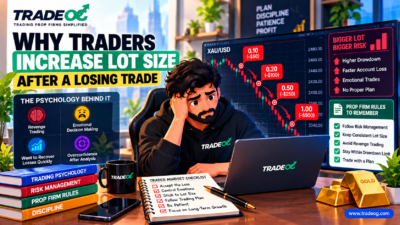

One of the most important forex trading skills is knowing when not to take a trade. Beginners often focus on finding entries, but experienced traders understand that avoiding low-quality setups can protect both capital and consistency.
Not every market condition deserves a position. Sometimes the best trade is no trade at all.
Why Knowing When Not to Trade Matters
A trading strategy does not need to generate signals all the time. If your rules only work under specific conditions, forcing trades outside those conditions can turn a tested edge into random speculation.
Every unnecessary trade also creates costs: spread, commissions where applicable, slippage, mental energy, and the possibility of losing capital on a setup that never met your rules.
10 Signs You Should Not Take a Forex Trade
1. There Is No Clear Setup
If you cannot explain exactly why the trade meets your entry rules, do not take it. A feeling that price “looks ready” is not the same as a defined setup.
Before entering, identify the trigger, invalidation level, stop-loss, target, and reason the setup fits your strategy. If those elements are missing, waiting is usually better.
2. The Market Is Choppy and Directionless
Sideways markets can produce repeated false breakouts and conflicting signals. If your strategy performs best in trends but the market is moving in a narrow, overlapping range, there may be no edge.
Do not force a trend-following setup simply because you have been waiting for a trade.
3. Major Economic News Is About to Be Released
High-impact economic releases can cause sudden volatility, spread changes, slippage, and rapid price reversals. If your strategy has not been tested around major news, waiting until the market stabilizes may be more sensible.
The exact decision should depend on your strategy and the trading rules of your broker or prop firm. Never assume that every news event affects every currency pair in the same way.
4. The Risk-to-Reward Ratio Is Poor
A technically attractive entry can still be a bad trade if the logical stop is too large relative to the realistic profit target.
If your planned entry offers little room before a major resistance or support level, do not manufacture a target just to make the trade look attractive. Let the market offer an acceptable structure first.
5. You Are Chasing a Move
After a large candle or sudden breakout, traders often feel pressure to enter because they believe they are missing the opportunity.
This is commonly called FOMO. If the original entry has already passed, wait for the next valid setup rather than changing your rules to catch the move.
6. You Are Trading to Recover a Loss
Revenge trading is one of the clearest reasons to stay out of the market.
If your motivation is “I need to make back what I just lost,” your decision-making is no longer based purely on your trading plan. Step away, review the previous trade, and return only when you can follow your normal process.
7. You Have Already Hit Your Daily Risk Limit
A daily loss limit is designed to prevent one bad session from becoming a major account problem. Once your predefined risk limit is reached, continuing to trade usually changes the objective from executing a strategy to trying to recover money.
For prop firm accounts, always follow the firm’s current drawdown and daily-loss rules rather than relying on generic limits.
8. You Are Tired, Distracted, or Emotional
Your trading setup can be perfect and the trade can still be wrong for you if your mental state is poor.
If you are angry, anxious, extremely tired, distracted, or desperate to make money, reducing exposure or stopping for the session can be a professional risk-management decision.
9. The Timeframe Is Too Noisy for Your Strategy
A strategy designed for a higher timeframe may perform poorly when applied to a very low timeframe filled with market noise.
Do not switch timeframes simply because the current chart is not giving you the signal you want. Use the timeframe defined in your tested plan.
10. The Trade Is Not in Your Trading Plan
This is the simplest filter of all.
If your plan says you trade specific pairs, sessions, setups, and risk parameters, a trade outside those rules is not automatically an opportunity. It is an untested decision.
The Forex No-Trade Checklist
Before entering any forex position, ask:
- Is my exact setup present?
- Is the market condition suitable for my strategy?
- Do I know where the trade is invalidated?
- Is the risk acceptable?
- Is the potential reward realistic?
- Is major economic news approaching?
- Am I entering because of my plan or because of FOMO?
- Am I trying to recover a previous loss?
- Am I mentally prepared to take this trade?
- Does this trade fit my written rules?
If several answers are “no,” there is no obligation to trade.
Good Traders Do Not Trade Every Signal
A common misconception is that successful traders are constantly entering positions. In reality, selectivity is an important part of many trading approaches.
Your strategy may produce ten potential setups, but after applying your filters only two may be worth considering. The objective is not to maximize the number of trades. It is to execute the trades that actually match your tested edge.
How to Build a No-Trade Rule
Create a written list of conditions that automatically stop you from trading.
For example:
- No clear setup = no trade.
- Outside trading session = no trade.
- Risk-to-reward below your tested minimum = no trade.
- Major untested news event approaching = no trade.
- Daily risk limit reached = no trade.
- Emotional or impaired decision-making = no trade.
- Setup does not match the strategy = no trade.
The exact rules should come from your own testing rather than copying another trader’s checklist.
Waiting Is a Trading Decision
Not taking a trade does not mean you missed an opportunity. If the setup did not meet your rules, staying flat means you successfully followed your process.
This mindset is especially important for traders who feel uncomfortable when they are not in the market. The market will continue producing opportunities. You do not need to participate in every movement.
What to Do When There Is No Trade
Use the time productively instead of searching for a reason to enter.
- Review previous trades.
- Update your trading journal.
- Mark important support and resistance levels.
- Check the economic calendar.
- Review whether current conditions match your strategy.
- Study your historical statistics.
- Wait for the next valid setup.
This turns inactivity into part of the trading process rather than something that feels like failure.
Forex Trading: Quality Over Quantity
More trades do not automatically mean more profit. If a trader takes low-quality setups simply to stay active, the additional trades can reduce overall performance.
A better objective is to maximize the quality of decisions. One well-planned trade can be more valuable than several impulsive trades, especially when risk is controlled consistently.
Final Takeaway
Knowing when not to take a forex trade is a core trading skill, not a sign of hesitation.
Stay out when there is no clear setup, market conditions do not fit your strategy, risk-to-reward is poor, major untested news is approaching, you are chasing price, you are revenge trading, or your mental state is compromised.
The strongest traders are not necessarily the ones who find the most trades. They are often the ones who can confidently say “no trade” when the market does not offer a setup that fits their plan.
FAQs
When should I not take a forex trade?
Avoid a trade when your setup is unclear, market conditions do not match your strategy, the risk is excessive, the reward is unrealistic, or your emotional state is affecting your decisions.
Should I avoid forex trading before major news?
If your strategy has not been tested during high-impact news, avoiding the event or waiting for volatility to settle can reduce unnecessary execution risk. Always check the rules that apply to your account.
Is it okay to have a day with no forex trades?
Yes. A no-trade day can be a successful day if there were no setups that met your predefined criteria.
How do I avoid FOMO in forex trading?
Use predefined entry rules and accept that missed trades are normal. Do not change your entry criteria simply because price has already moved.
What is the most important no-trade rule?
The most important rule is to avoid trades that do not meet your tested strategy. A setup outside your plan has no established statistical edge.