


If you’re new to trading, the jargon can feel like a different language. Words like “bullish,” “leverage,” or “stop-loss” get thrown around like everyone should already know them. But nobody is born knowing this stuff — every trader had to learn it at some point.
This glossary breaks down the most important trading terms in plain, easy English. No confusing definitions, no unnecessary jargon. Just simple explanations with real-life examples, so you actually understand what you’re reading — not just memorize it.
Bookmark this page. You’ll probably come back to it more than once.
Basic Trading Terms Every Beginner Should Know
1. Market
A market is simply a place — physical or online — where people buy and sell things like stocks, currencies, or commodities. The stock market, for example, is where shares of companies are bought and sold.
2. Stock (or Share)
A stock is a small piece of ownership in a company. If you buy one share of a company, you own a tiny part of that business. If the company does well, your share usually becomes more valuable.
3. Broker
A broker is the middleman between you and the market. You can’t just walk up and buy stocks yourself — you need a broker (usually an app or platform) to place the trade for you.
4. Bid and Ask
- Bid price: The highest price a buyer is willing to pay for something.
- Ask price: The lowest price a seller is willing to accept.
The tiny gap between these two is called the spread.
5. Bull Market
A bull market is when prices are generally going up, and people feel confident and optimistic about the market’s future. Think of a bull attacking upward with its horns — that’s the image to remember.
6. Bear Market
The opposite of a bull market. Prices are falling, and people feel worried or pessimistic. A bear swipes downward with its paws — hence the name.
7. Volatility
Volatility means how much and how fast a price moves up or down. A highly volatile stock can jump 10% in a day. A low-volatility stock barely moves at all.

Order Types Explained Simply
8. Market Order
This means “buy or sell right now, at whatever the current price is.” It’s fast, but you don’t control the exact price you get.
9. Limit Order
This means “only buy or sell if the price reaches a specific level I choose.” It gives you control over price, but there’s no guarantee your order will actually go through.
10. Stop-Loss Order
A safety net. It automatically sells your stock if the price drops to a certain level, so you don’t lose more money than you’re comfortable with.
11. Take-Profit Order
The opposite of a stop-loss. It automatically sells your stock once it hits a certain profit level, locking in your gains before the price can drop again.
Chart and Technical Analysis Terms
12. Candlestick Chart
A popular way to show price movement over time. Each “candle” shows four things: the opening price, closing price, highest price, and lowest price for that time period.
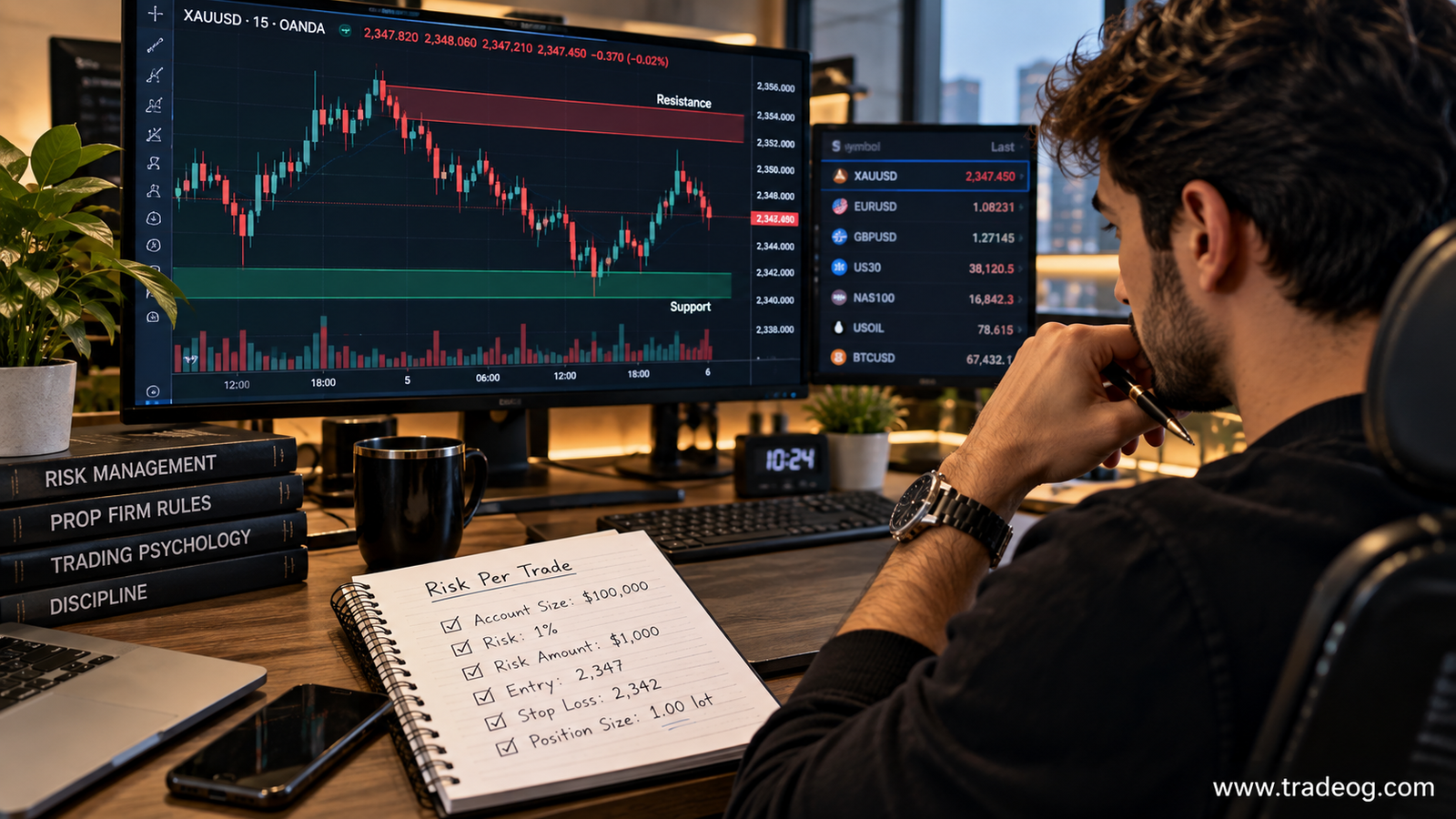
13. Support Level
A price point where a stock tends to stop falling and bounce back up, almost like a floor.
14. Resistance Level
The opposite of support — a price point where a stock tends to stop rising, like it’s hitting a ceiling.
15. Trend
The general direction a price is moving — up (uptrend), down (downtrend), or sideways (no clear direction).
16. Moving Average
An indicator that smooths out price data by calculating the average price over a certain number of days. It helps traders see the overall trend without getting distracted by daily ups and downs.
17. RSI (Relative Strength Index)
A tool that tells you if a stock might be “overbought” (price rose too fast, might drop soon) or “oversold” (price fell too fast, might bounce back).
18. Volume
The number of shares or contracts traded during a specific time period. High volume usually means strong interest — either buying or selling.
Risk and Money Management Terms
19. Leverage
Borrowing money from your broker to trade a bigger position than your own money would allow. It can multiply your profits, but it can also multiply your losses just as fast.
20. Margin
The amount of your own money you need to put up when using leverage. Think of it as a deposit or down payment.
21. Liquidity
How easily something can be bought or sold without affecting its price too much. A stock with high liquidity has lots of buyers and sellers, so trades happen quickly and smoothly.
22. Diversification
Not putting all your eggs in one basket. Spreading your money across different stocks or assets so that if one performs badly, it doesn’t wipe out your entire portfolio.
23. Portfolio
The complete collection of all the investments you own — stocks, bonds, crypto, or anything else.
24. Risk-Reward Ratio
A comparison of how much you could lose versus how much you could gain on a trade. A 1:3 risk-reward ratio means you’re risking $1 to potentially make $3.
Trading Styles
25. Day Trading
Buying and selling within the same day. Day traders close all their positions before the market closes, so they don’t hold anything overnight.
26. Swing Trading
Holding a trade for several days or weeks, trying to catch a “swing” in price direction.
27. Scalping
An extremely short-term trading style where traders make dozens or even hundreds of tiny trades a day, aiming for small profits each time.
28. Position Trading
A long-term approach where trades are held for months or even years, based on big-picture trends rather than daily price movement.
Common Trading Slang and Abbreviations
29. Long Position
Buying something because you expect its price to go up. “Going long” simply means betting on a price increase.
30. Short Position
Betting that a price will fall. “Shorting” a stock means you borrow it, sell it now, and hope to buy it back later at a lower price for a profit.
31. HODL
A popular crypto term (originally a typo for “hold”) meaning to hold onto your investment long-term, no matter how much the price swings.
32. FOMO (Fear of Missing Out)
The anxious feeling of jumping into a trade just because everyone else seems to be making money, often leading to poor decisions.
33. Dip
A short-term drop in price. “Buying the dip” means purchasing an asset while its price is temporarily low, expecting it to recover.
34. Rally
A quick and noticeable rise in prices, usually after a period of decline or flat movement.
35. Correction
A drop of about 10% or more from a recent high — usually seen as a normal, healthy pullback rather than a full crash.
36. Crash
A sudden and severe drop in prices, much sharper and faster than a normal correction.
Fundamental Analysis Terms
37. IPO (Initial Public Offering)
The very first time a company sells its shares to the public. Before an IPO, a company is privately owned.
38. Dividend
A portion of a company’s profit that gets paid out to shareholders, usually every few months, as a reward for owning the stock.
39. Market Cap (Market Capitalization)
The total value of a company, calculated by multiplying its share price by the total number of shares it has.
40. Earnings Report
A quarterly update where a company shares how much money it made (or lost). Traders watch these closely because they can cause big price swings.
Final Thoughts
Trading has its own language, but once you understand the basics, it stops feeling intimidating. You don’t need to memorize every term overnight — just come back to this glossary whenever you hit a word you don’t recognize.
The best traders aren’t the ones who know every fancy term. They’re the ones who understand the basics deeply and use that knowledge to make smart, calm decisions — even when the market gets noisy.
Want to keep learning? Check out our other beginner guides on how to read stock charts and how to build your first trading strategy.



[…] before paying a challenge fee. If you are unfamiliar with standard prop terminology, review our trading glossary for clear definitions of key […]