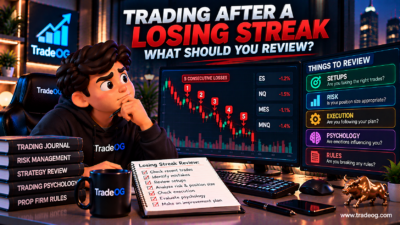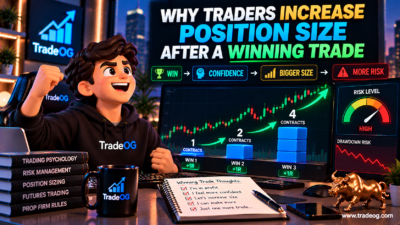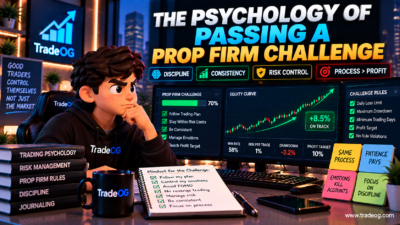

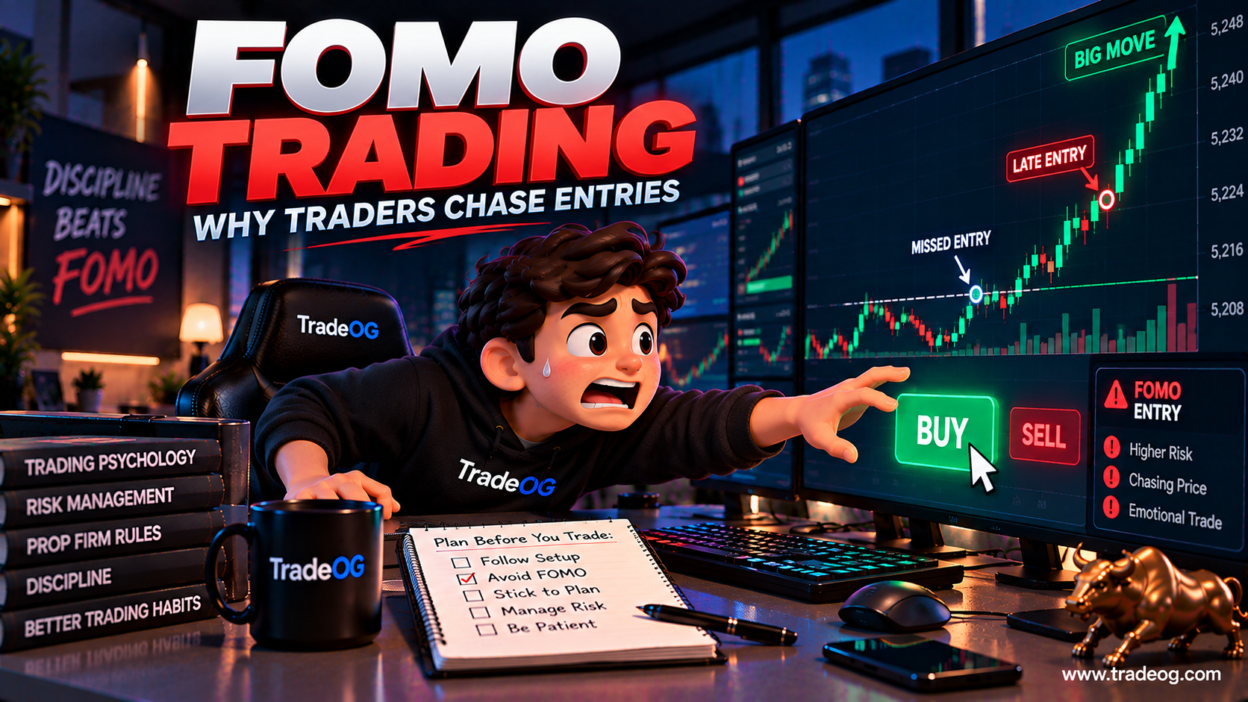
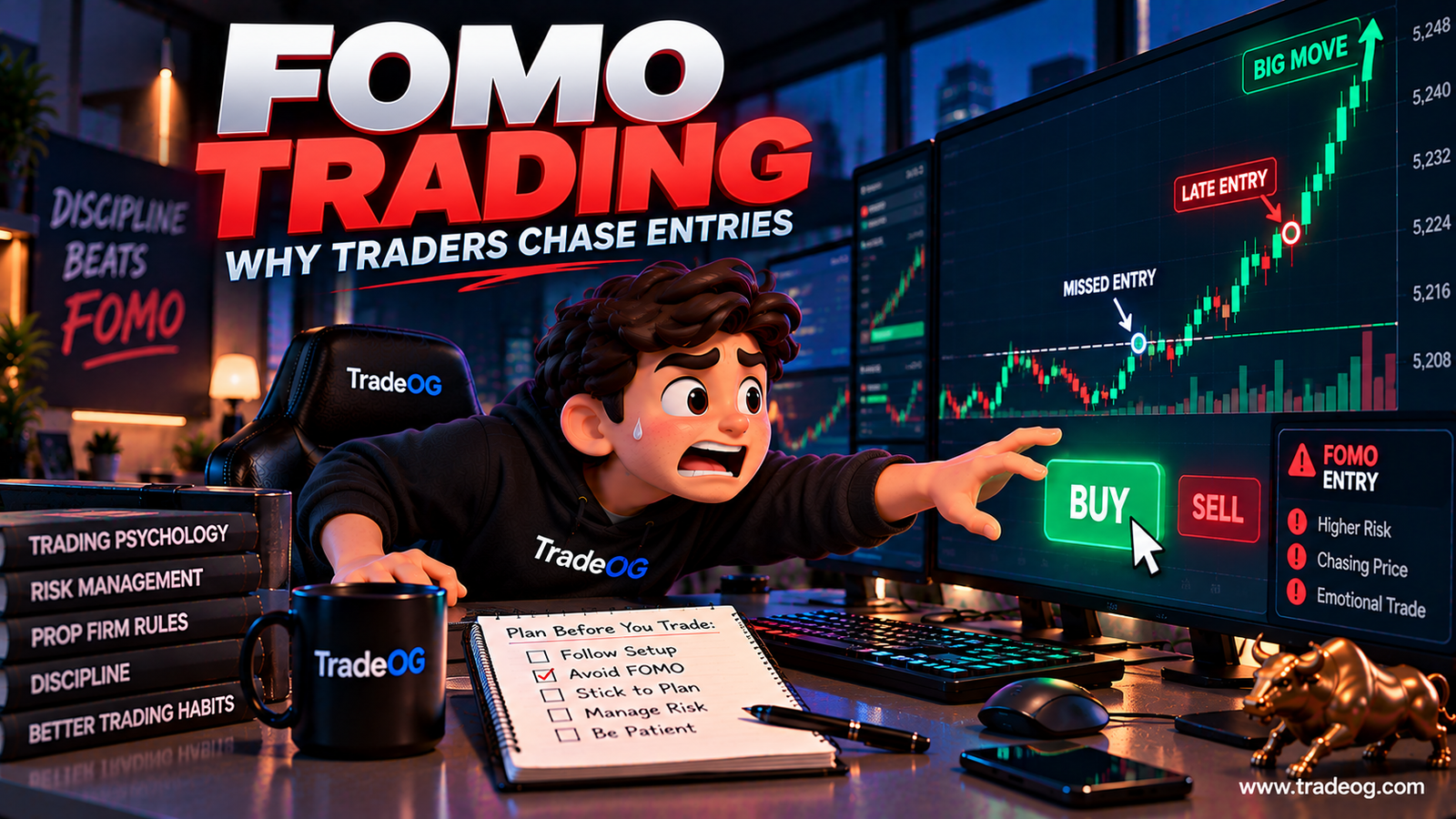
FOMO trading in futures usually starts with a simple feeling: the market is moving without you. A strong breakout appears, price accelerates, other traders seem to be making money, and suddenly the trader feels that waiting is more dangerous than entering.
That is how a planned setup can turn into a chase.
The trader may enter several points after the original level, move the stop because the logical stop is now too far away, reduce the profit target, increase position size to compensate for the late entry, or immediately re-enter when the first chase fails. In a futures prop firm challenge, those decisions can have an additional consequence because the trader is working inside defined risk and drawdown rules.
CME Group’s trading-psychology material emphasizes that traders need to understand psychological barriers and build a trading plan suited to their own process. CME educational content also specifically advises traders not to force trades because of FOMO and notes that another opportunity will exist. CME Group — Trading Psychology and CME Group — Plan Ahead & Be Proactive.
This article explains why futures traders chase entries, what FOMO looks like in real trading, how it affects position sizing and risk-to-reward, why prop firm challenges can intensify the behaviour, and how to create practical rules that make chasing less likely.
What Is FOMO Trading?
FOMO means fear of missing out. In trading, it describes the emotional pressure to participate in a market move because the trader believes that waiting will cause them to miss an opportunity.
FOMO is different from a normal trading decision.
A planned breakout trader might define a resistance level before the session, wait for price to reach it, establish confirmation criteria and calculate position size before entering.
A FOMO trader may see the breakout after it has already happened and think:
- “It is going without me.”
- “I need to get in now.”
- “If I wait for a pullback, I will miss the whole move.”
- “Everyone else is making money.”
- “I can manage the stop after I enter.”
The chart may look similar, but the decision process is completely different.
Why Do Futures Traders Chase Entries?
1. The brain treats a missed opportunity like a loss
A trader can watch ES rally 20 points without having a position and feel genuine frustration even though the account has lost nothing.
This is important.
The trader’s account is unchanged, but psychologically the trader may feel that money was “left on the table.” That perceived missed profit creates urgency.
The urgency then encourages action simply to remove the uncomfortable feeling.
FTMO’s educational material describes FOMO as a fear of missing large opportunities and identifies volatile markets, winning streaks, repeated losses, news and social influences as factors that can intensify it. FTMO — FOMO: The Fear of Missing Out.
2. Futures markets can move very quickly
Futures traders often watch instruments where a short burst of volatility can move price through several levels in a matter of seconds or minutes.
When price accelerates, a trader has less time to make a decision. A planned entry can suddenly become a missed entry.
The trader then faces a choice:
- wait for a new setup;
- wait for a pullback;
- accept that the move was missed;
- or chase the current price.
FOMO is the emotional pressure that makes the final option feel attractive.
3. A profit target creates urgency
Prop firm challenges can make FOMO stronger because the trader has a visible objective.
Suppose a hypothetical challenge requires $3,000 in profit. The trader sees NQ make a strong move and calculates that a position could have produced $500 or $700.
The trader begins thinking about the remaining target rather than the next valid setup.
That can create a dangerous mental equation:
Missed move = lost progress = need to catch the next move.
The market does not work that way. A missed trade does not create a trading debt.
4. Social media makes every missed move look obvious
Trading screenshots often show entries after the market has already moved. The chart looks simple in hindsight.
A trader scrolling through social media may see several profitable trades in a row and begin believing that every move was obvious.
This creates hindsight pressure:
“Why didn’t I take that?”
The next chart move then feels like an opportunity that must not be missed.
FTMO also warns that news, rumours and social media can influence FOMO-driven decisions and recommends taking time to evaluate information rather than following the crowd. FTMO — FOMO and Trading Psychology.
The Anatomy of a FOMO Entry
A typical FOMO sequence looks like this:
- The trader has a planned level.
- Price approaches the level.
- The trader hesitates.
- Price breaks the level.
- The breakout candle expands rapidly.
- The trader worries about missing the move.
- The trader enters late.
- The stop is now farther from the entry than originally planned.
- The reward-to-risk ratio becomes less attractive.
- The trader starts managing an uncomfortable position.
The key point is that the trade often becomes less attractive precisely when the trader feels the strongest urge to enter.
Planned Entry vs FOMO Entry
| Planned Entry | FOMO Entry |
|---|---|
| Level identified in advance | Level noticed after the move |
| Entry conditions defined | Entry justified by urgency |
| Risk calculated before execution | Risk calculated after entry or improvised |
| Stop location is logical | Stop may be too wide or arbitrary |
| Position size follows risk | Size may change because of excitement |
| Missing the trade is acceptable | Missing the trade feels unacceptable |
| Next opportunity is expected | Current move feels like the only opportunity |
Why Chasing Usually Changes the Risk Profile
One of the biggest problems with FOMO is that the entry changes but the trader often keeps the original idea.
Imagine a trader plans to buy a breakout at 5,200 in a hypothetical index future. The planned stop is 5,190, creating a 10-point stop distance.
Instead, price breaks 5,200 and runs to 5,215. The trader finally enters at 5,215.
If the same stop remains at 5,190, the stop distance is now:
5,215 − 5,190 = 25 points
The trader has transformed a planned 10-point risk into a 25-point risk without changing the strategy.
There are only a few ways out:
- accept the larger risk;
- reduce position size;
- use a different logical stop;
- wait for a new setup.
FOMO often causes traders to choose none of these deliberately. They enter first and solve the risk problem afterward.
FOMO Can Destroy Risk-to-Reward
Entry location directly affects reward-to-risk.
Suppose a planned long setup has:
- entry: 100;
- stop: 95;
- target: 110.
The planned risk is 5 points and the planned reward is 10 points, producing a 1:2 risk-to-reward structure.
If the trader chases at 106 while keeping the same stop and target, the risk becomes 11 points while the remaining reward is only 4 points.
The original structure has effectively disappeared.
This is why a trader can be directionally correct and still take a poor trade.
The problem is not necessarily the market direction. It is the location and timing of the entry.
FOMO and Futures Position Size
FOMO can affect position size in two opposite ways.
Oversizing
A trader may believe that a large move is unusually certain and increase the position to capture it.
This is dangerous because confidence generated by a fast move is not the same as a statistically tested edge.
Undersizing but trading anyway
Another trader may know the entry is late and reduce size, but still take the trade despite the setup no longer meeting the original criteria.
Reducing size does not automatically convert a bad setup into a good setup.
Risk control and trade validity are separate questions.
FOMO in ES, NQ and Micro Futures
Futures traders often use instruments such as ES, MES, NQ and MNQ. The Micro contracts can provide smaller dollar exposure than their E-mini counterparts, but smaller size does not remove the psychological problem of chasing.
A trader can FOMO into one MNQ contract just as easily as into multiple NQ contracts.
The difference is the financial consequence, not the behavioural trigger.
CME’s futures education emphasizes understanding contract specifications and managing position size according to risk rather than simply trading the maximum size available. CME Group — Position and Risk Management.
Why a Big Green Candle Creates FOMO
A large candle compresses a lot of information into a small amount of screen time.
The trader sees:
- strong directional movement;
- multiple candles in the same direction;
- increasing momentum;
- potential profit expanding rapidly;
- price moving farther from the previous entry area.
The visual impression is that the market is becoming more certain.
But a larger candle does not guarantee that the next candle will continue in the same direction.
The trader must separate movement already achieved from future opportunity still available.
That distinction is at the heart of avoiding FOMO.
The “It Will Keep Going” Trap
One of the most common FOMO thoughts is:
“It has already moved this far, so it will probably continue.”
The statement can be true sometimes. It is not enough to justify an entry by itself.
A trader needs to know what continuation condition is actually being traded.
For example:
- breakout and retest;
- pullback into a defined level;
- opening-range breakout confirmation;
- trend continuation after a planned consolidation;
- specific momentum condition tested in historical data.
Without a defined condition, “it will keep going” is a prediction rather than a trading rule.
FOMO After Missing an Opening Move
Futures traders often encounter this around major market opens.
The first directional move can be fast. A trader waits for confirmation, but the market does not provide the expected pullback.
The trader then enters at a much worse price because the original move is already underway.
A useful rule is:
Missing the first move does not invalidate the trading session.
There may be a retest, consolidation, second setup or later opportunity. If none appears, remaining flat is still an acceptable outcome.
FOMO Around Economic News
Scheduled economic events can produce unusually fast price movement. The visual effect can be especially powerful: a large candle appears immediately, followed by several smaller continuation candles.
FOMO can make the trader want to enter after the first expansion.
But news-related execution can also involve rapid price changes, spread changes, slippage or firm-specific restrictions. The trader should therefore verify the current rules of the relevant prop firm and understand the execution characteristics of the product.
Topstep, for example, publishes current guidance concerning economic releases and its trading rules. Topstep — Economic Releases.
FTMO also maintains separate rules for news trading depending on the account model and product. FTMO — Can I Trade During News?
FOMO and Prop Firm Challenge Pressure
Prop firm challenges can create several psychological pressures at the same time:
- visible profit target;
- limited drawdown;
- time pressure for some account models;
- fear of losing the challenge fee;
- comparison with other traders;
- desire to pass quickly.
These pressures can turn a missed trade into a perceived threat.
Instead of thinking:
“I missed that setup.”
The trader starts thinking:
“If I miss another move, I may not pass.”
That mental shift can encourage chasing.
FTMO’s discussion of the mental game of its challenge similarly highlights how focusing too heavily on the profit objective can encourage traders to stop following process and start trading the desired result. FTMO — The Mental Game of the FTMO Challenge.
FOMO Can Become Overtrading
FOMO is often the first emotional trigger. Overtrading can be the resulting behaviour.
The sequence can look like:
Missed move → chase entry → stop-out → fear of missing the next move → immediate re-entry → another loss → more chart watching → more trades.
This is why FOMO should be addressed before it turns into a frequency problem.
FOMO vs Momentum Trading
Momentum trading is not automatically FOMO trading.
A momentum strategy can legitimately enter after price has begun moving if the entry conditions are defined and tested.
The difference is whether the trader is following a repeatable rule.
| Momentum Trading | FOMO Chasing |
|---|---|
| Entry conditions defined | Entry triggered by urgency |
| Position size predetermined | Size may change because of excitement |
| Stop is planned | Stop may be improvised |
| Late entry has a tested reason | Late entry exists because price is moving |
| Missed setup is accepted | Missing feels unacceptable |
| Repeatable across many trades | Often inconsistent |
How to Recognize a FOMO Entry Before Clicking Buy or Sell
FOMO usually has physical and behavioural signals.
You may notice:
- rapidly switching between timeframes;
- clicking the order ticket before calculating risk;
- feeling your attention narrow onto one candle;
- checking how far price has already moved;
- thinking about missed profit instead of current risk;
- feeling that waiting is unbearable;
- changing the planned entry level;
- moving the stop farther away to justify the entry.
These signals do not prove that a trade is bad. They are warning signs that the decision should slow down.
The Three-Question FOMO Test
Before entering a fast-moving market, ask:
- Where was my original planned entry?
- Is the setup still valid at the current price?
- Would I take this trade if I had not just watched the move happen?
If the answer to the third question is no, the previous move may be influencing the decision.
A Better Question Than “Will It Keep Going?”
Instead of asking whether price will continue, ask:
“What exact condition would make this entry valid now?”
This changes the thought process from prediction to criteria.
For example:
- “I will enter only after a pullback to the breakout level.”
- “I need a candle close beyond the level.”
- “I need a retest and rejection.”
- “I need my predefined momentum condition.”
If the condition does not occur, there is no trade.
How to Prevent FOMO With Predefined Entry Zones
One practical method is to define an entry zone before the session.
Instead of deciding after price moves:
“I will buy somewhere around here.”
define:
- ideal entry;
- maximum acceptable entry;
- invalidation level;
- target area;
- position size;
- conditions for cancelling the setup.
Once price moves beyond the maximum acceptable entry, the setup can be marked as missed rather than chased.
Use Alerts Instead of Constantly Watching the Chart
Constant chart watching can increase FOMO because the trader sees every candle.
Price alerts can reduce the need to monitor every tick. An alert can tell the trader that price has reached a predefined area, after which the trader can evaluate the setup according to the plan.
The objective is not to eliminate screen time completely. It is to reduce the number of decisions triggered purely by visual movement.
Build a “Missed Trade” Rule
Every trading plan should answer one question:
What do I do when the market moves without me?
A simple rule could be:
If price moves beyond my predefined entry without triggering my setup, I do not chase. I wait for the next valid setup.
This rule is powerful because the decision is made before FOMO appears.
FOMO and Re-Entry After a Missed Trade
Some traders miss the first entry and then repeatedly attempt to find a way into the same move.
For example:
- Price breaks resistance.
- Trader hesitates.
- Price moves higher.
- Trader buys late.
- Price pulls back.
- Trader exits.
- Price rises again.
- Trader buys again.
The trader is effectively trying to correct the original hesitation.
The market does not owe a second chance.
A better rule is to define whether re-entry is part of the strategy. If it is not, the trader should not invent one after missing the original move.
How to Journal FOMO Trading
FOMO becomes easier to manage when it is measurable.
Add these fields to the trading journal:
- planned entry;
- actual entry;
- difference between planned and actual entry;
- market movement before entry;
- reason for late entry;
- position size;
- planned risk;
- actual risk;
- time between setup and execution;
- whether a pullback was available;
- emotional state;
- whether the trade would have been taken without the preceding move.
A particularly useful metric is:
Entry Chase Distance = Actual Entry − Planned Entry
For a short setup, the sign changes, but the concept remains the same: measure how far the actual execution moved away from the planned price.
After 30–50 trades, you may be able to see whether larger chase distances correlate with worse outcomes.
Track the Result of Missed Trades
This is an underrated exercise.
When you miss a setup, record what happened afterward without entering.
For example:
| Missed Setup | What Happened Without Entry |
|---|---|
| Breakout | Price continued |
| Breakout | Price immediately reversed |
| Pullback | Price returned to entry zone later |
| Momentum move | Price consolidated for 20 minutes |
This gives the trader real data instead of allowing the mind to remember only the moves that continued.
FOMO often survives because traders remember missed winners but forget missed trades that would have lost.
FOMO After a Winning Streak
FOMO is not limited to losing traders.
A winning streak can create overconfidence:
“I am reading the market perfectly today.”
The trader becomes less selective and begins chasing additional moves.
FTMO’s FOMO material identifies winning streaks as one possible external or psychological factor that can contribute to FOMO. FTMO — FOMO: The Fear of Missing Out.
The lesson is simple: a good start to the session does not justify abandoning the process.
FOMO After a Losing Streak
After several losses, FOMO can take a different form.
The trader becomes afraid of missing the trade that finally turns the day around.
That can create a combination of FOMO and revenge trading:
“This could be the move that gets me back to breakeven, so I cannot miss it.”
Now the trader is emotionally invested in the next setup before it even occurs.
That makes objective evaluation harder.
FOMO and the Prop Firm Drawdown Limit
FOMO becomes more dangerous as remaining drawdown gets smaller.
Imagine a hypothetical account with $1,500 of remaining drawdown.
The trader sees a breakout and enters late with a larger-than-planned stop. A loss of $300 would consume 20% of the remaining drawdown.
If the trader then chases another setup, the account is exposed to another independent risk event.
The key concept is remaining risk capacity.
The fact that a trader is allowed to trade does not mean that every opportunity should be taken.
Why “I Don’t Want to Miss This One” Is Not a Risk Model
Urgency is not a position-sizing formula.
Position size should come from the relationship between planned risk, stop distance and contract value.
CME’s position and risk-management education encourages traders to select contract quantity and stop placement according to risk rather than simply trading the maximum margin available. CME Group — Position and Risk Management.
If the trader cannot calculate the risk because the entry is moving too quickly, that itself can be a reason to wait.
Practical FOMO Prevention Rules
Rule 1: Never chase beyond the maximum entry
Define the maximum acceptable entry before the session.
Rule 2: Calculate risk before execution
If the trade is moving too quickly to calculate position size and stop distance, do not improvise.
Rule 3: Accept missed trades
Record them. Learn from them. But do not turn them into forced entries.
Rule 4: Require a fresh setup after a missed move
The next trade should qualify independently.
Rule 5: Do not increase size because price is moving quickly
Momentum is not permission to abandon the risk model.
Rule 6: Use alerts
Let predefined levels notify you rather than allowing every candle to trigger a decision.
Rule 7: Review chase distance
Measure planned versus actual entry over a meaningful sample.
A Simple FOMO Decision Tree
Before entering a fast-moving futures market:
- Was the setup planned? If no, stop and reassess.
- Is price still inside the planned entry zone? If no, do not automatically chase.
- Is the setup condition still valid? If no, wait.
- Can the stop be placed at a logical level? If no, wait.
- Can position size be calculated from the planned risk? If no, wait.
- Would you take this trade if you had not just watched the move? If no, step away.
What to Do After You Already Chased an Entry
If you realize after entering that the trade was driven by FOMO, the answer is not automatically to close the position immediately or automatically hold it.
Instead, return to the predefined trade-management rules.
Ask:
- Where is the valid stop according to the strategy?
- What was the original planned risk?
- Has the trade now exceeded that risk?
- Does the current position still meet the strategy’s criteria?
- Is the position size consistent with the plan?
The important lesson is to avoid making a second emotional decision simply because the first decision was emotional.
FOMO and Trading Frequency
A trader who repeatedly chases entries can also develop an overtrading problem.
Every missed move becomes a trigger. Every trigger produces an entry. Every entry creates a new emotional event.
Topstep’s current educational material on the funded trader mindset explicitly describes FOMO as a source of overtrading and emotional decisions and recommends stepping back after a missed move rather than forcing a trade. Topstep — Funded Trader Mindset.
This is an important distinction: patience is not inactivity; patience is waiting for your conditions.
Common FOMO Trading Mistakes
Entering because the candle is large
A large candle tells you what already happened. It does not automatically define the next entry.
Moving the stop after entering
A late entry can tempt the trader to widen the stop to accommodate the worse price. That changes the original risk model.
Increasing size to compensate for a late entry
Trying to make the same amount of money from a worse entry can produce unnecessary exposure.
Chasing after social-media screenshots
Hindsight charts can make entries look easier than they were in real time.
Trading every breakout
Not every breakout satisfies the conditions of your strategy.
Assuming missed profit is a loss
You cannot lose money you never put at risk. A missed trade is an opportunity you did not take.
FOMO Checklist for Futures Traders
Before clicking Buy or Sell on a rapidly moving market, ask:
- Did I define this setup before the move started?
- Is my planned entry still available?
- Has price already moved too far from my level?
- Can I define a logical stop?
- Can I calculate position size before entry?
- Does the trade still have acceptable reward-to-risk?
- Am I entering because of a rule or because I am afraid of missing out?
- Would I take this trade if I had not seen the previous candle?
- Am I within my personal daily risk limit?
- Does this trade comply with the current prop firm’s rules?
Final Takeaway
FOMO trading in futures happens when the fear of missing a move becomes stronger than the trader’s commitment to the original entry process.
The most common pattern is easy to recognize in hindsight: a trader misses the planned entry, watches price accelerate, enters late, discovers that the stop is now too far away, and then starts managing a trade that was never properly planned.
The solution is not to predict the market perfectly. It is to define the conditions under which a trade is valid and accept that some moves will happen without you.
A missed trade does not create a debt. The next candle does not owe you an entry. And a prop firm profit target does not make every market movement a required opportunity.
Build the entry before the excitement. Define the maximum acceptable price. Calculate risk before clicking. Use alerts. Record missed trades. Measure chase distance. Most importantly, make it normal to do nothing when the market has already moved beyond your setup.
As CME’s trading guidance puts it, traders should avoid forcing trades because of FOMO; there will be another opportunity. CME Group — Plan Ahead & Be Proactive.
FAQs About FOMO Trading in Futures
What is FOMO trading in futures?
FOMO trading is entering a futures position primarily because the trader fears missing a price move, rather than because the current price and market conditions satisfy a predefined trading setup.
Why do traders chase entries?
Common triggers include fast volatility, missed breakouts, social-media influence, profit-target pressure, recent winning or losing streaks, fear of missing the only opportunity and discomfort with remaining flat.
Is momentum trading the same as FOMO?
No. A momentum strategy can deliberately enter after price starts moving if the entry condition, stop, position size and management rules have been tested. FOMO is characterized by emotional urgency replacing those predefined criteria.
How can I stop chasing futures entries?
Define an entry zone and maximum acceptable price before the session, use alerts, calculate risk before execution, and create a rule that a missed setup must not be chased unless a new valid setup forms.
Why is FOMO dangerous in a prop firm challenge?
A late or oversized entry can consume more risk capacity than planned. In a prop challenge, that can interact with the account’s drawdown, daily-loss, position-size or other rules. The exact consequences depend on the firm’s current program.
Should I enter if a futures market is moving very fast?
Speed alone is not a reason to enter. If the market is moving faster than you can calculate the planned entry, stop and position size, waiting for a defined condition may be more consistent with a risk-controlled process.
How can I measure FOMO in my trading journal?
Record planned entry, actual entry, chase distance, time between setup and execution, position size, planned versus actual risk and the reason for entering late. Reviewing these metrics over a meaningful sample can reveal patterns.
What should I do after missing a big futures move?
Record the missed setup, observe what happened afterward and wait for the next independently valid opportunity. Do not treat missed profit as a loss that must be recovered.
TradeOG note: Futures trading involves substantial risk, and prop firm rules can vary by company, account type, product and platform. Always verify the current official rules and your own risk plan before trading.