

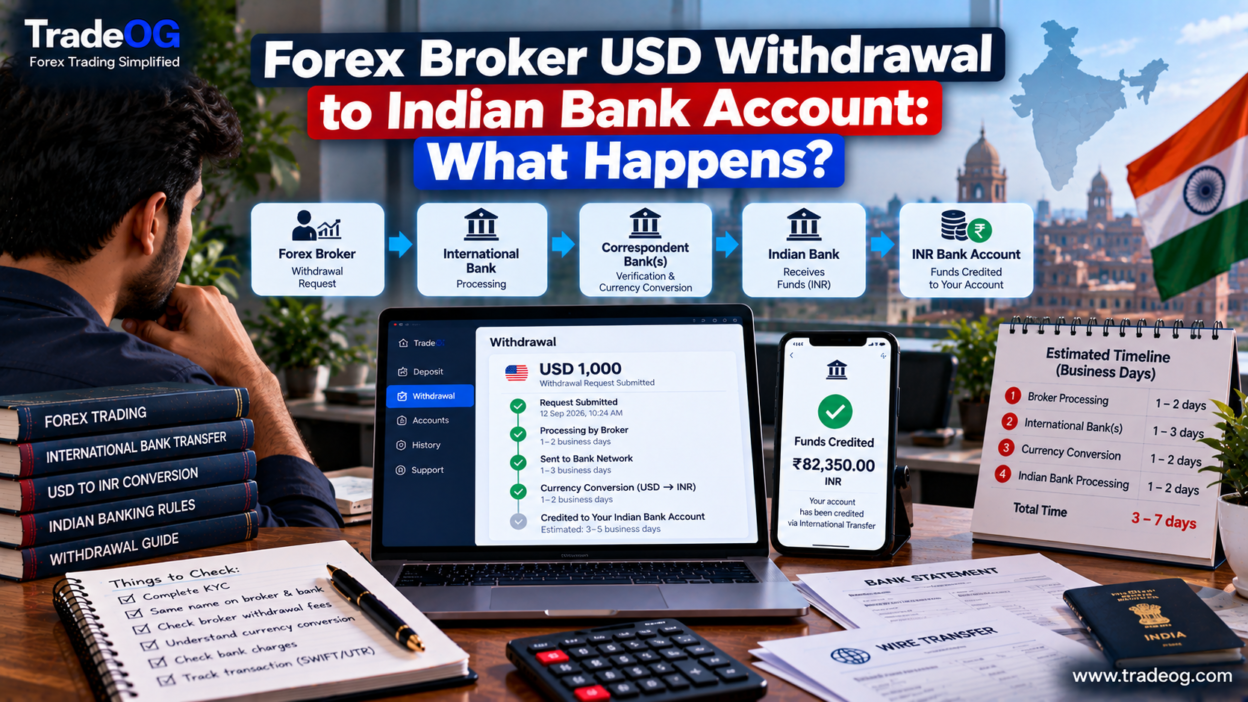
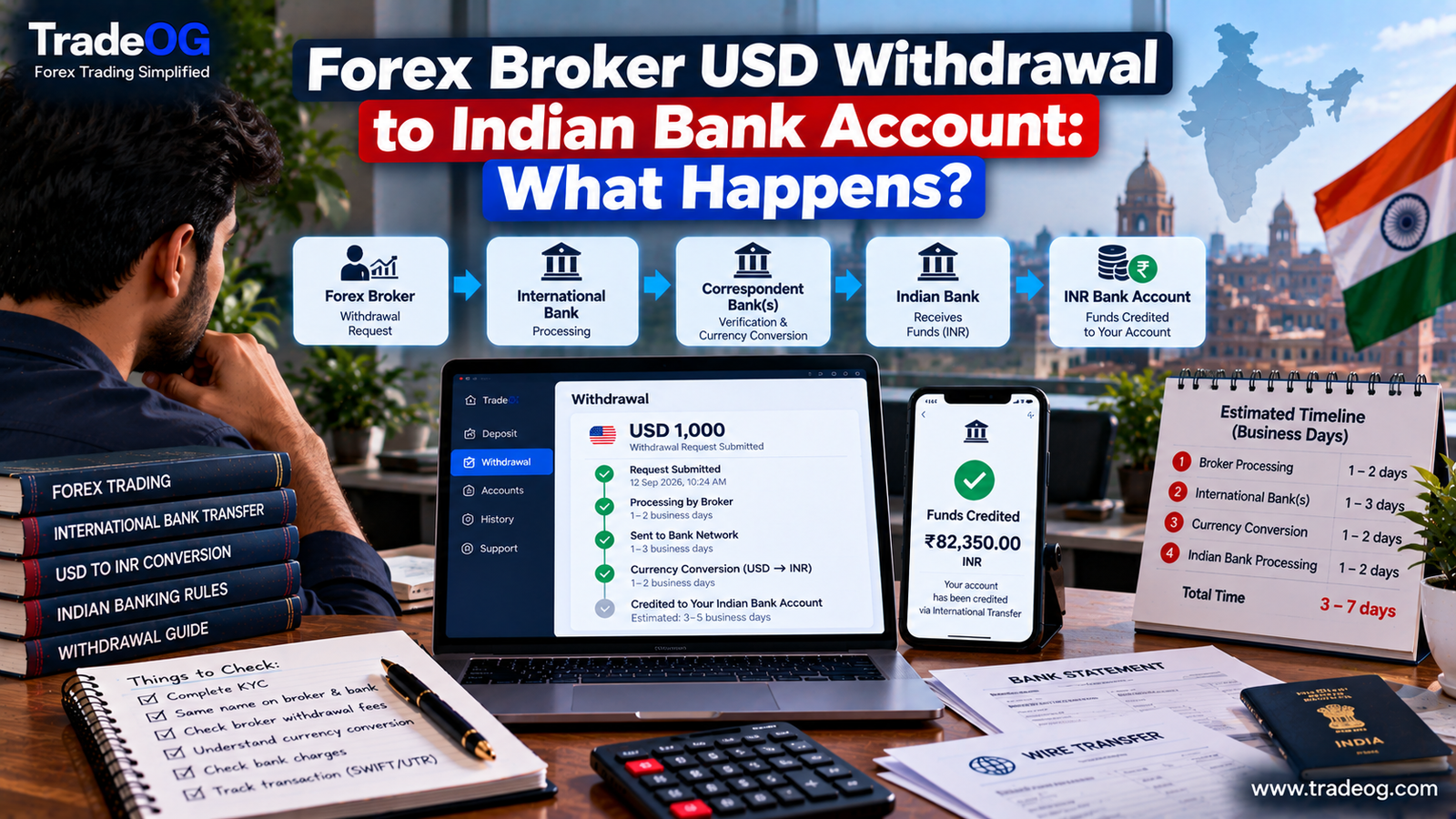
If you are an Indian trader and your forex broker sends your withdrawal in USD, the money does not always move directly from the broker to your Indian bank account.
In many cases, the payment can pass through several financial institutions before the final amount is credited in INR. That can make a simple $1,000 withdrawal look more complicated than expected.
For example, OANDA says international bank-wire withdrawals can take up to five business days on its U.S. service, while the receiving bank may take additional time. That is a useful example of why the broker’s processing time is not necessarily the same as the time required for the money to appear in your Indian account.
What Actually Happens When You Withdraw USD to an Indian Bank?
Think of the withdrawal as a chain rather than a single transaction.
Forex broker → payment/bank partner → correspondent bank(s) → Indian bank → INR account
Not every withdrawal uses every stage, and the exact route can be different for different brokers. But this model helps explain why a withdrawal can show as “processed” while the money has not yet appeared in your account.
The 5 Main Stages of a USD Withdrawal
| Stage | What happens |
|---|---|
| 1. Broker receives request | You submit the USD withdrawal from your trading account. |
| 2. Broker checks and releases funds | The broker verifies the request and sends the payment through its supported route. |
| 3. Banking/payment network | The USD payment may pass through a payment provider or correspondent bank. |
| 4. Currency conversion | If your receiving account is INR-based, the funds may be converted into rupees. |
| 5. Indian bank credit | Your bank completes its processing and credits the account. |
The important point is simple: “withdrawal completed by broker” and “money credited to Indian bank account” are two different events.
Step 1: You Request a USD Withdrawal
Suppose your forex account shows $1,000 available for withdrawal.
You enter your bank details, select the available withdrawal method and submit the request.
At this point, the money has not necessarily left the broker’s system.
The broker may first check:
- Whether the funds are available
- Whether your account is fully verified
- Whether the bank account belongs to you
- Whether the payment method follows its withdrawal rules
- Whether additional compliance information is required
For example, OANDA’s published withdrawal rules require bank-wire withdrawals to go to an account in the same name as the trading account and can require bank documentation for a bank account that has not previously been used for deposits.
Step 2: The Broker Processes the Withdrawal
Once the broker approves the request, it may show a status such as:
- Approved
- Processing
- Processed
- Completed
- Sent
Do not assume that every broker uses these words in exactly the same way.
One broker’s “completed” status may mean the funds have been released to its payment partner. Another may use the same word after a later stage.
If you are waiting for the money, ask the broker one specific question:
“Has the payment actually been released to the banking/payment network, and can you provide the transaction reference?”
Step 3: The USD Payment Enters the Banking Network
This is where the process can become less visible to the trader.
If your broker is outside India, the USD payment may be handled by an international bank or payment institution before it reaches your Indian bank.
A simplified example looks like this:
Broker → Foreign Bank → Correspondent Bank → Indian Bank
A correspondent bank is a bank that helps another bank process transactions, often across countries and currencies.
There may be one intermediary or more than one, depending on the payment route.
This is one reason international withdrawals can take longer than a simple domestic transfer.
What Is a Correspondent Bank?
A correspondent bank acts as a link between financial institutions that do not have a direct relationship for a particular international payment.
You may never have an account with that bank. It can still appear in the transaction chain.
For a USD payment to India, the path could look like:
Foreign broker/payment institution → USD correspondent bank → Indian bank → your account
If additional screening or payment instructions are required, the transaction can take longer.
Step 4: What Happens to the USD?
This depends on the type of bank account you have.
If you have a normal INR savings account, you should not assume that the bank will simply hold the incoming $1,000 as USD.
The bank may process the foreign-currency receipt and convert it according to the applicable banking arrangement and transaction details.
The exact treatment depends on the bank, account type, payment purpose, documentation and applicable rules.
Some Indian banks provide foreign-currency account options in specific circumstances, but a standard resident INR account is not the same thing as a USD account.
USD to INR Conversion: The Part Traders Often Miss
Suppose you withdraw $1,000.
You might look at the USD/INR rate online and think:
$1,000 × ₹90 = ₹90,000
But your final bank credit does not necessarily have to equal that exact calculation.
The actual amount can be affected by:
- The exchange rate applied by the relevant bank or payment provider
- Conversion spreads
- Bank charges
- Intermediary charges
- Other applicable transaction costs
So there are two separate questions:
- How many INR will I receive?
- When will I receive it?
The exchange-rate calculation affects the first question. Banking and payment processing affect the second.
Example: $1,000 Forex Withdrawal to an Indian Bank
Imagine an Indian trader requests a $1,000 withdrawal.
| Stage | Illustrative example |
|---|---|
| Withdrawal requested | Monday morning |
| Broker review | Monday–Tuesday |
| Funds released | Tuesday |
| International/payment processing | Tuesday–Thursday |
| Currency conversion/bank processing | Wednesday–Friday |
| Indian bank credit | Potentially within the same general window, depending on the route |
This is only an example, not a guaranteed timeline. A broker or bank can process a transaction faster or slower.
Why Your Broker May Say “Completed” Before You Receive INR
This is one of the most common sources of confusion.
Suppose the broker sends the payment on Tuesday.
The broker can mark the withdrawal as completed because its own obligation to release the payment is finished.
But the transaction may still need to move through:
- Payment processing
- International banking
- Correspondent banking
- Currency conversion
- Indian bank processing
Therefore:
Broker completed ≠ Indian bank credited
Always keep this distinction in mind.
What Is SWIFT and Why Does It Matter?
For international bank transfers, you may hear the term SWIFT.
SWIFT is a messaging network used by financial institutions to communicate payment instructions internationally. It is not the same thing as the bank account itself and does not mean that the money instantly moves from one country to another.
If your broker sends a bank transfer, the broker or bank may provide a payment reference or SWIFT-related information that can help trace the transaction.
If the withdrawal is delayed after the broker says it was released, ask for whatever transaction reference the broker can provide.
What Information Should You Give Your Indian Bank?
If your bank asks about an incoming international payment, provide accurate information and supporting documents.
Depending on the transaction, the bank may ask for information such as:
- Your identity details
- Purpose of the incoming funds
- Remitter information
- Transaction reference
- Broker/payment statement
- Bank statement
- Supporting documents related to the transaction
Do not guess the purpose of the transaction just to get it processed faster. Give the bank accurate information.
Indian banks can have their own documentation and processing procedures for inward foreign remittances. For example, Indian Bank currently publishes separate procedures for inward non-trade transactions and says additional documentation can be requested depending on the transaction.
Can Your Indian Bank Convert USD Automatically?
It depends on the account and the transaction structure.
For a normal INR account, the incoming foreign-currency transaction may be converted and credited in INR under the bank’s applicable process.
Do not assume that every bank handles an incoming USD payment in exactly the same way.
Before making a large withdrawal, ask your bank:
- Can my account receive an international USD remittance?
- How is the USD converted into INR?
- What exchange rate will be used?
- Are there inward remittance charges?
- Can intermediary charges be deducted?
- What documents may be required?
- What transaction purpose or declaration is required?
What If the Bank Asks for a Purpose Code?
Do not choose a purpose code randomly.
Foreign-exchange transactions can have specific regulatory and reporting requirements. The correct classification depends on the actual nature of the transaction.
If you are unsure, ask your bank’s foreign-exchange/remittance desk what information they require and provide truthful details.
A bank may also request additional documentation if the transaction does not fit an automated processing route.
Can the Bank Hold the Money?
A bank can ask for additional information or documentation when a transaction requires review.
This does not automatically mean that the funds are lost.
If the bank contacts you, respond through the bank’s official channel and ask exactly what is required.
For a delayed international payment, keep the broker’s withdrawal confirmation and transaction reference ready.
What If the USD Amount Is Large?
A larger transaction may receive more attention than a small routine payment.
That does not mean every large withdrawal will be delayed. It means you should be prepared to provide supporting records if your bank or payment provider requests them.
For a large amount, keep:
- Broker account statement
- Trade history
- Deposit records
- Withdrawal confirmation
- Payment reference
- Bank statements
- Relevant tax/accounting records
Good documentation can make a banking query much easier to handle.
Does the Withdrawal Method Change the Process?
Yes.
A bank wire is different from a card refund, e-wallet transaction or other payment method.
For example, OANDA says card withdrawals are treated as refunds and are generally limited to the amount originally deposited by card, while additional funds can be withdrawn using another supported method such as bank wire.
That is why you should not assume that the fastest deposit method is also the best withdrawal method.
| Method | What to understand |
|---|---|
| Bank wire | Can involve international and correspondent banking |
| Debit/credit card | Often follows return-to-source rules and may be limited to the original deposit |
| E-wallet/payment provider | Processing depends on the provider and country availability |
| Local payment method | Availability and withdrawal rules depend on the broker and provider |
Why “USD Withdrawal” Does Not Always Mean You Receive USD
This is an important distinction.
Your broker may show:
Withdrawal: USD 1,000
But your Indian bank statement could ultimately show an INR credit.
The $1,000 is the currency of the withdrawal instruction. It does not automatically mean your final bank balance will contain a $1,000 USD deposit.
If you specifically need to hold the funds in USD, ask your bank about eligible foreign-currency account options before requesting the transfer.
Can I Receive a Forex Withdrawal in a USD Account in India?
Some Indian residents can maintain foreign-currency accounts in specific circumstances, but eligibility depends on the account type and applicable rules.
RBI guidance describes circumstances in which resident individuals can maintain foreign-currency accounts, so do not assume that every ordinary savings account can simply be converted into a USD receiving account.
If you want to receive or retain USD rather than INR, speak with the foreign-exchange desk of your bank before making the withdrawal.
Important: Check Indian Forex Rules Before Using an Overseas Broker
This article explains the payment mechanics of a USD withdrawal. It should not be read as confirmation that a particular overseas forex trading activity is permitted for an Indian resident.
The RBI states that resident persons can undertake forex transactions only with authorised persons and for permitted purposes under FEMA. The RBI has also cautioned residents against unauthorised electronic trading platforms and states that remittances for margins to overseas exchanges or overseas counterparties are not permitted under the LRS framework.
So before sending money to an overseas forex broker, check the current RBI/FEMA position and whether the specific platform and transaction are permitted for you.
A successful withdrawal does not by itself prove that the original trading activity was authorised or compliant.
What About Tax on a USD Withdrawal?
Do not assume that the amount appearing in your bank account is automatically the taxable amount, and do not assume that withdrawing money creates a completely separate tax event by itself.
The tax treatment can depend on the underlying trading activity, instrument, frequency, source of income and your individual circumstances.
If you regularly receive significant foreign-currency trading-related funds, maintain proper records and speak with a qualified Indian tax professional.
How Much INR Will You Actually Receive?
Let’s use a simple example only to understand the mechanics.
Suppose you withdraw $1,000.
If the effective conversion rate used for the transaction were ₹89 per USD, the gross conversion would be:
$1,000 × ₹89 = ₹89,000
But that does not guarantee a final credit of exactly ₹89,000.
Depending on the transaction, there may be:
- Bank conversion spread
- Payment-provider charges
- Correspondent-bank charges
- Other applicable fees
So treat online USD/INR rates as an estimate, not a promise of the final bank credit.
Who Pays the International Bank Charges?
It depends on the payment arrangement.
The broker may charge a withdrawal fee, the sending bank may charge a fee, an intermediary bank may deduct a charge, or the receiving bank may have its own charges.
Some brokers advertise no withdrawal fee while making it clear that the receiving bank or payment provider can still charge its own fees.
Always check the broker’s current fee schedule and ask your bank about inward-remittance charges.
What If My Bank Receives Less Than Expected?
Suppose the broker confirms that it sent $1,000, but your bank records an amount that converts to less INR than your calculation.
Do not immediately assume the broker shorted you.
First compare:
- USD amount sent
- Exchange rate applied
- Bank conversion rate
- Any intermediary deductions
- Receiving-bank charges
Ask the bank for the applicable conversion rate and transaction details if necessary.
How to Track a USD Withdrawal
Keep a simple record for every withdrawal.
| Item | Example |
|---|---|
| Withdrawal amount | USD 1,000 |
| Request date | 6 October |
| Broker withdrawal ID | WD-12345 |
| Broker status | Completed |
| Payment reference | Provided by broker/bank |
| Indian bank | Your receiving bank |
| INR credited | Record actual amount |
This information is extremely useful if the payment becomes delayed.
What to Do If the USD Withdrawal Is Delayed
1. Check the broker status
Confirm whether the withdrawal is pending, processing or completed.
2. Check your email
Look for KYC, bank-account or compliance requests.
3. Ask when the funds were released
Do not ask only “Where is my money?” Ask for the date the payment was actually released.
4. Request the transaction reference
This is especially important for international bank transfers.
5. Contact your Indian bank
Give the bank the reference and ask whether an incoming foreign remittance is waiting for processing or documentation.
6. Keep all records
Save screenshots, statements and emails until the money is fully credited.
What Should You Ask Your Broker?
Use a clear message:
Subject: USD Withdrawal Tracking Request
Hello,
I requested a USD withdrawal of [amount] on [date]. My withdrawal ID is [ID].
Please confirm whether the funds have been released to the payment/banking network. If they have been released, please provide the transaction reference or bank payment reference that can be used to trace the transfer.
Please also confirm the currency in which the payment was sent and the date it was released.
Thank you.
What Should You Ask Your Indian Bank?
If the broker confirms that the payment has been released, ask your bank:
- Has an incoming international payment been received?
- Is any documentation required?
- Is the payment waiting for compliance review?
- What exchange rate will be applied?
- Are any bank charges applicable?
- Can you trace the payment using the transaction reference?
Give the bank accurate information about the transaction. Do not describe the payment as something different simply to avoid questions.
Red Flags: When a USD Withdrawal Problem May Be Serious
A normal international payment delay is one thing. A platform repeatedly demanding new payments is another.
Be very cautious if someone tells you to:
- Pay a “release fee” before withdrawal
- Deposit more money to unlock your balance
- Pay a “tax” directly to a private wallet or personal account
- Pay a “verification deposit”
- Pay a “blockchain fee” to receive your own funds
Do not send additional money just because a person on WhatsApp, Telegram or social media claims it is necessary.
Verify the broker through its official website and independently check its regulatory status.
Common Mistakes Indian Traders Make
Mistake 1: Looking only at the broker’s withdrawal time
The broker’s processing time is only one part of the journey.
Mistake 2: Assuming USD 1,000 means ₹90,000 exactly
The final INR amount depends on the actual conversion rate and applicable charges.
Mistake 3: Using someone else’s bank account
Third-party withdrawals can trigger verification problems or rejection.
Mistake 4: Ignoring bank emails
A missing document can keep an incoming payment waiting.
Mistake 5: Choosing an overseas broker only because withdrawals are fast
Withdrawal speed is not a substitute for regulatory and legal due diligence.
Mistake 6: Sending more money when a withdrawal is blocked
Never assume an additional deposit will unlock a withdrawal. Verify the reason first.
USD Withdrawal to Indian Bank: Simple Flow
Step 1: You request a USD withdrawal.
Step 2: The broker verifies and approves the request.
Step 3: The broker/payment partner releases the USD payment.
Step 4: The payment travels through the international banking network if required.
Step 5: A correspondent bank may process the transaction.
Step 6: The Indian bank receives the foreign-currency payment.
Step 7: The bank applies the relevant processing and conversion rules.
Step 8: The resulting amount is credited to your account.
That is why the withdrawal can take longer than simply clicking “Withdraw” on your broker dashboard.
Frequently Asked Questions
Can a forex broker send USD directly to an Indian bank account?
It depends on the broker, its payment route, your bank and the applicable rules. An international bank transfer may be possible through a supported route, but you should confirm the method with both the broker and your bank before relying on it.
Will I receive USD or INR?
If the receiving account is a normal INR account, the transaction may be processed and converted into INR. The exact treatment depends on your bank and the transaction structure.
How long does a USD withdrawal to India take?
There is no single guaranteed timeframe. Broker processing, international banking, intermediary banks, currency conversion, weekends, holidays and Indian bank processing can all affect the timing.
Why did my broker deduct less money than expected?
Compare the USD amount sent, conversion rate and any broker, intermediary or bank charges. The broker’s withdrawal amount and the final INR credit are not necessarily the same calculation.
Can my bank ask where the USD came from?
Yes. A bank can request information or supporting documents depending on the transaction and its processing requirements.
Can I receive forex profits in a USD account?
Do not assume that every resident can use an ordinary Indian bank account as a USD account. Foreign-currency accounts are subject to specific eligibility and regulatory rules. Ask your bank about the account type you actually hold.
What if the broker says the payment is completed?
Ask for the payment or transaction reference and the date the funds were released. Then ask your bank to trace the incoming payment if it has not appeared.
Should I pay an extra fee to unlock my withdrawal?
Do not send additional money simply because someone demands a release, unlock or verification payment. Verify the request through the broker’s official support channel first.
Final Takeaway
A USD withdrawal from a forex broker to an Indian bank account is not always a straight broker-to-bank transfer.
The payment may pass through a broker, payment provider, international bank, correspondent bank and Indian bank before the final INR credit appears. Currency conversion and banking charges can also affect the amount you receive.
The smartest thing you can do is track the transaction by stages. If the broker says the withdrawal is completed, ask when it was released and request the transaction reference. If the bank has not credited the money, give that reference to the bank and ask whether the payment is waiting for processing or documentation.
And remember: the mechanics of receiving a payment do not establish that a particular overseas forex trading activity is permitted for an Indian resident. The RBI says residents should undertake forex transactions only with authorised persons and for permitted purposes, and it has cautioned against unauthorised electronic trading platforms.
Before depositing or withdrawing through an overseas forex platform, verify the current RBI/FEMA position, the broker’s legal entity and the permitted transaction route.
Official Sources
- Reserve Bank of India — Official Website
- RBI — Caution Against Unauthorised Forex Trading Platforms
- OANDA — Funding and Withdrawals
- OANDA — Withdrawal Methods
- Indian Bank — Inward Non-Trade Transactions
- Indian Bank — Forex Remittance Facility
Risk disclosure: Forex and leveraged trading involve substantial risk of loss. This article is for general educational purposes only and is not financial, legal or tax advice. Broker policies, bank procedures, payment methods, exchange rates and Indian regulations can change. Verify current information with the relevant broker, bank and official Indian authorities.