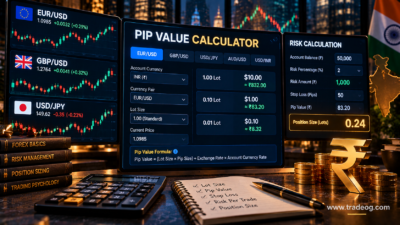

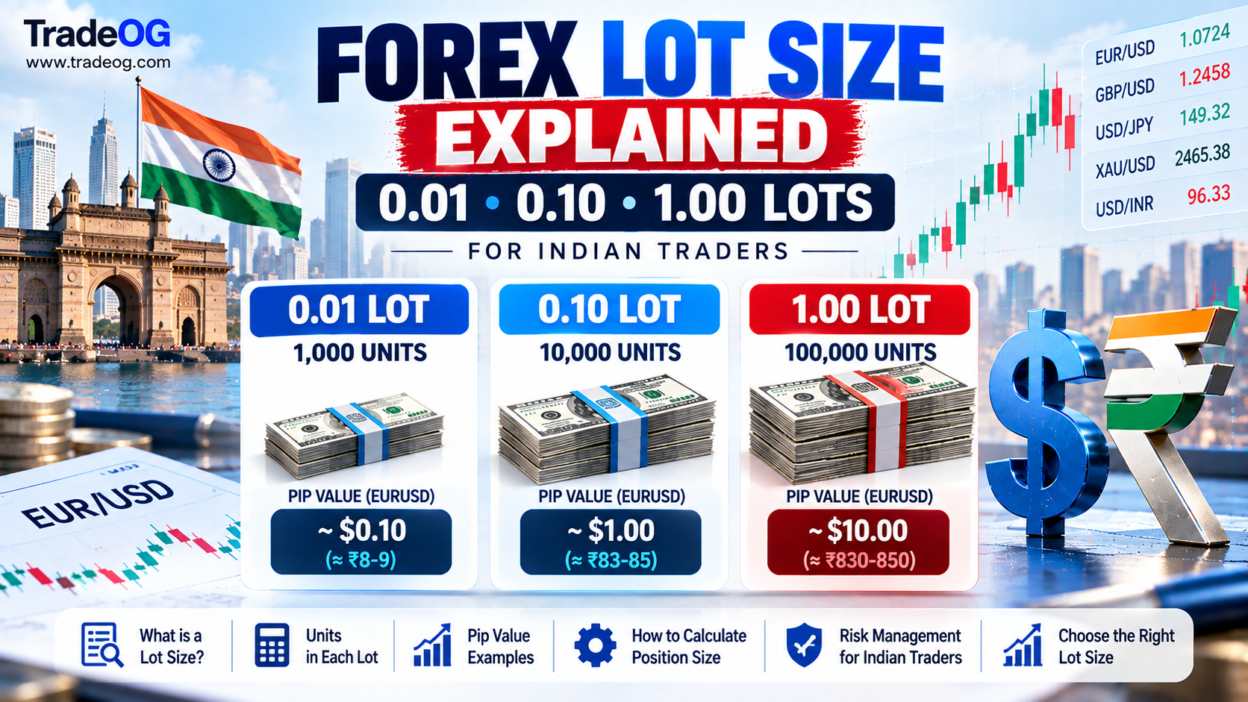
Forex lot size is one of the first concepts an Indian trader should understand before increasing position size. You may see 0.01, 0.10 and 1.00 lots on MT4, MT5 or another trading platform, but those numbers do not simply mean “small, medium and large.” They represent different quantities of the base currency and therefore different exposure, pip value and potential profit or loss.
For most major currency pairs, a standard forex lot represents 100,000 units of the base currency. A mini lot is 10,000 units and a micro lot is 1,000 units. That means 0.01 lot is generally a micro lot, 0.10 lot is a mini lot and 1.00 lot is a standard lot. Broker specifications can differ, so always verify the contract size and minimum trade size for the specific instrument you trade.
What Is a Forex Lot?
A lot is a standardised way of describing the size of a forex position. Instead of entering a trade in an arbitrary number of currency units, trading platforms commonly express the position as a fraction or multiple of a standard lot.
FOREX.com defines a standard forex lot as 100,000 currency units and identifies mini and micro lots as 10,000 and 1,000 units respectively. FOREX.com explains forex lot sizes here. IG provides the same conventional structure for standard, mini and micro lots. IG’s forex education guide also explains how leverage can allow traders to control a larger position with a smaller margin deposit.
For example, if you trade EUR/USD:
- 0.01 lot = 1,000 EUR of base-currency exposure.
- 0.10 lot = 10,000 EUR of base-currency exposure.
- 1.00 lot = 100,000 EUR of base-currency exposure.
The important point is that lot size controls your exposure. It does not tell you how much money you should risk until you combine it with the stop-loss distance and pip value.
0.01 vs 0.10 vs 1.00 Lots
| Lot Size | Common Name | Base Currency Units | Approx. EUR/USD Pip Value* |
|---|---|---|---|
| 0.01 | Micro lot | 1,000 | $0.10/pip |
| 0.10 | Mini lot | 10,000 | $1/pip |
| 1.00 | Standard lot | 100,000 | $10/pip |
*Approximate examples for major USD-quoted pairs such as EUR/USD. Exact pip value can vary with the currency pair, quote currency and exchange rate. FOREX.com notes that pip value depends on the pair and position size. Use a broker’s pip calculator for an exact figure.
What Does 0.01 Lot Mean?
0.01 lot is commonly called one micro lot. Under the conventional 100,000-unit standard-lot structure, it represents 1,000 units of the base currency.
For EUR/USD, 0.01 lot therefore represents 1,000 EUR of base-currency exposure. For a USD-based quote such as EUR/USD, the approximate pip value is around $0.10 per pip.
If EUR/USD moves 20 pips in your favour, the simplified calculation is:
20 pips × $0.10 = $2
If it moves 20 pips against you:
20 pips × $0.10 = -$2
This is why 0.01 lot is often useful when learning position sizing or when a trader wants relatively small exposure. It does not mean the trade is automatically safe. A trader can still take too many 0.01-lot positions, trade without a stop or stack correlated positions.
What Does 0.10 Lot Mean?
0.10 lot is commonly called one mini lot. It represents 10,000 units of the base currency.
For EUR/USD, the simplified pip value is approximately $1 per pip.
A 30-pip move would therefore represent roughly:
30 × $1 = $30
That means moving from 0.01 to 0.10 lot increases the pip impact by roughly ten times.
If your stop-loss is 30 pips, the approximate risk before spread, commission and execution effects would be $30 at 0.10 lot on EUR/USD under this simplified example.
What Does 1.00 Lot Mean?
1.00 lot is commonly called one standard lot. It represents 100,000 units of the base currency.
For EUR/USD, one pip is approximately $10 at a standard lot.
A 30-pip movement therefore represents approximately:
30 × $10 = $300
That is why increasing position size without recalculating risk can quickly become dangerous.
A trader may think that moving from 0.10 to 1.00 is simply “one decimal place,” but in terms of conventional exposure it is a tenfold increase.
Why Lot Size Matters More Than Your Entry Price
New traders often focus heavily on the entry price. Risk management requires a different perspective.
Suppose two traders both buy EUR/USD at the same price with the same 30-pip stop:
| Trader | Lot | Approx. Pip Value | 30-Pip Stop |
|---|---|---|---|
| A | 0.01 | $0.10 | $3 |
| B | 0.10 | $1 | $30 |
| C | 1.00 | $10 | $300 |
The chart is identical for all three traders. Their risk is not.
This is the central reason lot size should be selected after deciding the amount you are willing to lose and the distance to your stop.
How to Calculate Lot Size From Your Risk
A simple position-sizing framework is:
Lot Size = Maximum Money Risk ÷ (Stop-Loss Pips × Pip Value Per Lot)
Because pip value depends on the pair and account currency, the exact calculation may require a pip-value calculator. But the principle is straightforward.
Example: ₹1,000 Maximum Risk
Assume an Indian trader has decided that the maximum acceptable loss on a trade is ₹1,000. For illustration, use a reference exchange rate of approximately ₹96.33 per US dollar. The exact USD/INR rate changes continuously.
₹1,000 ÷ ₹96.33 ≈ $10.38.
Now assume a EUR/USD setup with a 20-pip stop and an approximate pip value of $10 per standard lot.
Risk per 1.00 lot:
20 × $10 = $200
Required lot size:
$10.38 ÷ $200 ≈ 0.052 lot
A broker may allow a position such as 0.05 lot, depending on its volume increment. At 0.05 lot, the approximate risk would be:
20 × $0.50 = $10, or roughly ₹963 at the reference exchange rate, before spread, commission and slippage.
This example demonstrates the correct sequence: define risk first, calculate lot size second.
Lot Size and Pip Value
Pip value is the amount your position gains or loses when the market moves by one pip.
For many major USD-quoted pairs, the simplified relationship is:
| Lot | Approx. Pip Value | 10-Pip Move | 50-Pip Move |
|---|---|---|---|
| 0.01 | $0.10 | $1 | $5 |
| 0.10 | $1 | $10 | $50 |
| 1.00 | $10 | $100 | $500 |
FOREX.com explains that pip value depends on the currency pair and position size, and its educational examples show the standard relationship of approximately $10 per pip for a standard lot, $1 for a mini lot and $0.10 for a micro lot when USD is the quote currency. See the pip-value calculation examples.
Why the Same Lot Can Have a Different Pip Value
The simple $10-per-pip rule is useful for EUR/USD and other USD-quoted major pairs, but it is not universal.
Consider USD/JPY. Yen pairs use a different pip convention, and the pip value must be calculated using the exchange rate. FOREX.com explains that JPY pairs typically use the second decimal place for the pip rather than the fourth decimal place used by most major pairs. FOREX.com explains pip conventions for JPY pairs here.
Crosses such as GBP/JPY, EUR/GBP and AUD/NZD can also have different pip values in your account currency.
Therefore, do not assume that 1.00 lot always means exactly $10 per pip.
Lot Size vs Leverage: They Are Not the Same
This distinction is critical.
Lot size determines position exposure.
Leverage determines how much margin may be required to control that exposure.
For example, a trader may open a large notional position while posting a much smaller amount of margin because of leverage. But the profit and loss is still based on the underlying position size, not simply the cash deposited as margin.
IG specifically warns that leverage allows traders to open larger positions with smaller deposits, while gains and losses are based on the full position. Read IG’s explanation of leverage and forex lots.
How Indian Traders Should Think About Lot Size
For an Indian trader, the cleanest approach is to convert the entire risk decision into INR before placing the trade.
Instead of saying:
“I will trade 0.10 lot because it looks small.”
Think:
“I am willing to risk ₹800 on this setup. My stop is 25 pips. What position size keeps the potential loss near ₹800?”
This approach makes lot size a consequence of risk rather than a guess.
Example: 0.01 Lot With a 50-Pip Stop
Assume EUR/USD and an approximate $0.10 pip value at 0.01 lot.
50 pips × $0.10 = $5.
At approximately ₹96.33 per USD:
$5 × ₹96.33 ≈ ₹482.
So a 50-pip stop on 0.01 lot would have a simplified risk of roughly ₹482 before transaction costs and execution differences.
Example: 0.10 Lot With a 50-Pip Stop
At 0.10 lot, the approximate pip value is $1 on EUR/USD.
50 pips × $1 = $50.
At ₹96.33 per USD:
$50 × ₹96.33 ≈ ₹4,816.
Notice the tenfold increase from 0.01 to 0.10 lot.
Example: 1.00 Lot With a 50-Pip Stop
At 1.00 standard lot:
50 pips × $10 = $500.
At ₹96.33 per USD:
$500 × ₹96.33 ≈ ₹48,165.
A trader who sees only “1 lot” on the platform may underestimate how large this position is. The underlying exposure and risk are substantial.
Lot Size for a ₹10,000 Trading Account
There is no universally correct lot size for a ₹10,000 account. The correct position depends on the trader’s predefined risk percentage, stop distance, instrument and execution costs.
Suppose the trader chooses a 1% maximum risk:
₹10,000 × 1% = ₹100 maximum risk.
If the calculated risk for 0.01 lot with the chosen stop is already greater than ₹100, then 0.01 lot may still be too large for that setup.
This is an important lesson: the smallest lot available is not automatically the correct lot size.
Lot Size for a ₹50,000 Trading Account
At a 1% risk limit, ₹50,000 gives:
₹50,000 × 1% = ₹500.
If the calculated risk for a particular 0.01-lot position and stop is ₹250, it fits below the 1% ceiling. If the same setup requires ₹900, it does not.
The account balance alone therefore cannot tell you whether 0.01, 0.10 or 1.00 lot is appropriate.
What Lot Size Should a Beginner Use?
There is no universal beginner lot size, but a smaller position generally makes it easier to keep monetary losses under control while learning.
The better question is:
- What percentage of the account am I willing to risk?
- Where is the logical stop-loss?
- What is the pip value of this exact pair?
- Does the calculated position fit the broker’s volume increments?
- Does the position remain acceptable after spread and potential slippage?
If the calculated position is larger than your risk limit, reduce the lot. If the minimum tradable size is still too large for the planned risk, the trade may simply be unsuitable for that account size.
Lot Size and Stop-Loss Work Together
Lot size should never be evaluated independently from the stop-loss.
Consider two EUR/USD trades:
| Trade | Lot | Stop | Approx. Risk |
|---|---|---|---|
| A | 0.10 | 10 pips | $10 |
| B | 0.10 | 50 pips | $50 |
| C | 0.05 | 50 pips | $25 |
Trade B has the same lot as Trade A but approximately five times the pip risk because the stop is five times wider.
This is why professional position sizing starts with the stop and risk budget rather than choosing a lot first.
Common Forex Lot-Size Mistakes
1. Choosing 0.10 Because It “Looks Small”
0.10 lot can represent meaningful exposure. On a USD-quoted major pair, a 100-pip move is approximately $100 at 0.10 lot.
2. Assuming 1.00 Lot Means $1 Per Pip
For many USD-quoted majors, 1.00 lot is approximately $10 per pip, not $1. Always check the pair.
3. Confusing Margin With Risk
A small margin requirement does not mean a small potential loss. Leverage can make a large position appear affordable.
4. Ignoring the Account Currency
An Indian trader may have an INR account or another base currency. The platform may convert P&L into the account currency automatically, but your risk calculation should still account for the conversion.
5. Using the Same Lot on Every Setup
A 10-pip stop and a 60-pip stop should not automatically use the same lot size if you want consistent monetary risk.
6. Forgetting Spread and Slippage
A theoretical stop calculation does not include every trading cost. Your actual result can differ because of spread, commission, slippage and execution conditions.
7. Increasing Lot Size After a Loss
Increasing position size simply to recover the previous loss can create a dangerous feedback loop. Your lot size should come from the trading plan, not frustration.
How 0.01, 0.10 and 1.00 Lots Compare
| Feature | 0.01 Lot | 0.10 Lot | 1.00 Lot |
|---|---|---|---|
| Typical type | Micro | Mini | Standard |
| Units | 1,000 | 10,000 | 100,000 |
| Relative exposure | 1× | 10× | 100× |
| Approx. EUR/USD pip value | $0.10 | $1 | $10 |
| Best use | Small exposure / learning | Moderate exposure | Large exposure |
| Risk warning | Still requires risk control | Can become significant quickly | Large P&L swings |
Can You Trade 0.001 Lot?
Some brokers or platforms may support smaller increments than the conventional 0.01-lot micro position, while others may not. Do not assume that every broker allows 0.001 lots.
FOREX.com, for example, describes 0.01 lot as 1,000 units on MT4 in its platform guidance. Check the broker’s minimum trade size and volume increment before relying on a particular lot size.
Lot Size in MT4 and MT5
On MetaTrader platforms, you will commonly see a field labelled Volume. Depending on the broker’s contract specification:
- 0.01 commonly represents 0.01 lot.
- 0.10 commonly represents 0.10 lot.
- 1.00 commonly represents 1.00 lot.
The platform’s contract specification remains the final authority because brokers can configure instruments differently.
Forex Lot Size and Prop Firm Trading
Prop firm traders should be especially careful with lot size because the account’s maximum daily loss, maximum loss, trailing drawdown or other rules can make oversized positions dangerous.
Suppose a prop account has a $1,000 daily loss limit. Opening a position where a normal market move can consume several hundred dollars of risk can leave very little room for additional trades.
For prop trading, think in this order:
- Account loss limit
- Maximum risk per trade
- Stop-loss distance
- Pip value
- Lot size
- Correlation and total open exposure
The lot size should be the final output of this process.
Does a Bigger Lot Mean Better Profit?
No. A bigger lot only increases the monetary effect of price movement.
If EUR/USD rises 20 pips:
- 0.01 lot may make approximately $2.
- 0.10 lot may make approximately $20.
- 1.00 lot may make approximately $200.
But if EUR/USD falls 20 pips, the losses are approximately the same amounts in the opposite direction.
Lot size magnifies both outcomes. It does not improve the quality of your trading setup.
How Indian Traders Can Build a Lot-Size Checklist
Before entering a forex trade, ask:
- What is my account balance?
- What is my maximum risk in INR?
- Where is my logical stop-loss?
- How many pips is that stop?
- What is the pip value for this pair and position size?
- What lot size keeps risk within my limit?
- Have I allowed for spread, commission and slippage?
- Will the total exposure remain safe if another correlated position is open?
If you cannot answer these questions, the lot size should not be chosen simply by looking at what the platform allows.
A Simple Formula You Can Remember
For many standard USD-quoted forex examples:
Approximate Risk = Stop-Loss Pips × $10 × Lot Size
So:
- 0.01 lot → approximately $0.10 per pip
- 0.05 lot → approximately $0.50 per pip
- 0.10 lot → approximately $1 per pip
- 0.50 lot → approximately $5 per pip
- 1.00 lot → approximately $10 per pip
For other pairs, use the exact pip-value calculation or broker calculator instead of blindly applying the $10 rule.
Final Takeaway
Understanding 0.01, 0.10 and 1.00 forex lots is not just about memorising that they represent 1,000, 10,000 and 100,000 units. The real purpose is understanding how position size changes your pip value and therefore your potential profit or loss.
For Indian traders, the safest framework is simple:
Risk in INR → stop-loss distance → pip value → lot size.
Do not start with the lot size and then try to justify the risk. Start with the amount you are prepared to lose and calculate the position size from there.
A 0.01-lot trade can be too large for a very small account with a wide stop, while a 0.10-lot trade may be perfectly manageable for another setup and account. The number itself is not “safe” or “dangerous.” The relationship between lot size, stop distance, account size and risk is what matters.
Frequently Asked Questions
What is 0.01 lot in forex?
Under the conventional forex structure, 0.01 lot is one micro lot and represents 1,000 units of the base currency.
What is 0.10 lot in forex?
0.10 lot is commonly one mini lot and represents 10,000 units of the base currency.
What is 1.00 lot in forex?
1.00 lot is commonly one standard lot and represents 100,000 units of the base currency.
How much is 0.01 lot per pip?
For many major USD-quoted pairs such as EUR/USD, 0.01 lot is approximately $0.10 per pip. Exact value depends on the currency pair and exchange rate.
How much is 0.10 lot per pip?
For many USD-quoted major pairs, 0.10 lot is approximately $1 per pip.
How much is 1.00 lot per pip?
For many USD-quoted major pairs, 1.00 lot is approximately $10 per pip.
What lot size is good for a beginner in India?
There is no universal beginner lot size. Calculate the lot from your account size, maximum INR risk and stop-loss distance. If the minimum available lot still exceeds your risk limit, do not force the trade.
Does leverage change the lot size?
Leverage can change the margin required to open a position, but it does not remove the underlying P&L exposure created by the lot size. A larger leveraged position can therefore create larger losses.
Is 1.00 lot too large?
Not inherently, but it represents 100,000 units under the conventional structure and can create large P&L swings. Whether it is appropriate depends on your account, stop distance, risk limit and instrument.