
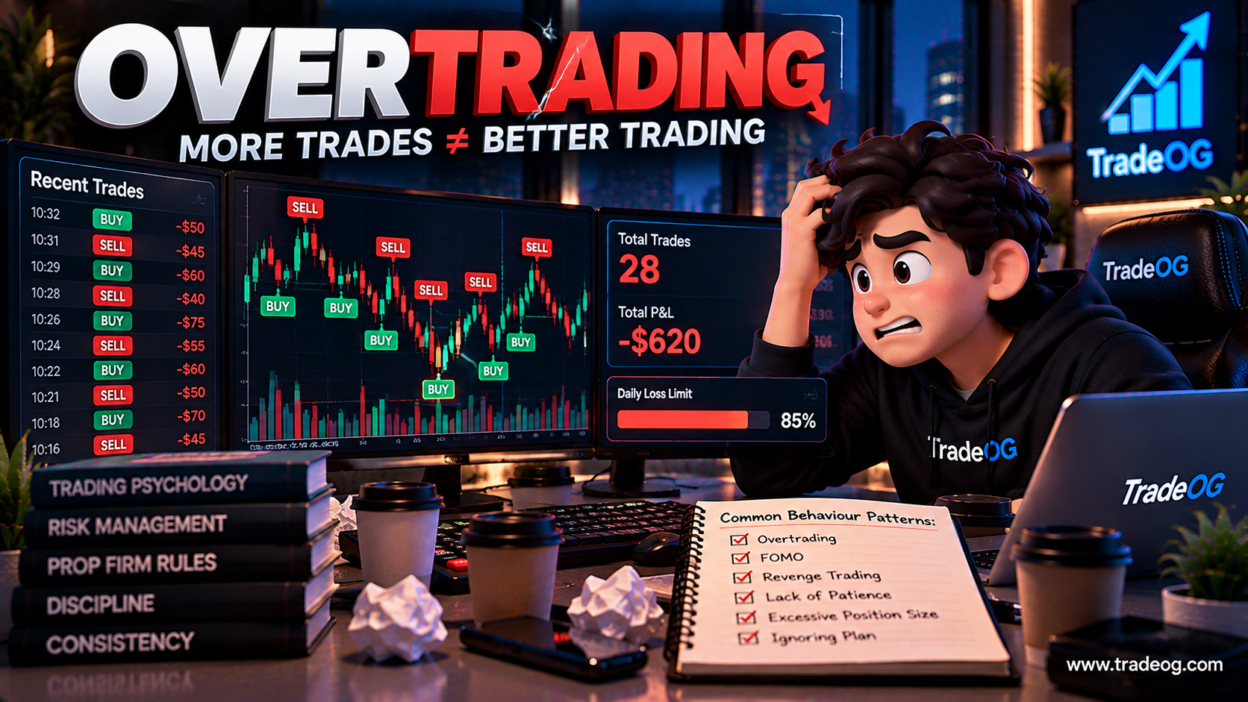
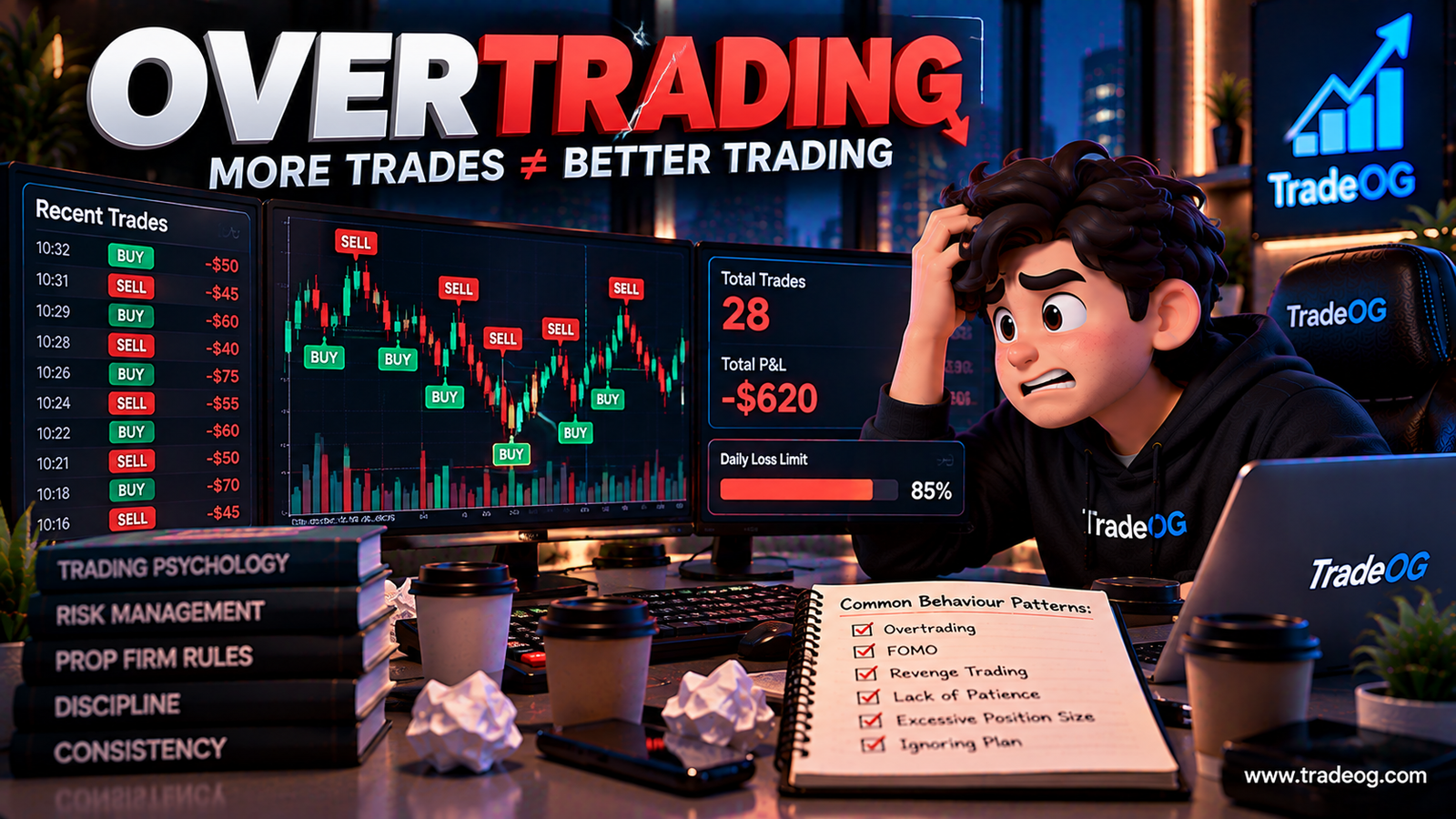
Overtrading is one of the easiest trading behaviours to misunderstand. A trader can take many trades without necessarily overtrading, while another trader can overtrade after only two or three impulsive entries. The important question is not simply “How many trades did I take?” but whether the number, frequency, size and timing of trades are justified by the trader’s tested strategy and risk plan.
In a prop firm challenge, this distinction becomes especially important. Traders usually operate within predefined drawdown, daily-loss, position-size, consistency or other program rules. When unnecessary trades accumulate, the trader can consume risk capacity without necessarily improving the quality of the opportunity.
FTMO’s trading-education material describes overtrading as trading too much and links it with poor decisions, increased risk, reduced discipline and failure to follow a trading system. Its current Futures rules also state that substantially inconsistent position sizing or trading activity can be considered inconsistent with sustainable risk management. FTMO Academy — Overtrading and FTMO Futures — Forbidden Trading Practices.
This guide explains the common behaviour patterns behind overtrading in prop firm challenges, why those patterns develop, how to identify them in a journal, and how to build practical controls that keep trading activity aligned with a written plan.
What Is Overtrading?
Overtrading occurs when trading activity exceeds what the trader’s strategy, preparation, market conditions or risk plan reasonably supports.
There is no universal number such as five trades, ten trades or twenty trades that automatically defines overtrading.
Consider two hypothetical traders:
- Trader A takes 12 short-duration futures trades because their tested strategy legitimately produces multiple independent setups during a highly active session.
- Trader B takes 4 trades, but the last 3 were entered without a setup because the trader was frustrated after an earlier loss.
Trader B may be displaying the more obvious overtrading pattern even though the trade count is much lower.
A better definition is:
Overtrading is a mismatch between trading activity and the trader’s actual edge, risk framework or written rules.
Why Overtrading Is Particularly Important in Prop Firm Challenges
A prop firm challenge is not simply a normal trading account with a target added to it. The trader must generally operate inside a defined rule set. The exact requirements differ across firms and account models, but common constraints can include maximum drawdown, daily loss limits, contract or position limits, trading-session restrictions and other risk controls.
For example, Topstep’s current Maximum Loss Limit is monitored in real time using both realized and unrealized P&L. Its current Daily Loss Limit documentation explains that when the applicable limit is reached, positions are flattened and new trades are blocked until the next session. Topstep — Maximum Loss Limit and Topstep — Daily Loss Limit.
That creates a mathematical problem for an overtrader:
More unnecessary trades → more opportunities for losses, fees, slippage and execution errors → faster consumption of available risk capacity.
The problem is not that every additional trade loses. The problem is that the trader is adding exposure without necessarily adding a corresponding edge.
Common Behaviour Pattern #1: Trading Because the Market Is Open
One of the simplest forms of overtrading is confusing market availability with opportunity.
Futures markets can provide price movement for long periods. A trader watching charts continuously may eventually feel that being inactive means missing something.
This can create a dangerous rule:
“If I am sitting at the screen, I should be in a trade.”
That is not a trading strategy. It is an activity bias.
A professional trading plan can contain periods where the correct action is to wait. If no setup exists, staying flat can be a valid decision.
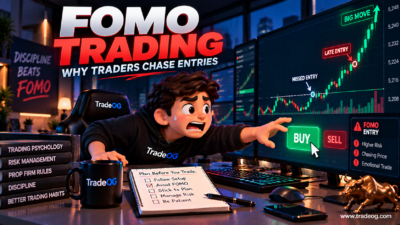
Common Behaviour Pattern #2: FOMO After a Large Move
Fear of missing out, or FOMO, often appears after a market makes a large move without the trader.
For example, a trader watches NQ move sharply higher for several minutes. The planned entry was never triggered. Instead of accepting the missed opportunity, the trader buys after the move has already expanded.
The trader may then:
- enter farther from the original setup;
- use a wider stop because the logical stop is now too far away;
- reduce the planned reward-to-risk ratio;
- take profit too quickly because the entry feels uncomfortable;
- re-enter repeatedly if the first late entry fails.
One missed trade can therefore turn into several unplanned trades.
Common Behaviour Pattern #3: Revenge Trading Turns Into Overtrading
Overtrading and revenge trading are related but not identical.
Revenge trading specifically involves an attempt to recover a previous loss or emotionally respond to it. Overtrading describes the excessive trading behaviour itself.
The sequence can look like this:
Loss → frustration → immediate re-entry → another loss → increased frequency → lower-quality setups → drawdown pressure.
FTMO’s educational material specifically identifies increasing the number of trades during losses as a warning sign and discusses revenge trading as a reaction to losses. FTMO Academy — Overtrading.
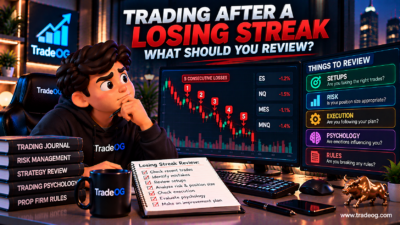
Common Behaviour Pattern #4: Increasing Trade Frequency After a Loss
A trader may have a perfectly normal first loss and then start searching aggressively for the next setup.
Instead of waiting for the next qualified opportunity, the trader begins entering on:
- small breakouts;
- minor pullbacks;
- unconfirmed reversals;
- weak support or resistance reactions;
- moves that would normally be ignored.
The trader is no longer following a setup-based process. The trader is searching for an outcome.
This behaviour is easy to identify in a journal. Compare the average time between trades before and after a losing trade. If the interval repeatedly collapses after losses, the trader may have a behavioural trigger worth addressing.
Common Behaviour Pattern #5: “One More Trade”
“One more trade” sounds harmless because the trader is not consciously planning to overtrade.
But the phrase can become a recurring escape from the trading plan.
A trader reaches the planned end of the session and sees one final chart movement. The trader takes a trade. After losing, another setup appears. Another trade follows.
Eventually the session has moved far beyond the original plan.
The important metric is not whether the final trade was profitable. The important metric is whether the trade was allowed by the original plan.
Common Behaviour Pattern #6: Trying to Reach the Profit Target Faster
Prop firm challenges often create a psychological temptation to focus heavily on the profit target.
Suppose a hypothetical evaluation requires $3,000 of profit. A trader makes $700 during the first few sessions and starts thinking:
“I am close. I can finish this quickly.”
The trader then increases trading frequency, takes marginal setups and attempts to accelerate the remaining progress.
This can be problematic because a profit target does not automatically improve the quality of the next market setup.
The market does not know that the trader is $2,300 away from a target.
A strategy should therefore be evaluated trade by trade rather than by how urgently the account needs to reach a particular number.
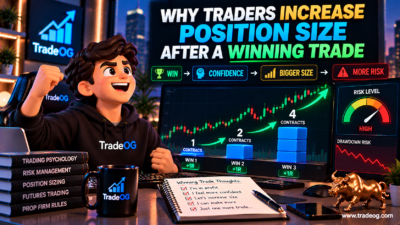
Common Behaviour Pattern #7: Maximum Position Size Becomes the Default
Another pattern is using the maximum permitted position size simply because the platform allows it.
Maximum contracts and appropriate contracts are not the same concept.
A trader may be allowed to trade several futures contracts while their normal strategy only requires a smaller position. Using the maximum size on every entry increases the financial consequence of every stop and makes a sequence of trades more damaging.
Topstep’s current Responsible Trading Program specifically identifies repeatedly maxing position size, going full port and trading on tilt or FOMO as behaviours that can lead to additional risk-management scrutiny. Topstep — Responsible Trading Program.
FTMO Futures also currently lists inconsistent position sizing as a prohibited trading practice when the activity is substantially inconsistent with the trader’s broader approach and does not reflect sustainable live-market risk management. FTMO Futures — Forbidden Trading Practices.
Common Behaviour Pattern #8: Switching Instruments After a Bad Trade
A trader loses on ES and suddenly moves to NQ. The NQ chart looks faster and more attractive, so another position is opened.
After another loss, the trader moves to a Micro contract or a different market.
Instrument switching can create the illusion of finding a fresh opportunity when the underlying problem is behavioural.
Different futures products have different contract multipliers, volatility characteristics, liquidity profiles and tick values. A change in instrument can therefore change dollar risk even when the chart pattern looks similar.
If an instrument is not part of the written plan, changing markets in response to a loss should be treated as a behaviour to review.
Common Behaviour Pattern #9: Re-Entering the Same Setup Repeatedly
Repeated entries at the same level can sometimes be legitimate. A strategy may explicitly allow a re-entry after a stop or after a new confirmation.
The problem begins when re-entry is automatic.
A trader gets stopped, immediately re-enters, gets stopped again and repeats the same idea because the trader believes the original direction must eventually work.
A useful distinction is:
| Planned Re-Entry | Emotional Re-Entry |
|---|---|
| Defined before the session | Created after the loss |
| Requires a new condition | Requires only hope |
| Uses predefined risk | May increase size or widen risk |
| Can be tested historically | Usually justified after the fact |
Common Behaviour Pattern #10: Trading Every Small Breakout
Some traders become overly sensitive to price movement during a challenge.
Every local high looks like a breakout. Every local low looks like a breakdown. Every candle close becomes a potential entry.
This creates signal inflation.
The trader may start taking setups that were never part of the original strategy because the chart continuously produces small movements.
A robust system should have enough filters to distinguish a meaningful setup from ordinary market noise.
Common Behaviour Pattern #11: Chasing Losses Through Higher Frequency
Not every revenge trader increases position size. Some increase frequency instead.
For example:
- normal plan: 3–5 trades in a session;
- after a loss: 4 additional trades;
- after another loss: 5 more attempts;
- result: 12–15 trades despite no change in strategy conditions.
The trader may believe the risk is controlled because each individual trade is small.
But repeated small risks can still produce significant cumulative exposure.
This is particularly important when the strategy has transaction costs, commissions and slippage. More entries mean more opportunities for these costs to accumulate.
Common Behaviour Pattern #12: Overtrading During Boredom
Boredom is an underestimated trading trigger.
A slow session can make a trader uncomfortable. The trader sees little movement and decides to “take something small.”
One low-quality trade becomes two. Then the trader begins watching smaller timeframes to create more apparent opportunities.
The problem is that changing timeframe does not necessarily create a new edge.
It can simply create more noise.
Common Behaviour Pattern #13: Lowering the Setup Standard
This is one of the most important patterns to track.
Imagine a strategy requires:
- trend alignment;
- key level interaction;
- breakout or rejection confirmation;
- defined stop location;
- minimum reward-to-risk requirement.
After two losses, the trader may quietly reduce the requirements:
“The trend is enough.”
Then:
“Maybe the level is enough.”
Then:
“I will just take a small position.”
The result is still a trade, but it is no longer the same strategy that generated the original backtest.
Common Behaviour Pattern #14: Trading Outside the Planned Session
A trader may have tested a strategy during one particular market window but begin trading outside that period during a challenge.
The reason may be simple:
“I have not made enough today.”
That sentence can extend a planned two-hour session into six hours of chart watching.
More screen time can create more temptation to trade. It can also produce fatigue, reduced concentration and a greater number of marginal decisions.
Common Behaviour Pattern #15: Trading After the Strategy Is Already Done for the Day
Some trading plans have a daily trade limit. Others use a daily profit target, loss limit, maximum number of consecutive losses or session cutoff.
The danger comes when the trader treats these rules as optional once the market becomes interesting.
A daily trading limit is not supposed to predict whether the next trade will win. It is a behavioural control designed to limit exposure.
Overtrading vs High-Frequency Trading
It is important not to confuse overtrading with legitimate high-frequency or short-term trading.
A strategy can generate many trades while remaining systematic. The key characteristics are:
- the entries are defined;
- the position size is planned;
- the strategy has been tested with that frequency;
- execution assumptions are realistic;
- trade frequency is not changing simply because of emotions;
- the activity remains within the firm’s current rules.
By contrast, overtrading usually contains an element of behavioural drift.
Topstep’s current prohibited-strategy guidance is a useful example of this distinction: it does not simply prohibit a high trade count; it specifically discusses abusive simulator exploitation such as hundreds of rapid trades designed to exploit unrealistic simulated fills. Topstep — Prohibited Trading Strategies.
How Overtrading Damages a Prop Firm Challenge
Overtrading can affect a challenge in several different ways.
| Effect | How It Happens |
|---|---|
| Higher cumulative risk | More positions create more opportunities for losses. |
| Drawdown acceleration | Repeated losses consume available drawdown faster. |
| Execution costs | More entries and exits create more commission, spread and slippage exposure. |
| Decision fatigue | Long sessions can reduce concentration and discipline. |
| Strategy drift | Trader gradually accepts setups that were not tested. |
| Emotional escalation | Losses can trigger more attempts rather than a reset. |
| Rule violations | Excessive activity can lead to inconsistent sizing or prohibited behaviour. |
A Simple Mathematical Example
Consider a hypothetical challenge where a trader plans to risk $150 per trade.
With a five-trade session, the trader’s planned gross risk exposure across independent trades could be:
5 × $150 = $750
Now imagine that after two losses, the trader begins overtrading and takes eight additional trades, still risking $150 each.
The total number of trades becomes 15 rather than the planned 5.
The theoretical gross risk allocated across those trades becomes:
15 × $150 = $2,250
This does not mean the trader will necessarily lose $2,250. Winning trades can offset losing trades, and actual exposure depends on the strategy. The example simply demonstrates how increasing trade count can materially increase cumulative risk opportunities.
How to Identify Overtrading in Your Journal
Do not rely only on feelings. Measure the behaviour.
Useful journal fields include:
- number of trades per session;
- number of planned trades;
- number of unplanned trades;
- time between entries;
- position size;
- risk per trade;
- result of the previous trade;
- time since previous loss;
- market/session;
- setup classification;
- reason for entry;
- rule violations;
- emotional state;
- daily P&L at entry;
- daily P&L after exit.
After a meaningful sample, calculate:
Unplanned trade rate = Unplanned trades ÷ Total trades × 100
You can also calculate:
Average trades after a loss
and compare it with:
Average trades after a win.
If the difference is consistently large, the trader may have a behavioural trigger worth investigating.
Five Warning Signals of Overtrading
Warning Signal 1: Trade count keeps increasing
If the strategy has not changed but trade count rises steadily, investigate why.
Warning Signal 2: Trade frequency changes after losses
Compare the time between trades after winners and losers.
Warning Signal 3: Position size becomes inconsistent
Large jumps in size can indicate emotional or opportunistic decision-making.
Warning Signal 4: More trades happen outside the tested session
This may indicate that the trader is extending the session because the target has not been reached.
Warning Signal 5: Trade reasons become vague
“Looks good,” “market should reverse,” or “I need to make it back” are not equivalent to a defined setup.
How to Prevent Overtrading Before the Challenge Starts
The best time to create anti-overtrading rules is before the challenge, not after a losing session.
Define valid setups
Write the exact conditions that qualify an entry. Include what must happen before the trade and what invalidates it.
Define a session
Specify when you trade and when you stop. If your strategy was tested during a particular session, do not casually expand the trading window.
Define risk
Position size should be calculated from planned risk and stop distance, not from the amount of margin the platform makes available.
Define a maximum number of attempts
This can be a strategy-specific rule. The number should be based on your tested process rather than treated as a universal standard.
Define what happens after consecutive losses
A pause, review or session stop can be written into the plan before emotions appear.
The Difference Between a Trade Limit and a Risk Limit
A trade limit controls activity. A risk limit controls financial exposure.
They are not interchangeable.
A trader could take three very large trades and create substantial exposure. Another trader could take ten Micro trades with small predefined risk.
Therefore, an anti-overtrading plan can use multiple dimensions:
- maximum number of trades;
- maximum planned risk per trade;
- maximum daily risk;
- maximum consecutive losses;
- maximum session length;
- maximum position size.
The purpose is not to create unnecessary restrictions. The purpose is to prevent one behavioural failure from becoming an account-level event.
What to Do When You Notice You Are Overtrading
The first step is to stop adding exposure.
Do not try to fix overtrading by taking another trade.
Instead:
- Close or manage existing positions according to the plan.
- Stop new entries if your rules require a pause.
- Record the trades that were planned and unplanned.
- Identify the first point where the plan changed.
- Calculate cumulative risk and current drawdown.
- Review the firm’s current rules if the account is near a threshold.
- Resume only when the predefined conditions for resuming are satisfied.
Do Not Use a Profit Target to Justify More Trades
A common mistake is to calculate how much money remains to reach a challenge target and then convert that number into a required number of trades.
For example:
“I need another $1,000, so I need four $250 winners.”
The calculation looks logical, but it assumes the market will provide four qualifying opportunities with the required outcome.
A better approach is to track process metrics:
- Did the setup qualify?
- Was the risk correct?
- Was the position size correct?
- Was the entry executed according to the plan?
- Was the stop respected?
- Was the trade recorded?
The profit target is an account objective. It should not become an excuse to manufacture trades.
Overtrading and the “Need to Be Right” Problem
Some traders keep re-entering because they believe their market direction is correct.
But being directionally correct is not enough.
A trade can fail because of timing, volatility, execution, stop placement, market structure or simply because the setup’s expected outcome did not occur.
Repeatedly entering the same direction does not make the original analysis more correct.
It only increases exposure to the same thesis.
How a Trading Journal Can Build an Overtrading Dashboard
A simple dashboard can show:
| Metric | Purpose |
|---|---|
| Total trades | Measures overall activity. |
| Planned trades | Measures intended activity. |
| Unplanned trades | Identifies behavioural drift. |
| Average trade gap | Measures trading frequency. |
| Trades after losses | Detects revenge/overtrading patterns. |
| Average risk | Measures sizing consistency. |
| Maximum risk | Identifies outlier exposure. |
| Session length | Shows whether trading extends beyond the plan. |
| Rule violations | Measures discipline failures. |
Over time, this can reveal whether the problem is primarily frequency, size, timing, emotional response or strategy selection.
Common Misconceptions About Overtrading
“More trades mean more chances to make money.”
More trades create more opportunities, but only if those trades have a valid edge. Increasing frequency without increasing edge can increase exposure without improving expected performance.
“If each trade is small, I cannot overtrade.”
Repeated small trades can still produce meaningful cumulative losses and costs.
“Scalpers cannot overtrade.”
Scalpers can overtrade when trade frequency exceeds the strategy’s tested process or becomes emotionally driven.
“I only overtrade when the market is slow.”
Slow markets can encourage boredom trades, but overtrading can also occur during highly volatile sessions when the trader reacts to every movement.
“I need to recover the challenge after a bad day.”
The market does not know the trader’s challenge status. Recovery should come from executing a tested process, not forcing additional trades.
Prop Firm Rules Can Change, So Check the Current Program
There is no universal prop firm rulebook. One firm’s treatment of a loss limit, position size, trading frequency or inconsistent behaviour can differ from another firm’s rules.
For example, Topstep’s current materials discuss daily loss limits, maximum loss limits and responsible trading behaviour, while FTMO’s current Futures rules address inconsistent position sizing and other practices that may not reflect sustainable live-market risk management.
FTMO also states that a hard loss-limit violation on a Futures Evaluation can cause the account to fail, while a soft violation can close positions and lock the account for the rest of the trading day depending on the specific rule. FTMO Futures — Trading Objectives and Violations.
Always read the current rules for the exact challenge or account you are trading. Do not assume that a rule from another prop firm applies to your account.
A Practical Anti-Overtrading Plan
Here is a simple framework a trader can adapt to a written plan:
- Before the session: define markets, session, setups, position size and maximum planned risk.
- Before each trade: confirm that every required setup condition exists.
- After each trade: record the result and whether the plan was followed.
- After a loss: pause rather than automatically searching for another entry.
- After consecutive losses: activate the predefined review or stop rule.
- Near a risk threshold: stop treating the firm’s maximum as a target and review remaining risk capacity.
- End of session: stop when the written session rule says to stop.
- Weekly review: compare planned versus actual trade count, risk and rule adherence.
Overtrading Checklist for Prop Firm Traders
Before opening another position, ask:
- Is this setup explicitly defined in my strategy?
- Was this trade planned before today’s trading began?
- Would I take it if my previous trade had been a winner?
- Has my position size changed because of recent results?
- Am I trading because there is an edge or because I am bored?
- Am I trying to reach the profit target faster?
- Am I trying to recover a loss?
- Is this outside my tested trading session?
- Have I already exceeded my planned number of attempts?
- Can I explain the setup in one or two objective sentences?
- Does the trade remain within the current prop firm’s rules?
If the answers repeatedly point toward emotion, urgency or activity rather than a defined setup, the trader should treat that as a warning signal rather than another reason to enter.
Final Takeaway
Overtrading in a prop firm challenge is not defined by a magic number of trades. It is defined by trading activity that has moved beyond the trader’s tested edge, written rules or risk framework.
The most common behaviour patterns include FOMO after large moves, revenge trading after losses, increasing trade frequency, taking “one more trade,” chasing profit targets, maxing position size, switching instruments impulsively, repeated re-entry, boredom trading, lowering setup standards and extending sessions beyond the original plan.
The most effective way to manage these behaviours is to identify them before the challenge starts and convert them into measurable rules. Track trade count, unplanned entries, time between trades, position size, risk, session length and behaviour after losses.
A trader does not need to trade constantly to make progress in a challenge. The objective is to make each trade part of a repeatable process rather than allowing the number of trades to become a substitute for having an edge.
FAQs About Overtrading in Prop Firm Challenges
How many trades per day is overtrading?
There is no universal number. Overtrading depends on the strategy, market, timeframe, execution model and risk plan. A trader should compare actual activity with the frequency that the strategy was designed and tested to handle.
Can scalping be considered overtrading?
Scalping itself is not automatically overtrading. A systematic scalper can take many trades if the activity is planned, tested, risk-controlled and allowed by the prop firm’s current rules. Excessive or abusive trading designed to exploit simulated execution can be treated differently by individual firms.
Why do traders overtrade during prop firm challenges?
Common triggers include FOMO, pressure to reach a profit target, boredom, revenge after losses, overconfidence after wins, lack of a written plan and the belief that more trades will accelerate progress.
Is overtrading worse after a losing trade?
It can be. Some traders respond to losses by increasing trade frequency, lowering setup standards or increasing size. Tracking behaviour immediately after losses can reveal whether this pattern exists.
Should I stop trading after a loss?
Not necessarily. A single normal loss does not automatically mean the strategy has failed. The appropriate response depends on the trader’s predefined loss protocol, strategy and account rules. The important point is not to let the loss automatically trigger an unplanned trade.
How can I measure overtrading?
Track planned versus actual trades, unplanned trade percentage, average time between trades, trades after losses, position-size changes, session length and rule violations. Reviewing these metrics over a meaningful sample is more useful than judging one session in isolation.
Can overtrading cause a prop firm account breach?
It can contribute to a breach when excessive trading causes cumulative losses, drawdown consumption, inconsistent sizing or violation of other account rules. The exact consequences depend on the firm’s current rules and account type.
What is the first rule I should create to prevent overtrading?
Define what qualifies as a trade before the session begins. Once the entry conditions, risk, session and stopping rules are written down, it becomes easier to distinguish a valid opportunity from an emotional urge to trade.
TradeOG note: Prop firm rules, drawdown calculations, loss limits, position limits and permitted trading practices can change and can differ by firm, account type and product. Always verify the latest official rules for your specific account before trading.