

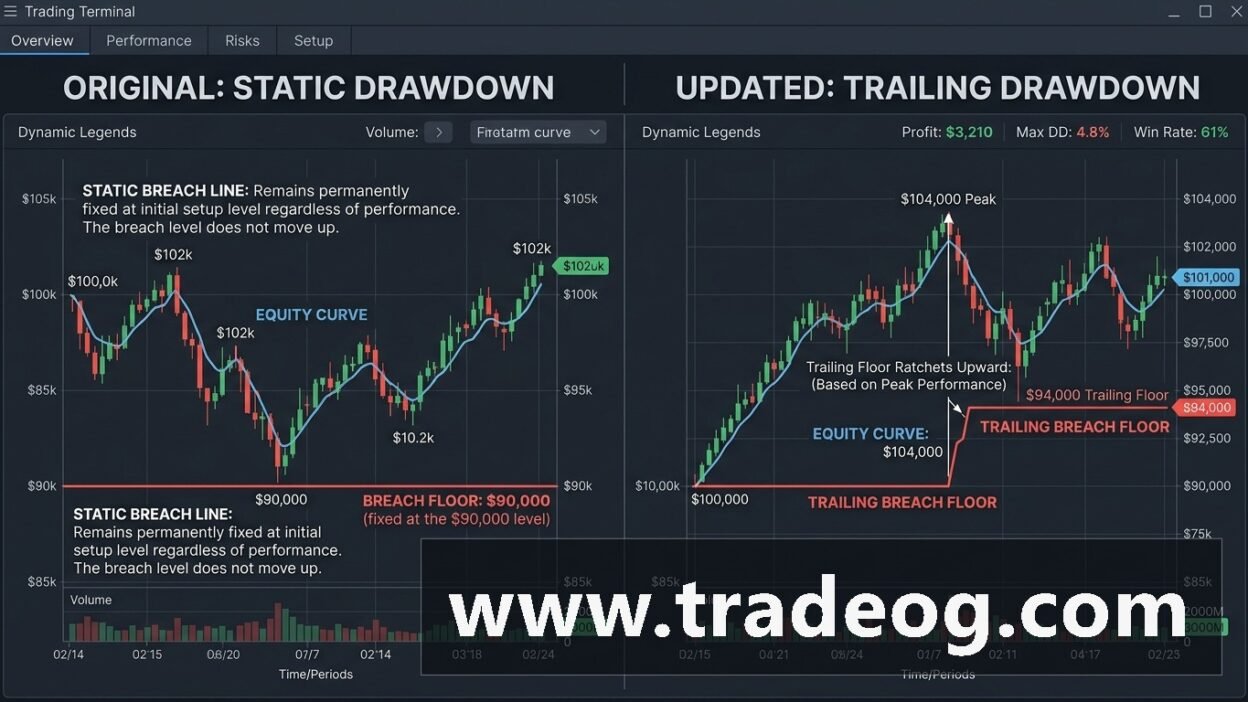
When a prop firm updates its drawdown parameters, the announcement email is usually phrased as an “enhancement” or a “streamlined risk update designed to better support traders.”
In reality, drawdown rule changes are rarely cosmetic. They are structural risk adjustments that alter the mathematical relationship between your position size, your failure buffer, and your account survival. Over the next 72 hours following any rule change, thousands of funded and evaluation accounts are routinely liquidated—not because the traders suddenly forgot how to trade, but because they continued operating under legacy assumptions.

Whether a firm shifts from static to trailing drawdown, moves its daily reset clock, or changes how open floating equity is monitored, here is the exact operational and financial reality of what happens after a prop firm modifies its drawdown rules—and the concrete steps you must take to protect your capital.
What Should You Do After a Prop Firm Changes Its Drawdown Rules?
Related: rule changes after buying a challenge and trailing vs EOD drawdown.
Prop firms do not change risk parameters arbitrarily. Rule revisions almost always stem from one of three institutional pressures behind the scenes:
- Liquidity Provider & Broker Mandates: Prop firms that hedge their funded traders or route volume to B-book/A-book liquidity pools must maintain strict margin covenants. If retail flow in Gold, Nasdaq, or Crypto experiences sudden systemic volatility, the liquidity provider forces the firm to tighten exposure floors to protect against margin deficits.
- Risk Book Imbalances (Payout Sustainability): If an evaluation model proves mathematically too easy to pass through high-leverage gambles, the firm’s payout-to-challenge-fee ratio becomes unbalanced. Tightening drawdown calculations (especially daily loss limits) is the primary lever firms use to filter out high-variance traders.
- Exploit Remediation: When systematic traders discover structural loopholes—such as straddling high-impact news spikes across multiple accounts or exploiting platform latency during session rollovers—firms alter drawdown monitoring to render those specific strategies unprofitable.
Grandfathered Accounts vs. Forced Migration: The Critical Distinction
The very first question you must answer after an announcement is whether your active account is grandfathered or subjected to forced migration.
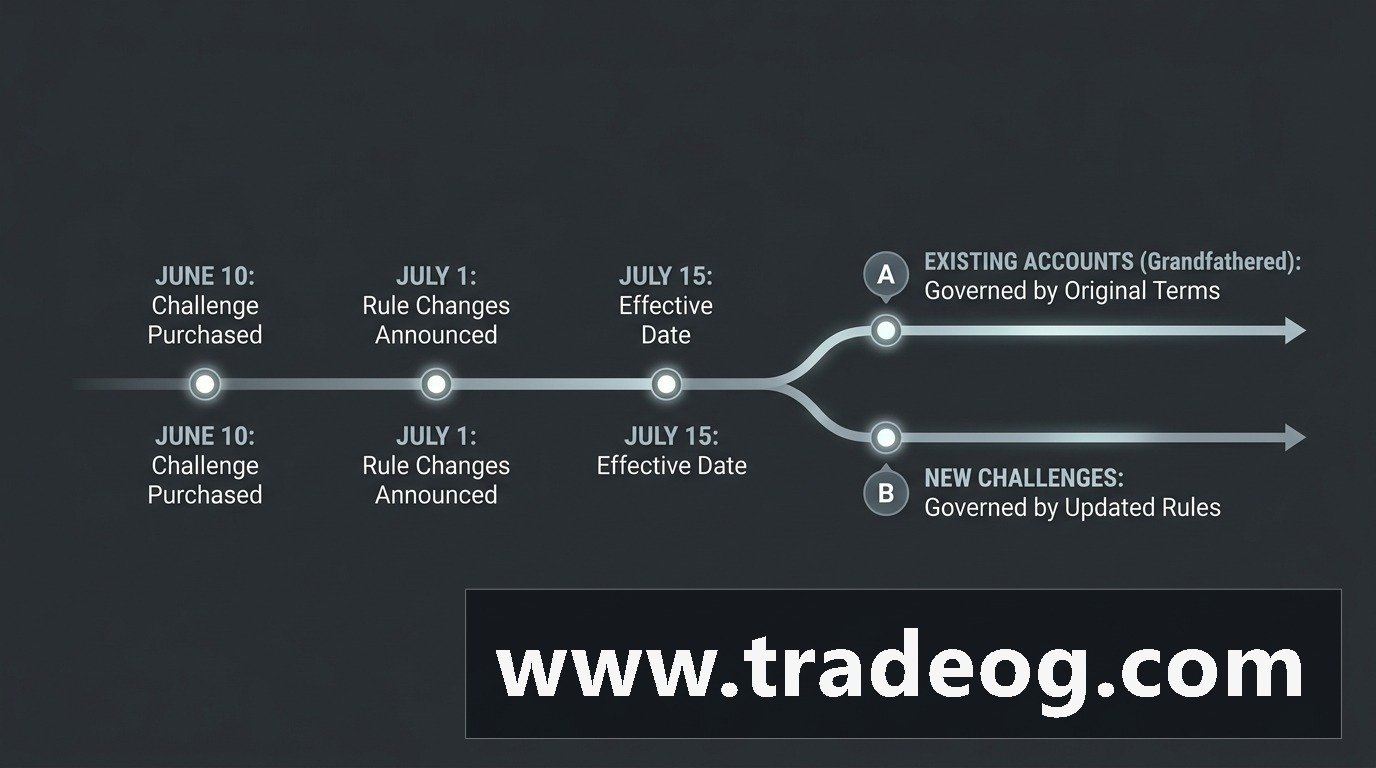
| Policy Model | What Happens to Active Challenges | What Happens to Funded Accounts | Trader Action Required |
|---|---|---|---|
| Full Grandfathering | Operates under original purchase rules until passed or failed. | Retains legacy drawdown terms for the lifetime of that specific account. | Document your original purchase terms and invoice; verify dashboard matches legacy rules. |
| Phased Migration | Given a grace period (e.g., 14 to 30 days) to complete the phase under old rules. | Transitioned to new rules at the next scheduled payout or billing cycle. | Adjust position sizing before the deadline; recalculate your daily dollar limits. |
| Immediate Forced Migration | Risk engine updates live on the server immediately across all active accounts. | All open trades and historical equity floors instantly recalculated under new rules. | Flatten all open positions immediately to verify how the new floor is calculated. |
The “Silent Update” Danger: Never assume you are grandfathered simply because you didn’t receive a direct email. Many firms update their Terms of Service or Knowledge Base quietly, relying on general announcements posted only in Discord announcements or platform banners. Always check your actual client dashboard metrics to see which rule engine is actively calculating your limits.
The 4 Most Common Drawdown Shifts (and How They Break Trading Plans)
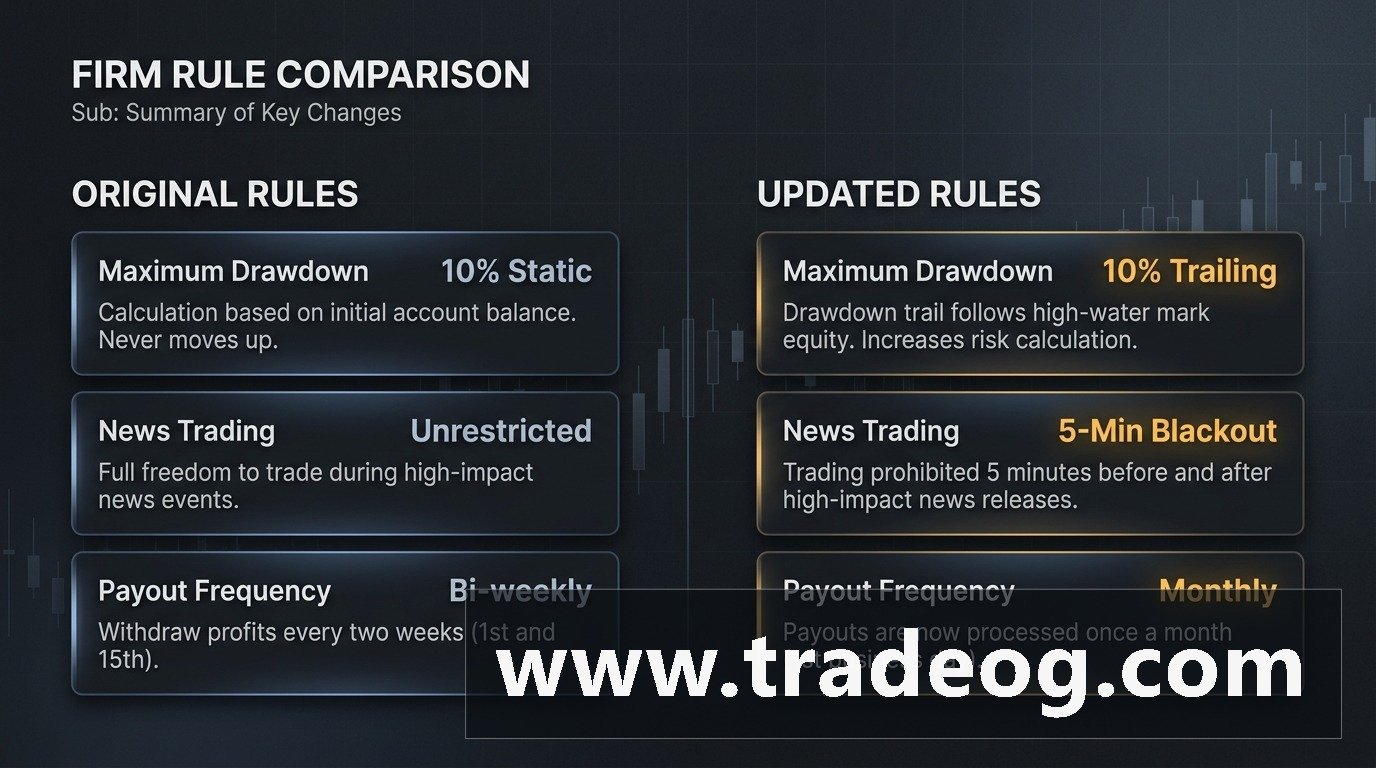
Drawdown rules generally evolve across four specific vectors. Each requires a distinct mathematical response:
1. Moving from Static Drawdown to Trailing Drawdown
This is the most punitive change a trader can experience. Under a static rule, your maximum loss floor is anchored permanently below your starting balance (e.g., $92,000 on a $100,000 account). Every dollar of profit you generate expands your cushion.
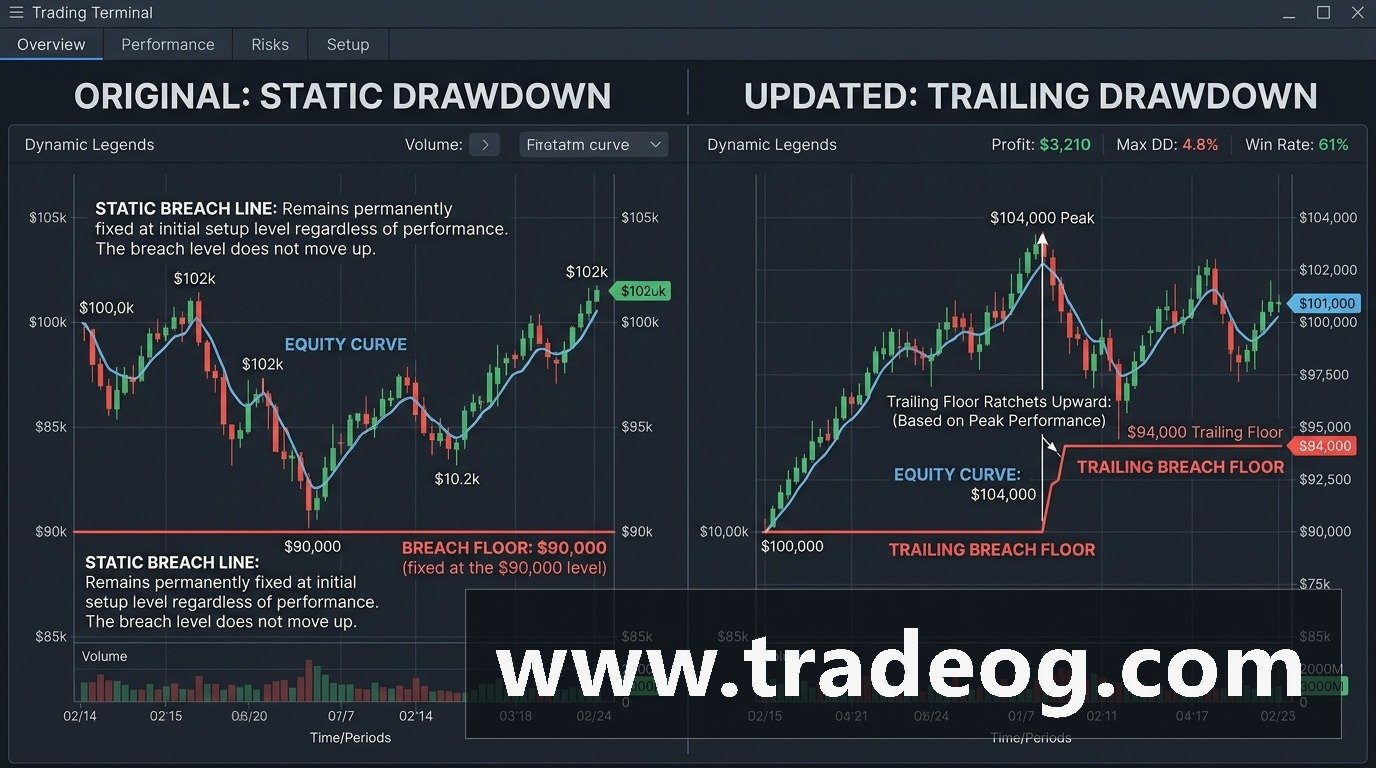
If the firm transitions to a trailing drawdown, your floor climbs in tandem with your account balance or high-water mark. If your account reaches $105,000, your floor pulls up to $97,000 (under an 8% rule). Your cushion never permanently expands. If this change occurs, continuing to risk 1% per trade will cause rapid account termination during normal retracements.
2. Moving from Balance-Based to Equity-Based Daily Drawdown
Under balance-based rules, you can allow an intraday position to draw down temporarily, provided it recovers before you close it. Under equity-based rules, the risk software monitors live tick-by-tick equity.
If your firm switches to equity-based monitoring, a mid-candle spread spike or temporary retracement that touches your daily threshold will terminate your account instantly—even if the trade ultimately hits your take-profit target 5 minutes later.
3. Changing the Daily Reset Timezone
Most traders calculate their daily loss based on their local time. However, prop firm daily limits reset based on the firm’s specific server clock (commonly 5:00 PM EST, 00:00 UTC, or 00:00 CE(S)T).
If a firm shifts its daily reset clock by even 2 hours, it alters the boundary between “yesterday’s closed loss” and “today’s allowed loss.” If you hold positions through the new reset window, you can accidentally compound losses from two distinct market sessions into a single daily calculation.
4. Changing Trailing Calculations: End-of-Day (EOD) vs. Intraday Tick-by-Tick
In futures and specific CFD evaluations, firms often debate between EOD trailing and intraday trailing. If a firm moves from EOD (which calculates the floor only at market close) to intraday (which trails open, unrealized peak profits in real time), trailing drawdown tightening accelerates drastically. You can no longer hold runners without trailing stops, because an open profit retracement is registered as a drawdown from the peak.
The Contractual Reality: Do Prop Firms Have the Legal Right to Change Rules Mid-Account?
Traders often react to sudden rule changes by demanding refunds or threatening legal action. To handle the situation rationally, you must understand the contractual structure of prop firm agreements:
- Not Regulated Brokerage Accounts: Evaluation and funded accounts are simulated demo environments provided under software-as-a-service (SaaS) or independent contractor agreements. You do not hold legal title to deposited funds.
- Unilateral Modification Clauses: Every major prop firm terms of service agreement includes a clause stating that the company reserves the right to amend trading rules, payout policies, and risk parameters at its discretion upon written notice.
- Payout Criteria: Prop firms legally tie withdrawal processing to compliance with the rulebook in effect at the time the withdrawal request is reviewed.
Understanding this reality removes emotion. Arguing on social media rarely overturns an automated liquidation. Adapting your risk parameters immediately is what keeps your funded status intact.
The 5-Step Emergency Protocol: What to Do Within 24 Hours of a Rule Change
If your prop firm announces an alteration to its drawdown or risk parameters, execute this five-step protocol immediately:

- Export Full Account Records: Immediately download your trade history, MT4/MT5/cTrader statement, and take a timestamped screenshot of your current dashboard showing your balance, equity, and stated drawdown limits. This is your evidentiary baseline if a calculation bug occurs during the server migration.
- Recalculate Your Dollar Failure Buffer: Never think in percentages after a rule change; think in hard currency. Calculate:
Current Live Equity - Hard Liquidation Floor = Real Failure Buffer ($)Write this dollar figure on a sticky note and place it directly on your monitor.
- Halve Your Position Size for 5 Sessions: During rule transition periods, technical discrepancies between broker bridge servers and web dashboards are common. Cut your normal risk per trade in half (e.g., from 0.50% down to 0.25%) for at least one week until you observe how the new rules behave across daily resets.
- Review and Cancel Existing Pending Orders: If maximum open risk or lot size limits were adjusted, existing Buy Limit or Sell Stop orders might exceed new compliance thresholds if triggered simultaneously. Clear all resting orders and re-enter them with updated lot sizes.
- Submit a Direct Ticket for Clarification: Open a support ticket asking one specific, documented question: “Does this rule update apply to my specific account ID [XXXXX] immediately, or is this account operating under grandfathered terms?” Save the agent’s written response. If an erroneous liquidation occurs later, that ticket provides immediate grounds for account reinstatement.
Frequently Asked Questions (FAQ)
Can I request a refund if a prop firm changes its drawdown rules mid-evaluation?
If the firm enforces an immediate forced migration that materially restricts terms on an active evaluation without grandfathering, most firms will offer a free account reset or a partial credit toward a new challenge if requested professionally via support before you breach the new rule. Cash refunds to your credit card or crypto wallet are rare, but credits are commonly granted.
What happens if a rule change occurs while I have an open swing trade?
If a rule change goes live while you are in an active trade, that trade is evaluated against the new parameters the exact second the server updates. If the new rule tightens drawdown and your open floating loss exceeds the new threshold, the server’s automated risk plugin will execute a forced liquidation. Always flatten open exposure prior to announced maintenance or rule change windows.
How does a drawdown rule change affect my pending payout?
Payout requests already submitted prior to the effective date are almost universally processed under the rules active when submitted. However, subsequent payouts will be audited strictly against the updated framework. If the new policy includes consistency rules or tighter daily loss allowances, ensure your post-announcement trading aligns with those metrics before requesting your next withdrawal.
Final Word: The Trader’s Edge Is Adaptability
In retail trading, your strategy is your edge. In prop firm trading, your risk architecture is your edge.
Prop firms will continue to modify rulebooks as market conditions, regulatory frameworks, and business models shift. The traders who survive across years rather than weeks do not complain about changing rulebooks—they read the contract, run the numbers, shrink their position sizing, and continue collecting payouts under whatever rules are in place.


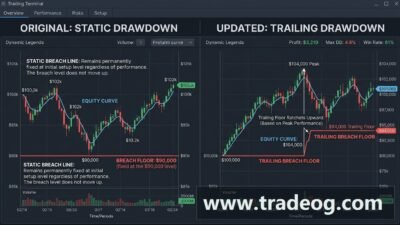
[…] Equity-Based Trailing (Peak High-Water Mark): The breach line ratchets upward in real time as your open floating equity reaches new highs. If your $100,000 account floats up to $106,000 before retracing to $101,000, your trailing drawdown floor (under a 6% rule) climbed from $94,000 to $99,640. Your open retracement just consumed $5,000 of your $6,000 drawdown buffer before the position was even closed! If your provider updates its drawdown structure mid-challenge, review what happens when a prop firm changes drawdown rules. […]
[…] Blaming the Broker or Prop Firm: Unsuccessful traders blame server slippage, spread widening, or rulebook updates for their losses. Professional traders acknowledge that market conditions change and take radical ownership of their risk management. If your firm recently modified its terms, read our protocol on what happens after a prop firm changes its drawdown rules. […]
[…] the firm’s news policy thoroughly. See what happens if a prop firm changes its rules for context on keeping up with policy […]
[…] and the firm has changed its news-trading rules since you began your evaluation, our article on what happens if a prop firm changes its rules after you buy a challenge discusses the […]