


You are trading a $100,000 funded account. You enter a position on EUR/USD, manage your risk properly, and your account equity sits comfortably at $103,500. Your floating loss has never exceeded 1.2%, leaving you miles away from the firm’s 10% maximum drawdown floor.
Then you check your email and see a notification: “Trading Violation Detected: Position Opened During Restricted News Window.”
Your heart races. You open your terminal to check your credentials. Is your account permanently terminated? Has your challenge fee been forfeited? Or has the position simply been closed with a warning?
This critical juncture is where the concepts of a soft breach and a hard breach come into play. But before diving into the details, every trader must understand a fundamental industry reality: There is no single, standardized, industry-wide legal definition of “soft breach” versus “hard breach.”

Different proprietary trading firms define rule violations in radically different ways. While one firm might classify placing an order during a high-impact CPI release as a “soft breach” that merely closes the offending trade, another firm may classify that identical execution as a “hard breach” that instantly closes your account and revokes funded credentials. Some firms do not use the term “soft breach” at all, classifying all non-drawdown infractions as “prohibited trading practices” subject to discretionary compliance review.
To protect your trading capital and your funded status, you cannot rely on informal community slang. You must understand the mechanics behind how proprietary firms classify rule infractions, how drawdown thresholds trigger account liquidations, and what consequences follow each type of violation.
What Is a Soft Breach?
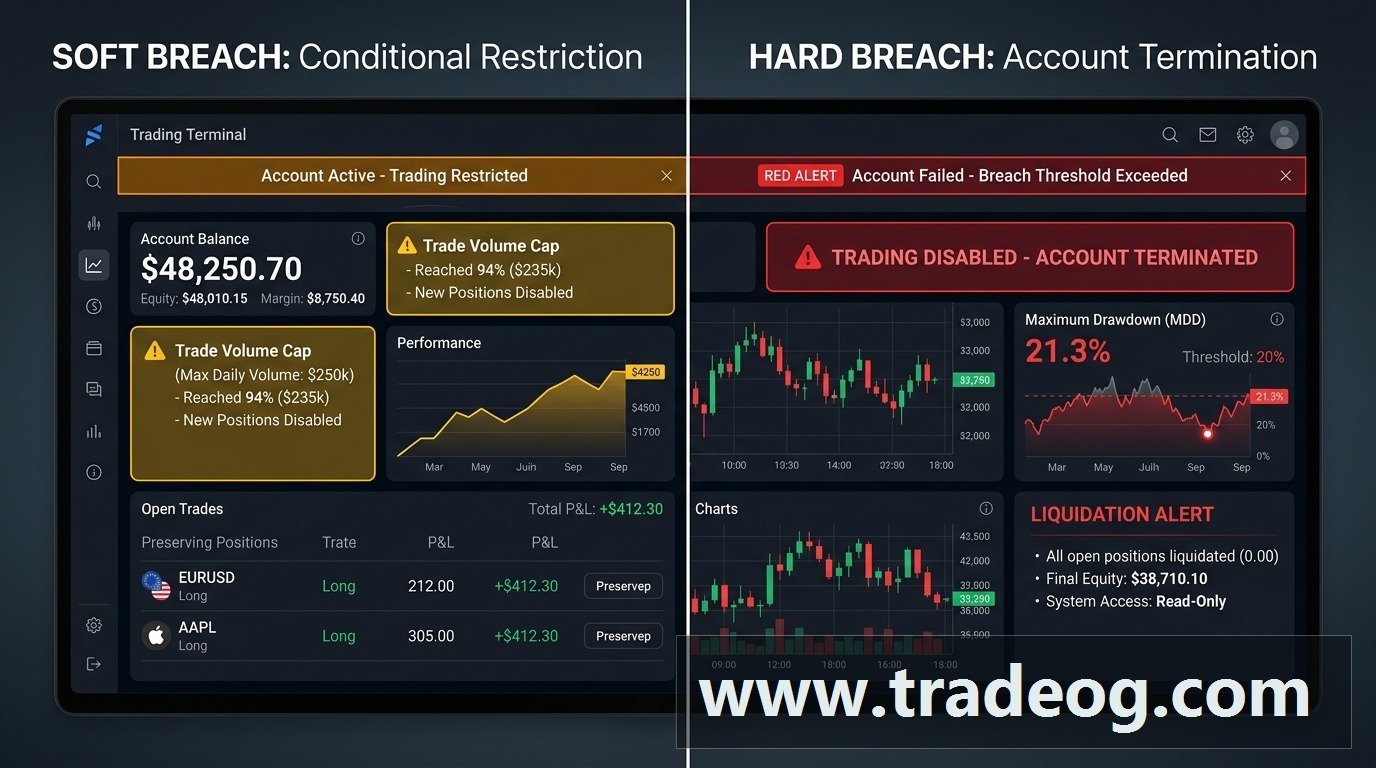
In retail proprietary trading, a soft breach generally refers to a secondary rule violation that does not result in the immediate, permanent termination of the trading account.
When a soft breach occurs, the account typically remains active or is placed into a temporary administrative holding state. The firm’s automated risk engine intervenes to neutralize the specific infraction rather than disabling your login credentials.
Common operational examples that firms may classify as soft breaches include:
- Executing Trades During News Windows: Opening a market order within a prohibited 2-to-5 minute window surrounding a red-folder economic release. The server script may automatically close the trade and deduct any profits generated from that specific ticket, while leaving the underlying account intact.
- Weekend or Overnight Holding Infractions: Leaving an open trade running past Friday’s market close on an account tier designated as “Day Trading Only.” The broker server may force-close the position at 4:59 PM EST without failing the evaluation.
- Trading Without a Required Stop Loss: Opening a position on a platform that requires a mandatory stop loss within 2 minutes of entry. The risk engine may close the position if no stop is attached within the required timeframe.
- Account Inactivity: Going 30 calendar days without placing a trade. Many firms issue a soft warning or place the account in a temporary dormant status that can be reactivated by contacting customer support.
- Minor Lot-Size Variance: Executing a trade that slightly exceeds a recommended lot-size band, triggering an automated volume rejection rather than account closure.
Important Caveat: Never assume a violation is a soft breach unless your firm’s published terms explicitly state so. Many prop firms treat repeated soft infractions as cumulative triggers that escalate directly into permanent account forfeiture.
What Is a Hard Breach?
A hard breach refers to a critical, non-negotiable rule violation that results in the immediate, permanent failure and termination of the trading account.
When a hard breach occurs, the firm’s automated liquidation engine executes a strict sequence: all open orders are closed at the prevailing market price, pending limit/stop orders are cancelled, dashboard trading credentials are revoked, and the contract is permanently terminated. You cannot trade that account again, and any fees paid for the evaluation are non-refundable.
Common triggers universally or widely classified as hard breaches include:
- Exceeding the Maximum Overall Drawdown: Allowing cumulative losses or live floating equity to drop below the firm’s designated maximum loss threshold (e.g., losing $10,000 on a $100,000 account).
- Exceeding the Daily Loss Limit: Allowing daily realized losses, open floating drawdown, or commission deductions to cross the daily loss limit (typically 4% to 5%) relative to the previous session’s balance.
- Prohibited Exploitative Strategies: Engaging in toxic latency arbitrage, reverse arbitrage, platform price-feed glitch exploitation, or high-frequency order spamming.
- Account Sharing & Commercial Pass Services: Hiring third-party account managers, using unauthorized group trade copiers, or sharing login credentials across different geographic IPs.
- KYC and Anti-Fraud Failures: Providing fraudulent identity documentation, failing AML screening, or operating multiple accounts beyond the firm’s maximum capital allocation cap.
Soft Breach vs. Hard Breach: Quick Comparison
The table below highlights the conceptual differences between soft and hard breaches across modern proprietary trading rulebooks:
| Feature | Soft Breach | Hard Breach |
|---|---|---|
| Typical Severity | Lower / Conditional / Procedural | Catastrophic / Contract-Ending |
| Account Status | Remains active or temporarily restricted | Permanently failed / closed |
| Drawdown Threshold Involved? | Not necessarily (often unrelated to loss limits) | Almost always involves daily or max loss limits |
| Can the Event Be Reviewed? | Frequently reviewed or remediated by support | Automated liquidation; rarely reversible |
| Can Trading Continue? | Yes, after closing position or resolving notice | No; platform credentials disabled immediately |
| Profit Deduction? | Profits from the offending trade often voided | All profits forfeited (unless pending verified payout) |
| Reset Available? | Account continues; reset not required | Must purchase a discounted reset or new challenge |
| Universal Definition? | No (Firm-specific policy) | No (Terminology varies across contracts) |
Disclaimer: These are general conceptual categories observed across the retail prop industry, not universal legal standards. Always consult your firm’s specific Terms of Service.
Why the Terms Can Be Confusing for Retail Traders
Retail traders frequently fall into a dangerous cognitive trap: they assume that “Soft Breach = Warning” and “Hard Breach = Drawdown.” In actual commercial contracts, reality is far more nuanced.
Consider three different prop firms handling an identical event: a trader forgets to set a stop loss within 2 minutes of opening an order.
- Firm A (The Soft Breach Model): The server script detects the missing stop loss, automatically closes the trade at market price, and sends an automated warning email. The trader’s account remains active, and they continue trading.
- Firm B (The Prohibited Trading Model): The firm does not use the term “soft breach.” Their rules classify trading without a stop loss as a “trading restriction.” The account is flagged for manual review upon payout submission, and profits from that trade are deducted.
- Firm C (The Strict Contract Model): The rulebook states that entering any trade without a stop loss constitutes an immediate “Hard Breach.” The account is terminated instantly, despite the trade being in green profit.
This disparity illustrates why traders must look past promotional labels. The marketing page might advertise “Forgiving Soft Breach Rules,” but the legal contract determines whether a simple procedural error ends your funded trading career.
Is a Drawdown Breach Always a Hard Breach?
In 99% of proprietary trading firms, exceeding a numerical drawdown threshold is treated as an irreversible hard breach.
Prop firms provide traders with access to simulated capital backed by liquidity lines. The drawdown limit—whether structured as a daily loss limit or a maximum cumulative drawdown—represents the absolute risk boundary the firm is willing to absorb. Once an account drops below that mathematical boundary, the risk engine terminates the account to prevent simulated insolvency.
However, the calculation methodology behind that drawdown determines whether you hit the limit unexpectedly:
- Mathematical Threshold: The raw financial level where your equity or balance breaches the contract.
- Firm Terminology: Whether the firm labels it an “Account Breach,” “Liquidation Event,” or “Evaluation Failure.”
To avoid unexpected liquidations, you must understand the exact math governing the two primary drawdown thresholds.
Numerical Example: The Daily Loss Limit Tripwire
The daily loss limit is the single most common cause of hard breaches in prop trading. Many traders mistakenly assume that if their trade has not closed, their daily loss limit cannot be breached.
Consider an account with the following parameters:
- Account Size: $100,000
- Daily Loss Limit: 5% ($5,000)
- Reset Time: 5:00 PM EST (New York Close)
Suppose you enter a long position on Gold at 3:00 PM EST. By 4:30 PM EST, Gold drops sharply, and your position is showing a floating unrealized loss of -$5,100.
You have not closed the trade. You believe price will bounce back. However, the firm’s risk engine evaluates tick-by-tick equity, not closed balance. The moment your equity drops below $95,000 ($100,000 starting day balance minus $5,000 daily limit), the automated server liquidation script triggers instantly. Your position is liquidated, and your account suffers an automated hard breach.
Furthermore, daily loss calculations factor in broker execution commissions, financing swap fees, and spread widening during session rollovers. To understand why stops fail to protect against daily limits, read our analysis on daily loss limit vs stop loss: why they are not the same.
Numerical Example: Maximum Overall Drawdown Mechanics
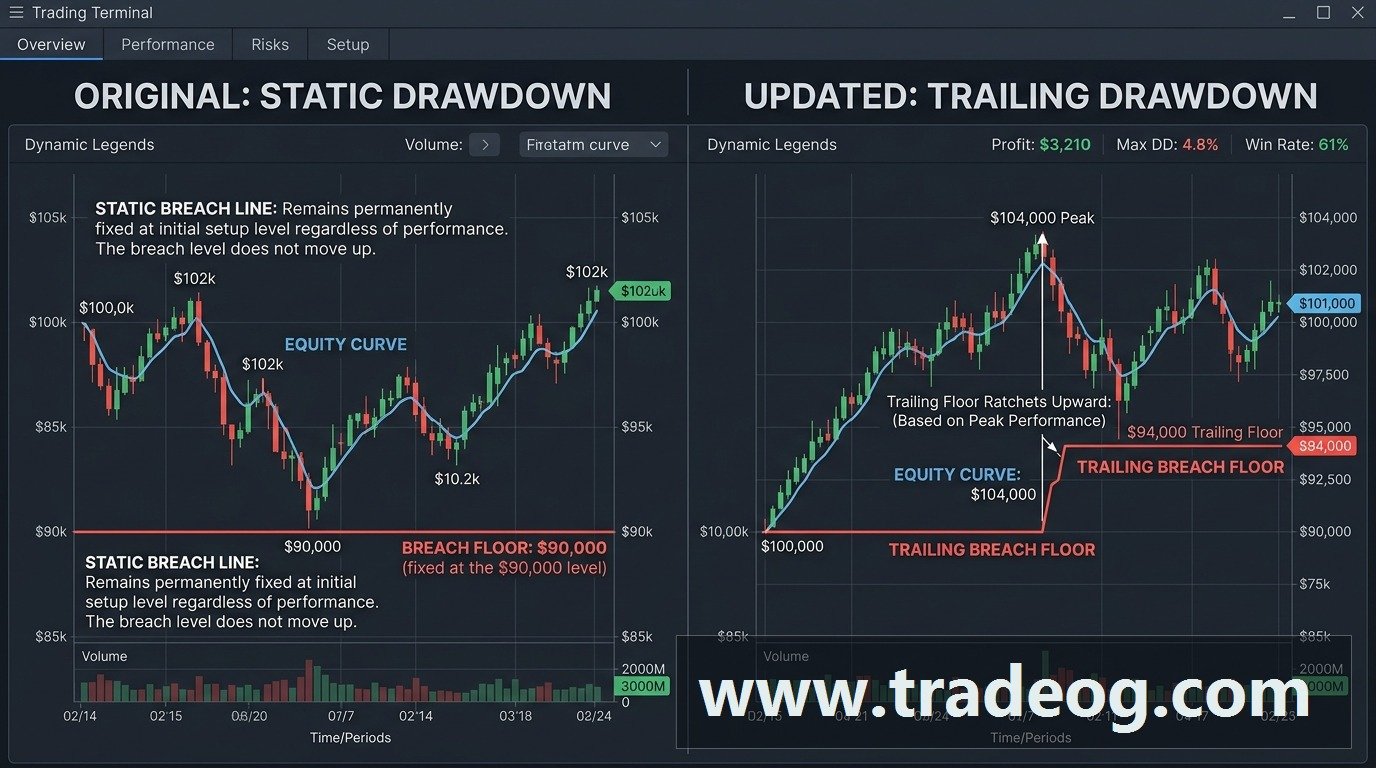
Maximum overall drawdown defines the absolute floor below which your account cannot drop during its entire lifecycle.
Consider a $100,000 evaluation account with a 10% ($10,000) Maximum Drawdown limit:
- Static Drawdown Model:
- Initial Breach Floor: Permanently fixed at $90,000 ($100,000 minus $10,000).
- If you make $5,000 in profit (account reaches $105,000), your breach floor remains at $90,000. Your allowable buffer expands to $15,000.
- Trailing Drawdown Model (High-Water Mark):
- Initial Breach Floor: Starts at $90,000.
- If open equity surges to $105,000, the trailing algorithm ratchets your breach floor upward to $95,000 ($105,000 peak minus $10,000).
- If your trade subsequently pulls back to $94,900, your account triggers an immediate hard breach—even though you are still above your initial $100,000 starting capital!
Understanding whether your maximum drawdown is static, end-of-day trailing, or tick-by-tick intraday trailing dictates your entire survival strategy. Learn more about these calculations in our guide on trailing drawdown vs EOD drawdown.
Real-World Soft Breach Scenarios
To see how soft breaches function in live trading environments, examine these three realistic cases:
Case 1: The News Window Order
A trader holds a funded account at a firm that enforces a 2-minute news blackout on red-folder releases. At 8:29 AM EST (one minute before US Non-Farm Payrolls), the trader executes a market order on GBP/USD. The firm’s automated compliance script detects execution inside the restricted window. Rather than terminating the account, the server closes the order immediately, cancels any generated profit, and issues an automated soft breach warning. The trader continues trading normal setups after 8:35 AM EST.
Case 2: The Extended Vacation Dormancy
A trader passes an evaluation, takes a two-month summer vacation, and forgets to place an active trade for 35 consecutive days. The firm’s inactivity policy stipulates that accounts without active orders for 30 days are flagged. The account is placed in a soft suspension state. The trader contacts customer support, confirms their identity, and support reactivates the account credentials without penalty.
Case 3: Missing Required Stop Loss
A firm mandates that all open positions must have a stop loss attached within 120 seconds of market execution. A trader opens 5 lots of EUR/USD but gets distracted and fails to enter a stop price. At the 120-second mark, the broker bridge automatically liquidates the position and sends a notification: “Position closed due to missing stop loss (Soft Breach). Account remains active.”
Real-World Hard Breach Scenarios
In contrast, hard breaches represent total account failure with zero room for automated recovery:
Case 1: The Rollover Spread Spike
A trader holds a long position on AUD/NZD with a floating drawdown of 4.2% on a 5% daily loss limit account. At 5:00 PM EST (New York close), bank liquidity thins, and broker spreads widen from 1.5 pips to 18 pips during rollover. The artificial spread widening pushes the trader’s floating equity to -5.2% for three seconds. The risk engine registers a hard breach, liquidates the trade, and terminates the account.
Case 2: Latency Arbitrage Detection
A trader uses a custom high-frequency EA that opens and closes trades within 400 milliseconds to exploit demo bridge pricing lag. The compliance desk’s automated trade forensics software flags the execution profile. Because feed manipulation violates core terms of service, the account is terminated for a hard breach, all profits are voided, and the user is barred from purchasing future challenges.
What Happens After a Soft Breach?
When an account registers a soft breach, the outcome depends entirely on the firm’s documented escalation policy:
| Possible Outcome | Operational Mechanism | Impact on Trading |
|---|---|---|
| Automated Warning | Email sent reminding the trader of the policy. | Zero disruption; trading continues normally. |
| Position Liquidation | The specific offending trade is closed at market price. | Account balance updated; trading continues. |
| Profit Cancellation | Profits generated during the restricted window are deducted. | Realized gains removed; principal equity preserved. |
| Temporary Freeze | Trading disabled for 24 hours while compliance reviews logs. | Trading paused; restored after automated audit. |
| Mandatory Remediation | Trader must complete a form or confirm rule understanding. | Credentials re-enabled upon compliance sign-off. |
Notice that in every soft breach scenario, the trader retains access to their underlying challenge or funded account.
What Happens After a Hard Breach?
When a hard breach occurs, the consequences are immediate, contractually final, and financially binding:
- Instant Platform Disconnection: Your trading terminal credentials (MT4, MT5, cTrader, DXtrade) are disconnected from the live simulated server bridge.
- Cancellation of Pending Orders: All active resting orders (limit orders, stop orders, take-profit tickets) are purged from the order book.
- Dashboard Status Update: Your user portal updates to display “Account Breached” or “Evaluation Failed,” detailing the exact timestamp and breach metric.
- Forfeiture of Challenge Fees: Evaluation purchase fees are non-refundable and forfeited in accordance with commercial terms.
- Payout Disqualification: If the breach occurs on a funded account before an approved payout distribution, accumulated profits are typically absorbed to offset the drawdown deficit.
To resume trading after a hard breach, the trader must either purchase a discounted account reset (if offered) or purchase an entirely new evaluation challenge.
Can a Soft Breach Become a Hard Breach?
Yes. A soft breach can escalate into a hard breach through three common mechanisms:
- Cumulative Strike Policies: Many firms operate a “three-strike rule.” A trader who commits three separate soft breaches (such as executing trades during news windows on three separate occasions) will have their account escalated to a permanent hard breach.
- Failure to Remediate Dormancy: If an account is placed into a soft inactivity hold and the trader fails to contact support within 30 to 60 days, the firm will administratively convert the suspension into a permanent contract termination.
- Secondary Adverse Price Action: If a soft breach closes a trade with an unexpected slippage penalty that pushes total account equity below the daily or maximum loss limit, the resulting financial loss instantly triggers a hard drawdown breach.
Soft Breach vs. Hard Breach vs. Account Termination
To avoid confusing legal terminology, review this 3-way operational breakdown:
| Category | What It Means | Typical Triggers | Final Result |
|---|---|---|---|
| Soft Breach | Procedural or operational rule violation with no direct drawdown failure. | News trading, weekend hold, missing stop loss, brief inactivity. | Warning, position closure, or temporary review. Account survives. |
| Hard Breach | Critical failure of a core risk parameter or ethical compliance standard. | Daily loss breach, max drawdown breach, latency arbitrage, fraud. | Immediate liquidation and credential revocation. Account fails. |
| Account Termination | The legal and operational conclusion of your contractor agreement. | Hard breach, KYC rejection, regulatory shutdown, Terms of Service breach. | Complete account closure; platform access revoked permanently. |
To understand the full spectrum of non-drawdown account closures, read our comprehensive guide on can a prop firm close your account without a drawdown breach.
Common Mistakes Traders Make Concerning Breaches
Traders repeatedly lose funded accounts due to preventable procedural errors. Eliminate these common misconceptions:
- Assuming All Prop Firms Share the Same Terms: Assuming Firm B treats news execution as a soft breach simply because Firm A did is a fatal mistake. Always check the active rulebook.
- Confusing Balance with Floating Equity: Believing that an open trade cannot breach an account until closed. Live equity triggers the automated liquidation engine.
- Miscalculating Broker Server Reset Times: Forgetting that daily loss limits reset on server time (typically 5:00 PM EST or 00:00 UTC), not your local time zone. Holding open trades through the reset tick can instantly compress your daily loss allowance.
- Assuming a Warning Email Means You Are Safe: Ignoring a soft breach warning without adjusting your strategy. Repeated infractions trigger hard liquidations.
- Relying on Unofficial Social Media Summaries: Taking advice from Reddit, Discord, or YouTube reviewers whose information is outdated or based on legacy rules.
What Should You Do If You Receive a Disputed Breach?
If you log in and discover an account breach that you believe was triggered by a technical error, broker feed freeze, or inaccurate calculation, follow this forensic protocol:

- Step 1 — Review the Breach Notice Thoroughly: Note the exact timestamp, ticket number, and rule section cited by the automated notification.
- Step 2 — Export Full Terminal Data: Immediately download detailed HTML and CSV trade statements from your platform, including tick-by-tick equity history.
- Step 3 — Check Server Execution Logs: Open the “Journal” or “Log” tab in your terminal to see exact execution millisecond timestamps, slippage reports, and connection pings.
- Step 4 — Compare Data Against Published Rules: Confirm whether the mathematical calculation used by the firm matches the Terms of Service active on your purchase date.
- Step 5 — Submit a Structured Support Ticket: Contact compliance with a polite, professional, data-backed inquiry. Include ticket IDs, chart screenshots, and timestamped calculations.
- Step 6 — Request Independent Review: If support refuses to investigate documented server outages or liquidity spikes, explore whether the firm participates in third-party dispute programs (such as the Financial Commission).
What Evidence Should Every Prop Trader Archive?
Professional traders maintain complete audit trails for every funded challenge. Maintain an offline archive containing:
The Prop Trader’s Evidence Checklist:
- ☐ Purchase Invoice & Terms of Service PDF: Downloaded on your checkout date.
- ☐ Account Activation Email: Showing initial balance and account credentials.
- ☐ Weekly Account Statements: Exported HTML/CSV logs of closed and open trades.
- ☐ Daily Equity Screenshots: Capturing account balance, equity, and margin before session close.
- ☐ Breach Notification Email: Preserved with full header data and timestamps.
- ☐ Written Support Correspondence: All communications with customer service.
How to Avoid Hard Breaches: Professional Risk Management
Preventing hard breaches requires treating risk management as an active mathematical protocol rather than an afterthought.
- Size for the Drawdown Buffer, Not the Account Balance: On a $100,000 account with a 10% ($10,000) max drawdown, your real risk capital is $10,000. Risking 1% of nominal balance ($1,000) is actually risking 10% of your remaining life. Professional funded traders risk 0.25% to 0.50% of nominal balance per trade. Learn the exact formula in our guide on position size based on drawdown buffer.
- Establish a Daily Personal Loss Circuit Breaker: If your firm’s daily limit is 5%, set your personal daily shutdown rule at 2.0% or 2.5%. If you lose 2.5% in a session, close all orders and log off. Leaving a 50% safety cushion ensures that spread spikes or execution slippage will never push you into a hard breach.
- Calculate Recovery Math Before Escalating: Remember that losses compound non-linearly. If you drop 5% into drawdown, clawing back requires a 5.26% gain; dropping 10% requires an 11.11% gain. Sizing down preserves the mathematical runway needed to recover. Read our complete quantitative derivation on drawdown recovery: how much profit is needed after a loss.
- Never Hold Trades Through Rollover With Tight Margins: Spreads routinely widen 5x to 15x between 4:59 PM and 5:15 PM EST. Flatten intraday trades before the rollover window to eliminate artificial spread breaches.
Soft Breach vs. Hard Breach Pre-Trading Checklist
Review this checklist before placing your first trade on any evaluation or funded account:
- ☐ I know the exact maximum overall drawdown percentage and dollar threshold.
- ☐ I know whether the maximum drawdown is static, EOD trailing, or intraday trailing.
- ☐ I know the exact daily loss limit percentage and understand how floating equity affects it.
- ☐ I know the exact broker server time and timezone when the daily loss limit resets.
- ☐ I have verified the firm’s news trading policy and know if blackout windows exist.
- ☐ I have confirmed whether holding positions over the weekend is allowed.
- ☐ I know if the firm requires a mandatory stop loss on every open position.
- ☐ I know the inactivity timeframe (number of days before an account is flagged).
- ☐ I understand the difference between soft warnings and terminal hard liquidations.
Frequently Asked Questions (FAQ)
What is a soft breach in prop trading?
A soft breach is a secondary rule violation—such as trading during a news blackout or leaving a position open over the weekend—that does not result in the permanent failure of the account. The firm may close the position, deduct trade profits, or issue a warning, while leaving the account active.
What is a hard breach in prop trading?
A hard breach is a catastrophic rule violation—such as exceeding the maximum drawdown, breaching the daily loss limit, or engaging in prohibited arbitrage—that results in the immediate, permanent termination of the account and forfeiture of evaluation fees.
Is a drawdown breach always a hard breach?
Yes. In virtually every proprietary trading firm, exceeding a numerical daily loss limit or maximum drawdown threshold triggers automated liquidation and permanent account failure.
Can a soft breach close a prop firm account?
A single soft breach typically does not close an account. However, repeated soft breaches under a strike policy, or a soft breach that incurs slippage pushing equity past a drawdown floor, can result in permanent account termination.
Can a soft breach be reversed?
Soft breaches are operational interventions (such as closing an open trade). If an automated soft breach resulted from a documented broker platform freeze, customer support can often review server logs and restore normal account status.
Can a hard breach be appealed?
Hard breaches triggered by standard market losses are final and non-negotiable. However, if a hard breach was caused by verified broker server downtime, unannounced platform migrations, or erroneous price-feed spikes, reputable firms will investigate and reinstate the account.
What happens when you exceed the daily drawdown?
The firm’s automated risk engine immediately liquidates all open positions, cancels pending orders, disables platform login credentials, and marks the account as permanently failed.
What is the difference between daily loss and maximum drawdown?
The daily loss limit measures losses incurred within a single 24-hour trading session against the previous day’s closing balance. Maximum drawdown measures the total cumulative loss permitted from the account’s historical peak.
Are soft and hard breach definitions identical across all prop firms?
No. Terminology, rules, and disciplinary actions vary significantly across firms. Some firms do not use the term “soft breach” at all, classifying all non-drawdown infractions as prohibited trading subject to discretionary review.
How can traders avoid account breaches?
Traders can avoid breaches by sizing positions based on their remaining drawdown buffer rather than nominal balance, establishing personal stop-out rules tighter than firm limits, flattening trades before rollover, and reading the official rulebook before trading.
Conclusion: Look Beyond the Label to the Rule
The terms “soft breach” and “hard breach” are practical concepts that help traders navigate prop firm risk. However, they are not universal legal protections.
A firm’s marketing page may promise “forgiving soft breach conditions,” but the legal reality is defined strictly by the contractual clauses governing your specific account. To keep your funded accounts safe, remember these core principles:
- Never trade based on community labels alone. Read the exact rule that sits behind the label.
- Know your numbers: understand whether your drawdown is static or trailing, balance-based or equity-based.
- Treat every rule infraction with professional urgency. Cumulative soft violations frequently escalate into permanent hard breaches.
By mastering your firm’s specific compliance architecture and managing your risk buffer with institutional discipline, you ensure that unexpected liquidations never derail your journey as a funded trader.
[…] For context on how violations are categorized when timing mistakes happen, review our analysis on prop firm soft breach vs hard breach. […]
[…] Our full breakdown is available in the article on prop firm soft breach vs hard breach explained. […]
[…] (which is typically automatic and final) is also important in this context. See our article on prop firm soft breach vs hard breach explained for the relevant […]